Search

Super Library Marketing: Practical Tips and Ideas for Library Promotion

Category

Marketing Basics

Need a Free Stock Photo or Illustration for Your Library Promotions? Here are the Top Ten Websites Where You Can Find Them!

Main Library Cincinnati Library Catalog Department 1946

A picture is worth a thousand words. That’s so true in marketing.

The visual you choose to accompany your promotions can make all the difference. The quality of that image may determine whether a person engages with your content… or moves on.

Most libraries don’t have a budget to hire a photographer for every campaign or marketing initiative. They may not have a graphic designer to create illustrations. So, they rely on free stock photos and art to create promotional material that looks professional and modern.

But libraries must navigate the tricky legal maze of copyright issues associated with images, icons, and photos.

The basics of copyright laws

Unless you have a stock photo subscription, your library should use images in the Public Domain or images that are covered by Creative Commons.

Public Domain: If a photo of image is in the public domain, that means the creator has dedicated the work to the public domain by waiving all his or her rights to the work worldwide under copyright law, including all related and neighboring rights, to the extent allowed by law. You can copy, change, distribute and perform the work, even for commercial purposes, all without asking permission.

Creative Commons: Anyone can then use the work in any way and for any purpose, including commercial purposes, subject to other laws and the rights others may have in the work or how the work is used.

This post gives a thorough explanation of copyright issues surrounding stock photos in particular.

Finding the right image for your library promotions

Your library can purchase a stock photo subscription. But, if you are working with a limited budget, there are many websites where you can find high quality, free stock photos. That’s where this list comes in handy.

I based my list on a couple of factors.

  • Websites where finding a photo or illustration is easy.
  • Websites where you don’t need an account to download photos or images.
  • Websites that had photos and/or art of subjects that pertain to libraries, like books, reading, and diverse populations.

I have provided a brief explanation of the copyright licensing for these websites. But, to fully protect yourself and your library, read the license requirements for each site thoroughly before you download.

The complete list of ten free stock photo websites for libraries

Creative Commons: This site is dedicated contains the most diverse selection of shots I’ve seen on a free photo site to date, with more than 500 million photos available. You can search by license so you can be sure to get the photos that you can use in any situation with or without attribution, according to your preferences. You can also search by the sources, and by the way in which you wish to use the photos. Attribution is required for most photos.

Freepik: Freepik has a limited number of free photos for download. You can use them for commercial or personal projects and in digital or printed media. Attribution is required.

Gratisography: This site contains a limited number of free photos and vectors. They are bright and eye-catching, even whimsical. It’s divided into easy-to-understand search categories. You can use the photos for personal and commercial projects including advertising campaigns, websites, blogs, and social media. Attribution is required.

Negative Space: Another site under Creative Commons with full use of photos for commercial purposes. Their photos are organized into collections for easy searching. They have plenty of photos of books and readers.

Pexels: A great site containing lots of high-quality photos and videos. They’re all free to use on your website, blog or app, in print materials, on social media, and in ads. Attribution is not required. You can modify the photos and videos.

Pixabay: The site contains 2.3 million free images and royalty free stock photos as well as free illustrations, vectors, videos, and music. You can download and modify content for commercial or non-commercial use without attribution. You cannot use the content for any products for sale, like t-shirts or other library merchandise.

Reshot: You can use any of the 25,000 photos and icons from this website for social media, online ads, education, commercial, and editorial projects for free. No attribution is required. Photos are searchable by orientation.

Stockvault: This site offers more than 138,000 free photos. You can search by license, but there are plenty of free photos for libraries licensed as Creative Commons CCo, which means you can use the works for personal, education, and commercial purposes without attribution.

Vecteezy: This website contains free vectors, photos, and videos. There are premium pieces for purchase, but their selection of free art is great. I like the modern feel of the work on this site. You can search by orientation, image style, number of people or age of people in the photo, and the composition of the photo (head shots, full body, etc.). Attribution is required and there are limits to the ways in which you can use the art under the free license.

Unsplash: An amazing site with a huge selection of high-resolution photos. Their license allows you to download and use the photos for free for commercial and non-commercial purposes. No permission is needed, although attribution is appreciation.


You may also want to read these posts

Donโ€™t Release All Your Library Promotions at the Same Time: Why a Staggered Approach Reaches More People!

The Quest for Perfection May Spoil Your Library Promotions! How To Walk the Line During the Revision Process and Still Create Authentic Messages

Angela’s latest book reviews

Think Again: The Power of Knowing What You Don’t Know by Adam Grant

Mediocre: The Dangerous Legacy of White Male America by Ijeoma Oluo

Subscribe to this blog and youโ€™ll receive an email every time I post. To do that, click on the โ€œFollowโ€ button in the bottom left-hand corner of the page. Connect with me on YouTubeTwitter, InstagramGoodreadsand LinkedIn.

The Quest for Perfection May Spoil Your Library Promotions! How To Walk the Line During the Revision Process and Still Create Authentic Messages

I learned a skill as a journalist which has been invaluable to me as a marketer.

As a journalist, I was an expert at knowingย when to let go of a piece of contentย and send it out into space, even though it was imperfect.

It’s the nature of the news business. You have a deadline and when the deadline arrives, you go to air or to print with as much information as you have. You know that youย can revisit the story later to add new details. And that must be enough.

One of the hardest adjustments I had to make when I left the newsroom and went to the library was the constant reshaping of promotional messages and campaigns.

The good and bad of the revision process

When I worked in a library, each blog post, print piece, email, social media post, or video would go through rounds of review by several departments. The record was held by our content marketing magazine, which sometimes went through upwards of 15 edits per issue.

All the scrutiny had its advantages. More edits meant grammatical, punctuation, and spelling errors were found and fixed. The revision process also gave me the chance to see how each message was perceived by different people with different perspectives.

I purposefully chose reviewers who worked with different target cardholder audiences. They told me whether they thought their patron base would respond to the message. I trusted their opinions and took their advice when they told me a phrasing or image change would increase my message’s effectiveness.

But there were also pitfalls to revision process. The message was sometimes reshaped by people who pressured me to add words or phrases that weren’t customer friendly. They might also wish to dilute or change the message altogether, depending on their department’s own goals or agenda.ย 

The point at which your library’s revision process goes from helpful to over-examined is the space I want to focus on in this post.

It’s very easy to start over-thinking text, images, and graphics. The message you’ve carefully crafted may not connect with your audience because it disappears in the search for perfection. It can be crippling.

There is a very thin line between authenticity and perfection. It takes practice to walk that line. Here’s the advice I have for you.

Constant improvement is better than perfection

The best content isn’t perfect. That is what makes it good.

Imperfection shows your library’s human side. When you write from the heart, your message feels more authentic. 

Don’t sabotage your own marketing efforts by waiting for the moment when every single detail is right.ย Give yourself permission to release a piece of marketing content when the time is right, not when it’s perfect.

Creative, honest messaging will be the doorway for your library to connect with consumers in the moment when they are genuinely searching for answers from your library.

I’m a fan of author, speaker, and showrunner Jay Acunzo. I highly recommend his newsletter. His niche is creativity. He inspires others by talking about how creativity intersects with work in the real world.

In this blog post, Jay makes a great point that I think about all the time. He says, “How can we aspire to perfection (even if it’s never something we reach) while still moving forward without delay (even if we aren’t creating amazing work yet)? Well, I think the key is to place perfection where it belongs: away in the distance. Then, we can busy ourselves with marching towards it.”

In the library, that means we must do the work and ship it when it needs to be shipped. But we also must commit to revising it, molding it, and realizing that it is a work in progress.

In your library promotional work, your goal must not be perfection. It must be constant improvement.

But I have a deadline!

You work in a real library with real goals and strategies. And the quest for perfection will sometimes seem like a lofty goal that you don’t have the luxury of achieving.

So how do you know when a piece of content is ready for release, even if it’s not perfect? Ask yourself these three questions.

1. Is your promotion as compelling and authentic as it can be in this moment?

2. Is your promotional piece free of grammatical, punctuation, and spelling errors?

3. Is the information in your promotional piece correct?

If the answer is yet to these three questions, it’s time to let go.

Marketing is one giant experiment. Even when you release a promotion that isn’t perfect, you will still learn plenty from it. Measure and record the results of your promotion. Then use that data to adjust and reconfigure your attempts on the next go-around.

Don’t get bogged down in the quest for perfection. Be human. Be authentic. Be true to your library voice.

And get the message out there! Your imperfect message may lead to some perfect insight into your community.


Do you have an example of a time when an imperfect message brought you some perfect insight into your customers? Share your thoughts in the comments!

You may also like these posts

Hereโ€™s When Itโ€™s Okay for Your Library To Forget Perfection and Just Push Send!

You Donโ€™t Have To Be Cool To Promote Your Library to Teens! Here Are Seven Seriously Easy Ways To Connect With Gen Z

Latest Book Review

The Only Good Indians by Stephen Graham Jones

Subscribe to this blog and youโ€™ll receive an email every time I post. To do that, click on the โ€œFollowโ€ button in the bottom left-hand corner of the page. Connect with me on YouTube, Twitter, Instagram, Goodreads, and LinkedIn.

The Ultimate Library Marketing Checklist: How to Decide When and Where to Promote Your Library

I am a list maker.

This is going to sound crazy but one of the most enjoyable parts of my day is the moment when I get to check something off my to-do list.

Recently, one of my readers asked me if I have a checklist for library marketing. She wanted to make sure she wasn’t missing any opportunities to promote her library.

Of course I do! Scroll down for the master checklist for library marketing.

But just because there are so many tactics available to market your library doesn’t mean that you should use every one. There is a bit of science involved in deciding when and where to run a library promotion.

To help you make these decisions, there is a series of questions you need to ask yourself. Do this every time you create a marketing campaign for anything at your library. This will ensure your promotions are effective and you are working efficiently.

How does this event, service, or item serve your library’s strategy?

Every piece of marketing you do needs to be in service of reaching your library’s strategic goals. They are the reason you come to work every morning. So make certain there is a solid connection between your promotional efforts and your library’s overall strategy.

What do you know about your current cardholders and the people who live in your community? 

A clear image of the person who will consume your marketing messages will help you do a better job of marketing to them.

Where do these cardholders live? How do they engage with your competitors like Amazon and other bookstores? Where do they get their news? Do they have access to Wi-Fi? Do they have children? What is their living situation like? Do they work? What is their transportation situation?

The answers to these questions will help you create promotions that resonate with your intended audience.

Click here to download the master checklist for library marketing.

Now it’s time to decide what to promote, how to promote, and when to promote. Here are three rules to live by when figuring out the best channel for your library marketing.

Don’t feast at the buffet of tactics.

You don’t have to use every tactic available to you. Choose which ones will work best for each promotion. It’s a smarter use of your time and energy.

For example, my library held a teen poetry contest in April every year. We know that teens are typically considered to be a really hard audience to reach. So I went after their parents and teachers!

I marketed the contest on our website, in social media, on the digital signs in branches, with posters, and with email. Notice all the categories I didnโ€™t use!

I didn’t send a press release because I had no evidence from past years to show that promoting this contest in the news would get us more entries. I didn’t use all the signage options available to me because teens donโ€™t pay attention to signs. And I didnโ€™t include the contest in our content marketing publication because the average reader of that publication was an older empty-nester–not the right audience for that promotion.

For each promotion, use only the tactics that work best for the intended target audience. You’ll be more efficient and effective!

Determine how you will measure success.

You must make sure that you accurately document the results of every promotion you do. This will help you to adjust your promotions to improve effectiveness. Keep meticulous records of data as it comes in.

As a starting point, you can measure every promotional request against two basic rules.

If the promotion doesn’t result in higher circulation, program attendance, or usage, donโ€™t do it.
If the promotion is not tied directly to the libraryโ€™s overall strategy, cut it.

When I worked at the Public Library of Cincinnati and Hamilton County, my marketing team conducted a year-long experiment to see if we could drive attendance at events. We hypothesized that emails sent to targeted cardholders would result in higher attendance.

We were wrong.

We did 118 branch promotional emails that year and only half were effective in boosting attendance AT ALL. With that data, we decided to cut way back on email branch promotions.

The next year, we sent only 34 emails promoting attendance at branches. Our effectiveness level increased to 68 percent. More than half of the programs saw a significant increase in attendance–at least ten percent–after their cardholders received an email. 

Why did the emails work the second year? When we cut down on the number we were sending, we were able to create messages that did a better job of resonating with people. Turns out, our audience responded to quality, not quantity!

At some point, you may realize there is an tactic that just doesnโ€™t seem to work. You have my blessing to drop anything that fails. Use only the things that can help you to achieve your goals and cut the rest.

Share your results.

Talk about the results with your colleagues and share your results with other departments. Transparency in marketing is a good thing. It helps your co-workers and administrators have a clearer understanding of what you do. And they may look at the results and find some new insight that you missed.

Failure is okay, by the way. Marketing is an experiment! Sometimes the stuff you do will work, sometimes it wonโ€™t. If something doesn’t work, don’t do it again. Spend your energy on the things that do work.

You may also like these posts

Going Live on Facebook? Here are Three Tips to Maximize the Reach of Your Libraryโ€™s Virtualย Programs

The Virtual Library Conference is Over and Now the Work Begins! Hereโ€™s What to do Once Youโ€™ve Closed Yourย Laptop

Latest Book Review

Caste: The Origin of Our Discontents by Isabel Wilkerson

Subscribe to this blog and youโ€™ll receive an email every time I post. To do that, click on the โ€œFollowโ€ button in the bottom left-hand corner of the page. Connect with me on YouTube, Twitter, Instagram, and LinkedIn.

Now, More Than Ever, Your Library MUST Market the Collection!๐Ÿ“š๐Ÿ“š Here’s Why.

Watch Now

The Library Marketing Show, Episode 69

In this episode, Angela explains why she believes that marketing your library’s collection will keep your library afloat during these trying times. She’ll lay out three reasons why at least 50 percent of your marketing should be promoting your collection.

Kudos in this episode go to Stacey Desroisers and Melissa Mannon who launched “The Curious Reader” podcast, a collaboration between the Goffstown Public Library and the local high school.

Do you have a suggestion for a topic for a future episode? Want to nominate someone for kudos? Let me know in the comments. And subscribe to this series to get a new video tip for libraries each week!

Thanks for watching.

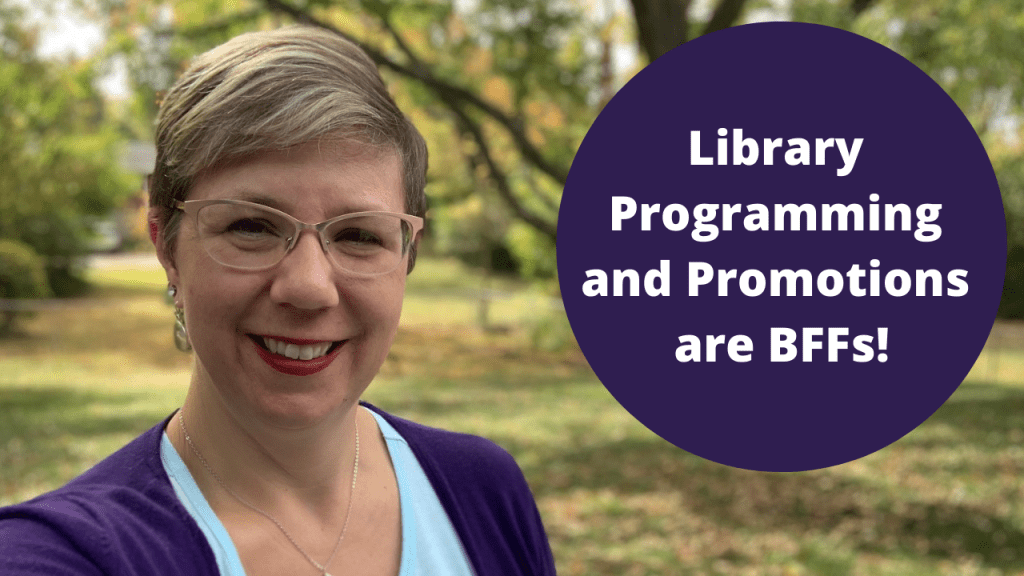
Library Programming and Promotions SHOULD Be BFFs! Here’s Why They Must Work Together.

Watch Now

The Library Marketing Show, Episode 68

In this episode, Angela shows you three reasons why you must keep promotions in mind while you create your library programming.

Kudos in this episode came from Evelyn Shapiro from the Champaign Public Library for their series of Library Love videos.

Do you have a suggestion for a topic for a future episode? Want to nominate someone for kudos? Let me know in the comments.

And subscribe to this series to get a new video tip for libraries each week!

Thanks for watching.

Targeted Email Marketing for a New Era: The Pros and Cons of How Most Libraries Segment Their Audiences

Photo courtesy Public Library of Cincinnati and Hamilton County. Bond Hill Branch.

This is the first in a two-part series on email marketing for libraries. Part two is here.

If there is one thing that I know about library promotion, it’s this:

If you want to be successful in library email marketing, you must target your messages.

This isn’t just my personal belief. It is a method which worked, with impressive results, during my years at a public library. And I see it working now for hundreds of libraries around the country and around the world in my day job at NoveList.

Why are libraries hesitant to do targeted email marketing?

There are two big reasons that libraries fear the idea of segmenting their email audiences.

First, libraries are worried about email marketing in general. They feel it’s too promotional and that email messages from the library will be received as spam. They may even believe that people don’t want to receive email marketing from anyone, even a library.

This is not the case. The average consumer is accustomed to giving out their email address in exchange for marketing messages targeted specifically to them. Opt-in Monster research shows 99 percent of people with an email address check their inbox at least once a day.

Why? Because they are looking for messages from friends, family, and places they love. They love the library. Your cardholders and community members feel excitement when they receive an email from you.

Libraries worry that, by sending targeted messages to segmented audiences, they will miss out on the chance to get a message to all their cardholders. 

Many libraries are sending the same message to every cardholder, sometimes hundreds of thousands of people in one burst. It feels like the natural thing to do. “Everyone needs to know about this!”

The problem with that approach is that your cardholders are individuals. One message never fits them all.

This is particularly true if your service area covers a range of incomes and demographics. The needs and interests of your cardholders vary greatly.

By targeting your message, you are more likely to say something that matters significantly to your cardholders, which makes them more likely to take an action, which makes it more likely that your email will be successful.

Targeted email marketing for libraries is effective because it serves the right message to the right group of people. And it works for all kind of messages.

Do not let your fears about email set you up for failure. Your cardholders want to hear from you. There are not very many industries which can say that. Let’s take advantage of it and give the people what they want!

Libraries who do segment their audiences tend to use three main methods. There are benefits and drawbacks for each.

Segmenting by library card use

Some libraries group their cardholders by the type of material they most frequently check out: kids’ books, print books, e-books, etc. Then, they send targeted email messages about those formats or collection types to those specific users.

This was the method we used when I worked a public library. For example, we would send an email promoting three new e-books every month to people who appear to favor e-books.

Benefits: This method is great for collection marketing. Most libraries will notice holds and checkouts increase, sometimes exponentially, when they send messages about items to people who have shown a previous interest in those items.

Drawbacks: The way a person uses their library card may not correspond to their true library interests.

For instance, an adult who frequently checks out children’s books for their kids may also love to read e-books. By focusing solely on the fact that they more frequently check out children’s books, a library may miss a key opportunity to market e-books to that cardholder.

A second drawback is that your library will want to promote things besides your collection, like programs, big events, and advocacy messages. Segmenting audiences solely by their favorite collection format gives you no clue as to your cardholders other potential interests.

Finally, this kind of segmentation often requires sophisticated email marketing programs that are expensive and time-consuming to manage. Smaller libraries without a dedicated marketing department and libraries with limited budgets may find these programs cost prohibitive.

Letting people self-select

Many libraries have an opt-in page on their website listing email interest groups. Visitors can self-select which emails they prefer to receive.

Benefits: When a person chooses to receive an email from you about a certain subject, they are also likely to open and engage with that email. They have already indicated their interest by selecting it.

Most library email opt-in pages do not require a person to be a cardholder to sign up. So, a second benefit of this method is that you can send marketing messages to people who aren’t in your cardholder base but can be enticed to use your library. That’s a fantastic way to expand your cardholder base!

Drawbacks: A library using this method must commit to intentionally market the marketing lists. They must make sure the community knows the opt-in page exists and convince people to sign up.

Segmenting by cardholder location

Some libraries have sent messages to people who have indicated a certain branch is their home branch or to people who live in a certain portion of the community.

Benefits: This is a great method for in-person program promotion. People are more likely to attend events that are near their home. Segmenting your audience by their location is an efficient use of your time for program promotion.

Drawbacks: There is a certain set of library cardholders who are willing to travel to attend programs and events at branches far from their home. They may be interested in hearing from your library about certain types of events, no matter where they are held.

In addition, the branch a person most frequently uses may not actually be near their home! Many people frequent the library branch near their workplace or some other important and frequently visited location.

You may also find these posts helpful

Three SUPER Easy Ways to Get More Results from Your Library Email Marketing!

Are My Library Email Metrics Goodโ€ฆ. or Bad?! Here Are the Latest Stats to Help You Figure It Out.

Latest Book Reviews

The Little Book of Lykke: The Danish Search for the World’s Happiest People by Meik Wiking

The Bear by Andrew Krivak

Find more 60-second Book Reviews here.

Subscribe to this blog and youโ€™ll receive an email every time I post. To do that, click on the โ€œFollowโ€ button in the bottom left-hand corner of the page. Connect with me on YouTube, Twitter, Instagram, and LinkedIn.

Three Transformative Tips to Improve Focus and Re-Energize You When Working in the Library Doesn’t Feel Fun Anymore

Blue Ash - Sycamore Branch staff: Mrs. Sonia Bibbs (left) Library Assistant, Douglas Robinson, Corinne Hand (right) Childrenโ€™s Librarian. Courtesy Public Library of Cincinnati and Hamilton County.

I don’t know about you, but I’m exhausted.

The pandemic is exhausting.

Worrying about the health and safety of family and coworkers is exhausting.

Natural disasters, a nation coming to terms with centuries of racial disparity, and a Presidential campaign here in the United States are exhausting.

And yet the library world continues to provide service during this crazy year. Your library probably still did a summer reading program. You’re providing virtual programs. You support students and teachers as they navigate distance learning. You’re promoting books and offering reading recommendations.

The world throws hurdles at you, and your library responds.

Is it any wonder if you feel like you need a nap and a hot bath nearly every day?

Library marketers are expected to be energetic and enthusiastic. More than any other library staffer, you’re expected to have exciting and innovative ideas to promote all these major developments and service changes as well as the smaller services that everyday cardholders rely on.

And you’re expected to produce results, driving people to watch virtual programs, use your curbside pickup service, and follow all the rules for social distancing.

It’s only natural to feel burned out by the speed at which everything happens at your library. And when you get stressed, work stops being fun. The quality of your work suffers.

But your library and your community depend on you. So here are some tips to help you manage your work and avoid burnout.

Prioritize, stay completely focused on your goals, and say “no” to EVERYTHING else.ย  Humans are all weirdly programmed to say yes, to take on more, to squeeze as much out of life as we possibly can.

Busyness feels wonderful. Weโ€™re doing something! Stuff is happening! Progress is being made!

But without space for creative thought, mistakes are going to happen. Your work won’t be what it could or should be. And that means your marketing will be less effective.

So, just like you weed your collection, you need to weed your promotions. This is especially true now, when your audience is suffering from content burnout because of the pandemic.

In my first year at a library, I said “yes” to everything. And nothing I did was any good.

When I realized I was doing too much, I set some ground rules for the goals I wanted my staff to focus on. I aligned these goals with my library’s strategic goals. They were:

  • A promotional tactic (like emails) had to produce a ten percent bump in circulation, program attendance, or usage. If it didn’t, we stopped doing it.
  • A service had to be easy for the cardholder to use to get promotion. Databases are a good example. If a cardholder was required to sign into the library website with their card to get to the database landing page, and then had to create a separate account tied to their email to use the database, we didn’t promote that database.
  • We only did full marketing campaigns for paid presenters. Free presentations got a poster or flyer and a social media mention.
  • All promotional requests had to tie directly to the libraryโ€™s overall strategy. If the branch or library staffer requesting promotion couldn’t demonstrate how the program or service moved the library’s overall goals forward, we didn’t promote it.

I know that sounds harsh. And some of those rules might not work for a smaller library or a different set of library leaders. That’s okay. Set your boundaries to work within your own system.

Weeding your marketing content will allow you to do a better job and be more creative with the promotions you have left. Evaluate your promotions twice a year to keep your marketing lean and reduce the stress on yourself and your co-workers.

The word โ€œnoโ€, while it may be very small, is liberating. Itโ€™s good for you and for your marketing strategy.

Define your workflow and make it the law of your marketing landscape. A defined workflow sounds like the opposite of a creative endeavor. But it ensures that a quality product is created in a timely and efficient manner. It creates space for you to think. And that’s incredibly important for anyone working in a library, especially right now.

There are two options: outward-facing workflow and team workflow. Choose the one that works best for you and your library.

Outward facing workflow means that you approach each job given to you by a senior leader or another library department or partner in the same way.

  • All marketing requests go through one person on your team, who acts as project manager.
  • That person is responsible for looking at the request and determining if it fits into the library’s overall strategic goals.
  • That person sets clear expectations and goals for each project and communicates a plan of action based on realistic timelines and due dates.

This is not to say that your team has no say in the work you do. But the ultimate decision rests with the project manager.

Team workflow is more collaborative.

  • All marketing requests are considered by the team.
  • The team looks at each request and decides what tactics will work, and whether they have the time to complete those tactics.
  • The team sets the goals and determines who will communicate due dates and expectations.

It may take some time to get a smooth workflow in place. Be patient with yourself and with others. Keep reinforcing your expectations. Eventually, your coworkers and supervisors will understand and appreciate your workflow, especially when they start to see results.

Be generous with positive reinforcement. Positive reinforcement is one of the easiest and quickest ways to improve happiness and effectiveness on the job. It bolsters self-confidence and inspires people to do their best work.

If you see a co-worker doing something well, say so, even if the job is small. A kind word can go a long way to boosting morale and creating energy. Don’t just say, “Well done.” Write out a note or an email praising specific actions or portions of work.

And, if you have a staff, give your employees unexpected breaks. When I was a library manager, I took my staff to lunch off-site. We had field trips to libraries outside of our system. Sometimes we had “reading time” where I would read them one chapter a day from a book we all chose together.

It might sound silly, but these little activities are energizing. They create bonds between co-workers. Staff return to work after these little breaks with enthusiasm for their work. And enthusiastic people do a better job… on the job.

You might also want to read these

Four Important Project Management Lessons Youโ€™ll Need to Survive the Next Year of Library Work

COVID-19 is STRESSFUL for Library Workers. Here Are Tips to Help You Feel Better.

Latest Book Reviews

The Bell Jar by Sylvia Plath

All the Broken People by Leah Konen

Find more 60-second Book Reviews here.

Subscribe to this blog and youโ€™ll receive an email every time I post. To do that, click on the โ€œFollowโ€ button in the bottom left-hand corner of the page. Connect with me on YouTube, Twitter,ย Instagram, and LinkedIn.ย 

ย 

Your Website is the MOST Important Gateway to Your Library Right Now. Here Are Eleven Quick Design Tweaks to Make It Amazing.

Photo courtesy Public Library of Cincinnati and Hamilton County

Your library website is getting quite the workout right now. In fact, during this pandemic, your website is the most important connection between your patrons and your services.ย It’s your digital doorway. It’s your news center. It’s a promotional tool. So, it needs to be welcoming and easy to navigate.

When the pandemic is finally over, your website will still be your most valuable digital asset. In fact, the design and layout of your library website is critical to your library’s ongoing success. Bad web design will make your library look outdated and inefficient. Good web design will keep people coming back. (Scroll down to see some examples of great library websites.)

You don’t have to completely overhaul your website to improve the user experience. There are 11 easy ways to improve your website.

First, you need to enlist the help of people who actually use your website.

Get input from patrons

Create a small focus group. You can do this remotely. Ask for patrons to join your focus group by email or on social media. Set up an email box where they can submit their request to join. Ask them to include their age, their comfort level with technology, and their need for accessible website features. This will ensure you have a well-rounded sample of patrons from different age and ability groups. Choose a larger sample than you will need, keeping in mind that there will be people who will want to join the focus group but won’t complete your feedback survey.

Once you have decided which patrons will be part of your focus group, create your feedback survey using a free platform like Survey Monkey or using a Google Form. Ask your focus group to take a close look at your website and answer these six questions:

  • What is the first thing your eye is drawn to?
  • How easy was it to find the items you want most at the library?
  • Does our current color scheme to draw attention to important services or detract from your experience?
  • Do the images we use cause you to feel any certain emotions? Do they make you want to use our services?
  • Do our web pages feel crowded or do they contain the right amount of information?
  • Can you easily read the text on our website?

Once you compile their feedback, you’ll have a clear picture of what changes you’ll need to make to ensure people keep using your website. And you’ll be ready to make your first six tweaks.

Create a focal point. Identify your library’s number one priority. Make that the first thing people notice when they log onto your site.

Identify the landing pages your patrons most frequently visit on your site. Put links to those pages in the header navigation bar or in a layout that makes it easy for your patrons to find.

Adjust colors to make sure patrons can find what they need. Make sure your website color palette is in line with your brand.

Adjust the images on your website. Do a diversity audit to make sure the images you use accurately represent your community. Look for images that evoke positive emotions like joy or surprise.

Reduce the amount of text, particularly on your homepage. If a service requires a longer explanation, direct patrons to a service landing page with more information.

Increase the font size on your homepage and make sure the font and the colors are accessible. I use this website to check color contrast for Web Content Accessibility Guidelines. And here is the Bureau of Internet Accessibility’s guide to picking an accessible web font.

Five more ways to optimize your library website

Prominently feature your e-newsletter opt-in and social network icons. Email and social media play a critical role in engaging your library patrons. Make sure your community can easily find how to connect with you.

Use easy language. Are you using a lot of library jargon or professional terms on your website? One word can make a huge difference. For example, a simple change from “periodicals” to “magazines” may help many people to find your downloadable magazine collection, which will increase circulation and engagement. So take the time to evaluate what you call things on your website.

Make a landing page for each of your services.ย  Many visitors will not see your home page. They’ll come to your website straight from a Google search or a link you provide on social media or in an e-newsletter. So group your services and create landing pages for each category, like workforce development or educational help.

If you do a good job with your landing pages, you’ll increase the chances that your library will be found in Google search. You’ll also increase the chances that a patron searching for services will find exactly what they need quickly. That’s good customer service! And as you create those landing pages, consider this next step.

Have a domain strategy. A good URL structure is short and includes a target phrase. For example, my former employer, the Public Library of Cincinnati and Hamilton County,ย  created a page for their summer reading program, CincinnatiLibrary.org/Summer. This URL makes promotion easy (people can remember that URL when they see it on print materials or digital signs) and ensures the site is search engine friendly.

Get rid of all your dead-end pages. Make sure that every page leads to an action that takes a cardholder to another page. This increases the chances that someone will spend more time and take more actions on your website.

Great examples of library websites

Saint Paul Public Library: The colorful, clear images and simple text make navigation easy. Notice they’ve placed the things most library lovers search for–catalog, events, and the calendar-right at the top. I love that their FAQs are right on the homepage.

Clinton Macomb Public Library: A great example of how to position your social media icons in a prominent location on your homepage.

Prince George’s County Memorial Library: Icons draw the eye to key areas. Their most important service areas are filed like cards on the homepage, making it easy for users to find exactly what they need.

Ann Arbor District Library: A modern design with friendly, casual language and easy-to-spot newsletter signups and social media icons.

Kalamazoo Public Library: Their community clearly values the collection, and Kalamazoo has put the best titles in all formats front and center on their website.

Qatar National Library: This library’s website reminds me of Pinterest, with their top features displayed in easy-to-navigate squares. Their use of images is top-notch.

You might also find these posts helpful

How Your Library Can Use Google Ad Grants to Supercharge Your Website and Reach a Huge Untapped Audience

Four Instant Ways to Improve the Most Valuable Page on Your Library Website

Latest Book Reviews

How to Be an Antiracist by Ibram X. Kendi.

Rodham by Curtis Sittenfeld.

Find more 60-second Book Reviews here.

Subscribe to this blog and youโ€™ll receive an email every time I post. To do that, click on the โ€œFollowโ€ button in the bottom left-hand corner of the page. Connect with me on YouTube, Twitter,ย Instagram, and LinkedIn.ย 

Worries in the Library World: Here are Answers to Your Four Biggest Library Marketing Concerns Right Now!

Photo Courtesy Public Library of Cincinnati and Hamilton County

A few weeks ago, a good number of you were kind enough to respond to this question, “What is your biggest library marketing concern right now?” As you can imagine, many of those worries are not all marketing related. In fact, as the responses came in, I realized they all fell into one of four categories: delivering a clear message about reopening and new safety precautions, keeping everyone safe, dealing with angry patrons, and communicating the library’s value.

I decided to research resources to help library staff tackle each of these concerns. I also mixed in a little of my own advice, gathered from my experience as a former public library staff member and my current work consulting with library staff.

I’d also love to hear your tips for dealing with these four concerns. If you have advice to add for your fellow library staffers, please share it in the post comments.

Clear messagingย 

Libraries are struggling to make sure everyone understands the new expectations for library service. Many libraries have fragmented social media accounts, with different branches or departments running their own Facebook pages and Instagram feeds. That makes the job twice as difficult.

Messaging is the most important job for libraries right now. Before anyone posts anything on social media, you must do one thing: Create a core set of talking points. Commit to repeating them on every promotional platform.ย 

Write posts word-for-word and send them to any staff handling social media accounts. Tell them to copy and paste the message into their pages to maintain consistent wording and calls to action.ย 

You’ll also want to use your core messages on signage, in emails, and in your videos. If you do live virtual events, ask staff to repeat the message before they go into their main program.

Itโ€™s going to seem redundant to staff. But a consistently repeated messaging campaign works. Remember, research tells us that people need to hear a message seven times in order to remember it and take action.ย 

And a consistent and clear message now will have long-range benefits for your library. It will reduce frustration and anger from patrons. And it will position your library as a strong yet calm institution with a plan to provide the best library service possible while keeping everyone safe. People will remember the way your library handled this crisis when it comes time to ask for funding later.

Keeping everyone safe

Health and library organizations have worked tirelessly to create guides for reopening. Some of my favorites are The Safe Work Playbook from the Toledo Lucas County Public Library, the Reopening and Working Safely Guide from the Idaho Commission for Libraries, and the Service Recovery Checklist from the Australian Library and Information Association. There is also guidance available in this article from Library Journal.ย 

If your managers haven’t communicated their plans for keeping you safe, now is the time to ask. If it’s your job to figure out the new protocols, first check your local health authorities for their mandates. Your library will need to follow those rules. Next, check with you state library association for guidelines. Many library consortiums are also putting together suggestions and holding virtual meetups to talk about the best practices for library reopening and safety.ย 

Dealing with angry patrons

This may be the most frequently expressed fear among library staff. A recent episode of the Library Marketing Show centered on this topic:ย Tips for Dealing With Angry Patrons When Your Library Reopens. I also recommend this webinar from RAILS (Reaching Across Illinois Library System) and this recent article from American Libraries magazine. Scroll down to the second half, which is all about libraries are dealing with staff anxiety.

Proving the library’s value

While you are knee-deep in reopening plans, there is another messaging mission your library must now champion with fervor. You must make sure the public and local lawmakers realize how valuable you are.

The pandemic has taken a toll on the economy. We may not be able to grasp the full extent of it now, but it will surely affect libraries, to the detriment of our communities. Messaging that emphasizes the value of the library is vital to our survival as an industry.

You must make sure the public knows how hard your staff was working while the building was closed. Did you help people file for unemployment? Did you help parents with remote learning? Did you help small business secure PPP loans to pay their workers?ย  Did you provide comfort and distraction to communities on lockdown?

Tell people what you did. Emphasize the ways your library helped with the economic recovery and the mental well-being of your community. Talk about how quickly you pivoted to online services and how your audience responded.

We must start letting people know about all the fantastic things we do when we are physically reopened. We must work a value-oriented message into everything we put out into the world. We must repeat these messages, over and over again, to drive home the point.

Libraries are too humble about their work. It’s a virtue that may lead to our downfall.

For more inspiration, read this post:ย Marketing is Not a Dirty Word! Why Libraries Need to Promote Themselves Now, More Than Ever

Latest Book Reviews

The Ballad of Songbirds and Snakes by Suzanne Collins

Conjure Women by Afia Atakora

Find more 60-second Book Reviews here.

Subscribe to this blog and youโ€™ll receive an email every time I post. To do that, click on the โ€œFollowโ€ button in the bottom left-hand corner of the page. Connect with me on YouTube, Twitter,ย Instagram, and LinkedIn.ย ย 


A WordPress.com Website.

Up ↑