Did you know that there are seven places inside your library building where you could be promoting your library and have a perfectly captive audience? You’ll look like a genius! I’m going to reveal the list in this episode of the Library Marketing Show.
Plus, we’ll give kudos to a library that used a book display to help the community understand the threat of anti-library legislation.
Do you have a suggestion for a future episode’s topic? Do you want to nominate someone for kudos? Let me know here. Thanks for watching!
Subscribe to this blog, and you’ll receive an email whenever I post. To do that, enter your email address. Then, click the “Follow” button in the lower left-hand corner of the page. You can also follow me on the following social media platforms:
A viewer says they’re getting a lot of requests from library staff for signage. But, they’re a little worried about walking that line between good customer service and too many signs.
I know this issue well, and in this episode of The Library Marketing Show, I have some tips to help you achieve that balance.
We’ll also give kudos to a library that clearly and beautifully communicated the value and impact of its summer reading program.
Do you have a suggestion for a topic for a future episode? Do you want to nominate someone for kudos? Let me know here. Thanks for watching!
Subscribe to this blog and you’ll receive an email whenever I post. To do that, enter your email address. Then click on the “Follow” button in the lower left-hand corner of the page. You can also follow me on the following social media platforms:
You may wonder, is it possible to over-communicate with my patrons?
Can you send too many emails, do too many social media posts, and put up too many posters and flyers in your library?
There are some telltale signs that you’re overdoing it! I have four tips to help you determine if you are flooding your community with too many messages in this Library Marketing Show episode.
Plus kudos go to a library that received press coverage for the return of a long overdue book with a funny note inside!
Do you have a suggestion for a topic for a future episode? Want to nominate someone for kudos? Let me know here. And thanks for watching!
Subscribe to this blog and you’ll receive an email whenever I post. To do that, enter your email address and click on the “Follow” button in the lower left-hand corner of the page. You can also follow me on the following social media platforms:
Your library’s digital signage is every bit as important as the print signs and posters you put up. But how can you maximize the effectiveness of your digital signs?
I have five tips to help you get the most out of that incredibly valuable space, all learned during my time with the Cincinnati and Hamilton County Public Library.
Plus we’ll give away kudos to a library doing outstanding work in library marketing. Watch the video to find out who is being recognized.
Do you have a suggestion for a topic for a future episode? Want to nominate someone for kudos? Let me know here.
Thanks for watching!
Subscribe to this blog and you’ll receive an email whenever I post. To do that, enteryouremail addressand click on the “Follow” button in the lower left-hand corner of the page. You can also follow me on the following social media platforms:
In this episode, I’ll answer a question from the Pottsboro Area Library. They are replacing an outdoor promotional banner and wanted some advice about the best things to promote in that very specific space.
Kudos go to the Thayer Public Library. Watch the video to find out why they’ve earned this week’s kudos.
Do you have a suggestion for a topic for a future episode? Want to nominate someone for kudos? Let me know in the comments. And subscribe to this series to get a new video tip for libraries each week.
Thanks for watching!
Subscribe to this blog and you’ll receive an email every time I post. To do that, enter your email address and click on the “Follow” button in the lower left-hand corner of the page.
There is a romantic notion attached to wandering the stacks of the library, aimlessly lost in a sea of books for hours on end.
But for a portion of our community, efficiency is the name of the game. They’re hoping to pop into your branch, find what they need, and get out as quickly as possible.
This is especially true in the Next Normal. Some community members just don’t feel comfortable spending a lot of time inside our buildings.
That’s where wayfaring signage comes into play.
Wayfaring signs help direct human traffic, making it easy for people to navigate our buildings. But the signs can do more than move bodies.
Wayfaring signage is a key marketing opportunity for libraries. An efficient and well-planned system of directional signs will make it easier for visitors to discover new or underused portions of your collection or services.
Unfortunately, for many libraries, wayfaring signage is an afterthought. Creating the best signage seems intimidating.
But now, when library buildings are just reopening for full service, we have an opportune time to reimagine and reshape the way the public moves through and uses our physical libraries. And this work doesn’t have to be complicated.
Here are six tips to help you create the traffic flow that is best for your community, your staff, and your library statistics.
Start with a signage audit.
Your first step will be to go through your library and make a list of all the wayfaring signs you currently have. Take photos to go with your list so that you can have an accurate record of your current signage situation.
Next, study how people are using your space. Pick an hour each day for three days and sketch a “heat map” of people entering and exiting your library. You’ll use a blueprint or map of your library. Watch how people enter the building, move through the space, and exit. As they move, trace a line on your map to indicate where they’ve been.
Using your heat map, you’ll be able to see how your current signage is affecting the way people move through your branch. This will help you identify which parts of the building are underused. You can start to imagine how to configure your new signage to move people into those key areas.
For instance, if you have a heat map that shows people are drawn to your computers and your holds shelf but are missing your Makerspace or your fiction collection, you’ll want to consider how you can use wayfaring signage to change the traffic pattern and draw people to those underused spaces.
Less is more.
It seems counterintuitive, but you don’t want to label every single shelf in every single section of your library. Too many signs are a distraction–the eye doesn’t know where to look and the brain gets overloaded.
Use your signs to point customers to underused areas. And consider leaving the other spaces blank. If a space is already popular and your customers know how to reach it, it likely doesn’t need any wayfaring signage.
Rely on a simple, consistent design.
Your library’s brand is your starting point for great wayfaring signage. Your logo use, color selection, font style, and wording should all be within brand guidelines.
Next, decide whether you’ll incorporate symbols, arrows, words, or a mix of all three. Moderation is key, but a well-placed arrow can help ease confusion and build confidence in your timid customers.
If your library has more than one branch, standardize wayfaring signs and signage terminology for all locations. Your customers will know exactly what to look for, no matter which branch they visit.
If your library doesn’t have clear branding, remember this: good signage isn’t fancy. It’s functional. Use a simple, accessible font in a neutral color like white or black with a plain background to make the sign pop. A clean, simple design will also add longevity to your signs and keep them from looking outdated.
You’ll also want to ask yourself whether your signs convey friendliness and helpfulness. Exclamation points, capitalized letters, and red font or a red background may come off as angry or unfriendly.
Ditch the library jargon.
In 2012, a reference librarian at the University of Berkley reviewed more than fifty library usability studies to pinpoint library terms that are generally not understood by the customer. His review uncovered problems with terms like “database”, “e-journals”, “periodical”, “serial”, and “reference.”
Whenever possible, we should be clear when we create our wayfaring signs. Instead of saying “reference”, you can use the word “research.” Instead of “periodicals”, say “magazines.”
Change the sign above your reference desk to say, “Ask us a question here!” The sign at your circulation might read “Check out your books here!”
Train staff to help with wayfaring.
Staff who know to look for signs of confusion in a community member are providing good customer service.
If an employee spots a customer who walks around directionless for a long time or who keeps looking around, staff can delight and surprise the cardholder by gently approaching them and offering to help find what they need.
It sounds simple but there is such an emphasis in our society on self-sufficiency that we often forget, sometimes our customers just need a little extra help.
Be flexible.
Good signage is always a work in progress. Wayfaring signage can be updated, taken down, or added to as your community needs change.
Re-evaluate your signage every 2-3 years. If you find that you need to make some changes, and you began with a simple, consistent design, it will be easy to correct any issues and create new traffic patterns that benefit your library and your community.
Subscribe to this blog and you’ll receive an email every time I post. To do that, enter your email address and click on the “Follow” button in the lower left-hand corner of the page.
A picture is worth a thousand words. That’s so true in marketing.
The visual you choose to accompany your promotions can make all the difference. The quality of that image may determine whether a person engages with your content… or moves on.
Most libraries don’t have a budget to hire a photographer for every campaign or marketing initiative. They may not have a graphic designer to create illustrations. So, they rely on free stock photos and art to create promotional material that looks professional and modern.
But libraries must navigate the tricky legal maze of copyright issues associated with images, icons, and photos.
The basics of copyright laws
Unless you have a stock photo subscription, your library should use images in the Public Domain or images that are covered by Creative Commons.
Public Domain: If a photo of image is in the public domain, that means the creator has dedicated the work to the public domain by waiving all his or her rights to the work worldwide under copyright law, including all related and neighboring rights, to the extent allowed by law. You can copy, change, distribute and perform the work, even for commercial purposes, all without asking permission.
Creative Commons: Anyone can then use the work in any way and for any purpose, including commercial purposes, subject to other laws and the rights others may have in the work or how the work is used.
This post gives a thorough explanation of copyright issues surrounding stock photos in particular.
Finding the right image for your library promotions
Your library can purchase a stock photo subscription. But, if you are working with a limited budget, there are many websites where you can find high quality, free stock photos. That’s where this list comes in handy.
I based my list on a couple of factors.
Websites where finding a photo or illustration is easy.
Websites where you don’t need an account to download photos or images.
Websites that had photos and/or art of subjects that pertain to libraries, like books, reading, and diverse populations.
I have provided a brief explanation of the copyright licensing for these websites. But, to fully protect yourself and your library, read the license requirements for each site thoroughly before you download.
The complete list of ten free stock photo websites for libraries
Creative Commons: This site is dedicated contains the most diverse selection of shots I’ve seen on a free photo site to date, with more than 500 million photos available. You can search by license so you can be sure to get the photos that you can use in any situation with or without attribution, according to your preferences. You can also search by the sources, and by the way in which you wish to use the photos. Attribution is required for most photos.
Freepik: Freepik has a limited number of free photos for download. You can use them for commercial or personal projects and in digital or printed media. Attribution is required.
Gratisography: This site contains a limited number of free photos and vectors. They are bright and eye-catching, even whimsical. It’s divided into easy-to-understand search categories. You can use the photos for personal and commercial projects including advertising campaigns, websites, blogs, and social media. Attribution is required.
Negative Space: Another site under Creative Commons with full use of photos for commercial purposes. Their photos are organized into collections for easy searching. They have plenty of photos of books and readers.
Pexels: A great site containing lots of high-quality photos and videos. They’re all free to use on your website, blog or app, in print materials, on social media, and in ads. Attribution is not required. You can modify the photos and videos.
Pixabay: The site contains 2.3 million free images and royalty free stock photos as well as free illustrations, vectors, videos, and music. You can download and modify content for commercial or non-commercial use without attribution. You cannot use the content for any products for sale, like t-shirts or other library merchandise.
Reshot: You can use any of the 25,000 photos and icons from this website for social media, online ads, education, commercial, and editorial projects for free. No attribution is required. Photos are searchable by orientation.
Stockvault: This site offers more than 138,000 free photos. You can search by license, but there are plenty of free photos for libraries licensed as Creative Commons CCo, which means you can use the works for personal, education, and commercial purposes without attribution.
Vecteezy: This website contains free vectors, photos, and videos. There are premium pieces for purchase, but their selection of free art is great. I like the modern feel of the work on this site. You can search by orientation, image style, number of people or age of people in the photo, and the composition of the photo (head shots, full body, etc.). Attribution is required and there are limits to the ways in which you can use the art under the free license.
Unsplash: An amazing site with a huge selection of high-resolution photos. Their license allows you to download and use the photos for free for commercial and non-commercial purposes. No permission is needed, although attribution is appreciation.
Subscribe to this blog and you’ll receive an email every time I post. To do that, click on the “Follow” button in the bottom left-hand corner of the page. Connect with me on YouTube, Twitter, Instagram, Goodreads, andLinkedIn.
I am collecting the reopening experiences of library staff members of all levels. Whether your library is now doing curbside or drive-thru service, books by mail or in-person interactions, how are you, your coworkers, your supervisors, and your patrons handling new reopening restrictions? All comments are anonymous. I may use your comments in a future episode of the Library Marketing Show or a future blog post. Thank you in advance.
When the pandemic forced libraries around the world to close their physical buildings, there was one major library marketing tactic that instantly became obsolete… signage. Suddenly, all the effort we put into the size of the sign, its design, and its placement vanished.
In my days working at a public library, signage was the most common marketing request from my fellow library staffers. It was a big deal. Everyone wanted a sign or a poster for their program. They wanted to put their sign in as many locations as possible.
When COVID-19 forced libraries to close, library marketing abruptly shifted to digital tactics. But now, as libraries move toward reopening, the debate over signage has returned to professional groups and library staff discussions. Signage is now crucial for communicating new rules about mask-wearing, social distancing, and time limits within physical library spaces.
In the old days, I would have encouraged staff to use less signage and do more talking with patrons. That’s not possible right now.
But we can still think strategically about how we place our signage, how it is designed, and how much of it we use. Here are some tips for planning your signage as your library moves toward reopening physical spaces.
Place the most important signs at the entrance, along with a staff member. My favorite neighborhood grocery store is small, like many library branches. I’ve been studying their signage and customer service model during the pandemic, and I think it is easily transferable to the library world.
The grocery store has a sign at the entrance informing patrons they must wear a mask and maintain social distance. They also have one masked staff member who stands six feet from the door, rain, or shine. This staff member points out the sign and ask the customer if they have any questions.
It’s incredibly simple but effective. It gives customers a chance to ask questions in a safer location–the exterior, where there is better ventilation and where it is easier to practice social distancing. It reduces staff interaction inside the store. Libraries might consider following this model to ensure that everyone entering the branch understands the expectations.
Map out your visitor’s journey through your branch. You’ll want to make it easy for people to understand how to get to your key service points while following the new social distancing rules. To do that, draw a bird’s eye view of your space. Then map out how you want people to move.
Walk the path yourself several times, noting where you need to put signs to maintain traffic flow. At each sign location, note how much space you have to work with and the color of the surface background. Do you need posters? Do you need laminated signs? Will you need plexiglass holders? Will you need double-sided tape? Then gather your supplies, make your signs, and place signage to facilitate a smooth flow of traffic.
Keep the map and the signage plan in a location where all staff can access it, so anyone can replace a sign when needed.
Create signs to make first-time visitors feel more at ease. Though the new rules may seem clear to you, or even to regular patrons, don’t underestimate the confusion your first-time visitors may experience. Some people will be unfamiliar with where to go or what to do when they arrive at your branch. Simple instructions such as, “Check out this way” or “Return Books Here” can make the difference between smooth traffic flow and potential bottlenecks.
Use color coding. Maybe you already have a color-coding system that your customers are familiar with. Use those colors as part of your new reopening signage to make your visitors feel at home in your library. Color coding of signage can be especially helpful in libraries with many departments and several floors of service.
If you don’t use color coding, pick a universally familiar scheme like red, yellow, and green to create a sense of direction within your branch. Use consistent color-coded signage from the entrance of your branch right through to the checkout to keep the flow of patrons going and minimize questions.
Use icons. Icons are common symbols that everyone can understand. Use icons with your text-based signage to make the new rules easy to interpret for everyone.
Use your digital signage. Libraries often use their digital signs to promote programs and collections. But you can also use those displays to communicate your new reopening restrictions.
Digital signage might also be used to encourage people to use an alternative service method like a drive-thru at a nearby branch. Post your new open and closing hours or updated information about the wait time to use a computer on your digital signage.
Don’t forget to use digital signage to help visitors understand the value of your library. A slide that demonstrates the online services your library provided during the pandemic will help your visitors to understand that your library staff was working even when your building was closed.
Be flexible. You may have done all your homework and put together an amazing signage plan. But it’s hard to predict every situation. None of us know exactly how people will interpret your signage until they enter your branch. Be ready to make changes to your plan to solve customer flow problems.
Subscribe to this blog and you’ll receive an email every time I post. To do that, click on the “Follow” button in the bottom left-hand corner of the page. Connect with me on YouTube, Twitter,Instagram, and LinkedIn.
Confession: When I took this job in library marketing, I knew nothing about graphic design. And I mean LITERALLY NOTHING.
I came from the world of TV news. There is no print element to that. All the graphics are done by a mysterious department located on the second floor of our station, where artists work in a dimly lit room surrounded by monitors. And their ability to get creative is limited by the fast pace of the workplace.
My first week in the library was a lesson in paper weight (text vs. cover?? What??), labels, printing terms, and equipment that I had never seen before, like a Baum Cutter that look a small tank with a blade like a guillotine. I was scared.
And I bet a lot of library marketers can relate. We have degrees in library science and communications, not design. Most of us do not have any training or background in graphic art. I don’t know about you, but I find it difficult and intimidating to manage an employee when I have no idea what their job is, how they do it, or how I could help them to improve.
I’m lucky to have two graphic artists at my library, serving a system of 41 locations and 600,000 cardholders. I can count on my artists to be a touchstone for all projects. They keep my library branches on brand. They help me turn ideas that seem stuck in my head into something clear and understandable to our cardholders.
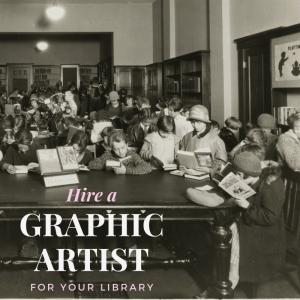
Visuals are a key part of marketing. Your graphic designer is an invaluable member of your library marketing team. So it’s an important hire to make.
A great artist can create a consistent look and feel to everything surrounding your library’s brand. You want your customers to be able to recognize your visuals as being part of your brand, even before they spot your name or logo on the material.
A good artist can convey the message of your library without actually using your library’s name. They can listen to you explain a vague idea and create something visually stunning which helps enhance the customer experience.
When you’re in the market to add a graphic artist to your team, you may be dazzled by stunning portfolios and creative resumes (graphic artists create some of the best resumes I’ve ever seen!) But there are nine important qualities your candidates must have.
Someone with good customer service. Your artists will be working with multiple departments, branches, customers, and outside partner agencies. You need someone who can listen to whoever they are working with, understand their needs, and translate their vision.
Someone who can communicate with your customers. Ask your candidates how they will create pieces for different age groups, ethnic backgrounds, and interests. Make sure your artist can switch viewpoints and create visuals that speak to many different library audience segments.
Someone who can translate your library strategy and goals into visuals. These are complex concepts. A good artist will take big ideas and turn them into a visual the audience can understand. Ask for examples of infographics and annual reports from previous employers or internships. Can you understand what the message is? Are the statistics presented in a clear and interesting way?
Someone who can work with multiple formats. You’ll be asking your artist to create print and digital graphics, so they should be comfortable working with both. Ideally, you should also look with experience in web design, video production, and animation.
Someone with a vision. You’ll want to make sure your graphic designer will stay on top of the latest trends in design so your marketing material doesn’t look dated.
Someone with whom you can collaborate. Your work with design will be a back and forth, give and take, and you will need someone who can walk through that messy process with you. A good designer will be able to defend their design as well as adapt to ideas that aren’t expressly theirs.
Someone who seeks inspiration. My two designers have a common belief that their work gets better as they learn more. They both have a desire to attend creative sessions and try new mediums. They both work on creative endeavors outside of the library.
You don’t want a designer who simple comes into the office, does what you tell them, and then goes home for the day. Ask potential hires if they do anything artistic outside of the workplace to fuel their own creativity.
Someone who can think on their feet. Ask your candidates to critique a design piece and explain what they would have done differently. Their answer will tell you a lot about their creative process, their ability to articulate their vision, and how they think when they’re asked to do a project on the fly.
Someone who can handle criticism. This is true of every hire you make, but graphic artists are creatives and in my experience, creatives take their work seriously. They may feel precious about their designs and may be resistant to your opinions about them. Make sure you can give positive and constructive feedback to your potential hire without worrying that they’ll refuse to take your suggestions.
Subscribe to this blog and you’ll receive an email every time I post. To do that, click on “Follow” button in the bottom left-hand corner of the page. Connect with me on YouTube, Twitter,Instagram, and LinkedIn.And check my list of upcoming events so we can connect.


 Super Library Marketing: Practical Tips and Ideas for Library Promotion