Search

Super Library Marketing: Practical Tips and Ideas for Library Promotion

Tag

advice for library marketers

๐Ÿ’›The Best Advice From the Top 4 Library Marketing Professionals: Special Episode!

Watch this episode now

This is a very special episode of The Library Marketing Show.

That’s because you are going to get marketing advice from not one… not two… not three… but four of the top professionals in the library marketing industry.

And I’m bringing it to you as my gift because this, my friends is… the 200th episode of The Library Marketing Show!

Plus weโ€™ll give kudos to someone doing great work in library marketing. Do you have a suggestion for a topic for a future episode? Want to nominate someone for kudos?

Let me know here.

Thanks for watching!


Will I see you soon?

Subscribe to this blog and youโ€™ll receive an email whenever I post. To do that, enter your email address and click on the โ€œFollowโ€ button in the lower left-hand corner of the page. You can also follow me on the following social media platforms:

Four Eye-Opening Library Marketing Lessons I Finally Learned When I Left My Library Job and Became a Regular Patron

Photo Courtesy Public Library of Cincinnati and Hamilton County

It’s been six months since I walked out of the Public Library of Cincinnati and Hamilton County for the last time as an employee.ย 

You’d think that moving from library staffer to library patron wouldn’t be that big of a revelation. After all, while I worked at the library, I was also a patron.

But there is a mindset shift that happens when you stop working on a library’s communication strategy and start seeing those communications exclusively from the customer side.

Now, when I receive an email from my library, or see a library social media post, or watch a library video, or see a sign at the library branch drive-through window, I don’t know what goal my library is trying to achieve.

I have no idea how long the marketing team worked on those promotional pieces.

I don’t have any insight into the discussion over wording, image selection, and calls to action.

I have no idea how many revisions they went through before they received final approval.

Once I took off my marketing hat and put on my customer hat, I started to see things very differently. I learned some eye-opening lessons.ย ย 

Patrons cannot fathom the breadth and depth of your services.

Libraries really do offer an extraordinary number of services. It is impossible for a regular person to understand or remember all of them.

I thought I had a pretty good handle on every service provided by my library. But I would be hard-pressed to list them all if I were forced to, even just six months out from my employment.

With that in mind, library marketing needs to get laser focused. Pick your promotions based on your library goals for the year.

With the pandemic, your goals likely shifted in the past few months. So, focus your promotions on achieving those goals.

Release your promotions consistently over a set period of time and on as many channels as makes sense for your audience.ย 

Most importantly, resist the urge to promote everything your library offers. It’s overwhelming to your community. Your message will get lost.ย 

Organic social media is not your friend.

I am a former library employee. I visit the library website at least once a day. I talk about the library on social media.

And yet, I rarely (if ever) get served my library’s Facebook, Twitter, and Instagram posts organically. Most of the time, I must go looking for them.

If I’m not seeing my library’s social media posts, can you imagine how many other people are not seeing them?

In my new job, I talk with a lot of libraries who rely heavily on social media. I’m not saying that you should not post to social. I just want to remind you that social media is also fickle and imperfect.

Be sure to distribute your marketing messages across multiple channels, including email, so you’re sure your whole community will see your message.

In a crisis, more communication is better.

The pandemic and the resulting shutdown came about six weeks after I left the library. And watching it unfold as a customer was interesting.

My honest assessment is that my library did a great job of communicating when it went into shutdown and when it reopened.

However, in the weeks in between those two major events, there was very little communication to patrons.

And I was craving news, even if it was “Our physical buildings are still closed, and we don’t know when we’ll reopen.” In fairness, this is a criticism I had for a lot of organizations, including my church and my kid’s school.

In a crisis, there is no such things as over-communication. Regular updates to your patrons and community are always better than radio silence.

The more you talk to your customer base, the more likely they are to remember you and support you when the crisis is over.

People just want to be informed. Silence feels like abandonment to your patrons. Communicate more often when your library is in crisis.

A well-designed website is a gift to your patrons and essential to your library’s success.ย 

The main digital entry point for your library is your most important asset.

In my new job, I do a lot of research on libraries of all shapes and sizes. I spend a lot of time looking at library websites.

Some are easy to use and some are not.

It’s no surprise that the libraries with beautiful, easy-to-navigate websites report more engagement from their patron base in the form of circulation, attendance at events (even virtual events), and donations.

If you have any say over your library’s website, it behooves you to spend time making it an amazing portal to your library.ย 

As a patron, I am grateful when I can find exactly what I need when I visit a library website. Need a place to start? Here are some tips.

You Might Find These Articles Helpful

This Free Tool Will COMPLETELY Change Your Libraryโ€™s Social Media Posts!

Why the Circle of Promotion is Your Best Bet for Library Marketing

Latest Book Reviews

The Voyage of the Morning Light by Marina Endicott

Find more 60-second Book Reviews here.

Subscribe to this blog and youโ€™ll receive an email every time I post. To do that, click on the โ€œFollowโ€ button in the bottom left-hand corner of the page. Connect with me on YouTube, Twitter,ย Instagram, and LinkedIn.ย 


You Can Fix It! If Your Library Marketing Is Failing, Here are the Top Eight Solutions

Do you remember when you learned to read?

I was in the first grade. The school was holding a contest to find a student to deliver a public service announcement about education on a local radio station. I was determined to win.

My mother, who was a first-grade teacher, was incredulous when I shared my plan for my broadcast debut. How could a kid who hadn’t learned to read yet get good enough to get that radio spot? She thought I was crazy.

And maybe I was. But I proved my mother wrong through sheer will and determination, and with a little help from the “Dick and Jane” series. By the end of first grade, I was reading well enough to tackle Laura Ingalls Wilder’s Little House in the Big Woods. And I was on the radio.

Twenty years later, I was working weekends as a newscast producer at a television station. That meant every Saturday and Sunday, I had to 8 hours to produce two shows… the 6 p.m. news and the 11 p.m. news. On a good night, it was a fast-paced and stressful proposition.

One day, the television station suffered a huge power failure. The station had backup generators that were supposed to kick on to keep us on the air. But a surge had fried the wiring and we were dead… really most sincerely dead. We had no way to get on the air. And the newscast had to get on the air.

Failure was not an option. We needed to get the show on the air because thousands of homes were also without power and those people looked to us for information. We also needed to get on the air because when the ads that are supposed to be a part of the newscast don’t air, the station loses money.

With airtime fast approaching, we came up with a plan. We would broadcast live from the parking lot using our live truck. It was crude but it worked. We felt like heroes. Journalism won the day and after that, I felt like there was no problem that I could not solve.

We all face obstacles during our work every day. Some are big, some are small. Your attitude plays a huge role in determining whether you overcome them, particularly for those of us working in the library marketing space. Many of our problems are unique to this industry. But trust me when I tell you that you are smart and you can figure anything out!

To prove it, here are the top five problems we face in Library Marketing along with eight solutions… because there are always more solutions than problems!

Problem: we simply don’t have enough time to do all the stuff we’re asked to do.ย The library year is kind of like the “lazy river” at my local YMCA… a constant swirling movement of events that keeps pushing us forward. It takes some force and a change of direction to break free. When you’re under pressure to promote each big event, it can leave you feeling like you never have enough time for your collection or services. You might feel like you don’t even have enough time to think or be creative.

Solution: a strategy gives you freedom. It not only helps you drive your marketing for the year in a measurable way, it will also provide a concrete reason the next time you have to say “no.”

Say “no” to promotions that don’t serve to drive your library’s strategic mission. Say “no” to promoting every exhibit, program, and author visit at your branches. Empower your branches to do some of their own promotion by providing them with simple guidelines for doing their own community marketing and set them free so you can focus on the big picture… your library as a whole.

Problem: we don’t have enough money. Tiny budgets really separate us most from the for-profit marketers. I do see more libraries spending big budgets but they’re doing it in smart and strategic ways, for re-branding and full production media ad buys, slick content marketing magazines, and direct mail to non-cardholders.

If you don’t have a big media budget, you can spend a little money to boost the effectiveness of your social media posts. Honestly, you can’t get much social media reach without a little spending.

Solution: social media advertising is cheaper than traditional ad buys. Your administrators might not realize how super effective targeted ads can be. You can easily prove that you can make a good return on their investment.

Solution: partnership opportunities to promote more than the big programs. At my library, we created media sponsorship guidelines which list the action items we’d like our potential sponsors to fulfill and what benefits we can offer them in return. Why not pitch a media sponsorship to promote your digital collection or your fantastic database resources?

Solution: find super library fans or influencers in your marketplace and invite them to write about your organization. At my library, when we opened our new MakerSpace and got lots of publicity outside the traditional media (this article is a good example).

Problem: we don’t have enough staff.ย If your handling a one-person marketing department, trying to take on marketing can be a scary proposition. You probably feel like you’re already just hanging on by the skin of your teeth.

Solution: use the talents of non-marketing co-workers. There are likely a number of librarians who have an interest and a proficiency for social media, writing, video, and design. Ask around and recruit those staff members to help you create content. Ask for permission to recruit interns. You’ll have someone to handle the grunt work and you’ll have the joy that comes with mentoring and encouraging the career of young marketers.

Problem: we don’t know enough about our cardholders to target them effectively with messages they will love.ย I suffer from this and many of my library marketing friends do too! It’s not a hard one to solve.

Solution: create a new cardholder survey to gauge the interests of people just entering your library system.

Solution: aย yearly satisfaction survey for all cardholders is also extremely helpful, particularly when you can take the results and split them into your different persona groups. From there, you can map your customer’s journey. When they get a card, how long does it take them to use it? Are they checking out books or using your digital collection or your computers, or do they simply let it languish? Do you have some customers who got a card years ago, used it a specific way, and then stopped altogether? Do you have some customers who are making the transition from print items to digital materials? Do you have some customers who are only interested in one particular kind of item–DVDs, audio books, or computers?

Break your customers into groups based on what they do with the card and start creating pieces of content that target those groups. Maybe you’ll want to focus your efforts at first on one group in particular. At my library, we’re targeting a persona we call “Occasionals” which are people who use their cards once every six months. We focus on moving people from that cluster into a more active user persona, by targeting them with messages about the convenience of our digital collection.

Problem: we are resistant to change. This problem is the biggest, in my opinion. We are too set in our ways. How many times have you heard someone in your library say, “But that’s the way we’ve always done it!” It’s the phrase I dread most.

It takes an enormous amount of effort and energy to change the minds of our fellow library staff members and our administration. It seems like it would just be easier to stay the course.

Do. Not. Give. In. Marketers have a reputation for being talkative, a little eager, a bit bold, and maybe a tad whacky, and these are all GOOD traits! We have to remember our main objective–to get customers to move through the cardholder journey and engage with the library. Without that engagement, the people who argue that libraries are obsolete will win! We can’t have that.

Solution: with patience and persistence, you can thoughtfully steer your library into the future. It works best when you start small. Think of it like a staircase. On the bottom step, you make a small argument and you try a new thing. You see results. You report the results and chances are, you’ll get to climb to the next step.

The more you do this, the faster you’ll get up the stairs–at some point, you might even be allowed to take the stairs two at a time. Keep the end goal in mind but set smaller goals that help you to get there.

Subscribe to this blog and youโ€™ll receive an email every time I post. To do that, click on โ€œFollowโ€ button in the bottom left-hand corner of the page. Connect with me on YouTube, Twitter,ย Instagram, and LinkedIn.
Email is Not Dead! Here are Eight New Ways to Help You Get the Best Results With Your Library Email Marketing

I have a thing for email marketing.

I think it’s fun. I like trying to figure out all the pieces. Which subject line is best? To emoji or not to emoji? How much text? What should it say?ย  What kind of photo or graphic should I use? What’s the best call to action? Who should I send it to? On what day and at what time?

I love experiments. I love sending the message and then watching the results. How many people opened it? More importantly, how many people clicked on my call to action? MOST IMPORTANTLY, how many people did the thing I wanted them to do?

Maybe I just like convincing people to do stuff.

Email is not dead, at least not for libraries. People want to hear from us. They love free stuff and that’s basically all we have to offer! I send tens of thousands of emails a week to my cardholders (I live in a large county service area with nearly a million residents). My unsubscribe rate is zero percent. No kidding.

Email marketing truly is the most effective method of digital promotion for libraries. I use it whenever I can at my library because it gives the best return on my investment of time and money.

And because it’s the most effective digital tactic at my disposal, I spend an awful lot of time researching email marketing. I read a ton of blogs. I listen to a lot of podcasts. I comb surveys for insights that will make my emails better.

I’ve started a document where I keep a bunch of statistics and insights gleaned. I realized that I needed to share these insights with you. Email marketing could be your most valuable asset too. So here are the eight newest things I’ve learned about email marketing that will improve the work you’re doing at your library.

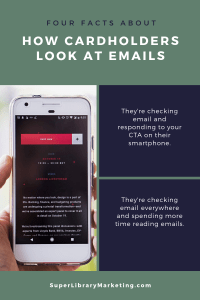
How cardholders look at your emails

You’ve heard it before but I’ll say it again. You must make sure your emails are mobile-friendly and responsive. About 3 in 5 consumers check their email on the go. 75 percent of Americans say they use their smartphones most often to check email. (Blue Corona)

And you must assume your cardholders will use their phones to respond to your email call-to-action. 62 percent of email opens occur on mobile. Only 10 percent occur on desktop. That’s huge! (Adestra)

Your cardholders are checking their email literally everywhere. People admit to checking email while watching TV, in bed, on vacation, in the bathroom, while walking, during meals, during commuting, while talking, while working out, while driving, and while at a formal ceremony! (Adobe)

Your cardholders are spending more time reading emails. In the last decade, the amount of time people spent reading an email actually increased by 7 percent, to 11.1 seconds. (Litmus)

How to design the best library email

Your subject line is the most important part of your email. It gets your cardholders in the door, so to speak. Focus on sentiment by using emotional words. Use different words for different audiences. The subject line for a message you send to teens will be completely different from the message you send to parents. Make it simple and easy. However, length doesn’t matter anymore, so you can make your subject longer if you need too!

Write like a human and make sure everyone can read your text. For the text, speak conversationally. No industry-speak (words like periodicals are out!).You don’t have to convey all the information about your product or service or collection item in the body of the email. Get to the point and drive users to your website or another platform for more information. Avoid multi-colored fonts. Use fonts that are accessible, like Arial, Helvetica, Lucida Sans, Tahoma, and Verdana. (Bureau of Internet Accessibility).

Make your email design hard to ignore. Use a one-column layout so people can scroll easily. Make the text large! Headlines should be no smaller than 25 pixels, body text should be no smaller than 18 pixels.ย  Call to action buttons can be pretty huge– anywhere from 44 x 44 pixels to 72 x 72 pixels.

Images matter. Photos of real people, especially faces with emotional expressions, are best. But don’t be afraid to use gifs too!

Learn more about email marketing for libraries

The Step-by-Step Method for Figuring Out the Best Time to Send Library Marketing Emails and Why You Should Never Stop Experimenting!

The Tiny Little Mistakes That Ruin Your Library Marketing Emails AND How to Fix Them!

This Advice Will Boost Your Library Marketing Email Click-Thru Rates

Don’t forget to join us for the LIVE LIBRARY MARKETING TALK ON INSTAGRAM every Tuesday at noon ET. We’ll talk about library marketing topics for about 15 minutes each week. My handle is Webmastergirl. You can email questions and topic suggestions ahead of time. Just fill out this form.

And check out these upcoming events and webinars where we can connect and discuss library marketing. Registration links included.

Subscribe to this blog and youโ€™llย receiveย an emailย every time I post. To do that, click on โ€œFollowโ€ button in the bottom left-hand corner of the page. Connect with me on Twitter,ย Instagram, and LinkedIn. ย 

The Library Marketing Live Show Episode 6: Figuring out Evergreen Content for a Library Blog

Watch Now

What We Talked About

Shandi from the Illinios Heartland Library System sent me this question: ย I just read your blog article “How to Launch a Library Blog.” I would love to hear more about this! Specific question: Our new website won’t be ready for maybe 8 months (at our current rate). I want to add a blog with the introduction of our new site. When do you suggest beginning to curate articles? I’m thinking I could start now with evergreen pieces, right? Thanks!

So I talked through my answer to that question and gave some advice for creating evergreen content for a library marketing blog. I’m excited to see what Shandi’s blog looks like and to read the content she curates.

If you’ve got a library blog that you really love, please let me know in the comments. I’m curating a list of great library blogs to share in a future post so get your nominations in! Thanks for the question, Shandi.

Stay in Touch

Thanks to everyone who attended the webinar with Library Journal and Recorded Books on July 25. I am going to answer all the questions either on the live show, on my blog, or via email so be watching for that!

I’m speaking at two conferences this fall and you can register for both on the Upcoming Events page. The OLC released their full agenda this week and it looks like a great conference. Plus, you’ll be able to tour my library!

Have an idea for the next Library Marketing Live Show? Submit it now.

Weโ€™ll chat on Instagram on Tuesday at noon EST for about 15 minutes. My handle is @Webmastergirl so follow me to see the show live!

How to Launch a Library Blog: A Guide to Pitching Your Idea and Getting It Off the Ground

How to Launch a Library Blog

We did a big, big thing at my library this year.

We launched a blog.

It’s been a long time coming. I first pitched the idea of a blog to senior leadership in 2015. I created a document that explained the reasons why our library needed a blog. It also laid out my bare bones ideas for how the content creation process would work.

Marketing Advantages to Having a Library Blog

  • Easy, cheap, effective way to promote smaller, niche programs.
  • We no longer have to rely on traditional media to get the word out about programs and services. We have our own publishing platform for reaching our audience. Traditional media outlets will follow the blog. The posts will be more engaging than a press release and will pitch themselves as bigger story ideas.
  • The blog will give us something to link to for promotional posts on social media.
  • ย A blog would be a place to show our thought leadership. We are the information experts! We can demonstrate why people should care about what we say in a long-form, insightful, and meaningful way.
  • ย Easy way to keep our brand top of mind all the time.
  • ย Easy way to show the Libraryโ€™s human side and let our customers get to know one another.
  • Partnership opportunity: We can invite partners to write posts for the library, creating great, shareable content for our users and in turn getting our posts shared by our partners.

So How Would This Work?

  • Marketing would be the centralized location for publication-we would manage the editorial calendar, recruit writers, copy edit, publish, and promote posts.
  • We would set a cadence for postsโ€”one post per week to startโ€”and re-evaluate at a later date.
  • We would recruit post writers from all branches and departments at the Library. We would also recruit Library customers, evangelists, and fellow bloggers and influencers to write guest posts. We would provide them with a simple template for writing their posts, which we would copy-edit and publish. We would ask all guest writers to share the content, once published, on their platforms, giving us instant exposure to their audience.
  • Editorial standards will be high: content must be written in a conversational tone, AP style usage of punctuation and grammar must be adhered to, and posts must be engaging, shareable, and interesting to our core audience.
  • We would also re-purpose content to use as posts, providing new/updated/additional information not seen in print from sources such as Library newsletters, and email.
  • We would evaluate top performing posts once per month and adjust our editorial calendar as necessarily based on data.

I also created a mock editorial calendar listing various post ideas and who might be tapped to write them. After presenting these to my boss, I waited.

And waited.

And waited.

For four long years.

Finally, in the summer of 2018, there was major leadership change at our library. Our previous director resigned and a new person took the director’s role. And a few months after that, marketing got the green light for a blog.

To say that there was much rejoicing and celebrating among my staff would be an understatement. After the confetti was cleaned up and the champagne was gone (I’m kidding–there was no confetti or champagne and I regret this immensely), we realized we had to launch this thing as we had promised. And so, we did! Here’s our beautiful finished product.

Our first blog was published on March 4, 2019. So far, we’ve published 65 posts on the blog.

It has already fulfilled all of the advantages I listed in the proposal document. Traffic to our website is up. Media are now going to our blog for story ideas about the library. Our search ranking increased. We have lots of partner organizations asking for permission to write posts for us. Our staff members are writing posts and using the blog as a way to let the public know about the important work they’re doing in their branches and departments. We haven’t spent any money creating beyond staff time. And it helps us to stay top-of-mind with our cardholders and the community at large.

We did learn some big lessons during the process and I want to share them with you now.

Lessons Learned While Launching a Library Blog

Lesson #1: The hardest part is getting started. It took forever to get buy-in on the idea.ย  Keep advocating. Don’t give up.

Lesson #2: Building something from scratch is exciting and frustrating. It was liberating to have the freedom to do whatever we wanted. It was also terrifying. Lean into it! Be open and honest about your fears and expectations. Keep your supervisors in the loop about your observations as you work through the process.

Lesson #3: Communication with staff is vital. Get a vision and guidelines set down on paper and approved as soon as possible, then tell staff so they can begin to build excitement among cardholders. Their enthusiasm is your best marketing tool.

Lesson #4: The first year will be about experimentation. Set a posting schedule that you can keep to without having a stroke. Write all kinds of posts to see what interests your audience. Experiment with posting on different days of the week to see which is best for capturing your audience’s attention.

Lesson #5: Promotion of your blog is just as important as your blog itself. Make sure you work out a plan for how you’ll promote the blog once it’s up and running.

My big piece of advice is to actually refrain from promoting the fact that you have a blog until you have a cache of articles. Promote individual posts but wait a couple of weeks to start talking about the blog as a whole service. Once you have a variety of posts up on the blog, then you can do your big promotional push and reveal. You’ll have to do this full push campaign at least once a year to remind the public that the blog exists, and to let new cardholders and community members know that it’s there.

Lesson #6: Your blog doesn’t have to be perfect on launch day. Pick a launch day and stick to it. It can be a work in progress. You can fix things as you go along. But if you wait for it to be exactly perfect,ย  it’ll never get off the ground.

Lesson #7: Measure and report. Data is your friend. Evaluate what works and what doesn’t. look at the data but also gather feedback from staff and customers about what they want to see.

Don’t forget to join us for the LIVE LIBRARY MARKETING TALK ON INSTAGRAM every Tuesday at noon ET. We’ll talk about library marketing topics for about 15 minutes each week. My handle is Webmastergirl. You can email questions and topic suggestions ahead of time. Just fill out this form.

And check out these upcoming events and webinars where we can connect and discuss library marketing. Registration links included!

Subscribe to this blog and youโ€™llย receiveย an emailย every time I post. To do that, click on โ€œFollowโ€ button in the bottom left-hand corner of the page. Connect with me on Twitter,ย Instagram, and LinkedIn. ย 

Eight Major Reasons To Add Content To Your Library Marketing {Infographic}

I’m so excited to be the keynote speaker for the Illinois Library Association Marketing Forum Mini-Conference in Chicago in a few weeks. My brain is entirely engulfed in content marketing as I formulate the talk. There are also some big content changes afoot at my library. I’ll talk more about those when we have our campaigns up and running. But, let’s just say that most of my marketing focus in my professional life is on content–why we should do it, how to make it work better, and how to be efficient in our content creation.

The most important part of the speech I’ll give next month is the “why.” Why is content marketing important to libraries? This was actually the focus of one of my early posts here on blog. The argument for content marketing hasn’t changed. You can make all the posters and fliers you want. People don’t pay attention to those push promotional tactics. That’s why marketing seems frustrating.

You want desperately to break through the noise of life and become a subconscious part of your cardholders’ thought process. You want them to think of you every time they face a problem. You want them to remember they can come to you for pretty much anything they need. This is the common struggle for libraries everywhere, no matter their size, staffing, or service area. Honest to goodness, the only way to achieve that is through content marketing. I know this from experience.

There is now a lot of data to back up the assertion that content works. I want to share some of that with you. I’m hoping that, if you are hesitant or nervous about working content marketing into your overall library marketing strategy, these stats will convince you. I truly believe this is an opportunity for libraries that cannot be missed. If we are to survive and thrive as an industry, we need to do more content marketing.

Here are the facts for why content is key to library marketing.

Why Content is Key to Library Marketing

80 percent of people prefer to get information about your library from a series of articles versus an advertisement.

71 percent of people are turned off by content that seems like a sales pitch. Which means, if you are doing mostly traditional promotional marketing, it’s not working.

75ย percent of people who find local, helpful information in search results are more likely to visit a physical building. We want to get more bodies inside our libraries. Content is the key.

Only 45 percent of marketers are using storytelling to create a relationship with their audience. Most big brands are still running ads and push promotion. This is our open door. It’s a huge opportunity for libraries. This is how we sneak in and take away audience share… by telling stories. And who doesn’t love a good positive story about a library?

95 percent of people only look at the first page of search results. Optimized content (that’s content that uses keywords that are likely to be picked up by Google and other search engines) is incredibly helpful. If your library’s content appears on the second page or later, people won’t see it.

Blog posts are the content that get the most shares. And if your post is helpful to others, it’s more likely to be shared. 94 percent of readers share a blog post because they think it can be useful to someone they know. And the more often you publish blog content, the more often your content will show up in search, which increases the likelihood that people will find your library while doing a search. Amazing, right?

90 percent of the most successful marketers prioritize educating their audience over promotion their company’s promotional messages. Education is our main industry. Libraries are perfectly aligned to make this work for us.

But here’s a stat that really surprised me. 78 percent of effective content marketers use press releases as part of their strategy. Yep, press releases can be content marketing too. Use your releases to be informative but to really pitch amazing story ideas to the media. If you have a great story and you can make all the elements available to the media, you can let them tell it and take advantage of their built-in audience to spread the word about your library.

These stats come from a variety of great blogs including Impact, Marketing Profs, OptinMonster, Elite Copywriter, Cision, and Forbes. I hope they’ve convinced you to do content marketing at your library.

Subscribe to this blog and youโ€™llย receiveย an emailย every time I post. To do that, click on โ€œFollowโ€ button in the bottom left-hand corner of the page. Connect with me on Twitter,ย Snapchat, and LinkedIn.ย I talk about library marketing on all those platforms!

How to Hook New Cardholders and Make Them Loyal with Email

We talk a lot about emailing our cardholders with information about new products, services, and collection items. But you can also use your email list in a powerful way to reach people who have just signed up for a library card.

Most libraries take a minimalist approach to “on-boarding” a new cardholder.ย  Once a person fills out a library card application, we hand them a card, a welcome brochure, and send them on their way. We’re friendly and we’re genuinely excited to welcome them to our system.ย But we make a mistake that’s common for a lot of businesses and organizations. We know our system inside and out and we often forget that our new cardholders know nothing about what we offer. We assume they can find their way to the things they need.

It’s important to help those cardholders learn to navigate the behemoth number of resources and items available at the library.ย A solid on-boarding campaign retains new cardholders and turns them into lifelong loyal users of the library. The first 90 days of a new library cardholder’s experience is crucial to determining their feelings of connection and loyalty to the library.

It also makes good business sense. Studies show it costs five times as much to gain a new customer than it does to retain them. A library marketer practicing good stewardship will want to do their best to keep new cardholders coming back to use the library.

The most effective way to on-board a new cardholder is through email marketing. Many libraries create a campaign with specific emails sent to new cardholders at a pre-determined pace. Those emails slowly introduce them to new features and inspire them to try out all the library has to offer. It’s easy to do this using some mail systems, like OrangeBoy and MailChimp.

My library has a 90 day on-boarding campaign set to run automatically through OrangeBoy. Creating it was a bit of process. But the effort was worth it. In addition to retaining customers, the on-boarding emails reduce unsubscribes for future targeted promotional emails. Here’s how we did it and what we learned about doing it well.

First, make a list of the services, events, and collection types that get the most use at your library. You’ll want to include information about the most popular features you offer in your emails to new cardholders.

Then, make a list of the services, events, and collection types that are interesting or unique to your library but don’t get a lot of use. These are the gold nuggets of your on-boarding campaign. You’ll have the attention of your new cardholder. The relationship is fresh. Why not use that to showcase the hidden treasures at your library.

Finally, create an outline of your campaign, mapping out each message, when it will be sent, and what it will say. Look at the two lists you’ve created and narrow your focus. Try to promote no more than four things per on-boarding message. You don’t want to overwhelm your new cardholder. Rather, you’ll want to introduce people to the library in small doses. Pick a theme for each message with a specific call to action. Keep the language simple, conversational, and free of industry jargon.

Create, test, and release the messages. This part took me nearly as long as creating the plan did! But you’re almost there.

Track results. Of course, you’ll want to use a Google URL tracker or Bitly link to see which services and items get the most interest from your new cardholders. You can also track unsubscribe rates, and if you have the ability to divide cardholders into clusters, you can see where your new cardholders land after they finish the on-boarding process.

Here are a couple of examples of my library’s on-boarding emails so you can see what we do.

How do new cardholders react to these messages? They definitely don’t hate them. Our unsubscribe rate is 0%. We’re a large system and we’ve sent these for several yearsย to thousands of new cardholders. Over the course of our campaign, we’ve had a couple of hundred people unsubscribe.

We send six emails over 90 days. The first email gets a lot of engagement, which is not a surprise.ย  The fifth email about using your neighborhood branch (see the image above) is the second most engaging email for us. Overall, about half of the new cardholders we sign up end up becoming loyal library customers. Most use our computers but the rest are checking out physical and digital items or using our MakerSpace.

If your library is doing something to on-board cardholders, I’d love to hear about it. Please take this poll and tell me about what you are doing in the comments.

Subscribe to this blog and youโ€™llย receiveย an emailย every time I post. To do that, click on โ€œFollowโ€ button in the bottom left-hand corner of the page. Connect with me on Twitter,ย Snapchat, and LinkedIn.ย I talk about library marketing on all those platforms!


Make #GivingTuesday Work and Raise Big Money for Your Library!

Boy, library marketers sure have a lot of responsibilities. We’re expected to drive attendance to programs, increase circulation, plan big events, provide outreach support, and make sure everyone in our community knows about all the services we provide. In addition, most of us are also expected to help market fundraising efforts for our library friends or foundation groups. Our libraries need money. That fact arguably makes this directive the most important of all our jobs.

The fundraising portion of library marketing has always been difficult for me, if I’m being honest. I think most of us feel queasy about asking people for money, even for something as important as the work of the library. I get the same feeling in the pit of my stomach when it comes time to market my church’s stewardship campaign. It’s hard to put into words why it feels weird to me to ask people to give to either organization, though both are incredibly worthy.

But worldwide giving campaigns like #GivingTuesday help. This global movement happens every year on the Tuesday after the American Thanksgiving holiday. It’s meant to motivate people to donate after the excess of spending that happens when the traditional Christmas shopping season kicks off.

The website for the movement has all kinds of ideas for fundraising organizations. The “holiday” is a prime opportunity to reach your library’s fundraising goals. According to NonProfit Pro, in 2017, #GivingTuesday campaigns raised over $300 million online for charities with an average gift exceeding $120. That’s a 64 percent increase in the amount of money raised in 2016.ย And NonProfit Pro also says that nonprofits raise 14 times more in their end-of-year campaigns when they take part in #GivingTuesday. And if that doesn’t convince you, the most recent study of #GivingTuesday donations conducted by DataKind shows that educational causes received nearly 40 percent of all donations made. Cultural organizations saw the greatest increase in donations, in some cases receiving nearly 20 percent of their annual donations from this single day. Libraries can be considered both education and cultural organizations. We’ve got so much to gain!

My library started doing campaigns around #GivingTuesday about three years ago. We’ve seen trends in giving that match NonProfit Pro’s numbers. Even better, we grow our donor lists. That gives us a new audience to market to throughout the entire calendar year.

Your library should participate, and you should plan your promotions ahead of time.ย Don’t just send out an email and put up a couple of social media posts on #GivingTuesday. ย Start promoting #GivingTuesday with content marketing at least a week ahead of the actual holiday, sooner if you are able.ย You’ve got to prove your library’s worth and get the idea of giving into your potential donor’s head space before the event. I start about three weeks before the “holiday” with motivational content like quotes from customers, brand-awareness videos, and motivational photos with clear donation calls to action. I like to tell our cardholders and community that #GivingTuesday is part of a busy time of year and I work to get them to donateย early. This method increases the chance that our campaign is successful.

Of course, incentives always help with donations, and it doesn’t have to be something that costs your organization. This year, we’ll be emailing a graphic to anyone who donates early. Donors can use it on their social media profiles to show that they’ve given to the library. They can have the pride of saying they’ve participated when the day arrives and use their influence to encourage others to do the same. Early promotion creates momentum.

Of course, we use email as part of our campaign along with social media and our website. Here’s the message we sent last year about a week before #GivingTuesday. It’s clear and easy to understand.

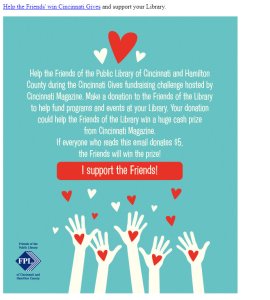
We did a similar message to members of the Friends organization. The audience for that group is different. But you’ll see we integrated the heart from our Foundation message into this message, to draw a subconscious message to our audiences about their love for the library. This one also has a clear call-to-action.


You can increase the effectiveness by extending the fundraising campaign through the end of the year. We create campaigns that run every two weeks beginning in November through the end of the year. Appealing to the tax deduction incentive is a major point of the campaign as we near the end of the calendar year. This is the email we sent last year about mid-December. Again, it’s clear, it concise, and it has a major call-to-action.


I’d love to hear about your successful library marketing fundraising efforts and campaigns. Please let me know what you’ve done right (and wrong!) in the comment box. We can all learn from each other. When one library is strong, it makes the whole industry stronger.

Subscribe to this blog and youโ€™llย receiveย an emailย every time I post. To do that, click on โ€œFollowโ€ button in the bottom left-hand corner of the page. Connect with me on Twitter,ย Snapchat, and LinkedIn.ย I talk about library marketing on all those platforms!


A WordPress.com Website.

Up ↑