Search

Super Library Marketing: Practical Tips and Ideas for Library Promotion

Tag

cardholder emails

⏱️7 Time-Saving Tips for Anyone Looking To Create High-Quality Library Marketing Emails That People Will Read!

Photo courtesy Cincinnati and Hamilton County Public Library

Last week, we discussed the pros and cons of email marketing automation. If your library chooses a program that requires a more hands-on approach to email marketing, this post is for you. These time-saving tips will let you create high-quality emails that resonate with your audience without spending all day on your emails. (Although, how fun would that be?!)

Time-saving Tip #1: Use templates.

This is the most effective way to save time when creating library marketing emails. If your email program doesn’t offer templates and you must make them yourself, here’s how to do it.

Decide on your buckets.

What kind of emails does your library need to send? Look at your library’s overall strategic goals and your marketing goals. Then, break your emails down into categories, like this:

  • Promote programs
  • Promote the collection
  • Promote services that bring people into our physical branches
  • Announcements like holiday closures, new services, renovations, service outages, etc.
  • Email to donors and legislators

Create one template for each category.

The ideal template will have sections with space for text, an image, and a call to action button. Here’s a great example of a library marketing email from Eisenhower Public Library made from a template.

Populate and send.

When it comes time to send the email, make a copy of your template. Insert the copy, images, and appropriate call to action, and hit send!

Time-saving Tip #2: Keep your emails short.

Emails that include no more than 4 topics perform best. If you have more to say, you can always send another email!

Keep the text in your email to a minimum. Think of your text as a tease. You want to write 1-3 enticing lines that compel your recipient to do something, like register for a program or put a book on hold.

Time-saving Tip #3: Target your messages to specific audiences.

It takes time to write copy that’s generic enough to appeal to everyone in your community. By comparison, it’s easier and faster to write text and find images when you know exactly what your audience is looking for in your library emails.

And, by targeting your message, you are more likely to say something that matters significantly to your cardholders, which makes them more likely to act, which makes your email more successful!

Targeted email marketing for libraries is effective because it serves the right message to the right group of people. And it works for all kinds of messages.

Also, your library should make your emails opt-in. This ensures your emails are going to community members who want your content.

Time-saving Tip #4: Let the robots help you with your subject line.

You should never rely on Artificial Intelligence tools like ChatGPT to do all the work for you when it comes to library email marketing. But they are a great starting point! Instead of staring at the wall trying to brainstorm ideas for the best subject line, ask the AI to get you started.

To show you, I ran this example using Microsoft’s Copilot.

Once you have a place to start, you can tweak the subject line to match the tone of your library. Move, change, or remove the suggested emoji. And then, run the subject line through one of the free analyzers below. Each has its own algorithm for predicting the success of a subject line. But all will help you get to a subject line that works for your target audience.

Time-saving Tip #5: Plan as much as humanly possible.

Plan your email campaigns in advance using an editorial calendar. This helps you stay organized and maintain consistency.

And, if you know ahead of time when you are sending emails, you can set aside time in advance to create them and get them approved. Have a few spare minutes at the beginning or end of your shift? Work on emails coming up in the next few months!

Time-saving Tip #6: Reuse and repurpose.

You don’t have to reinvent the wheel every time you create an email. If you wrote a social media post or a blog that did really well, steal the text you’ve already written and insert it into your email. Use the same image or graphics, sized correctly for your email of course, and hit send!

Time-saving Tip #7: Watch your metrics.

If you take an hour each month to analyze the performance of your library emails, you’ll soon start to get a clear picture of what works for your audiences. That will make you more efficient as you create your emails. You won’t waste time creating emails that your recipients won’t read.

Did I miss any tips? Let me know in the comments!


P.S. You might also find this helpful

Library Marketer Shares Her Ingenious Trick for Making Sure Her Community Sees Her Social Media Posts

Subscribe to this blog and you’ll receive an email whenever I post. To do that, enter your email address and click on the “Follow” button in the lower left-hand corner of the page. You can also follow me on the following social media platforms:

Psychographics Are the Key to Powerful Email Marketing: How to Unlock the Motivations and Aspirations of Your Cardholders

Photo courtesy Public Library of Cincinnati and Hamilton County

This is the second in a two-part series on email marketing for libraries. Read part one here.

At the Library Advocacy and Funding Conference in September, a new buzzword seemed to be on the lips of many of the presenters. They were all talking about psychographic segmentation of library audiences for email marketing.

I thought I knew most of the marketing buzzwords, but I confess this was the first time I’d ever heard the term. So, it was time to do some research.

What is psychographics?

Psychographics is the study and classification of people according to their attitudes, aspirations, and other psychological criteria, especially in market research (Oxford Dictionary).

Psychographics go beyond basic demographics: location, age, gender identity, and library card usage. To segment by psychographics is to divide your library audience into groups according to their beliefs, values, and reasons for being. It delves deeper into your cardholder’s values, dreams, desires, and outlook on life.

Psychographics identify motivation. Why does your library community take certain actions? Why do they feel the way they do about the library? How do they see the role of the library in their life? And what activities do they participate in, both inside and outside of the library?

Psychographics lead to compelling email marketing messages because they focus on your community’s unarticulated needs and motivations.

Understanding psychographics

The term is new to me but it’s not new to marketing. In 1964, Harvard graduate and social scientist Daniel Yankelovich wrote that traditional demographic traits—sex, age, and education level—lacked the insights marketers needed to target their audiences.

Around the same time, market researcher Emanuel Demby began using the term ‘psychographics’ to reference variations in attitudes, values, and behaviors within a specific demographic segment.

In the 1980s, the Stanford Research Institute developed the Values Attitudes and Lifestyles (VALS) psychographic methodology. It was hailed as a breakthrough in marketing.

One way to understand this concept is to find your own VALS type by taking this survey. My results show that I like to have historical context, that I buy proven products, and that I’m not influenced by what’s “hot.” I also like to experiment. Share your results in the comments.

The travel industry uses psychographics. Email marketing by hotels, cruise lines, and cities, states, and countries often focuses on why a person wants to travel: adventure, romance, curiosity, and relaxation.

Libraries can do the same thing.

Imagine if we started focusing our library email marketing messages not on what are cardholders want to do… but WHY they want to do it.

Uncover the psychographics of your library audience

How do you figure out what makes your library audience do the things they do? You must ask them! A survey is the best way to drill down on the psychographics of your library audience.

Most library surveys focus solely on demographics like age, location, and income. They generally ask people how they use the library now. They may ask people to predict how they’ll use the library in the future.

By adding psychographic questions, you’ll get a look at your audience’s true motivations. That may include questions like, “The last time you checked out a book, what was the reason?” “How do you feel about the library’s work with people experiencing homelessness?”

You can also use matrix-rated questions to gauge psychographics. For instance, you could include a statement like “The library helps people find a new job” and ask respondents to select an answer from a range of “not important” to “extremely important.”

How to Create an Effective Library Survey to Pinpoint the Needs of Your Community

You can also use outside data sources to get at the psychographics of your library audience. Take a closer look at the comments on your social media posts. Can you uncover any reasons why your followers are interacting with your library on social media? Do they share or comment on a particular type of post?

Check Google analytics on your library’s website. Are visitors taking the same steps to move from one landing page to another on your site? Do they spend a longer amount of time on one type of page?

Your circulation stats are a source of psychographics. Are you seeing a surge in the checkouts or interest of one genre of book, or one format? What language do your cardholders use when they ask for recommendations using your form-based readers’ advisory service?

If your library answers reference questions, what type of problems and language are your cardholders using when they ask for help?

Try to look at any interaction your library has with your cardholders, in any arena, as an opportunity to unlock their motivations and psychology. Then use those new insights to craft compelling email marketing messages.

Using psychographics in library email segmentation

Libraries can segment their email audience without violating CAN-SPAM laws. If your cardholders gave you permission to send them email, you can segment them into psychographic segments. As long as your email includes opt-out language (i.e. “If you no longer wish to receive emails about job services at the library, click here”), you are complying with the law.

Combine your demographic knowledge of your cardholders with the research you’ve done on the psychographics of your cardholders. Then divide your email recipients into new segments and try sending them psychographic messages.

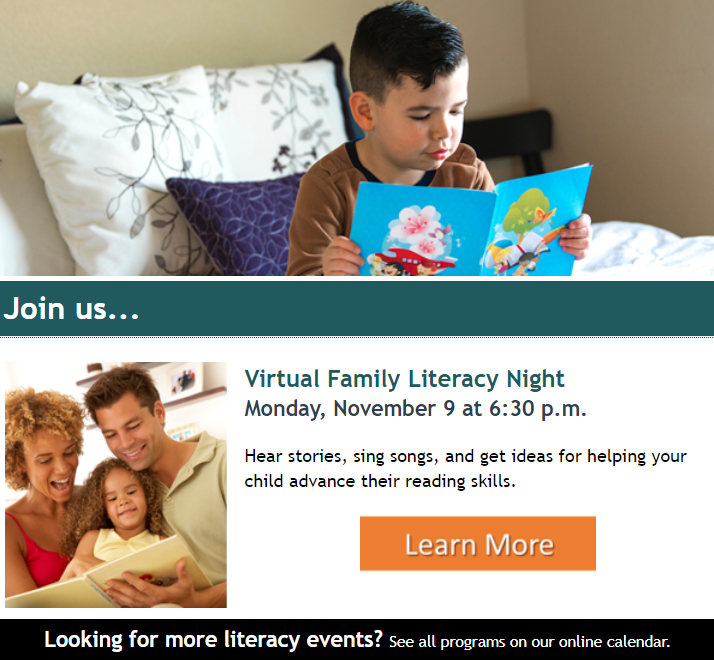
For example, let’s say you are already sending a monthly email to parents about storytime at the library. Now let’s say your library decides to offer a new program, like a virtual family literacy night, to help families whose children are not attending in-person classes during the pandemic.

Without psychographics, your email message may have looked like this:

But, thanks to your survey results, you know that many parents are worried about the effect that virtual learning is having on their child’s education. They believe their child will need extra tutoring and classroom attention to succeed in life because of the impact of virtual learning.

Now you can combine your audience’s motivations for attending with your message about the new program.

This marketing message pivoted from a simple invitation to a message that strikes at the heart of the caregiver’s concern for their child.

Psychographics activate the motivations and aspirations of your cardholders. When you get to know your community better, you’ll do a better job of getting your community to know your library!

You may also find these posts helpful

Are My Library Email Metrics Good…. or Bad?! Here Are the Latest Stats to Help You Figure It Out.

The Emoji Experiment: The Pros and Cons of Adding Emojis to Your Library Marketing Email Subject Lines

Latest Book Reviews

Nothing to See Here by Kevin Wilson

Find more 60-second Book Reviews here.

Subscribe to this blog and you’ll receive an email every time I post. To do that, click on the “Follow” button in the bottom left-hand corner of the page. Connect with me on YouTube, Twitter, Instagram, and LinkedIn.

Now is the Absolute BEST Time to Prove Digital Promotions are Essential for Library Marketing. Here’s How to Gather Evidence.

PHoto courtesy of Public Library of Cincinnati and Hamilton County

I had a wonderful conversation with a librarian from Canada this week. She heads technical services at her library. We were brainstorming about ways to market her library services, programs, and collection during the COVID-19 shutdown. And we both realized something. The pandemic is awful and scary. But it also affords one big opportunity for librarians and library marketers.

Now is the time to prove the value of digital promotions 

The Marketing Rule of 7 states that a prospect needs to “hear” the advertiser’s message at least seven times before they’ll take action to buy that product or service. This marketing maxim developed by the movie industry in the 1930s. Studio bosses discovered that a certain amount of advertising and promotion was required to compel someone to see one of their movies. 

What does the Marketing Rule of 7 have to do with your library? Digital promotion helps you fulfill the rule of seven. It’s the most efficient way to get your message in front of eyes in a variety of places.

In fact, if you’ve been thinking of slowing down the communication you do right now, don’t. Ramp it up! Your community needs to hear from you.

You should be sending more email to your cardholders. You should be posting to social media more frequently. You should be putting more notices about digital resources on the homepage of your website. 

In this moment, we can accurately measure the results of digital marketing because of the lack of competition from more traditional means of library marketing, like book displays, flyers, and posters. No one is seeing those at this moment, because no one is coming into your physical library building. Digital results are easy to record.

And, if we take this unique moment to gather data to prove that our work yields results, we can provide solid evidence of our worth in the community. We may prevent layoffs and budget cuts. When this is all over, we can say the library was there–and people turned to it for help. 

Statistics to gather now to prove your worth later

Measure virtual program viewing. Many libraries are putting together great virtual programming, particularly story times. If you do live streaming or on-demand videos, be sure to gather metrics on views.

Some platforms will tell you how a person got to your video and some will tell you how long they watch. Most will give you demographics on your viewers, like their age, identified gender, and location. All will give you stats on reach, engagement, and follower growth.

All those data points are valuable. Start a spreadsheet now and track the results day by day. You’ll be able to prove that people watched, how they found out about the video, which videos they liked most, and how long your library held their interest.

Send more emails, and track results religiously. Your library can use email to promote everything from services to events to the collection. Tell your cardholders about the new eBooks and eAudiobooks in your collection. Use your email to drive usage of those hidden treasures in your library, like online homework help, streaming music, and resume or job-hunting databases. Then…  

Tracks holds, checkouts, and usage for digital collection items. Be sure to write down how many holds and checkouts there are before you market, and one week after. It’s easy to prove the value of digital collection marketing when no one can walk into a library to check out a book. Every checkout is likely coming from your efforts!

Ramp up your social media posting schedule on two platforms. Social media is the second method most effective method for digital promotions. And it’s the best way for you to reach non-library cardholders right now.

Current research shows that people are Tweeting a lot more right now. With the amount of content on that platform, I would not recommend posting more frequently on Twitter. There’s too much competition and your posts are likely to get lost in the shuffle.

However, those same stats also show growth in use of LinkedIn and Pinterest during the pandemic. If your library is not posting on those platforms, now is a fantastic time to experiment and reach a new audience.

On LinkedIn, you can share collection items, services, and events that focus on job-hunting, career advancement, personal wellness, diversity, literacy, and entrepreneurship.

On Pinterest, post new eBooks and eAudiobooks added to your collection. If you have DIY, STEM-activities, or story time videos, you can also post those to Pinterest. People are using the platform for inspiration and to find activities to fill their time. Now is a great time to give them some content so they can discover your amazing library.

One more thing to do

Advocate to change your marketing emails from opt-in to opt-out. That means every cardholder who gives your library their email address, in the past or in the future, is on your marketing list. If they want to opt-out, they can (but they won’t!).

I know many libraries will find this to be a radical shift. Libraries worry about angering their cardholders by sending them emails. They don’t want to be one of the “bad brands” that sends spam. Many libraries have actual board policies making opt-in mandatory for emails.

Now is the time to advocate for change. Here’s why.

A library is NOT a business. The normal consumer sentiment about spam email does not apply to you. Your cardholders want your emails.

People love the library. They love what you offer them. They want to know what’s going on at the library. 

You are not going to spam people or make them mad by sending them emails. Unwavering cardholder loyalty is the one big advantage libraries have over their competitors in the profit world. And we should use it!

In addition, people are accustomed to opt-out emails. They know that if they give you their email, you’re going to message them. 

My argument for opt-out emails comes from lots of experience. When I worked for a public library, we sent marketing emails nearly every day of the week. My library’s unsubscribe rate was ZERO percent. I usually saw about 10-15 unsubscribes for every 10-thousand emails I send. Across the non-profit world, the average unsubscribe rate is about .19 percent, according to Smart Insights.

I worked the library outreach table at a book festival every year while I worked at the public library. Without prompting, customers asked about the library’s marketing emails. One lady said she heard her friends talking about them and wondered why she wasn’t receiving them! Several others mentioned they learned about new books and services from our emails. I had people GIVING ME their email addresses to check their status.

Do you think customers of other companies ask about their emails or talk about them with fondness to other customers?  I never have, and I sign up for A LOT of marketing emails from other companies.

Start sending your emails to every customer. They want to hear from you! And you can track usage and circulation increases from those emails to help prove your library’s worth.

You might also want to read these⬇️

What Metrics Demonstrate Your Library’s Social Media Marketing is Working?

How to Reverse Engineer Your Library Marketing Social Media Audiences!

The One Social Media Shortcut That Can Tank Engagement and Cost Your Library in a Pandemic–or Anytime!

Subscribe to this blog and you’ll receive an email every time I post. To do that, click on the “Follow” button in the bottom left-hand corner of the page. Connect with me on YouTube, Twitter, Instagram, and LinkedIn.  

The Emoji Experiment: The Pros and Cons of Adding Emojis to Your Library Marketing Email Subject Lines

I notice it, groggy from sleep. I check my email, as one does, first thing in the morning before getting out of bed. 😉

The sight of it causes my heart to skip a beat. “It’s going to be a glorious day,” I think to myself as I jump out of bed. 🤩

What is the magical thing that makes getting up in the morning easier? 🌟

An emoji. To be specific, a set of headphones, situated in the subject line of an email. An email that comes from my library.⬇️⬇️

The headphones signal to my brain, before I can read the words that come after them, that my audiobook from Overdrive is ready for download.

After dozens of such emails, my body has an almost Pavlovian response to the tiny drawing of headphones.

I get giddy. I get excited. I am filled with anticipation to download and start the audiobook.

According to Salesforce, only two percent of emails sent by businesses to consumers in 2019 had an emoji in the subject line. That’s not a lot, really. And that means there is room for libraries to experiment.

I don’t think there is any doubt that emojis are here to stay. As of October 2019, there were 3,178 widely-recognized emojis, according to Emojipedia. And the major cell phone and digital marketing companies keep adding emojis to their libraries.

I want my cardholders to have the same reaction I have to the headphone emoji when I send them library marketing emails. The idea that an email from my library could energize someone or fill them with anticipation or cause them to do a mini-celebratory dance is one I can’t ignore.

Why might emojis work?

Emojis work because the brain processes visual information 60,000 times faster than text. More than 90 percent of the information that we process is visual.

The emoji drawing stands out in a line of letters. And if your recipient is using a device that adds color to the emoji, that also makes your subject line pop.

Your subject lines can also be shorter when you use an emoji because an emoji can do the work of some of the wording. And the shorter the subject line, the more effective the email. In 2018, 61 percent of emails were opened on mobile. Subject lines exceeding certain character counts can get cut off by mobile devices. And that impacts your open and conversion rates.

The experiment

I kept reading articles on the increased use of emojis in emails for brand marketing. There isn’t much data to suggest whether they are effective in converting customers to take any action on the email. And I thought, as I am apt to do, that someone should experiment with emojis in the library marketing space. Would my cardholders find them amusing? Would emojis help increase the effectiveness of my emails? Or would people think we had lost our mind and gone too far?

There was only one way to find out.

Over the course of six months, I sent 17 test emails to my cardholders with an emoji in the subject line. I used them in instances where I thought they added value to the subject line or helped me to make the subject line shorter. I also made sure I sent emojis to cardholders who tend to use digital services.

The results

After the six-month trial period, I crunched the numbers. And I discovered…

60 percent of the emails with an emoji in the subject line were effective. Ten of the 17 emails caused an increase in circulation, program attendance, or database usage for the item we promoted via email. That’s close to the average effective rate of my regular emails which do not include an emoji.

Emojis DID increase my open rate. The 17 messages I sent had an average open rate of 40 percent. Most of my regular emails have an open rate between 20 and 35 percent. So that was an improvement.

Emojis DID increase my click-through rate. The average click-through rate for the messages with emojis was eight percent. That is also slightly higher than normal. Most of my emails have a click-through rate of five percent.

Here are the subject lines from the four emails in the emoji test that had the highest open and click-through rates.

Ebook Publisher Policies
🚨New publisher policies will limit your access to eBooks.

This email had an 81 percent open rate and a 22 percent click-through rate.

Penguin Programs
🐧Make a date to visit the Library to see real live penguins this month!

This email had a 37 percent open rate and a 23 percent click-through rate.

Beach Reads 2019 Booklist
🏖️ Dreaming of sand, sun, surf, and great books? Here’s our 2019 vacation reading list!

This email had a 39 percent open rate and a 19 percent click-through rate.

Green Township Library Anniversary
🎈You’re invited to the Green Township 30th Anniversary celebration!

This email had a 54 percent open rate and a five percent click-through rate.

Now, there is something to consider and that is that the emoji may have had absolutely no effect on the overall effectiveness of these emails! Because my email marketing provider does not give me the ability to do true A/B testing, it may be that these emails had higher open, click-through, and conversion rates because of the wording of the subject line or the content of the email itself. The fact that there was an emoji in the subject line might be pure coincidence.🤷

Are there downsides to emojis?

There are some negative things to consider when you’re using emojis for email subject lines in library marketing.

Your emoji may not display correctly for your cardholder, depending on what kind of email platform they use.

Emojis can give the impression that your emails are not authentic. In some instances, users see an emoji and wonder if your library wrote it… or a robot.

Emojis can be overused. Finding the perfect emoji is fun. It makes you feel cool. But if you start putting an emoji in every subject line of every marketing email you send, you will likely find that they’ll soon have no impact or, worse, a negative impact.

That said, I think it’s worth it to experiment with emojis in your library’s email marketing. Your audience may love or hate them. There’s only one way to find out.

Remember to use them in the right context. Use emojis sparingly and make sure they add something to the message of your subject. And get your emojis from reliable sources like Emojipedia, GetEmoji, or your email platform.

Check the Upcoming Events page for a list of webinars and conferences where I’ll be next. Let’s connect! Plus, subscribe to this blog and you’ll receive an email every time I post. To do that, click on the “Follow” button in the bottom left-hand corner of the page. Connect with me on YouTube, Twitter, Instagram, and LinkedIn. 

Email is Not Dead! Here are Eight New Ways to Help You Get the Best Results With Your Library Email Marketing

I have a thing for email marketing.

I think it’s fun. I like trying to figure out all the pieces. Which subject line is best? To emoji or not to emoji? How much text? What should it say?  What kind of photo or graphic should I use? What’s the best call to action? Who should I send it to? On what day and at what time?

I love experiments. I love sending the message and then watching the results. How many people opened it? More importantly, how many people clicked on my call to action? MOST IMPORTANTLY, how many people did the thing I wanted them to do?

Maybe I just like convincing people to do stuff.

Email is not dead, at least not for libraries. People want to hear from us. They love free stuff and that’s basically all we have to offer! I send tens of thousands of emails a week to my cardholders (I live in a large county service area with nearly a million residents). My unsubscribe rate is zero percent. No kidding.

Email marketing truly is the most effective method of digital promotion for libraries. I use it whenever I can at my library because it gives the best return on my investment of time and money.

And because it’s the most effective digital tactic at my disposal, I spend an awful lot of time researching email marketing. I read a ton of blogs. I listen to a lot of podcasts. I comb surveys for insights that will make my emails better.

I’ve started a document where I keep a bunch of statistics and insights gleaned. I realized that I needed to share these insights with you. Email marketing could be your most valuable asset too. So here are the eight newest things I’ve learned about email marketing that will improve the work you’re doing at your library.

How cardholders look at your emails

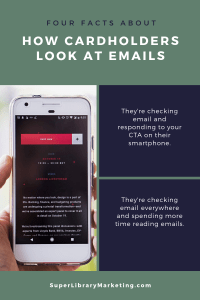
You’ve heard it before but I’ll say it again. You must make sure your emails are mobile-friendly and responsive. About 3 in 5 consumers check their email on the go. 75 percent of Americans say they use their smartphones most often to check email. (Blue Corona)

And you must assume your cardholders will use their phones to respond to your email call-to-action. 62 percent of email opens occur on mobile. Only 10 percent occur on desktop. That’s huge! (Adestra)

Your cardholders are checking their email literally everywhere. People admit to checking email while watching TV, in bed, on vacation, in the bathroom, while walking, during meals, during commuting, while talking, while working out, while driving, and while at a formal ceremony! (Adobe)

Your cardholders are spending more time reading emails. In the last decade, the amount of time people spent reading an email actually increased by 7 percent, to 11.1 seconds. (Litmus)

How to design the best library email

Your subject line is the most important part of your email. It gets your cardholders in the door, so to speak. Focus on sentiment by using emotional words. Use different words for different audiences. The subject line for a message you send to teens will be completely different from the message you send to parents. Make it simple and easy. However, length doesn’t matter anymore, so you can make your subject longer if you need too!

Write like a human and make sure everyone can read your text. For the text, speak conversationally. No industry-speak (words like periodicals are out!).You don’t have to convey all the information about your product or service or collection item in the body of the email. Get to the point and drive users to your website or another platform for more information. Avoid multi-colored fonts. Use fonts that are accessible, like Arial, Helvetica, Lucida Sans, Tahoma, and Verdana. (Bureau of Internet Accessibility).

Make your email design hard to ignore. Use a one-column layout so people can scroll easily. Make the text large! Headlines should be no smaller than 25 pixels, body text should be no smaller than 18 pixels.  Call to action buttons can be pretty huge– anywhere from 44 x 44 pixels to 72 x 72 pixels.

Images matter. Photos of real people, especially faces with emotional expressions, are best. But don’t be afraid to use gifs too!

Learn more about email marketing for libraries

The Step-by-Step Method for Figuring Out the Best Time to Send Library Marketing Emails and Why You Should Never Stop Experimenting!

The Tiny Little Mistakes That Ruin Your Library Marketing Emails AND How to Fix Them!

This Advice Will Boost Your Library Marketing Email Click-Thru Rates

Don’t forget to join us for the LIVE LIBRARY MARKETING TALK ON INSTAGRAM every Tuesday at noon ET. We’ll talk about library marketing topics for about 15 minutes each week. My handle is Webmastergirl. You can email questions and topic suggestions ahead of time. Just fill out this form.

And check out these upcoming events and webinars where we can connect and discuss library marketing. Registration links included.

Subscribe to this blog and you’ll receive an email every time I post. To do that, click on “Follow” button in the bottom left-hand corner of the page. Connect with me on Twitter, Instagram, and LinkedIn.  

The Step-by-Step Method for Figuring Out the Best Time to Send Library Marketing Emails and Why You Should Never Stop Experimenting!

I spend a good portion of my day as a library marketer trying to figure out how my cardholders live their lives. What do they do? When to they do it? What parts of their life are difficult? What parts are enjoyable? When do they have free time?

We do know a lot about the people who use the library, thanks to our own library surveys and great organizations like Pew Research Center. But you can also figure out what your cardholders are doing by email marketing experimentation. And your findings can increase the effectiveness of your marketing.

On the Library Marketing Live Instagram show, Dari from Cook Memorial Public Library District wanted to know how to figure out the best time to schedule marketing email to different audiences. The answer, in general terms, is between 6 p.m. and midnight. But I want to dive a little deeper into how I came to this conclusion and why this might NOT be the case for the people using your library!

If you’re just starting out with email marketing, check with the experts. There are a lot of companies (mostly email marketing software companies) which publish research on the best time of day and the best day of the week to send marketing emails, plus a bunch of other data points. So, start by gathering the latest research from these companies. Some of my favorites are Hubspot, AWeber, and Convertful.

Think about the daily life of your cardholder. If you are sending an email to a group of people who use a particular branch, or who are in a particular age group, try to imagine what they do all day. This generalization method will help you identify points in the day in which your target audience might have time to check their email.

Here’s an example: When I’m sending emails to parents of school-age children, I avoid 7 a.m. to 9 a.m., when parents are usually racing to get their kids ready to go to school. I also avoid 2:30 p.m. to dinner time, because many parents are picking up their kids, running them to extra-curriculars, and tackling homework.  I send marketing emails very early in the morning, like 5 a.m., so they are sitting in their inbox when they wake up but before their kids are up. I also send them after 8 p.m. when most school-age kids are in bed.

When I send emails to teenagers, I never, ever, ever send them in the morning. I exclusively email teenagers at night, and the later the better. That’s because most teens don’t have time to relax until 9:30 p.m. or later, after homework and after-school activities. They will likely check their email right before they fall to sleep at night, and they’re more likely to act on email in the late evenings.

Experiment. Send emails for a 3-6 months period of time. If you’re just starting out, try all hours of the day and night. Keep meticulous records of the results including open, click through, and conversion rates on all your emails.

After your allotted experimentation time, comb through the data and figure out which times of day resulted in the most click-throughs and conversions. Those are your optimum times to send emails! Focus most of your email scheduling on your proven best time of day.

And never stop experimenting. Start another experimentation period of 3-6 months, and then re-analyze data. If you notice a decline in click-through and conversion rates, go back to the drawing board.

My latest six-month analysis shows the best time to send email is between 6 p.m. and midnight, for all age categories and for all card types. This was not always the case. Two years ago, I could send my emails any time of the day EXCEPT between 7 a.m. and noon. But, at the end of 2018, that changed and the only emails that did well were the ones I sent at night.

Why did the effective time change? Because people’s lives change. Your cardholder base changes. The way that email gets delivered by various email providers changes. All of these factors mean that you’ll need to be in a constant state of experimentation. Don’t get married to any one time of day. Have an open mind and be ready to change your email scheduling strategy when the data tells you it’s time to change.

The most important thing is to have good content. If your emails contain stuff that your email audience wants to know about, they will engage with them, no matter what time of day it is. Try and keep your emails short. Focus on a few lines of really compelling text and one or two clear calls to action.

Bonus controversial opinion: I am not a fan of email newsletters. They usually contain too much information and too many calls to action. Their subject matter is usually too broad for their audience. I know a lot of us have to send them because senior leaders love them. But they aren’t an efficient use of email marketing. It would be better to take each section of your newsletter and send it separately to a targeted audience.

Don’t forget to join us for the LIVE LIBRARY MARKETING TALK ON INSTAGRAM every Tuesday at noon ET. We’ll talk about library marketing topics for about 20 minutes each week. My handle is Webmastergirl. You can email questions and topic suggestions ahead of time. Just fill out this form.

Subscribe to this blog and you’ll receive an email every time I post. To do that, click on “Follow” button in the bottom left-hand corner of the page. Connect with me on Twitter, Instagram, and LinkedIn.  

Powerful Things You Can Do to Convert Cardholders

This is the second in a two-part series on how to improve the metrics that really matter for library marketing emails. To read the first part on how to improve your library email click-thru rate, click here.

The other important metric to measure for email library marketing is the conversion rate. Conversion rate refers to the percentage of people who received the email AND end up taking an action, such as checking out an item, registering for or attending a program, or using an online service.

Conversion rate really is the gold standard for the success of any email campaign. Your goal should always be to get people to act!  For every email you send, you should be able to state in one sentence what it is you want email receivers to do when they read your email. Then you need to follow-up and track the results to see if your email led to the desired action. If it doesn’t, you need to adjust your email strategy.

Here are the tips I’ve discovered, through years of email marketing success and failure, that work to drive up the conversion rate.

Do deep research to find the right target audience. Sometimes it’s hard to pinpoint the best audience for your email. It takes a lot of research. But this is an incredibly important step.

My library recently sent an email to promote a service we’ve had for many years called Career Online High School. COHS is a course that helps people who never finished high school to get their diploma and career certification. Finding the right target audience for this message is problematic. My library doesn’t ask cardholders if they also have a high school diploma, a job, or any kind of career skills. My library also doesn’t keep anything more than superficial demographic statistics on the people who already graduated from the COHS program. I don’t really know who my prime audience would be. I can’t say with accuracy what motivates a person to take this 18-month course. So, I had to do some deeper research.

I found some local studies that laid out the high school diploma concentration in geographic regions inside my library’s service area. This helped me narrow the email audience down to a few neighborhoods within my county. I also asked staff to help me create a subjective profile of past COHS students. I asked the staff to guess at the COHS program applicants ages. I asked if the applicants identified the part of the city they live in. I asked if the applicants typically have a library card when they sign up, or if they have to get one (the service requires you to be a cardholder). Finally, I asked staff if the applicants ever talked about how they first heard about COHS. The staff helped me craft a cluster that I thought *might* work.

We sent this message to about 18 percent of our cardholder base. That’s a wide net. But it worked in this instance. Five percent of the people who opened and clicked on the message are now in the process of filling out applications and completing paperwork to join the class. I consider that a huge success! The staff who run the COHS program told me they were incredibly pleased with the number of new applicants.

Sometimes, your targeted email audience will be obvious. And sometimes you’ll have to ask some questions and dig around to determine your audience. Try not to guess. Base your decisions on the information available and you’ll find success.

Experiment to determine your goal conversion rate. When I started sending emails to my cardholders, I had no idea what success looked like. Through experimentation, I set a goal. Each email must create a ten percent or higher bump in circulation, program attendance, or usage. If the email falls short of these goals, it’s not worth my time or my cardholders’ time.

This isn’t an arbitrary number. It’s a number I’ve landed on after many emails and lots of calculations. For my library system, a ten percent increase in any one of these numbers is significant enough to warrant the effort it takes to create and send an eblast.

You’ll set your own optimum conversion rate. Your optimum rate will depend on the size of your cardholder base, your staff’s capacity to handle increased circulation, program attendance, and library visits, and your overall library goals. But you must have a goal.

Make your call to action clear and persuasive. You’ll notice the call to action on the Career Online High School email is very direct. When you create a call to action (CTA), say the words “I want to…” before the CTA. In the COHS email above, that sentence ends up being, “I want to apply to Career Online High School.”  If that sentence is short, direct, and easy to follow through on, you’ve got a good call to action. Some other good CTA’s are:

Register for this program.

Put this event on my calendar.

Place a hold on this book.

Get reading recommendations.

I think you get the picture. In my emails, I put the CTA inside a button or box so it draws the eye and is intuitive for clicking.

Change focus of your email from the library to your cardholder. To persuade cardholders to act on your emails, stop talking about how great the library service is and to instead talk about how it will change or improve the life of your customer. You can do this even with a simple collection-based email.

We do this with our book recommendation service. We might be tempted to say, “Our Librarians are book experts. We give the best reading recommendations anywhere!” And we do! But by slightly pivoting our message, we show how this service helps our cardholders. Our re-focused sentence is: “You’ve got a lot to do. Let us help you pick out a good book to read.”

See how subtle it is? But it really works. You’re just changing all the “we’s” in your copy to “you’s.” By pivoting the focus of the message from how great your library is to how much you can help the cardholders, you increase the chances that cardholder will take an action.

Include humans in your emails. When you create your email, using a photo that includes a human face or faces expressing an emotion. Your cardholders will look at the faces and identify with one. That face will humanize your message. They’ll be more likely to take an action. We use one or two human faces in most of our email marketing campaigns.

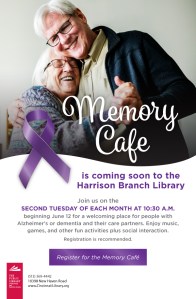
Now, there is some science to suggest that human faces negatively affect conversion rates, particularly if the faces don’t align with the email’s target audience. So, you must choose the photos carefully. For instance, this email promoting our Memory Cafe accurately represents the audience and the activities at the cafe (there is often dancing!). And it worked to drive people to this recurring program. If you make a thoughtful photo choice, you’ll see good results.

Subscribe to this blog and you’ll receive an email every time I post. To do that, click on “Follow” button in the bottom left-hand corner of the page. Connect with me on Twitter, Snapchat, and LinkedIn. I talk about library marketing on all those platforms!

This Advice Will Boost Your Library Marketing Email Click-Thru Rates

A few months ago, I wrote a post about email vanity metrics. Those are the statistics like open rates that make us feel good. But if we’re being honest, they’re relatively meaningless.

The meaningful metrics like click-thru and conversion rates are harder to obtain and must be tied to your library’s overall strategy to provide any meaning. Humans naturally like doing the easy stuff! But it’s the hard metrics that make our work valuable and worthwhile.

So, I want to spend the next two posts sharing some of my strategies for improving your library email click-thru and conversion rates. I learned most of these tips through trial and error and a lot of failures. Remember that failure is okay! It teaches us lessons that lead to success.

This week we’ll focus on improving your click-thru rates. The click-thru rate is the percentage of people who, after opening your email, will click on a link. Here’s what I’ve learned about how to improve that rate.

Promote the best possible content. Don’t send an email to promote every program or service your library carries. Choose your promotions strategically. Put the best content into your emails to make it more likely that your cardholders will click on your links.

For collection-based marketing, make sure the books you choose to promote in your email are buzz-worthy, newer, have a great cover (you’d be surprised how much the cover art affects click-thru rates!). For program promotions, of course you’ll choose events that are fun and interesting. But the programs you promote through email should either in demand by your cardholders or unavailable at any other organization or community group in your area. If you are asked to promote new or existing services like databases, movie streaming platforms, or reading recommendation services, pick the best of parts of those services to promote. For example, I recently did a three-month series of emails promoting the Great Courses section of the Kanopy video platform. Instead of trying to promote the entire Great Courses section, I promoted three specific video series–yoga, family history research, and weight loss. Promoting parts of a service makes it easier to target your message. Speaking of which…

Target your message. Click-thru rates skyrocket when the message you send is targeted to the audience most likely to be interested in it. Sounds like common sense, yes? But I still hear from lots of libraries who are afraid to stop sending emails to all their cardholders. If you have the technology to segment your audience, you should do so. Try to target your email messages to about ten percent or less of your existing email list. Don’t worry if that number seems small. If that audience is getting an email about something they’re interested in. you’ll see results in big click thru rates and engagement.

Here’s my strongest example. A few months ago, my library started a short, monthly eNewsletter targeted specifically at young professionals. This newsletter goes to about 300 people once a month. For my library, an email sent to just 300 people is really tiny… that’s only about .10 percent of our total email list. But it pays off! This email gets huge engagement numbers because those 300 people are really, really interested in the contents of the email. In October, the click-thru rate was 37 percent. I wish all my emails were that successful.

Give yourself time to create and revise your emails. This is the maybe the most important step. Plan your email schedule as far in advance as possible. Set aside time to write the copy. Then, walk away.  Come back later-preferably another day-and look over your work. Revise it. Walk away again. Repeat this process until the copy and structure of your email is as good as it possibly can be. Too many of us (myself included) rush through the creative process.

If you recognize that you are the kind of creative person who feels like he or she can never release anything into the word because it’s never perfect enough, set some boundaries. Give yourself a deadline for when you’ll send the email up the chain for approval and tell your supervisor when to expect it so he or she can hold you accountable. That will help you break the endless cycle of revision!

Write like a Buzzfeed blogger, not like a librarian. Write to entice. Make the text interesting. Use conversational language within your emails. Write short sentences. And don’t write too much! Less copy is better. Make your cardholders curious to find out more and then give them the means to do it by doing this next step, which is…

Embed clickable links in more than one location within the email. My personal rule of thumb is to include a link to the book, program, or service about three times in varying places within the email. This gives your cardholder the chance to act at various points as their eyes or mouse or thumbs roam your message. It also increases the chance that they’ll be able to act, if they so choose, by making it super easy for them.

Next read: How to improve your library email marketing conversion rate!

Finally, would you be so kind as to answer a question for me?

Subscribe to this blog and you’ll receive an email every time I post. To do that, click on the “Follow” button in the bottom left-hand corner of the page.  

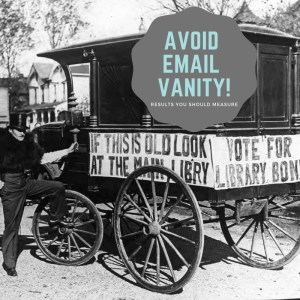
Avoid Email Vanity! Here Are the Results You Should Measure

I love email marketing. It’s one of the most effective tools in the modern library marketer’s toolbox. Emails are a direct way to interact with your cardholders and your community. They are easy to create. You can share stories, collection items, explain new services, and promote events directly with your audience. And library cardholders love getting emails from us. We don’t have to worry about unsubscribe rates the way other industries do.

Many libraries are now emailing their cardholders. And they’re reporting success with those campaigns. I’m so happy! But I’m also worried about something I hear often in conversation with other library marketers. I’m worried that we’re focused on the wrong measure of success–open rates. I’ve attended two events with other library marketers this summer. At both, there were deep and interesting discussions about success in email marketing. But at both events, the conversation about success centered on how to raise open rates.

Now, I have a confession to make. When I started targeted email marketing back in January of 2015, I was obsessed with my email open rates. And so were thousands of marketers in industries across the world. During my first trip to Content Marketing World, I attended several sessions on email marketing and every speaker mentioned open rates as a measure of success.

Open rates do mean something. They are a sign of customer loyalty. A high open rate means that your cardholders are eager to see what you’ve sent them. And that’s good. But it’s kind of like buying a house because it’s got a beautiful exterior. You may sign all the paperwork, open the front door and find all the walls are unfinished! Open rate is a vanity metric. It makes you feel good. But it’s what happens AFTER your cardholders open your email that counts.

I’m not suggesting you ignore open rates. They do give you information you can use to improve your emails. If your open rates are high, and your click-thru rates are low, you can be certain that you are writing compelling email subject lines (Good job, you!). You have a loyal and eager audience. But the content you are sending to your cardholders isn’t what they want. Now you can fix that problem!

Keep tabs on your open rate. But you should focus on two other valuable ways to really measure the success of your emails.

Click-through rates: The higher this number is, the more excited I get. It means that my cardholders opened an email, saw something they liked, and took an action! Most of the time, my library emails direct cardholders to do one of two things: click a link for a specific item in our collection or go to the event calendar where they can register or put an upcoming event on their calendar. Convincing a cardholder to take one of those actions is a huge victory. It also gives me data about what that particular cardholder is interested in. And I can use that information to craft future emails that are also compelling for that cardholder.

Conversion rates: A conversion rate is the most accurate way to measure email effectiveness. It is the percentage of people who take an action after clicking through an email. For example, let’s say 100 people click-through to look at a book I’ve promoted by email. If 50 of those 100 people put the book on hold, my conversion rate is 50 percent. Once I know what my average conversion rate is for a certain type of email, I can set goals to raise that conversion rate. I can  accurately compare my emails to one another.  I might see a high conversion rate for a certain genre of book and look for similar books to market to that cardholder. I might notice a spike in registration rates for a particular kind of program coming from an email and look for similar kinds of programs to market to my cardholders. Conversion rate is the most accurate measurement for determining the likes and dislikes of your cardholders.

For more on tracking the success of your email marketing, you can also read this article. And if you want to learn more about targeted email marketing and get more secrets for library email success, don’t forget the free webinar 

Subscribe to this blog and you’ll receive an email every time I post. To do that, click on “Follow” button in the bottom left-hand corner of the page. Connect with me on Twitter, Snapchat, and LinkedIn. I talk about library marketing on all those platforms!

A WordPress.com Website.

Up ↑