Search

Super Library Marketing: Practical Tips and Ideas for Library Promotion

Tag

cardholder marketing

Timing Is Everything: How To Determine the Perfect Day and Time To Send Library Emails

Photo of a woman on a computer courtesy Public Library of Cincinnati and Hamilton County

The plain fact is: Next to the face-to-face interaction between librarians and community, an email list is your most effective library marketing tactic.

How do your cardholders learn about new services? How do they find their next great read? How do they figure out how to use parts of the collection they didn’t even know existed, like video streaming or eAudiobooks? You can tell them all about your library’s awesome resources by talking with them in their inbox.

If your library isn’t already collecting cardholder email addresses, please start now.

You’ll create emails with an enticing subject line. Your emails will contain great content that your recipients will want to read. And you’ll be tracking metrics so you can build on your successes.

As your finger hovers over the send button, you may find yourself facing another important decision.

When should I send the email?

Does the timing really matter?

The simple answer is yes.

A great headline and great content are only half the battle for your cardholders’ attention. You’re also competing with their personal schedule, other messages sitting in their inbox, and social media.

Your message is more likely to catch their attention if it lands in their inbox at the right time of day.

Your library is fighting with others for urgency. You want your recipient to say to him or herself, “I need to read this and act on it, right now!”

Getting that message in front of your audience at the right moment increases the open, click-through, and conversion rate becauseย it takes advantage of that sense of urgency.

What the data tells us about the best time to send emails

I’ve done a lot of experimenting with time of day emailing over the course of my library marketing career.

There are three times of day to send messages for the most effective results.

  • Really early in the morning (by 5 a.m.)
  • Lunchtime (11 a.m. to 1 p.m.)
  • Before bed (between 8 and 10 p.m.)

The website Optinmonster calls these “key transition times.” And their research confirms what I learned.

A message sent in the early morning will be sitting in your cardholders mailbox when they first wake up. It’ll be among the first things they check. An email sent at lunch means it’ll be sitting there when they check their messages over their tunaย sandwich. An email before bedtime means it’ll be there when they scroll through their emails while they watch a show or before they get ready for bed.

Optinmonster also recommends sending emails at 4 p.m., when people need a little distraction as they get through the last hours of their workday.

As for day of the week, most libraries should avoid sending emails on Mondays and weekends. The agency Wordstream says their data agrees with that assessment.

Your recipients inbox may be flooded with emails on Mondays. And on weekends, many people are running errands and doing other things with their friends and family. They’re less likely to check their inbox on a Saturday or Sunday. Case in point: I’m writing this on a Saturday. It’s 9 a.m. and I just realized I haven’t checked my email yet today!

But what works for me and what works for Optinmonster and Wordstream might not work for you.

It’s crucial that you do your own experimentation.

Try this Four Email Experiment to narrow down the best day and time for your audience.

For this experiment, use the same email for your test. Perhaps you have a weekly newsletter you send to parents, or a bi-weekly email that you send to people who regularly visit a certain library branch. Those emails will work perfectly for this experiment.

Try to keep the subject line for each of the four emails in your experiment similar. You’re testing for the best day and time, so you want to rule out other factors that may make an email more or less likely to be engaging.

Start by sending your email on Tuesday at 4 a.m. The next time you send it, schedule the email for Tuesday at noon. The following send, try Tuesday at 4 p.m. and finally, Tuesday at 8 p.m.

Track your open, click-through, and conversion rates on all these messages to see which is most effective. Work through each day of the week to see which days get you the most traction.

When you find a day and time that works best for your audience, stick to it for about six months. Continue to track your metrics over that six-month period to ensure you’re not seeing a slip in the numbers.

If, after six months, that day and time continues to be effective for you, you don’t need to run the experiment again.

But the habits of your audience may change during that time. Outside forces (like the pandemic) may affect the daily rituals of your recipients. You may need to run the experiment again if you see numbers slipping.


I have a special request.

I’m putting together a conference presentation and I’m looking for some examples.

  • Libraries that have reopened and have had some success drawing people back into the physical branch.
  • Libraries who believe they’ve figured out the hybrid program model.
  • Libraries who are trying to turn their pandemic digital users on to other services now that the library has reopened.

I’ve created a form so you can brag about your library.

I know you are doing amazing work. I want to highlight you on a national stage! Thank you in advance.


Subscribe to this blog and youโ€™ll receive an email every time I post. To do that, click on the โ€œFollowโ€ button in the bottom left-hand corner of the page.

You May Also Want to Read These Posts

Looking for Guaranteed Email Marketing Success at Your Library? Here Are Four Essential Metrics To Track.

Try These Two Fun Tests To Improve the Effectiveness of Your Library Promotional Emails!

Angela’s Latest Book Review

The Southern Book Club’s Guide to Slaying Vampires by Grady Hendrix

Four Instant Ways to Improve the Most Valuable Page on Your Library Website

I find lately that I’m obsessed of late with library web pages. I’ve set aside time every week to look at how different libraries around the world set up their websites. What do library’s feature or highlight their homepage? How robust is their search engine? What’s in their drop-down menu? How is their library staff set up?

That last question usually ends with me scrolling through a library’s “About Us” page. And it’s there that I really get a sense of that organization, how it views itself, and how it views its relationship to its cardholders. This research brought me recently to this conclusion: Most libraries, including mine, need to update their About Us page.

Yourย library’s About Us page can be a gateway to all kinds of traffic to your website. Perhaps your analytics show that you aren’t getting any visits to that section of your website and therefore, you might think you don’t need to mess with it. But if you want to increase your market penetration or if you are considering any campaigns or direct marketing messages to increase the number of cardholders you serve, you’re going to want a kick a** About Us page. Likewise, if your library is in the midst of a levy campaign or waging any kind of battle with your city or county over funding, hours, or locations, your About Us page could help you in that battle. And that page will need to look inspire to win new users and funding.

The concept of a revolutionary change in the way About Us web pages are written and formatted is something that gets a lot of discussionย in marketing circles for major brands. I hear it all the time at Content Marketing World. Many big companies have moved away from a traditional approach–a long and wordy mission statement in non-conversational language that usually includes goals which have no meaning to the customer. They’re writingย in a conversational tone, including specific calls to action for customers, and striving for full transparency. They’re using their About Us page to connect with potential customers, build trust, and communicate what their brand stands for and what the customer can expect from a relationship with that brand. And I think it’s about time for the library world to get on board.

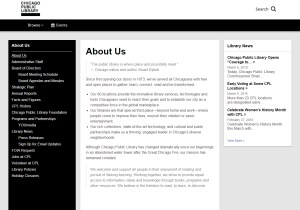
Chicago Public Library’s page is minimalist with clear language and an easy-to-navigate menu.

We should transform ourย About Us pages into something that really has meaning to our community. This is the web page where decisions are made by all of your stakeholders. You want the page to make potential cardholders feel “at home” and community leaders understand what it is that your library does and why it’s vital.

Here are four ways to transform your About Us page from an abstract section of your website into an amazing marketing tool.

Focus on the cardholder. Here’s a thought that many libraries have a hard time grasping: your About Us page isn’t actually about you. It’s about your cardholders. What is it that your library can do for the cardholder? Take yourย mission, vision, and values statement, which is likely written in lofty language, and rewrite it in a conversational tone. Or drop it from the page altogether! I know that’s a controversial standpoint but if your mission, vision, values statement is written with a bureaucratic bent, it won’t have any meaning to anyone outside your organization. Instead, think of your About Us page as a conversation between you and a non-library user. How would you, in normal conversation, tell someone about all the things your organization does? That’s what your About Us page should say. You might also take the opportunity to answer the most frequent questions your library gets from new cardholders.

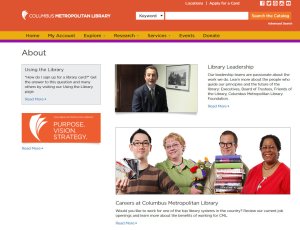
I love how the Columbus Public Library answers the #1 most frequent question right on their About Us page.

Tell your Library’s story. Whether your library has been around for decades or is newly formed, there’s a fantastic story about its birth and its longevity. Tell it on your About Us page, in a paragraph, with inspiring and optimistic language. Keep your bragging to a minimum. If your library has won many awards, you can mention them briefly and put them into the context of how that award translates to better service for your cardholders.

The Perth, Australia library’s About Us page includes all the essentials-how to get a card, sign up for a newsletter, and what is happening today at the library.

Less is more. Many libraries, including mine, have a long list of accomplishments and sub-headers on their About Us page. My library has 19 clickable sub-links!ย  Pare it down. White space is good. Pick the five most important things you’d want people to know and move the rest to another section of your website. Remember,ย your About Us page isn’t really about you… it’s about your cardholder. What are the five things a person would need to know to convince them to get a library card or to give you more money?

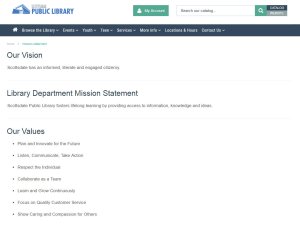
The Scottsdale, Arizona library takes a minimalist approach and it works!

Visuals are key.ย  Great, high-resolution photos that show people using your library and the workers who man the buildings are essential. Photos of faces are scientifically proven to be a more effective communication tool that text. Bold, easy to read fonts and primary colors work best for communicating ideas and drawing the eye to the page. Keep text to a minimum and pare down to five concepts that will tell your story.

I like how the Toledo Public Library’s page is heavy on visuals and includes easy-to-navigate sub links written in plain language.

Subscribe to this blog and youโ€™llย receiveย an emailย every time I post. To do that, click on โ€œFollowโ€ button on the bottom left-hand corner of the page. Connect with me on Twitter and Snapchatโ€“itโ€™s where I talk about library marketing! Iโ€™mย @Webmastergirl.ย Iโ€™m also onย LinkedIn,ย Instagramย andย Pinterest.ย Views in this post are my own and do not represent those of my employer.

Did You Notice? This Website Has a Super New Name!

Ladies and gentleman, this week I made an important decision. I took a leap and decided to rebrand this website.

I have been thinking about you for months (were your ears burning?) I’ve been thinking about your jobs, your passion, your drive, your constraints, your strengths, your weaknesses, your fears, and your hopes. I have gone out of my way to talk to librarians, marketing directors, library directors, and cardholders. I have thought about what I hope to accomplish with these weekly posts and where I want the future of libraries and library marketing to go.

I decided that library marketers are superheroes. And you deserve an appropriate place to go online for advice, tips, fellowship, and encouragement.

And so, the new name of this website is:

SuperLibraryMarketing.com

superlibrarymarketing-com

When you type in this URL, I want you to think about yourself and your work the way I do.

You are super. You are awesome. You are heroes in a cynical, hustle-driven, no-holds-barred world.

This thing you do–library marketing–this is valuable work. And I hope you’ll findย inspiration inย each visit to this website.

I think you are super.

Subscribe to this blog and you’llย receiveย an emailย every time I post. To do that, click on “Follow” button on the bottom left-hand corner of the page. Connect with me on Twitter and Snapchat–it’s where I talk about library marketing! Iโ€™m @Webmastergirl.ย Iโ€™m also on LinkedIn, Slideshare, ย Instagramย and Pinterest.ย Views in this post are my own and do not represent those of my employer.


A WordPress.com Website.

Up ↑