In this episode, we’ll share the latest social media platform headlines and break down what they mean for libraries. That includes a new scheduling feature for Instagram, a new, easy way for your Facebook followers to find your content, and new data on the use of Twitter by Gen Z.
Kudos go to the Invermere Public Library. Watch the video to find out why they were nominated by author Elinor Florence.
Do you have a suggestion for a topic for a future episode? Want to nominate someone for kudos? Let me know in the comments.
And subscribe to this series to get a new video tip for libraries each week.
Thanks for watching!
Subscribe to this blog and you’ll receive an email every time I post. To do that, enter your email address and click on the “Follow” button in the lower left-hand corner of the page.
In this episode, I’ll answer a question from the Pottsboro Area Library. They are replacing an outdoor promotional banner and wanted some advice about the best things to promote in that very specific space.
Kudos go to the Thayer Public Library. Watch the video to find out why they’ve earned this week’s kudos.
Do you have a suggestion for a topic for a future episode? Want to nominate someone for kudos? Let me know in the comments. And subscribe to this series to get a new video tip for libraries each week.
Thanks for watching!
Subscribe to this blog and you’ll receive an email every time I post. To do that, enter your email address and click on the “Follow” button in the lower left-hand corner of the page.
As you well know, libraries have changed, evolved, and adapted in some remarkable ways, particularly in the past 19 months.
But past perception continues to be a real hurdle for libraries. Plenty of people who would call themselves a fan of the library don’t know all the things the modern library does.
We must make sure our community understands who we are right now. And there is a movement to do that through storytelling.
One of those storytellers is Evelyn Shapiro, Promotions Manager at Champaign Public Library in Illinois. As I was preparing to speak at Content Marketing World, I reached out to Evelyn to ask for details about her content marketing campaign, A Library for Life.
Evelyn graciously shared the story of how she compiled this amazing YouTube playlist of patrons who shared the relevance and importance of the Champaign Library’s work. And she’s permitted me to share what she wrote with you.
I hope you will find inspiration in her words. But also, I hope you will see how practical and, frankly, easy it is to gather and tell stories about the ways your library is changing lives.
“Libraries are one of the best ideas humans have ever had.”
Danielle Borasky, Vice-President, NoveList
“Friends and colleagues have told me that connecting with amazing people is one of my superpowers. It’s funny because I can’t help thinking—doesn’t everyone feel like they know truly remarkable people?”
“So, part of the genesis of the project came through the #LibraryLove shared by Karin Markovitch, the parent I interviewed. She had been sharing the most fantastic comments and stories with us in social media posts, tagging the library, also in person with the desk staff. She is just a natural library ambassador, brimming with appreciation.”
“I kept thinking about how I wanted to share her enthusiasm and appreciation of what we offer with the world, but especially with local community members who might not know about or use the library, and with staff because we never tire of hearing that our efforts and expertise result in a positive experience and impact for customers.”
“Our Teen Librarian Kathie Kading was keen on introducing me to Mallory Morris, the educator I interviewed. Mallory’s energy is pure magic, and she can speak with authority about the impact the library has on teachers’ and students’ lives. Interviewing her would mean other people would get to hear her stories, in her words. She was able to put together our group of teen interviewees, drawing from students at her school (across the street from the library) which turned out to be powerful testimony as well.”
“Also, a colleague in the children’s department introduced me to an area artist, Stacey Robinson, who was using the study room next to the children’s desk as his studio, coming in regularly and drawing illustrations for a graphic novel he was creating. She had gotten to know him over time and wanted to be sure I knew his story. (He ended up surprising her by thanking her by name in the acknowledgments of his book!)”
“I connected with him, and it turns out we know people in common in town in the art/design/theatre/dance/music worlds. Again, he was passionate about the library and spoke so well about what a treasure this place is. I wanted to be able to share his story. He also teaches on the University of Illinois campus in the Art + Design department and is a lot of fun to follow on social media.”
“So, momentum had started building and because it was our tenth anniversary in this building, I realized I could propose the project as interviews with ten community members. It was our first video project and not part of my original budget that year, but it was the right timing to ask.”
“Once approved, I needed to build my list of who I would bring on camera. I knew about some of the range I wanted and topics I wanted to highlight including a parent and teen, a Board member, and someone who could speak about the Branch. Our director was able to recommend three of those featured—Candace, Thom, and Rajiv.”
“While working on developing our strategic plan, we invited a group of community members (around 50) to a retreat here to talk about the library and community needs. In one session I attended, Charlisa spoke up about the Douglass Branch, what libraries meant to her as a child, and how children access literacy in our community. I was so compelled by what she had to say. Charlisa has become a very active participant on our social streams as well.”
“Around this time, I’d met a new-to-the-community social media manager named Huan who worked remotely with an international org in communications and marketing. It turned out she spent a lot of time in our new walk-in co-working space for area entrepreneurs. She used it as her office and was getting involved with supporting the library in a few different ways—through a United Way young professionals project and through serving on the Library Friends Board. We met by chance in the FriendShop Bookstore. At the time, she was volunteering in the shop, and we had a chance to chat. She had an international perspective, having lived, and worked in co-working spaces in London. She could compare what we offered here with co-working amenities in a Big City.”
“I already knew Amanda personally and at this time she was heading up the local Project READ initiative and both our locations were public sites where their group offered tutoring. I love talking with her about making good things happen in our community. She had held the role of liaison for families as part of a school program our daughter participated in. I had seen how fluidly she moved in different worlds and languages and what an effective advocate she is. She turned out to be an ideal example of how the library partners with community groups and how our services help immigrants.”
“I learned to bring a stash of tissues with me each time because someone always started crying. The stories were so heartful. I’ve also thought about additional ways we could share these stories, including in print somehow. I haven’t even transcribed them yet or pulled quotes from them. There may be obvious ways to expand and reuse their stories. The key seems to be selecting people who could talk glowingly about the library, without a lot of prompting from me.”
“As communicators, we focus a lot on our messages, as we need to. However, I see our role as much as a listener—how else can we share great comments and stories?”
Evelyn Shapiro is Promotions Manager at Champaign Public Library in Illinois. Before that, she worked in graphic design and has more than 75 published books and CDs to her credit, along with numerous awards from Parents’ Choice, University College and Designers Association, and the Chicago Book Clinic.
Is your library telling stories about your work and your patrons? I’d love to see and share those stories! Send me an email with more information.
Subscribe to this blog and you’ll receive an email every time I post. To do that, enter your email address and click on the “Follow” button in the lower left-hand corner of the page.
In this episode, in light of last week’s Facebook and Instagram outage, we’ll look at the term “rented land.” And I’ll give you some alternatives to putting library marketing content on “land” that your library owns. 🙂
Kudos go to Sayville Public Library. Watch the video to see why they’re being highlighted.
Do you have a suggestion for a topic for a future episode? Want to nominate someone for kudos? Let me know in the comments.
And subscribe to this series to get a new video tip for libraries each week.
Last week, I felt like a groundhog venturing out of its hole after a long winter of hibernation. But groundhogs only hibernate for five months, and I’ve been in lockdown for 19 months.
I went to Content Marketing World, a global marketing conference run by the Content Marketing Institute. You’ve heard me talk about it (a lot!) here on the blog before. It’s the conference where I get the most inspiration. I come away with pages and pages of practical tips. And this year was no exception.
I listened to the top experts talk about the ways the pandemic has changed consumer behavior in email, social media, and engagement with brands. I will be bringing you more of those insights, and what they mean for libraries, in the coming weeks.
But I’m eager to share the top seven takeaways with you right now. These big ideas will impact the promotions you do for your library in the coming year.
Jill says you may hear from many experts that you need to be measuring certain key data points. And there are many things you can learn from data.
But, your library should focus on tracking and measuring the data points that will show you if you are meeting your strategic goals. And Jill gives you permission to ignore the rest.
Lesson #2: Email is a community builder.
Dennis Shiao, Founder of Attention Retention LLC, and Ashley Guttuso, Director of Marketing for Simple Focus Software.
According to Ashley and Dennis, the purpose of a newsletter is not to promote your events and services. It is to build trust between your library and your community.
I’ll be translating more of their tips in the coming weeks. But for now, here’s a challenge from Ashley and Dennis: Create a newsletter that’s habit-forming, one that your audience gets excited to read whenever you send it.
The first step to doing that is to make your email newsletters opt-in. Ashley and Dennis have data to prove opt-in newsletters are more effective because readers are intentionally choosing to receive your information.
Lesson #3: We have to stop forcing our content on people. Instead, we must work to be invited into their lives.
Jay is an amazing author and speaker, and his keynote gave me a lot to think about.
He used the analogy of a castle and a moat to explain why people might be ignoring your promotions. Here’s how it works.
Our audience lives in a castle. Marketers are always trying to take over the castle by putting out lots and lots of promotions.
But the audience has built a moat around their castle to protect themselves from the onslaught of content. The moat is when your community unsubscribes or deletes your emails, or bounces out of your virtual programs, videos, or website after only a few seconds.
In history, armies tried to get around a moat by building a tall ladder and forcing their way into the castle. Anyone who has watched any historical drama knows this never works. The ladder gets pushed off the castle, and the soldiers never make it inside.
Instead, Jay challenged the audience to “get moativated” and get invited inside the castle by being radically relevant. He pointed out that the word “custom” is inside the word “customer.” People want content that is custom-tailored to them!
I’ll dive deeper into this idea and what it means for libraries in this Wednesday’s episode of The Library Marketing Show.
Lesson #4: Make sure your library is active on social media if you plan to do a PR push.
Michelle says journalists look at your library’s social media, especially Twitter, when they consider covering your library. So, if you are planning to do a major press push, you want to be active on social media before you send out your press release.
Many libraries have scaled down their posts on certain social media platforms because of a lack of engagement. I still believe that’s a good strategy, especially if your library lacks time and resources.
But, if you are planning something big and you’d like media coverage, Michelle says it’s in your library’s best interest to start posting on those platforms again a few weeks before you contact the media. It will increase your chances of getting covered.
Lesson #5: You can’t be remarkable on more than one social media channel at a time.
You may think this piece of advice runs contradictory to lesson #4. But when your library posts on social media with information about an upcoming event or service ahead of a PR push, you’ll be fulfilling a relevant but short-term objective.
Your library’s long-term objective with social media is to build audience engagement and drive people back to your website or catalog. To do that, you must be truly memorable with your social media posts. And to be truly memorable, you need to focus your efforts on one channel, preferably the place where most of your community is engaging.
Start thinking about which social media channel you would use for your library posts if you could only pick one channel. Then, create content that is relevant and remarkable in that channel.
Andrew said the pandemic was a once-in-a-generation marketing experiment that answered the question: What happens when every business in the world is faced with the same disruptive forces?
Then he told the amazing story of a sustainable farm that made an incredible pivot during the first days of the pandemic. They ended up making a huge profit, more than they had projected to make before the pandemic.
And all I could think about was the work of libraries in the pandemic. The services you created and unveiled to the public in a matter of days, including curbside pickup, book bundles, phone reference, take and make craft kits, virtual author events, and so much more, were born out of constraints.
YOU proved Andrew’s point.
I want you to recognize the awesomeness of what you did when you were constrained. Now, think about how constraints on your time and budget may lead to new creative ideas in the future.
Lesson #7: Purpose-driven marketing makes people follow, engage, and get behind your brand.
Jacquie Chakirelis, Director of Digital Strategy, Quest Digital Great Lakes Publishing
Jacquie’s talk made me realize that libraries need to highlight our doing purpose-driven work. She points out that consumers know that they have a voice. And that they are using that voice more frequently to make statements in their decisions to engage with brands who have a purpose.
Our mission statement differentiates libraries from our for-profit competitors. This is the core reason why library patrons feel loyal to your library.
Jacquie encourages you to find stories of how your library has taken a stand on issues in your community. Those stories will activate your community to become loyal fans of your library.
Subscribe to this blog and you’ll receive an email every time I post. To do that, enter your email address and click on the “Follow” button in the lower left-hand corner of the page.
In this episode, I’ve got three big updates for libraries that will affect your ability to post to social media.
Kudos go to the University of North Carolina Libraries for their free racial equity challenge syllabus.
Do you have a suggestion for a topic for a future episode? Want to nominate someone for kudos? Let me know in the comments. And subscribe to this series to get a new video tip for libraries each week.
Subscribe to this blog and you’ll receive an email every time I post. To do that, enter your email address and click on the “Follow” button in the lower left-hand corner of the page.
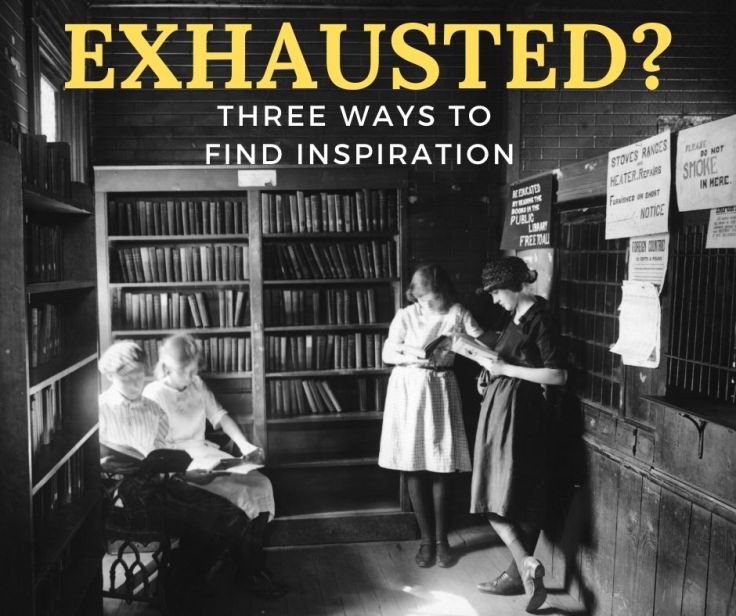
More than once, I’ve sat down at my computer to turn out a clever, groundbreaking, truly engaging library promotion… and ended up staring at a blank wall.
There are days, or weeks, or months (or let’s be honest, years… like 2020) when work in a library will run you ragged. As much as you’d like to create the most inspiring and noteworthy marketing piece for your library, you are just Too. Dang. Tired.
When I worked in a library, the exhaustion usually hit me after summer reading ended. With fall and winter looming, I felt my inspiration seeping away as quickly as the leaves fell from the trees.
If this happens to you, there are some things you can do to get your creativity back. If you need a little inspiration, look no further than your community.
The easiest and most effective library promotions are the ones that solve your cardholders’ big problems. If you have no idea what your community wants and needs from your library, here are three easy ways to figure that out and find the inspiration for your next effective promotion!
“Stalk” your library users.
There are three places you can go to learn more about your community.
Inside the building
If your library is currently open, take a walk around the library or visit the branches. This is your spy moment! Take off your badge and pretend to browse. Or sit at a table in a corner with your laptop.
Observe the way the cardholders browse the shelves, interact with staff, work the self-checkout machines, and use the public computers. Answer these questions.
Do they look for a map?
Are they drawn to a particular book display?
Do they linger over the new books, or do they dash in for their holds and dash out?
Do you notice all customers follow a particular path through your branch or are drawn to a particular place within the branch?
If your library has a drive-thru, is it busy? What kinds of customers use the drive-thru?
Watch how your community behaves inside the building to get an idea of what customers love and what problems they encounter during their interactions with your library. Both of those discoveries can be the basis for your next library promotion.
On your website
Take a close look at your library website’s analytics to find out who is visiting and what they’re doing.
Google Analytics is the best place to get a sense of how your community is interacting with your library’s website. If you don’t have access to your library’s Google Analytics, make an appointment to meet with whoever does have access. Talk with that person about their work. Then, share your goals for the library promotions you create. It’s your chance to form a collaboration that can lead to a more effective library website.
When you get a chance to see the data, ask these five questions:
Which landing pages are the most popular?
Which pages get zero traffic?
Has website traffic to certain pages changed over time or remained relatively the same?
How long did people stay on our website?
How does the bounce rate compare on your landing pages?
If you notice that people are interested in a certain section of your website, you may want to create promotions that support that. Likewise, if you realize that cardholders are missing some key places on your website, you may want to create promotions to entice people to visit those pages!
And if you notice that people are visiting a certain webpage but bouncing right off, you may want to think about improving the customer experience on that page.
On social media
Social listening is an insightful way to get promotional inspiration. It’s kind of like eavesdropping. It’s the purposeful search for conversations about your library on social media platforms.
Social listening will give you a clearer picture of how people feel about your library. You may be able to spot problems before they happen. And you will certainly spot promotional opportunities which you can amplify to connect to more users.
For full details about how to actively use social listening for promotional inspiration, read this post.
Check your statistics.
Your library likely makes circulation and programming stats available on your internal website. These pieces of data can inspire you to find ways to help make their interaction with the library more worthwhile.
If you make it a regular part of your job to check your library statistics, you will find promotional inspiration. You’ll notice when there is a dip in the use of a service. When it happens, you’ll want to consider shifting some of your promotional focus to re-educate your community about that service.
If you work for a system with more than one location, you may notice trends in visits and circulation between the locations. Library staff at branches with lower visits and circulation can reach out to those with higher visits and circulation to see if you can steal some of their successful promotional ideas!
Talk to your coworkers.
You might find inspiration simply by “interviewing” your fellow staffers. Some key questions you can ask include:
You might also learn that there is a customer problem that you can help to solve with your promotions. Answering a commonly asked cardholder question is an easy and effective way to promote your library.
Subscribe to this blog and you’ll receive an email every time I post. To do that, enter your email address and click on the “Follow” button in the lower left-hand corner of the page.
In this episode, we’ll talk through some tips for coming up with a name for your library program or event that will help you with promotion. Yes, this has marketing and promotional benefits! I’ll explain.
Kudos go to the Chesapeake Public Library for telling patron stories on Facebook for Library Card Signup Month.
Do you have a suggestion for a topic for a future episode? Want to nominate someone for kudos? Let me know in the comments.
And subscribe to this series to get a new video tip for libraries each week. Thanks for watching!
Subscribe to this blog and you’ll receive an email every time I post. To do that, enter your email address and click on the “Follow” button in the lower left-hand corner of the page.
In 1960, Kelly Johnson was the lead engineer at a division of Lockheed that made spy plans.
One day, he handed a team of design engineers a handful of tools. Then he told the engineers that they must design a jet aircraft that would be repairable by the average mechanic in the field under combat conditions using only those tools.
At that moment, the popular design phrase “Keep it Simple, Stupid” or KISS was born. It describes the idea that most systems will work better if they are designed simply.
I first heard this phrase in journalism school. Reporters, marketers, ad agents, and public relations employees are all taught the power of simplified language in copy.
Simplified copy is easy to read and understand. It sounds authentic. Conversational copy subconsciously signals to your audience that you are a person, and people like communicating with other people.
Librarians are intelligent and sophisticated people. They have a deep understanding and appreciation of complex concepts. They’re driven by accuracy and information. It’s challenging to write clearly when you’re an expert in your field!
But our cardholders may have a difficult time understanding library brochures, posters, blogs, and websites with convoluted and confusing language. They may be tune out if the wording of your promotions isn’t conversational.
Your job as a library marketer is to translate complex thoughts and concepts into a concise and clear language your audience can understand and appreciate. You must present information in a way that the cardholder can understand.
It’s easier said than done, but here is some guidance you can put into practice any time you’re asked to write a piece of library marketing.
Identify your target audience and the action you want them to take.
Before you even write the first draft of any promotion, pinpoint your audience as precisely as possible.
Are you writing for teens ages 13-15? Are you writing for women, ages 25-54, who love to read cozy mysteries? Are you aiming your message at parents of preschoolers who need help finding books to read to their children?
When you’ve settled on your target audience, write a sentence about them at the top of the page. Be as descriptive as possible.
Underneath that, write a sentence that describes the point of your marketing material. Are you trying to persuade someone to try a new service? Do you want to increase participation in a preschool storytime? Are you trying to get teens to enter an art contest?
Once you know precisely who your audience is and what you want them to do after they’re read your marketing material, you’ll have an easier job of writing clearly.
Define unfamiliar or difficult words, titles, or services.
Go through the draft of your material and highlight words or terms that may confuse your audience. Then, find a better way to say or explain those words.
Never take it for granted that your reader has been a lifelong user or follower of the library. Words used by librarians to describe services, programs, catalogs, and databases, which may seem common and every day to you and your staff, may not be so to your reader.
Shorten your sentences and paragraphs.
You may have noticed that, about 18 months ago, I started writing shorter sentences and paragraphs here on the blog. Views rose by 118 percent!
That’s because shorter sentences and paragraphs make it easier for your reader to understand and absorb what you are saying. Long paragraphs look thick and off-putting. Multiple studies show readers will skip lengthy paragraphs. And the Poynter Institute’s Eyetrack Study shows people are more likely to read an entire webpage when the paragraphs are short.
There are two rules you can remember to help you get into the habit of shortening sentences and paragraphs.
Ziomek’s 1-2-3-4-5 rule: Created by Jon Ziomek, a professor at the Medill School of Journalism. The rule says each paragraph must contain: 1 idea, expressed in 2 to 3 short sentences, taking 4 to 5 lines.
Nityesh Agarwal‘s 80-20 rule: You can convey 80 percent of the information in any piece of writing using 20 percent of the words.
Get into the habit of hitting your return key more often. You can also break your writing up using bullet points or lists.
Use online writing tools.
There are lots of free tools that can help you craft sentences that are clear and concise, even when the subject matter is not! They can help you figure out a headline that will draw readers in. They can help you discover just the right word to make your meaning clear.
I often ask my family members to read my writing. If they find anything to be confusing or convoluted, I know I need to change it.
Bonus Tip: Read or listen to the book Everybody Writes by Ann Handley. It’s life-changing. Check your library collection first. If you have Overdrive, you’ll have the audiobook version. You MUST read this. It will make you a better writer.
Do you have tips for writing more clearly or examples where you have taken a complex library concept and simplified it for an audience? Share your experience or questions in the comments.
Subscribe to this blog and you’ll receive an email every time I post. To do that, enter your email address and click on the “Follow” button in the lower left-hand corner of the page.