Search

Super Library Marketing: Practical Tips and Ideas for Library Promotion

Tag

library marketing

The Virtual Library Conference is Over and Now the Work Begins! Here’s What to do Once You’ve Closed Your Laptop

Photo courtesy Public Library of Cincinnati and Hamilton County

This post is part two in my series on making the most of your virtual conference experience in 2020. If you haven’t already, I’d love for you to read part one here.

Once you close your laptop, the second part of your conference experience begins. It’s time to reflect on what you’ve learned, share with your co-workers and, most importantly, figure out how to put these new ideas into practice at your library.

Here’s a framework you can follow to maximize the value of your virtual conference experience with three important post-conference steps.

Reflect on what you’ve learned

After a virtual conference, you might be tempted to switch your brain off the minute you close your computer. But try to resist the urge to unplug right away. Instead, commit to capturing the insights you’ve learned while they are fresh in your mind.

I usually spend a half hour to an hour at the end of a conference day organizing my thoughts. At an in-person conference, I would return to my hotel, grab an adult beverage from the bar, and head to my room to organize my notes. At home, I schedule “buffer time” into my work calendar to complete this step. Reviewing your notes in detail while they are still fresh in your mind will help you retain the information.

First, copy important names, insights, and ideas into a collaboration tool like Evernote, Trello, a Google doc, or your library’s shared documents drive. Fill in details you may have scribbled down in haste. If you took screenshots, organize them so you can easily identify the presenter and session later.

If the virtual conference organizers are making videos available after the conference ends, go back to the sessions you watched to copy and paste the URLs into your notes. That way, if you want to re-watch them again, you’ll save yourself the time hunting for the right video!

Next, formalize any connections you made with other attendees. Look them up on Twitter and LinkedIn and follow them or send them a connection invite. Include a personalized message so they understand why you are reaching out.

If there were speakers or sessions that really inspired you, send a thank you email to the presenter. As a speaker, I can tell you I really appreciate hearing from attendees, especially when a session inspires them.

Finally, be sure to fill out any post-conference survey. Conference organizers and speakers truly appreciate the feedback.

Share what you’ve learned

At the very least, you’ll want to share what you’ve learned with your boss and your team. But more than likely, your conference learnings contain lessons that everyone at your library could benefit from. So, turn your notes into a short presentation and invite co-workers to watch. My husband does this as a “lunch and learn” for his co-workers.

If you aren’t comfortable doing a “live” presentation, you can record yourself on Zoom, Teams, or WebEx, and share the video (like you do with virtual story times!). Loom is also a great option for recording yourself.

During your presentation, share the top-line things you learned at each session you attended. Tie your findings to your library’s overall strategy. This will help prove the value of your conference attendance to your supervisors. It will also lay the groundwork for when you put your new ideas into practice.

After your presentation, make sure your co-workers have access to the notes you took at the conference using the collaboration tool in step one. Include links to any slideshows, handouts, or screenshots you have.

Put big ideas to work

Here’s where you find the true nuggets that will help your library. I suggest you look through your notes again and organize a new list of action items in categories that correspond with your work.

Tools and technology: List any digital trends and industry advances that your library should act on.

For instance, at the Library Advocacy and Funding Conference, I learned about new software platforms which allow libraries to gather and use data related to their community. I also learned new information about how to increase organic reach on Facebook and Instagram.

If you learn about a new social media platform or about a product that helps you to do a better job at promoting your library, list those in this section. Include the reasons why an upgrade or a change in tools and technology will help your library. Research cost and timetables for implementation.

Content inspiration: List any new creative concepts or topics you think your cardholders would respond to. If you attended a session from someone who shared practical ideas for what to put in your library’s newsletters or how to design print pieces, list those ideas. Then, pull out your editorial calendar and start scheduling!

Productivity and project management: List anything you learned that will help you and your library co-workers to do your job more efficiently.

Maybe you had a Twitter exchange with a fellow attendee whose library has an approval process you wish to imitate. Or maybe you attended a demonstration of a platform like Trello or Asana.

If you learn about new ways to address existing challenges, optimize workflow, or streamline your promotional methods, put those on your list. Your co-workers and supervisors will appreciate any new insight on how to improve efficiency at your library.

Have you changed the way you work at your library because of something you learned at a conference? I’d love to hear about it. Let me know in the comments.

You might also find these posts helpful

Six Tips to Make the Most of Your Online Experience During Virtual Conference Season

Three Transformative Tips to Improve Focus and Re-Energize You When Working in the Library Doesn’t Feel Fun Anymore

Latest Book Reviews

The Escape Artist by Helen Fremont

Devolution by Max Brooks

Find more 60-second Book Reviews here.

Subscribe to this blog and you’ll receive an email every time I post. To do that, click on the “Follow” button in the bottom left-hand corner of the page. Connect with me on YouTube, Twitter, Instagram, and LinkedIn. 
Five BIG Reasons Why Your Library Needs a Targeted Social Media Strategy

Watch Now

The Library Marketing Show, Episode 63

In this episode, Angela answers a viewer request. “I need help justifying to my people why our organization should have a targeted strategy rather than just ‘will you post this, please?'”

She also shares Kudos with the blog, Ontarian Librarian.

Do you have a suggestion for a topic for a future episode? Want to nominate someone for kudos? Let me know in the comments.

And subscribe to this series to get a new video tip for libraries each week! Thanks for watching.

Experts Reveal the Truth About What Your Library Needs to Do Now to Build Support for the Future

Photo Courtesy Public Library of Cincinnati and Hamilton County

For three days this week, more than a thousand library employees took part in the Library Advocacy and Funding Conference, sponsored by EveryLibrary. The organization helps builds support for libraries across the United States. This is the first conference of its kind, designed exclusively to help libraries learn to advocate on the ballot, in the donor arena, and in the hearts of their community.

The conference featured presenters from outside the world of libraries, so attendees got a chance to hear from successful, experienced experts talking about what works in politics and fundraising.

By Wednesday evening, my head was full of new information. Once I finished organizing my notes, I realized that the experts at the conference shared five big ideas specific to library marketing and advocacy. Here is what I learned.

Libraries must target ALL messages

Ashlee Sang, content strategist and copywriter for Ashlee Sang Consulting, said marketing fails when we try to send the same message to all cardholders. You must create marketing that talks to one person, on a level that speaks to their truth, their needs, and their problems.

Sang encouraged libraries to create personas to help with targeting. You can use data like checkouts and holds, as well as in-person interactions at the checkout desk, in the comment section of your social media, and even email, to help you create those personas.

Then, when you create marketing messages, think about targeting those personas. This will help you avoid designing around your own personal biases. Instead, it puts the focus on the people you are trying to serve.

Key quote: “If you create a message for everyone, you are creating a message for no one.”

Your library brand is more than a logo or a color scheme

Anjelica Triola, marketing director for Wethos, wants libraries to understand that your brand is not the colors and fonts that you use. It is the feeling that people get when they think about your library but are not actually in your library or around a librarian. That feeling will lead a cardholder to be an evangelist for the library.

Kimberly Gordon, brand strategist and marketing consultant, added that people crave a library with clear values and a commitment to being good corporate citizens. If your library communicates those two points, you’ll stand out in a positive way and showcase your value.

Gordon pointed out that we are living in a heightened state of emotion (I’m writing this pieces a few hours after the death of United States Supreme Court Justice Ruth Bader Ginsburg so that note really resonates with me!). She wanted libraries to remember that your brand represents a promise to your community.

Key quote:Marketing your brand improves likeability and sets you apart from your competitors. It makes you stand out in a positive way.”–Kimberly Gordon

Librarians connect with their community by finding common ground

Jasmine Worles, trainer for the National Democratic Training Committee, emphasized that the issues that mean the most to library staffers, both on the job and personally, are not unique to you. Other people care about the same issues!

Worles encouraged librarians to talk about why they love the library and why they are passionate about their work. Your “story of self” is the starting place of a connection. It builds genuine relationships and makes you trustworthy and credible.

As a library staffer, you may think that the library is bigger than you or that it’s not about you. But it IS about you.

Key quote: “Tell your story of self all throughout the campaign. It’s the most magical and effective piece of any campaign.” 

Diversity should be a part of your library strategy

Kim Crowder runs a consulting firm dedicated to diversity, equity, and inclusion in the workplace and in marketing. She’s been a guest on this blog before.

Crowder pointed out that diversity is looking at the ways people are different, then celebrating and acknowledging that. It’s not monolithic. And libraries must ask themselves, “How can inclusiveness be centralized in our message on a regular basis?”

She believes libraries must create a strategy about their commitment to inclusiveness and make it available to anyone to see. Crowder asked attendees to be open to feedback, to be willing to be uncomfortable, and to talk about diversity and inclusivity internally, as well as externally.

Key quote: “We all have bias, but we don’t always recognize it. If you fumble, admit your mistake, sincerely apologize, and be authentic in your efforts.”

Libraries should mix content formats for better engagement on Facebook and Instagram

Two representatives from Facebook and Instagram held a joint session with lots of tips for library social media engagement.

They encouraged libraries to share frequently and consistently, especially during important times like the pandemic. They also said the latest research shows a mix of format types (video, carousel images, static images, gifs, etc.) can help boost your page engagement. Avoid one kind of content all the time.

Finally, they encouraged libraries to livestream more often on both platforms, engage more frequently with other pages and profiles, and use Stories on both Facebook and Instagram to share content.

Key quote: “Highlight important announcements, share frequently and consistently, post more frequently during important times, and be informative and timely.”

Did you attend LAFCON? What did you learn? Share your takeaways in the comments.

You may also find these posts helpful

Six Tips to Make the Most of Your Online Experience During Virtual Conference Season

Why Libraries Lost HUGE Parts of Their Patron Base During the Pandemic and How to Fix It

Want to Make the World a Better Place? Tools and Tips for Libraries to Combat Racial Inequity in Their Communities

Latest Book Reviews

The Truths We Told by Kamala Harris

Craigslist Confessionals by Helena Dea Bala

Find more 60-second Book Reviews here.

Subscribe to this blog and you’ll receive an email every time I post. To do that, click on the “Follow” button in the bottom left-hand corner of the page. Connect with me on YouTube, Twitter, Instagram, and LinkedIn. 

Are My Library Email Metrics Good…. or Bad?! Here Are the Latest Stats to Help You Figure It Out.

Watch Now

The Library Marketing Show, Episode 62

In this episode, Angela shares the latest metrics on open and click-thru rates for library email marketing and helps you figure out what metrics are good!

She also shares Kudos with the Madison Public Library for their back-to-school teacher button project.

Check out the virtual conferences I’ll be attending. Let’s connect!

What did you think of this episode? Are you struggling with marketing and promotion right now? Do you have a suggestion for a topic for a future episode? Want to nominate someone for kudos? Let me know in the comments. And subscribe to this series to get a new video tip for libraries each week!

Thanks for watching.

The BIG Debate: Should We Use the Word “Customer” to Describe Our Library Users?

Should we use the word "customer" to describe our library users?

Watch Now!

The Library Marketing Show, Episode 60.

Does it matter what we call people who use the library?

A blog post by Ned Potter that prompted this episode. Watch the video to see my response and get a link to Potter’s post.

Also this week,  find out who was nominated by another library in their state for Kudos!!

What did you think of this episode? Are you struggling with marketing and promotion right now? Do you have a suggestion for a topic for a future episode? Want to nominate someone for kudos? Let me know in the comments. And subscribe to this series to get a new video tip for libraries each week!

Thanks for watching.

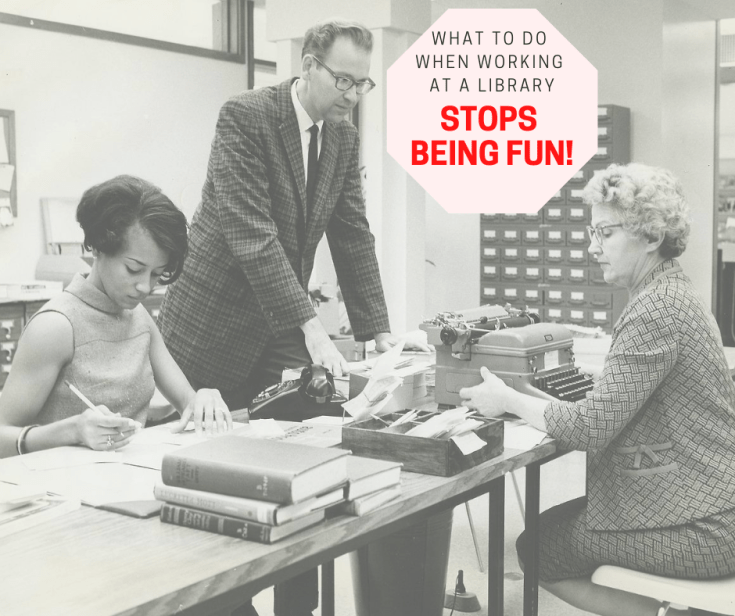
Three Transformative Tips to Improve Focus and Re-Energize You When Working in the Library Doesn’t Feel Fun Anymore

Blue Ash - Sycamore Branch staff: Mrs. Sonia Bibbs (left) Library Assistant, Douglas Robinson, Corinne Hand (right) Children’s Librarian. Courtesy Public Library of Cincinnati and Hamilton County.

I don’t know about you, but I’m exhausted.

The pandemic is exhausting.

Worrying about the health and safety of family and coworkers is exhausting.

Natural disasters, a nation coming to terms with centuries of racial disparity, and a Presidential campaign here in the United States are exhausting.

And yet the library world continues to provide service during this crazy year. Your library probably still did a summer reading program. You’re providing virtual programs. You support students and teachers as they navigate distance learning. You’re promoting books and offering reading recommendations.

The world throws hurdles at you, and your library responds.

Is it any wonder if you feel like you need a nap and a hot bath nearly every day?

Library marketers are expected to be energetic and enthusiastic. More than any other library staffer, you’re expected to have exciting and innovative ideas to promote all these major developments and service changes as well as the smaller services that everyday cardholders rely on.

And you’re expected to produce results, driving people to watch virtual programs, use your curbside pickup service, and follow all the rules for social distancing.

It’s only natural to feel burned out by the speed at which everything happens at your library. And when you get stressed, work stops being fun. The quality of your work suffers.

But your library and your community depend on you. So here are some tips to help you manage your work and avoid burnout.

Prioritize, stay completely focused on your goals, and say “no” to EVERYTHING else.  Humans are all weirdly programmed to say yes, to take on more, to squeeze as much out of life as we possibly can.

Busyness feels wonderful. We’re doing something! Stuff is happening! Progress is being made!

But without space for creative thought, mistakes are going to happen. Your work won’t be what it could or should be. And that means your marketing will be less effective.

So, just like you weed your collection, you need to weed your promotions. This is especially true now, when your audience is suffering from content burnout because of the pandemic.

In my first year at a library, I said “yes” to everything. And nothing I did was any good.

When I realized I was doing too much, I set some ground rules for the goals I wanted my staff to focus on. I aligned these goals with my library’s strategic goals. They were:

  • A promotional tactic (like emails) had to produce a ten percent bump in circulation, program attendance, or usage. If it didn’t, we stopped doing it.
  • A service had to be easy for the cardholder to use to get promotion. Databases are a good example. If a cardholder was required to sign into the library website with their card to get to the database landing page, and then had to create a separate account tied to their email to use the database, we didn’t promote that database.
  • We only did full marketing campaigns for paid presenters. Free presentations got a poster or flyer and a social media mention.
  • All promotional requests had to tie directly to the library’s overall strategy. If the branch or library staffer requesting promotion couldn’t demonstrate how the program or service moved the library’s overall goals forward, we didn’t promote it.

I know that sounds harsh. And some of those rules might not work for a smaller library or a different set of library leaders. That’s okay. Set your boundaries to work within your own system.

Weeding your marketing content will allow you to do a better job and be more creative with the promotions you have left. Evaluate your promotions twice a year to keep your marketing lean and reduce the stress on yourself and your co-workers.

The word “no”, while it may be very small, is liberating. It’s good for you and for your marketing strategy.

Define your workflow and make it the law of your marketing landscape. A defined workflow sounds like the opposite of a creative endeavor. But it ensures that a quality product is created in a timely and efficient manner. It creates space for you to think. And that’s incredibly important for anyone working in a library, especially right now.

There are two options: outward-facing workflow and team workflow. Choose the one that works best for you and your library.

Outward facing workflow means that you approach each job given to you by a senior leader or another library department or partner in the same way.

  • All marketing requests go through one person on your team, who acts as project manager.
  • That person is responsible for looking at the request and determining if it fits into the library’s overall strategic goals.
  • That person sets clear expectations and goals for each project and communicates a plan of action based on realistic timelines and due dates.

This is not to say that your team has no say in the work you do. But the ultimate decision rests with the project manager.

Team workflow is more collaborative.

  • All marketing requests are considered by the team.
  • The team looks at each request and decides what tactics will work, and whether they have the time to complete those tactics.
  • The team sets the goals and determines who will communicate due dates and expectations.

It may take some time to get a smooth workflow in place. Be patient with yourself and with others. Keep reinforcing your expectations. Eventually, your coworkers and supervisors will understand and appreciate your workflow, especially when they start to see results.

Be generous with positive reinforcement. Positive reinforcement is one of the easiest and quickest ways to improve happiness and effectiveness on the job. It bolsters self-confidence and inspires people to do their best work.

If you see a co-worker doing something well, say so, even if the job is small. A kind word can go a long way to boosting morale and creating energy. Don’t just say, “Well done.” Write out a note or an email praising specific actions or portions of work.

And, if you have a staff, give your employees unexpected breaks. When I was a library manager, I took my staff to lunch off-site. We had field trips to libraries outside of our system. Sometimes we had “reading time” where I would read them one chapter a day from a book we all chose together.

It might sound silly, but these little activities are energizing. They create bonds between co-workers. Staff return to work after these little breaks with enthusiasm for their work. And enthusiastic people do a better job… on the job.

You might also want to read these

Four Important Project Management Lessons You’ll Need to Survive the Next Year of Library Work

COVID-19 is STRESSFUL for Library Workers. Here Are Tips to Help You Feel Better.

Latest Book Reviews

The Bell Jar by Sylvia Plath

All the Broken People by Leah Konen

Find more 60-second Book Reviews here.

Subscribe to this blog and you’ll receive an email every time I post. To do that, click on the “Follow” button in the bottom left-hand corner of the page. Connect with me on YouTube, Twitter, Instagram, and LinkedIn. 


Why Your Library Should Have One Social Media Account to RULE THEM ALL!

Watch Now

The  Library Marketing Show, Episode 59

Angela answers a question from a viewer, who wishes to remain anonymous, about whether their library should have one social media account per platform for the entire library system.

It’s a good question, and one that Angela gets all the time. Watch the video to find out what she advises.

Kudos this week to the Public Library of Cincinnati and Hamilton County for unveiling a new website and branding in the midst of a pandemic!  

What did you think of this episode? Are you struggling with marketing and promotion right now? Do you have a suggestion for a topic for a future episode? Want to nominate someone for kudos? Let me know in the comments. And subscribe to this series to get a new video tip for libraries each week! Thanks for watching.

What to Do When Someone Tells Your Library to CALM DOWN on Social Media!

Watch Now

The  Library Marketing Show, Episode 58

Angela is back in her outdoor work space. She answers a question from a viewer who said: “We have gotten a lot of criticism recently for posting too much on social media. We’ve even had people reach out to us and tell us to ‘calm down!’ How do I approach this? I have decreased the amount of posting (1-2/day on FB, 2-3/ week on Insta and Twitter), but I have noticed a plateau in our engagement on social media. Help!!!”

Angela talks about what to do!  

Kudos this week to Mandel Public Library for an amazing post, which you can share if you give them credit.  

What did you think of this episode? Are you struggling with marketing and promotion right now? Do you have a suggestion for a topic for a future episode? Want to nominate someone for kudos? Let me know in the comments. And subscribe to this series to get a new video tip for libraries each week!

Thanks for watching.

I Took a Vacation… and Realized Two Big Things About Libraries and Library Marketing!

Watch Now

The Library Marketing Show, Episode 57

Angela moved her quarantine from Ohio to Virginia last week. While she was there, she realized two big things and she wanted to share those insights with you.

And she shares kudos this week for all the libraries who managed to pivot super fast and make their Summer Reading work in a pandemic. It was HARD WORK and you deserve kudos! 👏👏

What did you think of this episode? Are you struggling with marketing and promotion right now? Do you have a suggestion for a topic for a future episode? Let me know in the comments. And subscribe to this series to get a new video tip for libraries each week!

Thanks for watching.

A WordPress.com Website.

Up ↑