Search

Super Library Marketing: Practical Tips and Ideas for Library Promotion

Tag

marketing libraries

The Top Eight Free Websites to Spy on Competitors and Get Ahead in the Library Marketing Game!

Eight Free Websites to Use to Spy on Your Library Marketing Competition

Library marketers are asked to make a lot of miracles happen. We are asked to grow circulation, drive attendance at programs, and increase the visibility of our libraries.

To reach your goals for 2020, your library marketing needs to stay ahead of your competitors. Who are you competing with? You’re fighting with independent bookstores, Amazon, Audible.com, video streaming services like Netflix, museums or other local attractions, genealogy websites like Ancestry.com, language apps like Duolingo, retail stores, and co-working spaces for your cardholders’ time and attention.

But don’t be discouraged! You can spy on your competitors and identify their areas of weakness. Then, you can use those weaknesses as an opportunity to promote your library. And you don’t have to pay to find out how to target your competitors.

I found eight websites that will help you gather intelligence on your competition’s website and social media presence. Most of these sites require you to sign up with an email and password for free access but their information is extensive. They also have paid plans (most are very affordable) that give you access to more data. I use all of them.

Here are my top picks to help you spy on your competitors in 2020!

SEMrush: This is my favorite tool. I check it frequently. Their analytics are incredibly robust. You can compare your own website and your competitors’ website in several areas, including keywords, traffic, where your page ranks on Google, what websites are sending traffic to your library’s website, and so much more. The colorful charts will tell you how well your website is positioned on the internet in comparison with your competitors. And it will even show you the cost, in dollars, that your library is losing in traffic to other websites. That’s a great statistic to have if you’re trying to advocate for additional resources for your library’s online presence.

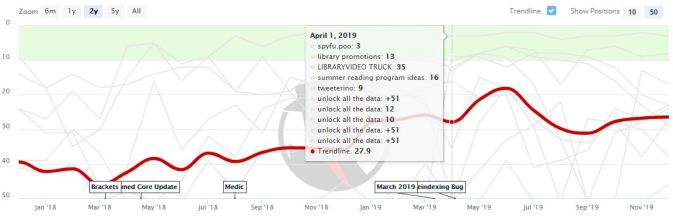
SpyFu:  Use this tool to check how high your competitors rank in SEO keyword search. Get insight on keywords that lead people to your competitors’ site, including any paid keywords they may be using. You can plot the reach of any website on a timeline, giving you an idea of when the site is seeing a spike in traffic. The graphic below shows you what that looks like for this website!

My favorite feature on SpyFu is the keyword analysis. I found out that people searching for “free downloads,” “free download music,” and “free faxing” are most likely to end up at my library’s website. Now I know that I need to make sure the word “free” appears frequently on every page of my library’s website to drive more traffic!

Social Searcher: This real-time social media search engine allows you to quickly pull all recent mentions of a competitor from the major social media platforms and the internet together into one dashboard. You can search for keywords and hashtags to see recently published posts. You can also set up email alerts to keep track of what people are saying about your library, a competitor, or a service, like Audible or DuoLingo.

SimilarWeb: This tool reminds me of Google Analytics, but with prettier graphics. You can see all kinds of useful information about your competitors including where their customers live, how much of their website traffic comes from social media, what keywords people are using to find their website and more. You can also see the top five “interests” of visitors to your competitors’ websites. And of course, you can compare that with your library’s website.

Moz: The site is focused on links and can tell you how other websites are linking to your competitors’ website, and how your competitor is using anchor text to drive traffic. You can also download their reports for free as a CSV file. You can also find out your website’s Spam Score!

Alexa:  This site will show you how your bounce rate and traffic sources compare with your competitors, as well as how much of your audience overlaps with that of your competition. Best of all, Alexa will identify keywords to drive more traffic to your website, based on what people in your area are searching for on Google and Amazon (Alexa is owned by Amazon).

TalkWalker: An alternative to Google Alerts, it lets you search blogs, websites, and news for posts about your competitors. You can have the alerts delivered to your inbox once a day or once a week.

MarketGrader: This free tool from Hubspot grades your website or your competitors on factors like how fast the pages load, keyword ranking, and security.

I did an analysis of this website and found that 30 percent of my traffic comes from mobile devices. That’s incredibly important information because that means that I must make sure everything I do on this website is responsive. This tool also gave me tips on how to increase my SEO ranking and security. All of those tips would be invaluable for my library’s website as well.

Check the Upcoming Events page for a list of webinars and conferences where I’ll be next. Let’s connect! Plus, subscribe to this blog and you’ll receive an email every time I post. To do that, click on the “Follow” button in the bottom left-hand corner of the page. Connect with me on YouTube, Twitter, Instagram, and LinkedIn.   

Attention! Here’s How to Write Headlines That People Simply Can’t Ignore for Any Piece of Content

In my former life as a web journalist for a television news station, crafting the best headline for each story was the most challenging part of my day. It was also the most crucial task.

A compelling headline for any piece of content–email, social media posts, blog posts, newsletters, posters, and signage is essential. The right headline will make it impossible for people to ignore your content.

It may seem silly to spend a lot of time, energy, and brainpower on a couple of words. But it’s a critical component of all your marketing efforts. Libraries should spend time crafting the best headline on every piece of content they publish. This applies to their website, blog, social media posts, press releases, and emails, including personal emails and mass emails to customers.

A good headline should give your readers a hint at the copy that lies ahead without giving away the whole story. It should trigger an emotional response that includes an irresistible urge to read more.

Think of your headline as the gateway to all the content you have poured energy into creating. It may seem tall order for a short succession of words but it can be done.

So how do you write a good headline? Here are my tips.

If someone held a gun to your head and demanded you describe the copy in one sentence, what would you say? This is my twisted yet effective technique for getting that first draft of a headline down on paper. It forces you to boil your work down to its main point or big idea. Go for the emotional core of your copy.

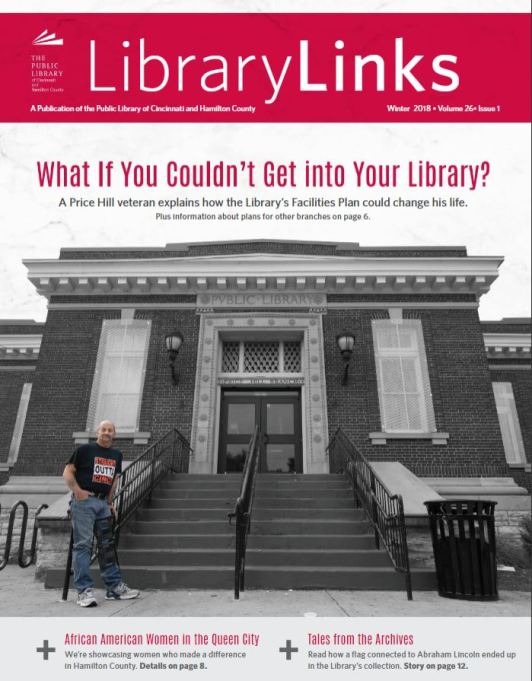
Example:  The title of this issue of our Library Links magazine. The lead story was about a veteran living with a disability. His neighborhood branch is a Carnegie library built in 1909. It’s never been renovated and it’s inaccessible to people living with mobility issues. We were about to ask voters to pass a levy to fund upgrades to this branch and more just like it.

I asked to interview him. He told me the story about how he can’t climb those stairs, and how fellow veteran friends who also live in his neighborhood have to drive their motorized wheelchairs to the next closest branch. The trip sometimes takes three hours. His story invoked a feeling of frustration and injustice. How the heck do you encapsulate that in a short sentence?

Keep the length manageable and the vocabulary conversational. Remember, you want to tease your readers into craving more information, not give away the whole story. You also don’t want to confuse them by using language they don’t understand.

Example: Our library recently made a pivotal switch in the way we market our storytimes. We want to emphasize the educational aspects.

It would be easy to get lost in a lot of technical language and big words to describe our focus on literacy and learning. I decided the best approach would be to write text that sounded like what I would say in person if I were talking to a parent about storytime.

This sounds like an easy step, but I see a lot of libraries and brands that get caught up in the technical language of their products and services. It makes us feel important when we use big words. But headlines and copy need to be simple in order to connect with the audience.

Headlines for press releases deserve as much attention as headlines for emails and blogs.  Library marketers must remember newsrooms are a target audience and journalists crave a good story just as much as the average Joe. You really have to dig deep to grab their attention and evoke your emotional response. You want them to go into their morning meeting and fight for the permission to cover your library’s story. So, give them enough ammunition.

Example:  This release triggered coverage by all the major media outlets in town. Its headline is very simple and straightforward but it got the job done.

Be versatile–it’s okay to change the headline based on the distribution platform. If you have a great blog post you want to share on Twitter, but the headline, when coupled with the URL and a photo, exceed the 280-character limit, re-craft the headline just for Twitter. You might also want to re-craft headlines for different social media audiences. Your Twitter fans may have a different perspective on your article than your LinkedIn fans. You can rewrite it for an email distribution too.

Example: This blog! I often change the headline for the different social media platforms. Sometimes I’ll repost a blog in a month or two with a different headline as well, just to freshen it up and catch viewers who might not have been interested by my first headline. Experimenting is good!

Use the tools. There are lots of fantastic tools to help you fine tune your headline. My absolute favorite is Sharethough’s Headline Analyzer. It’s easy to understand. Since I’ve been using it to craft headlines for this blog, my views have gone up about 10 percent!

For this particular post, Sharethrough gave me a 75 rating, which is above average. It says this headline works because it’s long, it has a human connection, and limited use of positive sentiment. It also gives suggestions on how to improve the headline to get a higher score.

Go with your gut.  Sometimes, all the tools and analysis can cloud your head. If you’ve composed a headline that you feel will do the best job at capturing your audience’s attention, use it. You know your audience best.

Subscribe to this blog and you’ll receive an email every time I post. To do that, click on “Follow” button in the bottom left-hand corner of the page. Connect with me on YouTube, Twitter, Instagram, and LinkedIn.  And check my list of upcoming events so we can connect.

How to Pick Amazing Library Marketing Swag That People Will Love AND Build Brand Awareness and Loyalty For Your Library!

One of my staff members has a request for every event, conference, and convention I attend. “Hey boss, bring me swag!”

Who doesn’t love free stuff? And seeing what other organizations give out to promote their institutions and brands is fun.

Most libraries and vendors stick to items like pens, notebooks, candy, cups, and stickers. We spend a lot of money on this free stuff, in the hopes that event attendees will love it and use it. We also use swag to increase awareness of our library and build loyalty with current cardholders and new folks!

When your budget is limited, picking the perfect swag is a big deal. Your swag has to be interesting, but it should also align with your strategy and helps your library achieve its overall marketing goals. That’s a tall order.

When a guest walks away with your swag and can’t stop raving about it, you will have done your job. And if it’s something a library cardholder or community member can use over and over again, and that makes them think of your library, your money will be well spent. A study done by Schreiber & Associates found 39 percent of all people who have received a promotional product can accurately remember the name of the company that it’s associated with as long as six months after the event!

There is another important reason for swag: it’s a conversation starter. Great swag can be a talking point for volunteers working your table to share information about services, collection items, and other related events at the library. Marketing studies show us that you have to get your message in front of your cardholder an average of SEVEN TIMES before they’ll be compelled to act on it. A direct conversation with a community member about your library counts as one of those “touches.”

A conversation between a library worker or volunteer and an event attendee is a highly effective means of marketing. According to Nielsen, 75 percent of people don’t believe the advertisements they read but 92 percent believe brand recommendations they receive from trusted sources.

Finally, giving good swag gives people a positive memory of your library. Memorable and useful items given freely and generously leaves people smiling and prompts sentiments like, “I love my library” and “I’ll always support my library.” You can’t beat that!

How to Pick Swag

Pick something functional and useful. I like to make sure the items I choose are necessary and can be used over and over again. That means that my library’s logo or name is an integral part of the life of my cardholder. I want them to constantly be seeing my library’s name or website. Some great ideas that fit this category are water bottles, kitchen utensils, ice scrapers, and pop-stoppers.

One word of caution: be aware that some attendees will take issue with certain types of swag. Many people don’t want to take a plastic bag at events because of environmental concerns. I’ve also had people turn away plastic bottles because of the possibility of harmful chemicals leaching into their water. Kids toys can be tricky because of small, removable parts.

Make sure your swag is unique and something that other organizations aren’t giving out regularly. Head to any library event or conference and you’ll find no shortage of pens, notebooks, stickers, tags, and buttons. And while all of these items are useful and cheap, I don’t want to buy any for my table because everyone is giving them out. Hand sanitizer, lip balm, license plate frames, and pet bandannas are all great examples of fun, useful swag that will set your library apart from other organizations.

Make sure your swag is relevant to the attendees of an event. Be sure to ask the organizers before you go who their attendees will be, how many people they expect, and what the event is focused around. Don’t bring all your swag to all events… pick and choose carefully. At my library, we buy different swag for different age groups. We have earbuds and multi-function charging hubs for teens, piggy banks and temporary tattoos for kids, and aluminum water bottles and drawstring totes for adults.

Make sure your swag can be branded. Check the space where logos or text can be printed on items to make sure your particular logo, tagline, or library website will fit and be legible. I’ve totally made this mistake: you spot a great piece of swag at a great price. But the area where your logo or tag line is imprinted is too small or oriented the wrong way. No one can tell it’s from your library! Pay special attention to the imprint area, especially if you have a long tagline or a logo that can’t easily be resized or re-oriented.

Watch The Library Marketing Show to see some of my favorite choices for swag and talk more about why it’s so important for marketing!

No budget for swag? Do a giveaway. I’ve often had leftover donated items like gift cards that I use as giveaways at events. A giveaway, when promoted ahead of time, will drive attendees to your table. Ask people to give their email address and add them to your newsletter or email subscription list in exchange for an entry in your contest.

Subscribe to this blog and you’ll receive an email every time I post. To do that, click on “Follow” button in the bottom left-hand corner of the page. Connect with me on YouTube, Twitter, Instagram, and LinkedIn.  And check my list of upcoming events so we can connect.


The Four Library Marketing Myths That Need to Die RIGHT NOW!

One of my staffers wrote a post for our Library’s blog recently about common library myths. You can read it here. That post got me to thinking about library marketing myths, and how library marketing professionals can “bust” them. Here are my top four choices.

My library marketing video/blog post/article needs to be short because people will only consume “snackable content.” This one is really prevalent for all kind of companies and institutions, and it’s so, so wrong!

At the beginning of 2019, I started to write longer blog posts. Did you notice?? I went from 500-700 words to between 1000 and 1500 words.

And what happened? My site stats jumped. Already in October of 2019, I’ve exceeded the number of views and visitors for the site in 2018. I’ve had twice the number of people reading each post as I did in 2018.

When you write long form, more people will read your posts. People stay on the site longer. They read multiple posts. This is also true for longer blogs written for our library’s website.

I made the switch to longer posts because I’d read a lot of research about long form content and its benefits. It’s not easy. I spend more time on each post. I have to do more research. I have to be careful not to add words or sentences just to fill this imaginary word count goal in my head. It’s sometimes difficult. But it’s worth it.

The smart people at a company call serpIQ did a study of the average length of the content in the top ten results of search queries. The company found that the top-rated posts usually were more than 2,000 words long.

If your post is written well, helpful, educational, interesting, and builds interest or suspense, people will stay on your site longer. This will boost your library’s web page rankings in Google and drive more traffic to your site. Long form content also builds trust in the authority of your library. There’s no downside to longer pieces.

The only exception to this myth is email. The text inside mail marketing messages should be short, because evidence shows people will not read emails that are longer than 200 words (sorry, fans of the newsletter). Your short email can and should link to a longer piece but the actual text body itself should be 50-200 words max.

A high open rate is the best way to tell that my library email marketing is successful. So many libraries focus on high open rates for their emails. It’s sometimes hard to contradict that measure. But I’m going to do it because I want your work to matter. And if your open rates are high, you may still be failing at email marketing. Hear me out.

Open rates do mean something. They are a sign of customer loyalty. A high open rate means that your cardholders are eager to see what you’ve sent them. And that’s good. You are writing compelling email subject lines (Good job, you!). You have a loyal and eager audience.

But it’s what happens AFTER your cardholders open your email that counts. If your click-thru rate is low, you’ll know the content you are sending to your cardholders isn’t what they want.

The higher the click-thru rate is, the more excited I get. It means that my cardholders opened an email, saw something they liked, and acted!

Most of the time, my library emails direct cardholders to do one of two things: click a link for a specific item in our collection or go to the event calendar where they can register or put an upcoming event on their calendar.

If a cardholder takes one of those actions is a huge victory. It gives me data about what that particular cardholder is interested in. And I can use that information to craft future emails that are also compelling for that cardholder.

As happy as I get over a high email click-thru rate, a high conversion rate is the most accurate way to measure email effectiveness. It is the percentage of people who take an action after clicking through.

For example, let’s say 100 people click-through to look at a book I promote by email. If 50 of those 100 people put the book on hold, my conversion rate is 50 percent.

Conversion rate is the gold standard for the success of any email campaign. Your goal should always be to get people to act!

I need to grow my Twitter/Facebook/Pinterest followers. I’m not saying that a huge social media following wouldn’t be nice. But in the age of algorithms, it’s not as important as it once was.

What you really want is a large audience of ENGAGED followers. You don’t just want people to see your posts. You want them to compel people to take an actual: like, share, subscribe, comment, post emojis, and generally jump up and down virtually.

It’s kind of like speaking at a conference. You might be thrilled at the prospect of talking to a huge group of people. But it’s disheartening if half of your audience is yawning or looking at their phones. It’s much more meaningful to speak in front of a small room of people who are riveted by what you have to say.

I don’t care how many followers my library has on any social account. I want to see people engage with our content. Focus on actions and not the number of followers.

If you need to tell your cardholder something, just make a sign. No one reads signs. Seriously, we just don’t. I lead the team that makes signs at my library FOR A LIVING and I don’t read them.

Too many signs in a branch, particularly in a small location, can create clutter and confusion. And too much signage can annoy your cardholders, particularly if most of your signs are bombarding them with marketing messages.

Just as white space works to create breadth and depth for a website or a graphic, well-spaced signage in a branch creates flow. About 75 percent of the signs in your library locations should be wayfaring only, directing cardholders to important service points in the building. The other 25 percent can be selective marketing–promoting services and items that are of interest to your cardholders.

Don’t rely on signs to convey everything you want to tell the customer. Hire staff who are willing to speak with customers and show customers where items are located.

Do you have a myth you encounter in your work? Let me know about it, and how you’re busting it in the comments.

Subscribe to this blog and you’ll receive an email every time I post. To do that, click on “Follow” button in the bottom left-hand corner of the page. Connect with me on YouTube, Twitter, Instagram, and LinkedIn.

The Library Marketing Show Episode 15: 🤷What to Do If You’re a Librarian Who HAS to Do Marketing!

WATCH NOW

In this short video, we talk about what you should do if your a librarian and your library has asked/forced/demanded/requested that you also handle the marketing. If you don’t have a communications degree, what should you do? Can you do it? Answer: YES!
(Watch episode 14 to see why I generally don’t hire librarians to do marketing).

Also KUDOS to Chicago Public Library for going fine free!

Talk to me! Share thoughts about this video in the comments, LIKE it, SHARE it, and subscribe (Pretty please!). Let’s grow this channel together.

Stay in Touch

Check the Upcoming Events page to see where I’ll be soon. Let’s connect! More events are coming soon.

Have an idea for the next Library Marketing Live Show? Submit it now.

Subscribe to this blog and you’ll receive an email every time I post. To do that, click on “Follow” button in the bottom left-hand corner of the page. Connect with me on Twitter, Instagram, and LinkedIn.  

The Library Marketing Show Episode 12: How to Convince People that Flyers ARE NOT the Be All, End All of Library Marketing!!

Watch Now

In this episode, we’ll answer a reader question from Jenny at the Redwood City Public Library about how to address that age-old complaint: WHY CAN’T I HAVE MORE FLYERS? FLYERS ARE AMAZING! from your fellow library staff and how to convince them that digital promotions are worth time and effort. Thanks for the question, Jenny!

You can submit a question or a discussion topic by going to this page and filling out the form.

Also Kudos to Stark County Library in Canton, OH –find out why I think they’re amazing.

And a book review of “Calypso” by David Sedaris PLUS find out which book I couldn’t finish and why!

Stay in Touch

I’m speaking at two conferences this fall and you can register for both on the Upcoming Events page. I just finished the slides for OLC! I’m really excited about that one. Details about the talks at both conferences are on the page and more events are coming soon!

Have an idea for the next Library Marketing Live Show? Submit it now.

Subscribe to this blog and you’ll receive an email every time I post. To do that, click on “Follow” button in the bottom left-hand corner of the page. Connect with me on Twitter, Instagram, and LinkedIn.  

How Your Library Can Use Google Ad Grants to Supercharge Your Website and Reach a Huge Untapped Audience

Note: A newly updated version of this blog post is now published. Read it here.

Frustrated with Your Library Marketing Newsletter? Here’s Why You’re Not Getting the Results You Want AND How to Fix It

I hold a controversial opinion. Newsletters are an ineffective tool for library marketing.

I totally understand why libraries create them. Our customers are a wide and diverse audience and our budget is limited. Newsletters are an easy and efficient way to get information to our audience.

But many libraries are frustrated by the lack of demonstrable results from their newsletters, both the print and email versions. And there’s a reason you can’t get good results from a newsletter.

The mistake is: You’re sending the same message to all of your cardholders.

It’s understandable. It feels like the natural thing to do. Your library has great stuff and you want everyone to know about everything.

The problem with that approach is that your cardholders are individuals. One message never fits them all. The needs and interests of your cardholders vary greatly.

I’m not suggesting you ditch your newsletter. By transforming the way you approach your current print and e-newsletter, you can make it actually work! The trick is to make changes that increase your newsletter’s value by refining the message.

Tips that work for both print and e-newsletters

Give your cardholders LOTS more of what THEY want. I know you’ve been keeping track of attendance at events and holds or checkouts of books you promoted in your previous newsletters. If you notice that your newsletter audience turns out for a particular type of event or that they like a particular genre of books or collection items, put MORE of those in your newsletters.

Library marketers are often pressured to promote what their co-workers or bosses think is interesting. Or worse, what their co-workers think the audience NEEDS to hear.

I’ve actually had to gently explain to my colleagues that, while reading classic authors like Ernest Hemingway and Jane Austen are good for the brain, most people are not looking for an intellectual challenge when they reach for a book. It’s like getting kids to eat their vegetables. Veggies are healthy, but if your child doesn’t like them, they’ll clamp their mouth shut and refuse to take a bite.

The newsletter audience is the same. You can’t make people attend events or read books because they’re healthy or intellectual. Library marketers sometimes have to be an advocate for their audience; you have to be persistent in your defense of what your cardholders want.

At my library, we pivoted our newsletter to focus more on our the parts of our collection that our cardholders like. We had the data to back it up. We know that our cardholders really love content about coding and coding classes. We know they love mystery books. We know they love workshops about writing and publishing their own books. We learned all of these nuanced preferences by carefully measuring our audience’s response to marketing in all areas. Patterns emerge. And now, we do a lot of promotion around these areas because we know, for a fact, that our cardholders love this kind of content.

Make your content helpful, not promotional. Your cardholders are regularly bombarded with offers, sales, and promotions, both in their inbox and in your mailbox. To get people to read your newsletter, the content needs to be interesting, useful, or helpful.

Hundreds of studies and surveys about consumer behavior show us that content that is educational or entertaining gets better results that content that is promotional. So how can you promote something while being entertaining or informative? Content marketing in the answer.

Content marketing is a strategic approach focused on creating and distributing valuable, relevant, and consistent content to attract and retain a clearly defined audience–ultimately, to drive profitable consumer action.

Content marketing breaks through the noise and the clutter by providing compelling, useful information for your cardholder–any type of information. It addresses whatever pain points your cardholders have. It positions your library as the go-to place for information. It builds trust.

And through content marketing, your library gets a better and deeper understanding of your cardholders. You can use that understanding to do a better job of addressing your cardholders’ needs. It’s a constant circle of giving and it carries more weight for a longer period than a traditional newsletter promotion.

Stop thinking of your publication as a newsletter. Start creating news magazines. Most library newsletters that come to my inbox or mailbox are long and contain a ton of text and images. There isn’t much white space and scanning them is difficult, because there is so much to scan.

At my library, we increased the effectiveness of our print newsletter by transforming it into a magazine. We trimmed it from 16 to 12 pages. My graphic artists started to give the publication a magazine feel in layout, using bolder visuals and shorter, more engaging articles. We left some white space. We changed the balance of the articles from 100 percent promotional to 50 percent informational and 50 percent promotional (even I have to fight the battle with my library to be less overtly promotional!).

What happened when we made these changes? Our news magazine became a must-read. People started asking when the next issue would be out. We had to order more copies. Library staff and outside partners vie for space in the publication. The news magazine is popular!

Tips specific to e-newsletters

Keep the text short and scannable. Your e-newsletter is a touch point, not the end of a conversation. Readers should get enough to be left with the feeling of wanting to know more about a particular subject. Drive your recipients to your website or another platform where they can get more information with compelling text and enticing calls to action.

Make it easy to share your e-newsletter. Include social share buttons that link directly to your library’s social pages.

Segment your e-newsletters. You can segment your e-newsletter in a number of ways… by age, by interest, and by location. This means you’ll need to create more than one e-newsletter. But each one will be targeted to a specific audience, which increases effectiveness. This step will be more work for you but it’s worth it for better results.

By targeting your message, you are more likely to say something that matters significantly to your cardholders. That individualized message makes them more likely to take an action, which makes it more likely that your newsletter will be successful.

More help for library marketers

How the Best Newsletters Get-and Keep-Reader’s Attention from Content Marketing Institute

NoveList’s Guide to Best Practices for Library Newsletters

7 Tips for Creating Engaging Newsletters from Mailjet

Great examples of targeted library newsletters

Dallas Public Library’s Young Black Readers Newsletter

Indian Prairie Public Library’s DVD Preview

Subscribe to this blog and you’ll receive an email every time I post. To do that, click on “Follow” button in the bottom left-hand corner of the page. Connect with me on Twitter, Instagram, and LinkedIn.
 

The Library Marketing Show Episode 9: Make Your Library Website Accessible!

Watch Now

What We Talked About

Library News: A civil California Grand Jury decides that the Santa Cruz Public Library’s potential use of a data analytics tool would threaten patron privacy. The library ended up not using the tool, but it’s an interesting conversation about how much data we can use to market to our cardholders without threatening the sacred privacy of a cardholders’ data. I feel very conflicted about it. Read the article and let me know what you think!

Reader Question: Lori from the Nicolet Federated Library System in Green Bay, Wisconsin asked us to discuss web accessibility basics for library websites.  Thank you for this very important question, Lori! We know web accessibility is important. Some of our cardholders may not have full use of their hands. Others have a vision disability. There is a tool you can use to audit your website so you can see where accessibility is an issue and correct it. The tool is free and was developed by the ADA. You can get it as a Chrome extension here. You could also hire a web accessibility expert. They can do a hands-on audit of your site, identify problems, help you to fix them, and keep an eye on your site to make sure you stay in compliance in the future. This company has good reviews. I hope this helps!

Kudos: To the Pima County Public Library. They got media coverage of an overdue postcard notice sent back to them after 40+ years. The story had all the things our cardholders love–mystery, nostalgia, and it reminded the community of the length of service and commitment of the library in the community. It’s hard to get media coverage so kudos to them for finding this unique pitch! Watch it here.

Stay in Touch

I’m speaking at two conferences this fall and you can register for both on the Upcoming Events page. If you come to OLC, you’ll be able to tour the Downtown Main Library where I work! I’m getting ready to add new events soon so check back.

Have an idea for the next Library Marketing Live Show? Submit it now.

Subscribe to this blog and you’ll receive an email every time I post. To do that, click on “Follow” button in the bottom left-hand corner of the page. Connect with me on Twitter, Instagram, and LinkedIn.  
A WordPress.com Website.

Up ↑