Search

Super Library Marketing: Practical Tips and Ideas for Library Promotion

Tag

Print Marketing

Why Print Marketing Still Works for Libraries… and How to Prove It!

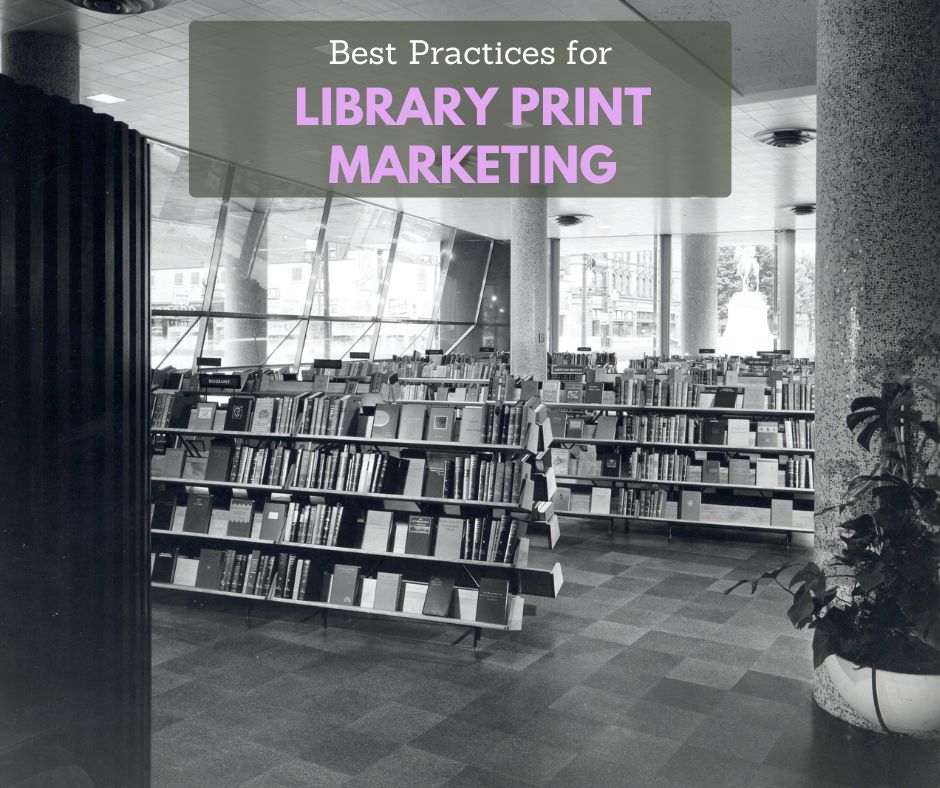
Photo courtesy Cincinnati and Hamilton County Public Library

Quick Summary

  1. Print marketing is not dead. When used strategically, it helps libraries cut through digital noise and even strengthens digital marketing.
  2. Measure return on investment of print marketing with opt-ins, QR codes, custom trackable links, and interactive prompts.
  3. Repurpose print content across social, blogs, and email to extend its reach and prove its impact.

Every day, I run with anticipation to the mailbox.

I can’t help myself. As a member of Gen X, snail mail was a significant part of my life when I was growing up. A letter or postcard from a family member or friend brought me such joy. We had phones, of course, but no social media. So if a friend went on vacation, I couldn’t follow each step of their journey on Instagram.

I also love mail because it’s physical. There is something about the feel of paper in your hands that adds to the joy of reading. It’s why I prefer print books to eBooks.

And I know that digital correspondence is also permanent, but there is something different about a stash of letters, held together with ribbon or string, kept to be read again years later.

What does any of this have to do with library marketing?

The 10th Annual Super Library Marketing survey closed a few weeks ago. I’m analyzing the results now and will publish the full report on January 5, 2026.

But one theme has emerged already: Library promotions are getting lost in the constant digital noise.

I work with hundreds of libraries worldwide every day at NoveList. They’re all facing this struggle. And some are beginning to lean on print to cut through the noise.

That’s because print still matters when itโ€™s intentional, measurable, and audience-focused.

Print is not dead. Itโ€™s strategic!

It might feel old-fashioned or even risky to invest staff time and budget in print. After all, email and social media offer instant metrics and quick reach. But hereโ€™s the truth: Print has never been more valuable.

Now, I realize this statement may come as a surprise. Readers of this blog know how much I value email marketing. It is, hands down, the most effective use of your marketing time.

But clever library marketers know that there are some audiences we cannot reach with email. Print helps you connect the dots between those groups. It can spark attention in people who might otherwise overlook your digital promotions. And it can deepen the relationship with those who are already engaged with your library.

Imagine this: Youโ€™ve been on a storeโ€™s email list for years, eagerly clicking through their sales messages. Then one day, a coupon shows up in your mailbox. Suddenly, the brand feels even more present, more valuable, and youโ€™re more likely to act on the next email, too. (BTW, this example is born of my own experience with Bath and Body Works!) And it works because…

Print doesnโ€™t replace digital marketing; it amplifies it.

How do you know if your print marketing is working?

Hereโ€™s the challenge I’ve always faced with print marketing: How do you prove that it’s effective? How do you know itโ€™s worth the investment? Because, let’s face it, print can be costly.

Here are five concrete ways you can measure the effectiveness of print marketing at your library.

1. Start with an opt-in model for longer print publications.

Many libraries print thousands of copies of their print newsletter or magazine. Then they send them out to all the people living in their service area. They might also send copies home with each child in their school district.

I totally understand that strategy. But it’s akin to sending un-targeted email messages. If someone isn’t already engaged with the library, the sad truth is they may throw that print piece in the trash. That’s a waste of money for the library and a waste of time for you.

A better approach is to ask readers to opt in to the publication. There are a couple of ways to do this.

  • Ask people to sign up either when they sign up for a library card or through an email campaign.
  • Send your print publication to anyone who donates to your library’s fundraising groups.
  • Put copies out in your branches. You can also distribute copies to partner organizations with locations that have a lot of foot traffic, like museums and theaters. Be sure to include a QR code so those new audiences can sign up to receive their own copies at home.

2. Make your print marketing interactive.

Ask readers to post a social media comment on a story or an event in your print publication. This works really well for print calendars and fliers.

Add a unique hashtag to the piece, and ask people to use it when they post their comment. Then count how many comments you receive.

You can also ask readers to send an email with an answer to a special prompt, like, “Which storytime is your child’s favorite?” Create a special inbox to receive comments from your print publications. Then you can count the number of emails you receive.

3. Use custom trackable links.

When I worked at the Cincinnati and Hamilton County Public Library, I used Bit.ly to create special trackable links for our website. With a free Bit.ly account, you can edit the back half of a link and then track how many people click on it. This makes it easy to see which traffic is coming directly from your print marketing.

4. Add QR codes.

Add a QR code to your print piece, then track how many scans you get. One library marketer I spoke with takes this a step further by creating a different QR code for each poster, depending on where itโ€™s displayed. That way, she can compare engagement across different locations or departments!

Pro tip: This strategy works for all your libraryโ€™s print pieces, from bookmarks to event flyers. If you ever feel like youโ€™re doing too much print marketing, the data you collect from trackable links and QR codes can help you make the case for (or against) continuing.

5. Repurpose your content across other channels.

Save time and amplify your content by repurposing stories from your magazine or newsletter into social posts, blog articles, or email content. If those repurposed pieces perform well digitally, itโ€™s another signal that your print marketing is resonating.

When I worked at the library, many of the stories we published in our quarterly newsletter or on our blog were repurposed in this way. This helped us to get more traction for the stories and gave us another way to measure whether the story is interesting to our audience.

This trick can also help your community to learn that you have print promotions and give you a reason to solicit sign-ups for the print version!

How is your library using print marketing?

Iโ€™d love to hear how your library is using print. Share your experiences in the comments below.


Need more inspiration?

Libraryโ€™s Print Magazine Is a Community Must-Read! Here Is Their Secret Formula.

Subscribe to this blog, and youโ€™ll receive an email whenever I post. To do that, enter your email address and click on the โ€œFollowโ€ button in the lower left-hand corner of the page. You can also follow me on the following social media platforms:

Update on Fighting the Endless Poster-Flyer-Sign Cycle: How To Explain Strategic Print Promotions

Watch this video now

#LibraryMarketing Show, episode 244

I posted a video five years ago about fighting back against the endless flyer-poster cycle. It ended up being the most popular video I’ve ever made.

I have an update! In this episode, let’s dive deeper into using print promotions smartly and strategically.

Plus I’ll give kudos to a library using email to market special services to educators.

Do you have a suggestion for a topic for a future episode? Want to nominate someone for kudos? Let me know here. And thanks for watching!โ€‚


Miss the last episode? No worries!

Will I see you soon?

Subscribe to this blog and youโ€™ll receive an email whenever I post. To do that, enter your email address and click on the โ€œFollowโ€ button in the lower left-hand corner of the page. You can also follow me on the following social media platforms:
Award-Winning Library Marketing Team’s Advice for Promotional Success: โ€œTry New Things. Fail. Try More Things.โ€

Photo courtesy Cincinnati and Hamilton County Public Library

A few months ago while at a conference, Meghan McCorkell,  got the email of a lifetime. The chief of Marketing, Communications, and Strategy for the Enoch Pratt Free Library, she called back to Baltimore and put her team on speaker phone.

Meghan was delivering great news: her team won the coveted Library Marketer of the Year award from Library Journal.

โ€œWe all jumped around excited (them in the office and me in a hotel lobby),โ€ recalled Meghan. โ€œMore than anything I am so proud that we won as a team. We had to keep it a secret for about two months. So that was challenging.โ€

Meghanโ€™s road to award-winning library marketer began in the 7th grade when she volunteered to shelve books for her hometown library, the Brielle Public Library on the Jersey Shore. Little did she know that years later, after a successful career as an Emmy-award-winning television journalist, she would assemble a team and lead the marketing for the vibrant Enoch Pratt Free Library.

โ€œI love being surrounded by creative people, who all think differently than me,โ€ explained Meghan. โ€œIโ€™m constantly blown away by the ideas that bubble up from our team. Six years ago, the Pratt didnโ€™t have a marketing department. With support from the CEO, we built it.โ€

โ€œThe Print & Design studio was originally part of the Programming department, with four talented designers, Katherine Marmion, Eric Archibald, Jamillah Abdul-Saboor, and Jack Young. The studio was reorganized into a new marketing department.”

“We hired Andrew Klein to oversee the robust work that department does, as well as to lead the revamp of our Compass magazine. Our social media manager, Vianey Becerra, was made full-time, and translation duties were added because Vianey is bilingual.โ€

โ€œA few years in, as we built out our email marketing strategy we brought on Ashley Barnes, a digital marketing strategist. And finally, I advocated for a photographer/videographer position. John Cassini was a former news photographer, so given our skill sets together the Pratt now has its own full-service production studio.โ€

Like many libraries, Enoch Pratt really had a challenging time communicating with patrons during the Covid lockdown because of the digital divide. Nearly 40 percent of Baltimore residents had no access to a computer or Wi-Fi at the time lockdown began.

โ€œWhen we knew weโ€™d have to close library doors, we started working nonstop to figure out how weโ€™d serve the customers who rely on us,โ€ remembered Meghan. โ€œWe started trying new things to see what worked.โ€

โ€œWe used census data to send targeted postcards with QR codes and unique URLs in communities where internet in households was unreliable. We let them know about device lending and our free outdoor Wi-Fi. We geofenced those communities and pushed targeted ads that looked like those postcards.โ€

โ€œWe sent targeted emails based on location and library usage trends to customers. We were specific in how we reached people, who we were trying to reach, and measuring what was successful.โ€

โ€œThat all may sound pretty complicated and expensive, but targeting that way actually really cuts down on the cost. If you can mine the data and figure out who needs to hear your message, you can send 5,000 postcards instead of 50,000.โ€

Once the doors of Enoch Pratt reopened, the team faced a huge challenge: rebuilding cardholder usage.

โ€œIt was a daunting task,โ€ admitted Meghan. โ€œWe define active cardholders as customers that used the library in the past year. During COVID we lost more than half of those cardholders. But we learned a lot of lessons along the way too, and we doubled down on what worked.โ€

โ€œPre-pandemic we sent around 5-6 emails a month. That expanded massively as we launched more regular campaigns and saw success.”

“Today, we send anywhere between 35-40 targeted emails a month to different audiences, have an unsubscribe rate of less than 1 percent, and regular open rates close to the 50 percent mark.โ€

โ€œOur print publication, the Compass used to be a 16-page list of programs. Over the past 4 years, weโ€™ve expanded to a 24-page magazine that tells the libraryโ€™s story. Staff across the library also stepped up with dynamic programs and services responding to community needs. Last week, we hit 3,000 more active cardholders than our pre-pandemic high. So, weโ€™ve climbed the mountain.โ€

Reflecting on the work, and her team, Meghan clearly gives credit for their LJ win to her team, whom she says make it a joy to come to work. They even came up with a creative approach to their award photo shoot.

โ€œLibrary Journal let us take our own picture for the feature, and of course, we couldnโ€™t give them something normal,โ€ exclaimed Meghan. โ€œThe Brady Bunch style photo perfectly captures the spirit of everyone on the team. We shared a behind-the-scenes video on the Prattโ€™s Instagram page of our photo shoot.โ€

Though Meghan has a wealth of riches in her large and talented team, she still faces struggles in terms of budget. Many of the tactics her team uses to reach cardholders can be replicated by smaller libraries.

โ€œMy advice would be to look at low to no-cost tactics,โ€ explained Meghan. โ€œI think targeted emails can really change the game.โ€

โ€œStart a sign-up list at your library for people interested in kidsโ€™ events. Create a really specific monthly email for that audience and keep an eye on how it performs and if itโ€™s achieving your goals of getting more people through the doors. Thatโ€™s how we started our email strategy. Then we were able to leverage the success of those lists to convince our Board that we could be more successful with fancy software.โ€

โ€œI also think you should try things, and if they donโ€™t work, let them go. Just because things have always been done a certain way doesnโ€™t mean you should keep doing it. Try new things. Fail. Try more things.โ€

Meghanโ€™s team is now focusing on cardholder retention and data collection.

โ€œI donโ€™t like throwing spaghetti at a wall and seeing if it sticks,โ€ said Meghan. โ€œI want to run measurable marketing campaigns the whole way through.โ€

โ€œWeโ€™ve got some fun upcoming projects like our Macyโ€™s-style winter windows that have become a Baltimore tradition thanks to our amazing graphic design team. Weโ€™ve got some challenges too including messaging out a Master Facilities plan and a series of upcoming renovation projects. Our designer Eric is probably already stressing the design of next yearโ€™s Summer Break Baltimore shirt! His design this year has been directly cited by customers for a 36 percent increase in program participation. (no pressure, Eric!)โ€

When she needs inspiration, Meghan looks at the work of other library marketers.

โ€œIโ€™ve made amazing friends in library marketing. I send them emails and say โ€˜What do you think about thisโ€™ all the time. The environment is so collaborative.โ€

โ€œFor inspiration, Iโ€™m often looking at other industries and seeing how we could adapt ideas from there. Right now, Iโ€™m in love with our Library Card Sign-up Month video campaign. That was born out of a brainstorming session with our whole team. Our graphic designer Katherine said, โ€˜What about those annoying lawyer commercials?โ€™ That idea led to a 3-video campaign that is becoming wildly popular on social media. We even have it running on a TV station and in a movie theater now.โ€ (Here are the videos: Lawyer Commercial, Car Commercial, Pharma Commercial.)

Meghan wants my readers to know that, although sheโ€™s had a lot of success in her current role, there was a time not too long ago when she was uncertain. For support, she turned to youโ€ฆ the community of library marketing professionals!

โ€œSix years ago, I felt like I was just figuring out what the heck I was doing in a new career,โ€ remembered Meghan. โ€œOne of the things that helped was finding the community of people in this field.โ€

โ€œLibrary marketers are really collaborative and weโ€™re all facing the same challenges. I love hearing from colleagues who want more info on going fine-free, or major renovations. I reach out to friends in the field to talk about ideas. From this blog to social media groups, and conferences, there is a sea of people out there all rooting for each other to succeed. Go find them!โ€


P.S. Want more advice?

Plan for Library Marketing Success! How To Create an Effective Marketing Plan No Matter the Size of Your Library (Plus a Free Downloadable Template!)

Subscribe to this blog and youโ€™ll receive an email whenever I post. To do that, enter your email address and click on the โ€œFollowโ€ button in the lower left-hand corner of the page. You can also follow me on the following social media platforms:

You Don’t Have to Choose Between Print and Digital Books: How to Promote Your Collection to Patrons Who Use BOTH Formats

Image courtesy Cincinnati and Hamilton County Public Library

Dear readers: I have a poll for you to take this week. Thanks in advance!

How many times have you been asked the question: which do you prefer most, print or digital books?

For me, the answer isโ€ฆ yes. Both.

I am not unusual. The Pew Research Center questions Americans about their reading habits and preferred book format every year. The survey for 2021 shows there are plenty of readers just like me who read both print and digital formats. Here are the topline numbers:

  • 75 percent of adults in the United States read a book in some format over the last year.
  • 33 percent say they read both print books and eBooks.
  • Nine percent say they only read eBooks or audiobooks.

And, although libraries don’t sell titles, book sales provide more evidence of our readers’ format preference.

  • Sales of print books increased in 2021 by about 9 percent.
  • eBook sales decreased, but that was to be expected after skyrocketing during the 2020 pandemic.
  • Audiobook sales continue to rise, up six percent in 2021 over the previous year.

The bottom line is that readers love to read. When theyโ€™re searching for a title, many readers want to get their hands on it in whatever format it’s available, as quickly as they can.

Who are these cross-format readers?

One email company I know has a name for people who read both digital and print books. They call them “transitionals”. But I think thatโ€™s not an entirely accurate way to describe cross-format readers.

First, most people are not transitioning from one format to the next. They are using both.

Secondly, that term lends an air of credibility to the notion that your print and digital collection are two separate things that need to be marketed in two separate ways. But they are not.

The collection is the collection, no matter what format our community members use. And the reasons they read both digital and print formats are opportunities for our marketing.

How to promote to cross-format readers

Remember, if your community is checking out books in all formats, circulation numbers will increase for your library. And youโ€™ll be fostering a deeper level of engagement for these readers.

They’ll become dependent on your library for their reading material. And they’re more likely to volunteer, donate, and advocate for your library.

Cross-promote readalikes using context clues during in-person interactions.

Most people who visit your physical library branch are there to check out print. But you can cross-promote readalikes in digital formats to these readers.

To do this, look at your current print circulation statistics. Identify the three genres or topics of physical books most often checked out by your patrons. Next, create a bookmark or a quarter sheet flyer with three readalike suggestions for each of these topics. Specifically suggest your readalikes in a digital format.

Or, instead of suggesting three specific titles on your print piece, create a booklist of readalikes in digital format on your website. Your readalike bookmark or flyer should include a shortened URL link that leads to your online booklist.

When you see someone checking out print materials that might match your digital readalikes, hand them your digital readalike bookmark or flyer. Or slip the bookmark or flyer into holds.

You can also cross-promote print readalikes to your digital readers. Most digital format vendors will let you download the email addresses for your eBook and audiobook users.

Pull those lists and then send an email to those digital users promoting readalike titles, both new and backlist, in print formats.

Remember if you live in the US, you are not breaking any laws by emailing patrons, even if they don’t opt-in to an email. In fact, they expect you to market to them.

If they donโ€™t want to receive emails from your library, they will opt-out. The overwhelming majority will appreciate your reading suggestions.

Libraries outside of the U.S. can add a section to their library news email to promote their digital and print collection. Use a link that allows your readers to check out your book suggestions in whatever format they prefer.

Make sure you track holds and checkouts of the titles you promote in your emails. That will give you data to help you make decisions about what to promote next. It will also be proof of the effectiveness of your work.

In my experience, one collection-based email a month can drive a circulation increase on average from 125 percent to 375 percent!

Include a digital option for your physical library book displays.

A patron who visits your library and sees your display may want to read those books in digital format. You can serve that patron by including a small sign or a bookmark with a QR code that allows readers to check out those same books in digital formats.

Offer titles in the format with a shorter wait list.

A few weeks ago, a staffer at my library was helping me search for a book I’d been wanting to read. She mentioned the holds list for the title was shorter for the audiobook version than for the print or eBook versions.

I honestly appreciated that! It’s a simple thing, but it’s good customer service. It gets books into the hands of your patrons more quickly and drives circulation.

Promote the benefits of each format.

In library marketing, we often focus on the title itself. But the format is a promotional opportunity too.

People find it easier to retain information when they read print. Readers also talk about the tangible experience of a print book: the feel and smell of it.

This is an opportunity for you to create experience-based marketing. Talk about the physical and emotional experiences readers have when they read print materials.

Likewise, you can talk about the benefits of digital formats in your promotions. eBooks let readers adjust font and background color for accessibility. They take up less physical space and they’re automatically returned at the end of a loan period. And audiobooks allow readers to get lost in a book while doing something else like exercising or cleaning.

Incorporate these features into your collection promotion. Your marketing will resonate with readers who feel comfortable jumping between formats.


Further Reading

Subscribe to this blog and youโ€™ll receive an email every time I post. To do that, enter your email address and click on the โ€œFollowโ€ button in the lower left-hand corner of the page.

DONโ€™T Feel Conflicted About Digital vs. Print Promotions at Your Library! Hereโ€™s Why You Need Both. [VIDEO]

Watch Now

The Library Marketingโ€‹โ€‹โ€‹โ€‹โ€‹โ€‹โ€‹โ€‹ Show, Episode 133: In this episode, I’ll address a recent discussion in the chat of a virtual conference I attended.

The commenter said, “I struggle with marketing our digital collection when my goal is getting people back in the Library. I am thankful for our digital collection and how it meets the needs of patrons, but when patrons mostly use our digital collection, they donโ€™t come into the library. How should I be rethinking this?”

Kudos in this episode go to Rhone Talsma of the Chicago Public Library. Watch the video to find out why he’s being recognized.

Do you have a suggestion for a topic for a future episode? Want to nominate someone for kudos? Let me know in the comments. And subscribe to this series to get a new video tip for libraries each week.

Thanks for watching!


Subscribe to this blog and youโ€™ll receive an email every time I post. To do that, enter your email address and click on the โ€œFollowโ€ button in the lower left-hand corner of the page.

Seven Cheap and Clever Ways to Bridge the Digital Divide and Promote Your Library to People Who Don’t Have Internet Access

ย 

If I had a nickel for every time I was asked, how do we promote our library to people who don’t have internet access or who choose to live offline?, I’d be a rich woman.

This problem has always plagued libraries. By nature, our services are needed most by those who struggle with economic disadvantage. And it’s a huge concern of many librarians right now. Some libraries in the United States are reopening their physical buildings and returning to services involving in-person interaction with patrons, like curbside pickup or drive-thru windows. But there seems to be no way to make sure our offline community members know we have returned to service.

I’ve always been a fan of digital marketing because it’s targeted, effective, and easy. The problem of reaching people who don’t have access to Wi-Fi and will never see those messages has always bothered me.

What’s a library to do?

I decided to stop letting it bother me. It’s time to solve the problem.ย 

Prepping for promotion

First, concentrate on your core message. If you only had 10 seconds to tell someone about your library’s reopening, what would you say? Boil your message down to the most important points. Then create a few, highly focused and easy-to-deliver print pieces to carry that message. Good choices are a bookmark, a quarter-sheet flier, and a postcard. These will be your library’s main promotional vehicles for non-digital marketing efforts.

Second, adopt an outreach attitude. Many libraries are hesitant to market themselves. They worry they are intruding. They don’t want to seem pushy or salesy. They are convinced their promotional efforts will be viewed as “spam”.

You are not spam. You are not intruding. You are not selling a product. You are promoting a service that is free and necessary.ย 

Your community is already paying for library services in some form or fashion. They need to know what they’re paying for. They need to know how you can help them. They are grateful to learn how to access the services they are funding.

It’s more important than ever to promote your library. We need to make sure, at the very least, that our community understands what we do and why our work is important. So, make a commitment to banish humility! Don’t be timid!

Now, here are seven relatively cheap, yet clever ideas for promoting your library. And they all have nothing to do with the internet.

Non-digital promotional tactics

Mail your postcard. If you have the budget, now is a good time to try mailing your postcard to people in your community. Start with your patrons. And if you have leftover money, a mailing house can help your library secure addresses for people who are not patrons.

In some U.S. states, your library can request a list of voter addresses from the Board of Elections for free. You can reach people who aren’t library patrons but who are registered voters, legally and cheaply.ย ย 

Canvass. Adapt this political campaign strategy for library awareness! Distribute your printed piece door-to-door.

Now, I know it’s time-consuming but it’s also effective. In my former job at a large metropolitan library, our outreach librarians went to apartment complexes and hung door hangers with information about the library. Door hangers are relatively cheap. If you can’t spring for them,ย  slip your postcard into screen doors. This is a great job for libraries looking for ways to keep their staff busy. And, of course, you will reach people who have forgotten the library or who have never interacted with the library.

Buy a print ad. Many newspapers will give your library a discount on ad space. Try to use your limited space to the full advantage. Use a catchy graphic to draw the eye.

Put your partnerships with local businesses and other non-profit organizations to use. Ask partner organizations to distribute a bookmark or some other kind of small print promotional piece to their visitors. Ask local businesses, like restaurants, to include a small promotional piece in their takeout bags. Ask local realtors and rental agencies to give your promotional piece to prospective homeowners or new renters. Give some of your print pieces to day care providers, teachers, summer camps, and recreational centers. Seek the help of any business or organization with a physical location that is open in some capacity and ask them to distribute your material to people who use their services.

Place signs outside your building. A banner in your front yard or a sidewalk sign can help spread the word to people in the neighborhood. There are lots of online stores that will sell you weather-proof signage for a reasonably cheap price.

Pitch to the media. Despite what you may see on the news right now, journalists are always looking for good news stories. And your library offering services is good news. Try pitching to individual reporters. Keep THEIR audience in mind and make sure you point out how a story about your library will be beneficial to their audience.

And be helpful. If they need photos but can’t make it over to your branch, offer to provide some. Have staff members who are comfortable on camera at the ready to deliver soundbites to local TV news crews. You might even offer to write a piece for your community paper. Free press is a great form of marketing.

Call patrons. I spoke to some librarians this week who called people to let them know that their library had reopened. They clearly identified themselves at the beginning of the call and asked permission to proceed with the call. If the receiver said “yes”, the library staffer proceeded to relay the information about their library’s new hours and service requirements and asked the receiver if they had any questions. Like canvassing, this is a time-consuming tactic, but it may be necessary in a community without internet access.

Related Help

Email vs. Social Media: Which is Better for #LibraryMarketing Right Now?โš”๏ธ

Marketing is Not a Dirty Word! Why Libraries Need to Promote Themselves Now, More Than Ever

Latest Book Reviews

You Don’t Look Your Age and Other Fairy Tales by Sheila Nevins.

Postscript by Cecelia Ahern.

The Familiars by Stacey Halls.

Find more 60-second Book Reviews here.

Subscribe to this blog and youโ€™ll receive an email every time I post. To do that, click on the โ€œFollowโ€ button in the bottom left-hand corner of the page. Connect with me on YouTube, Twitter,ย Instagram, and LinkedIn.ย ย 

The Library Marketing Show Episode 12: How to Convince People that Flyers ARE NOT the Be All, End All of Library Marketing!!

Watch Now

In this episode, we’ll answer a reader question from Jenny at the Redwood City Public Library about how to address that age-old complaint: WHY CAN’T I HAVE MORE FLYERS? FLYERS ARE AMAZING! from your fellow library staff and how to convince them that digital promotions are worth time and effort. Thanks for the question, Jenny!

You can submit a question or a discussion topic by going to this page and filling out the form.

Also Kudos to Stark County Library in Canton, OH –find out why I think they’re amazing.

And a book review of “Calypso” by David Sedaris PLUS find out which book I couldn’t finish and why!

Stay in Touch

Iโ€™m speaking at two conferences this fall and you can register for both on theย Upcoming Eventsย page. I just finished the slides for OLC! I’m really excited about that one. Details about the talks at both conferences are on the page and more events are coming soon!

Have an idea for the next Library Marketing Live Show?ย Submit it now.

Subscribe to this blog and youโ€™llย receiveย an emailย every time I post. To do that, click on โ€œFollowโ€ button in the bottom left-hand corner of the page. Connect with me onย Twitter,ย Instagram, andย LinkedIn.ย ย 

A WordPress.com Website.

Up ↑