Search

Super Library Marketing: Practical Tips and Ideas for Library Promotion

Tag

Video Marketing

Listening Is the Key: How One Woman Turned Her Superpower Into a Video Marketing Series That Changed Public Perception of Her Library

Photo of children reading courtesy the Public Library of Cincinnati and Hamilton County's Digital Collection

As you well know, libraries have changed, evolved, and adapted in some remarkable ways, particularly in the past 19 months.

But past perception continues to be a real hurdle for libraries. Plenty of people who would call themselves a fan of the library donโ€™t know all the things the modern library does.

We must make sure our community understands who we are right now. And there is a movement to do that through storytelling.

One of those storytellers is Evelyn Shapiro, Promotions Manager at Champaign Public Library in Illinois. As I was preparing to speak at Content Marketing World, I reached out to Evelyn to ask for details about her content marketing campaign, A Library for Life.

Evelyn graciously shared the story of how she compiled this amazing YouTube playlist of patrons who shared the relevance and importance of the Champaign Library’s work. And sheโ€™s permitted me to share what she wrote with you.

I hope you will find inspiration in her words. But also, I hope you will see how practical and, frankly, easy it is to gather and tell stories about the ways your library is changing lives.

โ€œLibraries are one of the best ideas humans have ever had.โ€

Danielle Borasky, Vice-President, NoveList


“Friends and colleagues have told me that connecting with amazing people is one of my superpowers. It’s funny because I can’t help thinkingโ€”doesn’t everyone feel like they know truly remarkable people?”

“So, part of the genesis of the project came through the #LibraryLove shared by Karin Markovitch, the parent I interviewed. She had been sharing the most fantastic comments and stories with us in social media posts, tagging the library, also in person with the desk staff. She is just a natural library ambassador, brimming with appreciation.”

“I kept thinking about how I wanted to share her enthusiasm and appreciation of what we offer with the world, but especially with local community members who might not know about or use the library, and with staff because we never tire of hearing that our efforts and expertise result in a positive experience and impact for customers.”

“Our Teen Librarian Kathie Kading was keen on introducing me to Mallory Morris, the educator I interviewed. Mallory’s energy is pure magic, and she can speak with authority about the impact the library has on teachersโ€™ and students’ lives. Interviewing her would mean other people would get to hear her stories, in her words. She was able to put together our group of teen interviewees, drawing from students at her school (across the street from the library) which turned out to be powerful testimony as well.”

“Also, a colleague in the children’s department introduced me to an area artist, Stacey Robinson, who was using the study room next to the children’s desk as his studio, coming in regularly and drawing illustrations for a graphic novel he was creating. She had gotten to know him over time and wanted to be sure I knew his story. (He ended up surprising her by thanking her by name in the acknowledgments of his book!)”

“I connected with him, and it turns out we know people in common in town in the art/design/theatre/dance/music worlds. Again, he was passionate about the library and spoke so well about what a treasure this place is. I wanted to be able to share his story. He also teaches on the University of Illinois campus in the Art + Design department and is a lot of fun to follow on social media.” 

“So, momentum had started building and because it was our tenth anniversary in this building, I realized I could propose the project as interviews with ten community members. It was our first video project and not part of my original budget that year, but it was the right timing to ask.”

“Once approved, I needed to build my list of who I would bring on camera. I knew about some of the range I wanted and topics I wanted to highlight including a parent and teen, a Board member, and someone who could speak about the Branch. Our director was able to recommend three of those featuredโ€”Candace, Thom, and Rajiv.”

“While working on developing our strategic plan, we invited a group of community members (around 50) to a retreat here to talk about the library and community needs. In one session I attended, Charlisa spoke up about the Douglass Branch, what libraries meant to her as a child, and how children access literacy in our community. I was so compelled by what she had to say. Charlisa has become a very active participant on our social streams as well.”

“Around this time, I’d met a new-to-the-community social media manager named Huan who worked remotely with an international org in communications and marketing. It turned out she spent a lot of time in our new walk-in co-working space for area entrepreneurs. She used it as her office and was getting involved with supporting the library in a few different waysโ€”through a United Way young professionals project and through serving on the Library Friends Board. We met by chance in the FriendShop Bookstore. At the time, she was volunteering in the shop, and we had a chance to chat. She had an international perspective, having lived, and worked in co-working spaces in London. She could compare what we offered here with co-working amenities in a Big City.”

“I already knew Amanda personally and at this time she was heading up the local Project READ initiative and both our locations were public sites where their group offered tutoring. I love talking with her about making good things happen in our community. She had held the role of liaison for families as part of a school program our daughter participated in. I had seen how fluidly she moved in different worlds and languages and what an effective advocate she is. She turned out to be an ideal example of how the library partners with community groups and how our services help immigrants.”

“I learned to bring a stash of tissues with me each time because someone always started crying. The stories were so heartful. I’ve also thought about additional ways we could share these stories, including in print somehow. I haven’t even transcribed them yet or pulled quotes from them. There may be obvious ways to expand and reuse their stories. The key seems to be selecting people who could talk glowingly about the library, without a lot of prompting from me.”

“As communicators, we focus a lot on our messages, as we need to. However, I see our role as much as a listenerโ€”how else can we share great comments and stories?”

Evelyn Shapiro is Promotions Manager at Champaign Public Library in Illinois. Before that, she worked in graphic design and has more than 75 published books and CDs to her credit, along with numerous awards from Parents’โ€‹ Choice, University College and Designers Association, and the Chicago Book Clinic.

Is your library telling stories about your work and your patrons? I’d love to see and share those stories! Send me an email with more information.


You Might Also Want to Read These Articles

The Top Four Reasons To Use Content Marketing To Promote Your Library on Every Platform

The Dreaded Library Annual Report: How to Create a Masterpiece that Showcases Your Libraryโ€™s Value and Inspires Your Readers

Latest Book Review

Subscribe to this blog and youโ€™ll receive an email every time I post. To do that, enter your email address and click on the โ€œFollowโ€ button in the lower left-hand corner of the page.
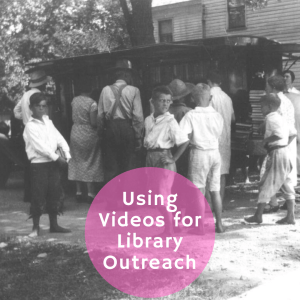
Videos Can Reach Library Users at Home Now and in the Future. Here’s Your Starter Kit.

In a time of social isolation, video is a great way to communicate with patrons. A video can help you provide service to the community without having an open physical building.

If you are nervous about using video for marketing, I’ve got a secret for you. Video, whether live or recorded and edited, is easy and relatively inexpensive. During the COVID-19 crisis, it’s now necessary for you to produce videos. And, when things return to normal (and they will) you will have the skills to extend the reach of your library to home-bound customers through video.

Using video for library outreach

This list will help you brainstorm specific videos to fill your library marketing content editorial calendar.

Demos: You can show library users how to navigate your digital resources. You can show them how to use specific platforms, like Overdrive, LearningExpress Library, or Lynda.com. Demonstrate how to search a database, like NoveList or Consumer Reports. Make a video to show how patrons can talk to a librarian through chat or email while buildings are closed.

Programs: Many libraries are moving their planned program presents online right now. And this is a great video opportunity. You can record a teaser video, then the actual event, and a highlight reel for further promotion of more presenters. You can also move your story times to video format.

If you do these videos live on Facebook, Instagram, or YouTube, your viewers can still ask questions by commenting. In fact, live videos are a great option for library reach.ย  Viewers spend up to eight times longer with live video than with video-on-demand.

Book reviews: Turn the camera on yourself or a fellow book lover and record a review! I have started doing this on my YouTube channel. It took me about five minutes, once I figured out what I was going to say. Writing a Goodreads review of the book first helped me to organize my thoughts.

What equipment do you need?

In the past, producing video was expensive and difficult. But that is no longer the case. If you have a smartphone, you’re set. You can also record video on most DSLR cameras.

If you have an Adobe Creative Suite license already, you can use that to edit. You can also use iMovie or a host of other online editing software pieces, many of which are free. Here’s a great list. I edit the Library Marketing Show videos on my iPhone or using YouTube studio. And that’s really all you need!

Before you begin

Before you record anything, it’s important to identify who your target audience will be, and what the goal of the video will be. What do you want your audience to do after watching the video? This will help you plan the script, the call to action, the setting, and the goals by which you’ll measure the video’s success.

You should also decide where the video will live… on Facebook, on Instagram’s IGTV, on your library’s webpage, on YouTube, etc. Decide on one target location for your video.

Writing a script or outline

Most library videos will need a script or, at the very least, an outline. If you skip this step, you’ll may spend more time than you want editing. You may even discover you have to re-record certain sections. Your video might end up being longer than necessary. It might not be as engaging as you hope.

When I do the Library Marketing Show, I write a script. Sometimes it’s just an outline with key points. And sometimes it’s a word-for-word account of what I want to say. The script or outline helps me to formulate my thoughts. It also helps me time the video so I’m sure I’m not babbling on for longer than I need to be. But I don’t memorize my script. You know those cards with key points that I hold up during the video? Those are like slides in a conference presentation–they are visual cues to me so I can remember what I need to say.

As with any kind of library marketing, the language of your video should be relaxed, clear, and conversational. Avoid complex sentences and industry jargon or buzzwords. Speak to your video audience as you would to a customer at the front desk.

Also remember that the written word will sound different when you read it out loud. I rediscover this every time I do a webinar or a video! Be sure to read your script out loud before you record.

If your video features an outside presenter, write an introduction, as you would if you were doing the program in person. Be sure to tell your viewers how they can contact you with questions or comments during the video, if it’s live, or later if they are watching on-demand.

Time to record

Before you start recording, be sure your device has enough storage. If you’re using your smartphone, turn on the “Do Not Disturb” feature to avoid distracting notifications. When I shoot my videos, I also do a few test recordings to make sure the lighting, the background, and the sound are the best they can be.

Record horizontally. This gives your video the best viewing experience on most platforms. If you are recording yourself speaking, be sure your camera is on a level surface and won’t fall over! And don’t forget to focus on the object that’s most important, like your face.

If you are shooting a video of yourself, be sure to look at your phone’s camera… not at yourself on the screen. This may feel like the weirdest thing ever. But it looks more normal because it mimics looking someone in the eye.

It may take a couple of takes to get a video right. Don’t despair… and don’t erase any bad takes until you publish your finished video officially. You never know what footage you may need in editing.

If your video needs music

The right music can set the mood and tone for your video. Do you need background music or something that will manipulate the mood of your viewers? Will someone be speaking in the video? What kind of pace should your music have–fast, steady, ethereal, dramatic? These are all factors to consider when choosing your music.

Most music isn’t free. If you use an artist’s music without permission or proper licensing, you risk legal action against your library and your video may be removed from social media channels. Look for royalty free tunes to fill your music needs.

Royalty free songs aren’t free to use; they’re quality songs available for a single flat fee. This means you don’t have to worry about paying additional licensing fees or royalties in the future. YouTube, Shutterstock, and Epidemic Sound are all great sites to find royalty free music.

Posting your video

You’ve got a couple of good options for housing your finished video. YouTube is the largest video hosting platform It’s free to upload your videos to YouTube and optimize them for search. I created this guide for optimizing your videos on YouTube.

Vimeo is another choice. There is a free option, with limited storage space. During the COVID-19 crisis, videos on Vimeo might be higher quality because YouTube has reduced its streaming quality to deal with bandwidth issues.

You can also post videos on Facebook, IGTV (this is Instagram’s version of YouTube), and of course, your library’s own website.

Pick one spot to house the full-length video. Then use your other marketing channels to drive traffic to your video on that one, main location.

It doesn’t have to be perfect

We all have this idea that the video must be narrated by the perfect person with the perfect hair in front of the perfect background. That’s old school TV thinking and it’s no longer necessary. In fact, the best videos are the ones that show your library’s authentic self. Don’t worry about getting every little hair to lie in place, having the right clothes, or always saying the right thing. You’re talking to real people, even if they are on the other end of a video screen. And they’ll forgive you–and love you–if you aren’t robotic. You will find fans will love you just for being you!

More Library Marketing Help During the COVID-19 Crisis

Recording of live session on promoting your online resources through social media.

Self-Care for Library Social Media Staff in the Midst of a Crisis like #COVID-19

Library Marketing During a Pandemic: Tips for Working from Home or the Office and Dealing with the Stress of a Crisis

How #COVID-19 is Impacting Social Media Marketing and What That Means for Libraries

Subscribe to this blog and youโ€™ll receive an email every time I post. To do that, click on the โ€œFollowโ€ button in the bottom left-hand corner of the page. Connect with me on YouTube, Twitter,ย Instagram, and LinkedIn. ย 


How to Use Tiered or Staggered Promotion in Your Library Marketing! The Library Marketing Show: Episode 25

Watch This Episode

In this episode of The Library Marketing Show, Angela answers a webinar question: “How do you keep the public informed about what the library has to offer? Often we promote a new product or service, but if patron missed that wave of new promotion they probably donโ€™t know about it (especially databases and other electronic resources). Do you ‘re-promote’ and how?”

I was at a conference where I heard a marketing expert named Andrew Davis talk about tiered distribution. The approach takes advantage of a consumer cycle of excitement. I talk about that in the video!

Also kudos to Champaign Public Library for their โ€œWhy People Love the Libraryโ€ video. The production value is beautiful, and they did a really good job showing the library as a diverse, welcome space. They really give you a sense that their library is modern and more than books. The last soundbite is the best! Watch the video here.

Have an idea for the next Library Marketing Live Show?ย Submit it now.

Want more Library Marketing Show? Watch previous episodes!

Check the Upcoming Events page to see where I’ll be soon. Let’s connect!

Subscribe to this blog and youโ€™llย receiveย an emailย every time I post. To do that, click on โ€œFollowโ€ button in the bottom left-hand corner of the page. Connect with me onย Twitter,ย Instagram, andย LinkedIn.ย ย 

A WordPress.com Website.

Up ↑