Search

Super Library Marketing: Practical Tips and Ideas for Library Promotion

Category

library marketing ideas

The Top Eight Free Websites to Spy on Competitors and Get Ahead in the Library Marketing Game!

Eight Free Websites to Use to Spy on Your Library Marketing Competition

Library marketers are asked to make a lot of miracles happen. We are asked to grow circulation, drive attendance at programs, and increase the visibility of our libraries.

To reach your goals for 2020, your library marketing needs to stay ahead of your competitors. Who are you competing with? You’re fighting with independent bookstores, Amazon, Audible.com, video streaming services like Netflix, museums or other local attractions, genealogy websites like Ancestry.com, language apps like Duolingo, retail stores, and co-working spaces for your cardholders’ time and attention.

But don’t be discouraged! You can spy on your competitors and identify their areas of weakness. Then, you can use those weaknesses as an opportunity to promote your library. And you don’t have to pay to find out how to target your competitors.

I found eight websites that will help you gather intelligence on your competition’s website and social media presence. Most of these sites require you to sign up with an email and password for free access but their information is extensive. They also have paid plans (most are very affordable) that give you access to more data. I use all of them.

Here are my top picks to help you spy on your competitors in 2020!

SEMrush: This is my favorite tool. I check it frequently. Their analytics are incredibly robust. You can compare your own website and your competitors’ website in several areas, including keywords, traffic, where your page ranks on Google, what websites are sending traffic to your library’s website, and so much more. The colorful charts will tell you how well your website is positioned on the internet in comparison with your competitors. And it will even show you the cost, in dollars, that your library is losing in traffic to other websites. That’s a great statistic to have if you’re trying to advocate for additional resources for your library’s online presence.

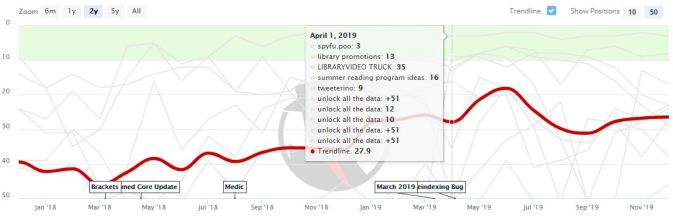
SpyFu:  Use this tool to check how high your competitors rank in SEO keyword search. Get insight on keywords that lead people to your competitors’ site, including any paid keywords they may be using. You can plot the reach of any website on a timeline, giving you an idea of when the site is seeing a spike in traffic. The graphic below shows you what that looks like for this website!

My favorite feature on SpyFu is the keyword analysis. I found out that people searching for “free downloads,” “free download music,” and “free faxing” are most likely to end up at my library’s website. Now I know that I need to make sure the word “free” appears frequently on every page of my library’s website to drive more traffic!

Social Searcher: This real-time social media search engine allows you to quickly pull all recent mentions of a competitor from the major social media platforms and the internet together into one dashboard. You can search for keywords and hashtags to see recently published posts. You can also set up email alerts to keep track of what people are saying about your library, a competitor, or a service, like Audible or DuoLingo.

SimilarWeb: This tool reminds me of Google Analytics, but with prettier graphics. You can see all kinds of useful information about your competitors including where their customers live, how much of their website traffic comes from social media, what keywords people are using to find their website and more. You can also see the top five “interests” of visitors to your competitors’ websites. And of course, you can compare that with your library’s website.

Moz: The site is focused on links and can tell you how other websites are linking to your competitors’ website, and how your competitor is using anchor text to drive traffic. You can also download their reports for free as a CSV file. You can also find out your website’s Spam Score!

Alexa:  This site will show you how your bounce rate and traffic sources compare with your competitors, as well as how much of your audience overlaps with that of your competition. Best of all, Alexa will identify keywords to drive more traffic to your website, based on what people in your area are searching for on Google and Amazon (Alexa is owned by Amazon).

TalkWalker: An alternative to Google Alerts, it lets you search blogs, websites, and news for posts about your competitors. You can have the alerts delivered to your inbox once a day or once a week.

MarketGrader: This free tool from Hubspot grades your website or your competitors on factors like how fast the pages load, keyword ranking, and security.

I did an analysis of this website and found that 30 percent of my traffic comes from mobile devices. That’s incredibly important information because that means that I must make sure everything I do on this website is responsive. This tool also gave me tips on how to increase my SEO ranking and security. All of those tips would be invaluable for my library’s website as well.

Check the Upcoming Events page for a list of webinars and conferences where I’ll be next. Let’s connect! Plus, subscribe to this blog and you’ll receive an email every time I post. To do that, click on the “Follow” button in the bottom left-hand corner of the page. Connect with me on YouTube, Twitter, Instagram, and LinkedIn.   

How to Use Tiered or Staggered Promotion in Your Library Marketing! The Library Marketing Show: Episode 25

Watch This Episode

In this episode of The Library Marketing Show, Angela answers a webinar question: “How do you keep the public informed about what the library has to offer? Often we promote a new product or service, but if patron missed that wave of new promotion they probably don’t know about it (especially databases and other electronic resources). Do you ‘re-promote’ and how?”

I was at a conference where I heard a marketing expert named Andrew Davis talk about tiered distribution. The approach takes advantage of a consumer cycle of excitement. I talk about that in the video!

Also kudos to Champaign Public Library for their “Why People Love the Library” video. The production value is beautiful, and they did a really good job showing the library as a diverse, welcome space. They really give you a sense that their library is modern and more than books. The last soundbite is the best! Watch the video here.

Have an idea for the next Library Marketing Live Show? Submit it now.

Want more Library Marketing Show? Watch previous episodes!

Check the Upcoming Events page to see where I’ll be soon. Let’s connect!

Subscribe to this blog and you’ll receive an email every time I post. To do that, click on “Follow” button in the bottom left-hand corner of the page. Connect with me on Twitter, Instagram, and LinkedIn.  

Welcome New Cardholders and Make Them ❤️ Your Library! The Library Marketing Show: Episode 24

Watch Now

Lisa at Oshkosh Public Library asks “Do you have any examples of libraries that do an exceptional job welcoming new cardholders? What do they focus on when someone signs up for a library card? How do they follow up to gauge their new cardholders’ experiences and ultimately turn them into regular library users? I’m talking about libraries that do a great job engaging with new cardholders – not just bombarding them with all the rules involved with using the library.”

I use an email drip campaign to introduce the best of what my library offers. But readers, help a sister out! Tell us what you do in the comments.

KUDOS this week to the Princh blog for their blog article “Why The Library Intimidates Me.” It was heartbreaking and great food for thought for library marketers. Read it here.

Have an idea for the next Library Marketing Live Show? Submit it now.

Want more Library Marketing Show? Watch previous episodes!

Check the Upcoming Events page to see where I’ll be soon. Let’s connect!

Subscribe to this blog and you’ll receive an email every time I post. To do that, click on “Follow” button in the bottom left-hand corner of the page. Connect with me on Twitter, Instagram, and LinkedIn.  

Don’t Forget This Important Step in Library Marketing! The Library Marketing Show: Episode 23

Watch Now

There is ONE THING that many libraries miss when they are making big decision. This thing is super important to marketing and to serving our communities. In this episode,  learn about this step is, why it matters, and how I almost missed an opportunity to put this one thing to use when making changes to my library’s print publication!

Also Kudos go out to NoveList for the free book The Secret Language of Books, which is incredibly helpful for marketing your collection. You can get a free print or digital copy!

Have an idea for the next Library Marketing Live Show? Submit it now.

Want more Library Marketing Show? Watch previous episodes!

Stay in Touch

Check the Upcoming Events page to see where I’ll be soon. Let’s connect!

Subscribe to this blog and you’ll receive an email every time I post. To do that, click on “Follow” button in the bottom left-hand corner of the page. Connect with me on Twitter, Instagram, and LinkedIn.  

Five Creative Ideas to Help You Beat the Blues, Get Inspired, and Create Amazing Library Marketing Campaigns Again!

It is hard to believe that in a building filled with the stories, a library marketer would need inspiration.

But alas, we are human. And sometimes we get stuck in a rut.

Library marketers are expected to be energetic and enthusiastic at all times. We must come to all meetings and be able to give a list on the fly of exciting and innovative ideas for promoting major developments and smaller decisions that affect the everyday cardholders.

I don’t know about you, but sometimes, I just too plain exhausted to be the marketing superwoman. The busyness of the library summer reading season seems to melt every year into the busyness of fall. There is little time to rest. And exhaustion makes it even more difficult to find creative inspiration.

We struggle to inspire our cardholders, both old and new. We want our customers to use our collection and enjoy our services every day, but we can’t seem to figure out a way to make them act. The tried and true methods of marketing no longer work and we’re frustrated, angry, and frankly, a little worried.

Here’s what I do when I find myself stuck in a marketing rut.

Define your workflow and make it the law of your marketing landscape. A defined outward-facing workflow sounds like the opposite of a creative endeavor. But in reality, it creates space for you to think. It ensures that you have time to be thoughtful so you can develop and deliver a quality product.

Set an expectation about who will manage workflow. That means all marketing requests go through one person on your team. That person is responsible for looking at the request and determining if it fits into the library’s overall strategic goals. That person sets clear expectations and goals for each project. That person communicates a plan of action based on realistic timelines and due dates.

Let me tell you: a defined workflow is a lifesaver. It reduces stress and anxiety for everyone on your team. When your staff understands what is expected of them, they can focus on the creative parts of the job.

If you are new to your library, it will take time to get a smooth workflow in place. Be patient with yourself and with others. Keep reinforcing your expectations. Eventually, your coworkers will be on board with you, especially when they start to see results.

Be generous with positive reinforcement. Positive reinforcement always creates an emotional experience for individuals or a team working together. Don’t just say, “Well done.” Write a note or a card praising specific actions or portions of work. Give yours staff unexpected breaks: team lunches and surprise treats can lift the spirit of your team and re-energize them.

Use your staff’s strengths to create passion for the work. I highly recommend that you invest in the Gallup Strengths Finders test. It gives you incredible and nuanced insight into yourself and your staff members. It shows you how to recognize the strengths of your team members and how to actually manage them to put those strengths to good use. You can find the book by Tom Rath at Walmart and Target for about $15. It includes a code that each team member uses to take the test online.

Through the Gallup process, I discovered my team members have a strong capacity for collaboration. This wasn’t much of a surprise to me. But the book also gave me suggestions for how to actually use that desire for collaboration to the advantage of my library. It also gave me greater insight and empathy for team members who prefer to work alone or who seem resistant to change. I can assign tasks to the best person for each job. It’s really changed the dynamics of my staff and made work easier for everyone.

Observe your customers. It helps me just to take a walk around the library or to visit the branches. I pretend to be browsing the books but really, I’m watching the way the cardholders browse the shelves, interact with staff, work the self-checkout machines and use the public computers. Do they look for a map? Do they look confused? Are they drawn to a particular book display? Do they linger over the new books or do they dash in for their holds and dash out? What questions do they ask? How do people actually move through the branch?

Observing the behavior of customers inside the library can give you an idea of what visitors love and what problems they encounter during their interaction with your system. Then, you can focus on creating new marketing ideas that spotlight the things your cardholders love, and answer the questions they have.

You can also observe online visitors. Spend some time poking around Google Analytics. Figure out which pages get the most visitors. Look for the pages where visitors stay for the longest period of time. Look for the landing pages with a high bounce rate. Page views and read time will help you focus effort on improving the customer experience for your website.

Check your statistics.  Our library makes circulation and programming stats available on our intranet. This little piece of data inspires me to find ways to help make their interaction with the library more worthwhile.

Sometimes a surprising trend emerges and that gives me a creative marketing idea. Sometimes a service takes a dip in usage, and it becomes clear that we need to shift our marketing focus to re-educating the public about that service. Data is such a valuable inspirational tool. Use whatever stats you can get your hands on!

More inspiration

11 Powerful Quotes for Marketing Inspiration

5 Ted Talks for Marketing Inspiration

Need Marketing Inspiration? It’s All Around You!

Subscribe to this blog and you’ll receive an email every time I post. To do that, click on “Follow” button in the bottom left-hand corner of the page. Connect with me on YouTube, Twitter, Instagram, and LinkedIn.  And check my list of upcoming events so we can connect.
How to Create a Library Marketing Strategy from Scratch! The Library Marketing Show: Episode 20

Watch now!

Your library has no strategic marketing plan in place! What do you do? Emily from Berks County Public Library System in Pennsylvania asked: “I’m the Community Relations Coordinator for the Berks County Public Library System. Our headquarters provides support services to the 19 member libraries in our county. As someone who stepped into this role two years ago where there was no strategic marketing plan in place, could you give some suggestions on best practices when creating a plan from scratch?”

Plus KUDOS go out to the Evanston Public Library in Illinois for their free book distribution centers. Find out why this is a great way to reach non-cardholders and get them introduced to the your library! Read all about their efforts here.

Stay in Touch

Check the Upcoming Events page to see where I’ll be soon. Let’s connect! I’m doing a webinar soon, so be sure to sign up… it’s free!

Have an idea for the next Library Marketing Live Show? Submit it now.

Subscribe to this blog and you’ll receive an email every time I post. To do that, click on “Follow” button in the bottom left-hand corner of the page. Connect with me on Twitter, Instagram, and LinkedIn.  

Attention! Here’s How to Write Headlines That People Simply Can’t Ignore for Any Piece of Content

In my former life as a web journalist for a television news station, crafting the best headline for each story was the most challenging part of my day. It was also the most crucial task.

A compelling headline for any piece of content–email, social media posts, blog posts, newsletters, posters, and signage is essential. The right headline will make it impossible for people to ignore your content.

It may seem silly to spend a lot of time, energy, and brainpower on a couple of words. But it’s a critical component of all your marketing efforts. Libraries should spend time crafting the best headline on every piece of content they publish. This applies to their website, blog, social media posts, press releases, and emails, including personal emails and mass emails to customers.

A good headline should give your readers a hint at the copy that lies ahead without giving away the whole story. It should trigger an emotional response that includes an irresistible urge to read more.

Think of your headline as the gateway to all the content you have poured energy into creating. It may seem tall order for a short succession of words but it can be done.

So how do you write a good headline? Here are my tips.

If someone held a gun to your head and demanded you describe the copy in one sentence, what would you say? This is my twisted yet effective technique for getting that first draft of a headline down on paper. It forces you to boil your work down to its main point or big idea. Go for the emotional core of your copy.

Example:  The title of this issue of our Library Links magazine. The lead story was about a veteran living with a disability. His neighborhood branch is a Carnegie library built in 1909. It’s never been renovated and it’s inaccessible to people living with mobility issues. We were about to ask voters to pass a levy to fund upgrades to this branch and more just like it.

I asked to interview him. He told me the story about how he can’t climb those stairs, and how fellow veteran friends who also live in his neighborhood have to drive their motorized wheelchairs to the next closest branch. The trip sometimes takes three hours. His story invoked a feeling of frustration and injustice. How the heck do you encapsulate that in a short sentence?

Keep the length manageable and the vocabulary conversational. Remember, you want to tease your readers into craving more information, not give away the whole story. You also don’t want to confuse them by using language they don’t understand.

Example: Our library recently made a pivotal switch in the way we market our storytimes. We want to emphasize the educational aspects.

It would be easy to get lost in a lot of technical language and big words to describe our focus on literacy and learning. I decided the best approach would be to write text that sounded like what I would say in person if I were talking to a parent about storytime.

This sounds like an easy step, but I see a lot of libraries and brands that get caught up in the technical language of their products and services. It makes us feel important when we use big words. But headlines and copy need to be simple in order to connect with the audience.

Headlines for press releases deserve as much attention as headlines for emails and blogs.  Library marketers must remember newsrooms are a target audience and journalists crave a good story just as much as the average Joe. You really have to dig deep to grab their attention and evoke your emotional response. You want them to go into their morning meeting and fight for the permission to cover your library’s story. So, give them enough ammunition.

Example:  This release triggered coverage by all the major media outlets in town. Its headline is very simple and straightforward but it got the job done.

Be versatile–it’s okay to change the headline based on the distribution platform. If you have a great blog post you want to share on Twitter, but the headline, when coupled with the URL and a photo, exceed the 280-character limit, re-craft the headline just for Twitter. You might also want to re-craft headlines for different social media audiences. Your Twitter fans may have a different perspective on your article than your LinkedIn fans. You can rewrite it for an email distribution too.

Example: This blog! I often change the headline for the different social media platforms. Sometimes I’ll repost a blog in a month or two with a different headline as well, just to freshen it up and catch viewers who might not have been interested by my first headline. Experimenting is good!

Use the tools. There are lots of fantastic tools to help you fine tune your headline. My absolute favorite is Sharethough’s Headline Analyzer. It’s easy to understand. Since I’ve been using it to craft headlines for this blog, my views have gone up about 10 percent!

For this particular post, Sharethrough gave me a 75 rating, which is above average. It says this headline works because it’s long, it has a human connection, and limited use of positive sentiment. It also gives suggestions on how to improve the headline to get a higher score.

Go with your gut.  Sometimes, all the tools and analysis can cloud your head. If you’ve composed a headline that you feel will do the best job at capturing your audience’s attention, use it. You know your audience best.

Subscribe to this blog and you’ll receive an email every time I post. To do that, click on “Follow” button in the bottom left-hand corner of the page. Connect with me on YouTube, Twitter, Instagram, and LinkedIn.  And check my list of upcoming events so we can connect.

How to Pick Amazing Library Marketing Swag That People Will Love AND Build Brand Awareness and Loyalty For Your Library!

One of my staff members has a request for every event, conference, and convention I attend. “Hey boss, bring me swag!”

Who doesn’t love free stuff? And seeing what other organizations give out to promote their institutions and brands is fun.

Most libraries and vendors stick to items like pens, notebooks, candy, cups, and stickers. We spend a lot of money on this free stuff, in the hopes that event attendees will love it and use it. We also use swag to increase awareness of our library and build loyalty with current cardholders and new folks!

When your budget is limited, picking the perfect swag is a big deal. Your swag has to be interesting, but it should also align with your strategy and helps your library achieve its overall marketing goals. That’s a tall order.

When a guest walks away with your swag and can’t stop raving about it, you will have done your job. And if it’s something a library cardholder or community member can use over and over again, and that makes them think of your library, your money will be well spent. A study done by Schreiber & Associates found 39 percent of all people who have received a promotional product can accurately remember the name of the company that it’s associated with as long as six months after the event!

There is another important reason for swag: it’s a conversation starter. Great swag can be a talking point for volunteers working your table to share information about services, collection items, and other related events at the library. Marketing studies show us that you have to get your message in front of your cardholder an average of SEVEN TIMES before they’ll be compelled to act on it. A direct conversation with a community member about your library counts as one of those “touches.”

A conversation between a library worker or volunteer and an event attendee is a highly effective means of marketing. According to Nielsen, 75 percent of people don’t believe the advertisements they read but 92 percent believe brand recommendations they receive from trusted sources.

Finally, giving good swag gives people a positive memory of your library. Memorable and useful items given freely and generously leaves people smiling and prompts sentiments like, “I love my library” and “I’ll always support my library.” You can’t beat that!

How to Pick Swag

Pick something functional and useful. I like to make sure the items I choose are necessary and can be used over and over again. That means that my library’s logo or name is an integral part of the life of my cardholder. I want them to constantly be seeing my library’s name or website. Some great ideas that fit this category are water bottles, kitchen utensils, ice scrapers, and pop-stoppers.

One word of caution: be aware that some attendees will take issue with certain types of swag. Many people don’t want to take a plastic bag at events because of environmental concerns. I’ve also had people turn away plastic bottles because of the possibility of harmful chemicals leaching into their water. Kids toys can be tricky because of small, removable parts.

Make sure your swag is unique and something that other organizations aren’t giving out regularly. Head to any library event or conference and you’ll find no shortage of pens, notebooks, stickers, tags, and buttons. And while all of these items are useful and cheap, I don’t want to buy any for my table because everyone is giving them out. Hand sanitizer, lip balm, license plate frames, and pet bandannas are all great examples of fun, useful swag that will set your library apart from other organizations.

Make sure your swag is relevant to the attendees of an event. Be sure to ask the organizers before you go who their attendees will be, how many people they expect, and what the event is focused around. Don’t bring all your swag to all events… pick and choose carefully. At my library, we buy different swag for different age groups. We have earbuds and multi-function charging hubs for teens, piggy banks and temporary tattoos for kids, and aluminum water bottles and drawstring totes for adults.

Make sure your swag can be branded. Check the space where logos or text can be printed on items to make sure your particular logo, tagline, or library website will fit and be legible. I’ve totally made this mistake: you spot a great piece of swag at a great price. But the area where your logo or tag line is imprinted is too small or oriented the wrong way. No one can tell it’s from your library! Pay special attention to the imprint area, especially if you have a long tagline or a logo that can’t easily be resized or re-oriented.

Watch The Library Marketing Show to see some of my favorite choices for swag and talk more about why it’s so important for marketing!

No budget for swag? Do a giveaway. I’ve often had leftover donated items like gift cards that I use as giveaways at events. A giveaway, when promoted ahead of time, will drive attendees to your table. Ask people to give their email address and add them to your newsletter or email subscription list in exchange for an entry in your contest.

Subscribe to this blog and you’ll receive an email every time I post. To do that, click on “Follow” button in the bottom left-hand corner of the page. Connect with me on YouTube, Twitter, Instagram, and LinkedIn.  And check my list of upcoming events so we can connect.


🤷If You’re New to Library Marketing, Where the Heck Do You Begin? The Library Marketing Show Episode 18

WATCH NOW

In this episode, we answer a question from Megan from the Redford Township District Library in Michigan. She asks, “I’m brand new! New to the Redford library and new to the Library realm in general. I am two years out of college and my most recent marketing experience is in the automotive field (very different ). I am wondering where do I start? Tips & tricks for just starting off?”

I offer some advice and starting tips for Megan. Be sure to add your advice to the comments! Let’s crowd source a great experience for Megan’s first year as a library marketer!

I also offer kudos to the King County Library system in the state of Washington for their brave decision to stop buying eBooks from Macmillan. They did it in response to Macmillan’s decision to embargo new eBook sales to libraries for two months. It’s brave and if we all band together and follow their lead, we might be able to make a difference! Read this great article from Publisher’s Weekly on their decision.

Stay in Touch

Check the Upcoming Events page to see where I’ll be soon. Let’s connect! I’m doing a webinar soon, so be sure to sign up… it’s free!

Have an idea for the next Library Marketing Live Show? Submit it now.

Subscribe to this blog and you’ll receive an email every time I post. To do that, click on “Follow” button in the bottom left-hand corner of the page. Connect with me on Twitter, Instagram, and LinkedIn.  

A WordPress.com Website.

Up ↑