In this episode, we talk about an anonymous question from a reader who has a little problem: The departments in their library get upset when they re-write their text suggestions for marketing messages. I’ll talk about how I handle this situation at my library. We’re all in this boat, right??
As promised, some articles to help convince your skeptical programming co-workers about the importance of writing library marketing text.
Also kudos to the West Gippsland Libraries in Australia for their hilarious new brand awareness video.
Stay in Touch
Check the Upcoming Events page to see where I’ll be soon. Let’s connect! More events are coming soon.
Have an idea for the next Library Marketing Live Show?Submit it now.
Subscribe to this blog and you’ll receive an email every time I post. To do that, click on “Follow” button in the bottom left-hand corner of the page. Connect with me on Twitter,Instagram, and LinkedIn.
In this short video, we talk about what you should do if your a librarian and your library has asked/forced/demanded/requested that you also handle the marketing. If you don’t have a communications degree, what should you do? Can you do it? Answer: YES!
(Watch episode 14 to see why I generally don’t hire librarians to do marketing).
Also KUDOS to Chicago Public Library for going fine free!
Talk to me! Share thoughts about this video in the comments, LIKE it, SHARE it, and subscribe (Pretty please!). Let’s grow this channel together.
Stay in Touch
Check the Upcoming Events page to see where I’ll be soon. Let’s connect! More events are coming soon.
Have an idea for the next Library Marketing Live Show?Submit it now.
Subscribe to this blog and you’ll receive an email every time I post. To do that, click on “Follow” button in the bottom left-hand corner of the page. Connect with me on Twitter,Instagram, and LinkedIn.
A few weeks ago, I had an incredibly disappointing interaction with a man I’ve looked up to for ages. I’m not going to name him or his website in this post. But I’ve been listening to his podcasts for more than five years. I’ve sent staff to his conference. I’ve recommended his website and his materials here on the blog. I’ve met him in person. He was lovely to me.
But about a year ago, he started doing something that really upset me. He got into the habit of interrupting guests on his podcast. All. The. Time.
I’m a manager. I’ve been trying to foster better listening skills in myself and my staff.
It irked me that this person never let anyone finish a thought. It got so bad that he started cutting people off as they were explaining concepts and giving specific instructions on marketing tactics.
I decided to email him to ask him to stop interrupting his guests. I was as polite. I told him I loved his show and website. I said that I wished he would just let people finish their thoughts.
Here was his response:
Thanks for the feedback Angela. I pre-discuss with all of my guests that I often have questions and will likely stop people who are fast talkers and dig deeper. They all know I will do it. Indeed many of my listeners love that I do this. For example: ” I have to say that you have a special gift for asking great questions and making sure the audience can actually visualize the process & pin down your guest to clarify so we fully understand the material presented. It’s like you have a second sense for what we are thinking. I think of a question, and BAM!…you come in with the perfect question that was on my mind. (I don’t even know if I’m saying this right but I bet you know what I mean). I listen every day and look forward to the incredible, valuable and TIMELY nature of what you share. I’ve been a long-term fan of your blog for years and if anyone is seeking to stay current in what’s going on with everything related to social media marketing, you’d be crazy not to take advantage of this invaluable podcast. Thank you, for your gift of putting yourself in your audiences shoes and knowing how to get clarity from your guests. It’s truly an awareness most podcasters lack. Truly inspiring!”
So yes I understand that sometimes I interrupt guests but it really is by design to help make the show better AND the guests are fully in agreement that it’s okay for me to do it.
I NEVER intend for it to be rude EVER. I am actually friends with most of the guests that get on my show so I will reach out to them and see what they say. Thanks again for your perspective.
There’s a lot to unpack here. In a nutshell, this was a defensive response. I didn’t feel heard. I didn’t feel acknowledged. I didn’t feel that this person was willing to do anything to address my complaint. The unattributed customer testimonial is self-important.
I ended up unsubscribing from the podcast.
And because I always try to learn from my experiences, I decided to use this exchange as a catalyst to think about the best way to respond to negative comments from library customers.
Libraries have it pretty easy. Most of our cardholders love us and rave about everything we do. It’s good to be loved.
But we do have our critics. They may post their comments online or in email. They may express their complaints to you in person at the front desk or at events.
Like this podcaster, your immediate reaction may be to go to defensive mode. You may feel the need to defend your library, its services, and practices. That’s a totally natural response.
But I want you to take a step back (and a big, deep breath) and find the opportunity in that negative comment. There are ways to response to customer feedback, even negative feedback, that acknowledge the complaint without damaging the relationship between your customer and your library.
Your response to complaints can also build credibility for your organization. And, because emotions are involved, it’s best to have a process in place beforehand so you can handle complaints professionally and swiftly. Here are your new best practices.
Don’t censor online comments. Unless the comment violates your social media or website standards of behavior in some grave way, don’t hide the comment and don’t want to respond negatively.
Respond as quickly as possible. It’s important to address the issue as soon as you can. The basic rule of thumb for businesses now is to respond to complaints within 60 minutes. I know that’s difficult for a lot of libraries, who struggle to balance staff work time in a 24-hour a day world. Make your best effort to respond to complaints quickly. Never let a complaint sit without an answer for more than 24 hours, even if that means you have to answer it on your off time.
Acknowledge the customer’s words and apologize. By simply telling your user that you hear what they are saying, and that you are sorry for the situation, you can diffuse a good deal of the anger or hurt that can be associated with a bad library experience. An apology is not a sign of guilt. It doesn’t mean that the complainer is right. Just saying, “I’ve been in situations like this before and it’s frustrating. I’m sorry this happened to you” can help to smooth the road for resolving the issue. It increases the likelihood that your complainer will leave the interaction with a renewed love for the library.
A co-worker asked me what I had hoped to hear from the podcast host I emailed. This was all he would have had to say to keep me as a fan and listener: “I’m sorry. I’ve been interrupted while speaking and it is frustrating. I’ll work on that.”
If the problem cannot be solved easily, take it offline. Ask the cardholder for their email address so you can continue to resolve the complaint without doing so in front of an audience. “I’m sorry to hear you are having this problem. We want to make it right. Can I have your email so I can ask for more details about your experience? Then I can make sure your issue gets in front of the right person and is addressed.”
Realize that you cannot please everyone. Every once in a while, someone will complain about something and you will not be able to fix the problem. Apologize, explain your library’s side of the situation as best you can, and move on.
Don’t forget to join us for the LIVE LIBRARY MARKETING TALK ON INSTAGRAM every Tuesday at noon ET. We’ll talk about library marketing topics for about 15 minutes each week. My handle is Webmastergirl. You can email questions and topic suggestions ahead of time. Just fill out this form.
Subscribe to this blog and you’ll receive an email every time I post. To do that, click on “Follow” button in the bottom left-hand corner of the page. Connect with me on Twitter,Instagram, and LinkedIn.
Can you answer this super short survey about the live show? I need some feedback, please!
Things We Talked About
Collection marketing! Tracy from Wright Memorial Public Library asked to talk about marketing the collection. I do this at my library mainly through email and social media. I have a strong relationship with my friends in the Materials and Acquisition Selection department and I talked about that and why it’s important to not take it for granted that your cardholders know that the library has new materials.
You still have time to register to attend the free webinar on digital promotions happening tomorrow, Thursday, July 25! You’ll find the link to that plus two conferences where I’ll be speaking on the events page.
Have an idea for the next Library Marketing Live Show? Submit it now.
We’ll chat on Instagram on Tuesday at noon EST for about 15 minutes. My handle is @Webmastergirl so follow me to see the show live!
It’s been a long time coming. I first pitched the idea of a blog to senior leadership in 2015. I created a document that explained the reasons why our library needed a blog. It also laid out my bare bones ideas for how the content creation process would work.
Marketing Advantages to Having a Library Blog
Easy, cheap, effective way to promote smaller, niche programs.
We no longer have to rely on traditional media to get the word out about programs and services. We have our own publishing platform for reaching our audience. Traditional media outlets will follow the blog. The posts will be more engaging than a press release and will pitch themselves as bigger story ideas.
The blog will give us something to link to for promotional posts on social media.
A blog would be a place to show our thought leadership. We are the information experts! We can demonstrate why people should care about what we say in a long-form, insightful, and meaningful way.
Easy way to keep our brand top of mind all the time.
Easy way to show the Library’s human side and let our customers get to know one another.
Partnership opportunity: We can invite partners to write posts for the library, creating great, shareable content for our users and in turn getting our posts shared by our partners.
So How Would This Work?
Marketing would be the centralized location for publication-we would manage the editorial calendar, recruit writers, copy edit, publish, and promote posts.
We would set a cadence for posts—one post per week to start—and re-evaluate at a later date.
We would recruit post writers from all branches and departments at the Library. We would also recruit Library customers, evangelists, and fellow bloggers and influencers to write guest posts. We would provide them with a simple template for writing their posts, which we would copy-edit and publish. We would ask all guest writers to share the content, once published, on their platforms, giving us instant exposure to their audience.
Editorial standards will be high: content must be written in a conversational tone, AP style usage of punctuation and grammar must be adhered to, and posts must be engaging, shareable, and interesting to our core audience.
We would also re-purpose content to use as posts, providing new/updated/additional information not seen in print from sources such as Library newsletters, and email.
We would evaluate top performing posts once per month and adjust our editorial calendar as necessarily based on data.
I also created a mock editorial calendar listing various post ideas and who might be tapped to write them. After presenting these to my boss, I waited.
And waited.
And waited.
For four long years.
Finally, in the summer of 2018, there was major leadership change at our library. Our previous director resigned and a new person took the director’s role. And a few months after that, marketing got the green light for a blog.
To say that there was much rejoicing and celebrating among my staff would be an understatement. After the confetti was cleaned up and the champagne was gone (I’m kidding–there was no confetti or champagne and I regret this immensely), we realized we had to launch this thing as we had promised. And so, we did! Here’s our beautiful finished product.
Our first blog was published on March 4, 2019. So far, we’ve published 65 posts on the blog.
It has already fulfilled all of the advantages I listed in the proposal document. Traffic to our website is up. Media are now going to our blog for story ideas about the library. Our search ranking increased. We have lots of partner organizations asking for permission to write posts for us. Our staff members are writing posts and using the blog as a way to let the public know about the important work they’re doing in their branches and departments. We haven’t spent any money creating beyond staff time. And it helps us to stay top-of-mind with our cardholders and the community at large.
We did learn some big lessons during the process and I want to share them with you now.
Lessons Learned While Launching a Library Blog
Lesson #1: The hardest part is getting started. It took forever to get buy-in on the idea. Keep advocating. Don’t give up.
Lesson #2: Building something from scratch is exciting and frustrating. It was liberating to have the freedom to do whatever we wanted. It was also terrifying. Lean into it! Be open and honest about your fears and expectations. Keep your supervisors in the loop about your observations as you work through the process.
Lesson #3: Communication with staff is vital. Get a vision and guidelines set down on paper and approved as soon as possible, then tell staff so they can begin to build excitement among cardholders. Their enthusiasm is your best marketing tool.
Lesson #4: The first year will be about experimentation. Set a posting schedule that you can keep to without having a stroke. Write all kinds of posts to see what interests your audience. Experiment with posting on different days of the week to see which is best for capturing your audience’s attention.
Lesson #5: Promotion of your blog is just as important as your blog itself. Make sure you work out a plan for how you’ll promote the blog once it’s up and running.
My big piece of advice is to actually refrain from promoting the fact that you have a blog until you have a cache of articles. Promote individual posts but wait a couple of weeks to start talking about the blog as a whole service. Once you have a variety of posts up on the blog, then you can do your big promotional push and reveal. You’ll have to do this full push campaign at least once a year to remind the public that the blog exists, and to let new cardholders and community members know that it’s there.
Lesson #6: Your blog doesn’t have to be perfect on launch day. Pick a launch day and stick to it. It can be a work in progress. You can fix things as you go along. But if you wait for it to be exactly perfect, it’ll never get off the ground.
Lesson #7: Measure and report. Data is your friend. Evaluate what works and what doesn’t. look at the data but also gather feedback from staff and customers about what they want to see.
Don’t forget to join us for the LIVE LIBRARY MARKETING TALK ON INSTAGRAM every Tuesday at noon ET. We’ll talk about library marketing topics for about 15 minutes each week. My handle is Webmastergirl. You can email questions and topic suggestions ahead of time. Just fill out this form.
Subscribe to this blog and you’ll receive an email every time I post. To do that, click on “Follow” button in the bottom left-hand corner of the page. Connect with me on Twitter,Instagram, and LinkedIn.
I spend a good portion of my day as a library marketer trying to figure out how my cardholders live their lives. What do they do? When to they do it? What parts of their life are difficult? What parts are enjoyable? When do they have free time?
We do know a lot about the people who use the library, thanks to our own library surveys and great organizations like Pew Research Center. But you can also figure out what your cardholders are doing by email marketing experimentation. And your findings can increase the effectiveness of your marketing.
On the Library Marketing Live Instagram show, Dari from Cook Memorial Public Library District wanted to know how to figure out the best time to schedule marketing email to different audiences. The answer, in general terms, is between 6 p.m. and midnight. But I want to dive a little deeper into how I came to this conclusion and why this might NOT be the case for the people using your library!
If you’re just starting out with email marketing, check with the experts. There are a lot of companies (mostly email marketing software companies) which publish research on the best time of day and the best day of the week to send marketing emails, plus a bunch of other data points. So, start by gathering the latest research from these companies. Some of my favorites are Hubspot, AWeber, and Convertful.
Think about the daily life of your cardholder. If you are sending an email to a group of people who use a particular branch, or who are in a particular age group, try to imagine what they do all day. This generalization method will help you identify points in the day in which your target audience might have time to check their email.
Here’s an example: When I’m sending emails to parents of school-age children, I avoid 7 a.m. to 9 a.m., when parents are usually racing to get their kids ready to go to school. I also avoid 2:30 p.m. to dinner time, because many parents are picking up their kids, running them to extra-curriculars, and tackling homework. I send marketing emails very early in the morning, like 5 a.m., so they are sitting in their inbox when they wake up but before their kids are up. I also send them after 8 p.m. when most school-age kids are in bed.
When I send emails to teenagers, I never, ever, ever send them in the morning. I exclusively email teenagers at night, and the later the better. That’s because most teens don’t have time to relax until 9:30 p.m. or later, after homework and after-school activities. They will likely check their email right before they fall to sleep at night, and they’re more likely to act on email in the late evenings.
Experiment. Send emails for a 3-6 months period of time. If you’re just starting out, try all hours of the day and night. Keep meticulous records of the results including open, click through, and conversion rates on all your emails.
After your allotted experimentation time, comb through the data and figure out which times of day resulted in the most click-throughs and conversions. Those are your optimum times to send emails! Focus most of your email scheduling on your proven best time of day.
And never stop experimenting. Start another experimentation period of 3-6 months, and then re-analyze data. If you notice a decline in click-through and conversion rates, go back to the drawing board.
My latest six-month analysis shows the best time to send email is between 6 p.m. and midnight, for all age categories and for all card types. This was not always the case. Two years ago, I could send my emails any time of the day EXCEPT between 7 a.m. and noon. But, at the end of 2018, that changed and the only emails that did well were the ones I sent at night.
Why did the effective time change? Because people’s lives change. Your cardholder base changes. The way that email gets delivered by various email providers changes. All of these factors mean that you’ll need to be in a constant state of experimentation. Don’t get married to any one time of day. Have an open mind and be ready to change your email scheduling strategy when the data tells you it’s time to change.
The most important thing is to have good content. If your emails contain stuff that your email audience wants to know about, they will engage with them, no matter what time of day it is. Try and keep your emails short. Focus on a few lines of really compelling text and one or two clear calls to action.
Bonus controversial opinion: I am not a fan of email newsletters. They usually contain too much information and too many calls to action. Their subject matter is usually too broad for their audience. I know a lot of us have to send them because senior leaders love them. But they aren’t an efficient use of email marketing. It would be better to take each section of your newsletter and send it separately to a targeted audience.
Don’t forget to join us for the LIVE LIBRARY MARKETING TALK ON INSTAGRAM every Tuesday at noon ET. We’ll talk about library marketing topics for about 20 minutes each week. My handle is Webmastergirl. You can email questions and topic suggestions ahead of time. Just fill out this form.
Subscribe to this blog and you’ll receive an email every time I post. To do that, click on “Follow” button in the bottom left-hand corner of the page. Connect with me on Twitter,Instagram, and LinkedIn.
NEW LIVE LIBRARY MARKETING SHOW ON INSTAGRAM! I’ve decided to try a new thing! I’ll be doing a live Instagram Q&A and discussion about Library Marketing. The sessions will be every Tuesday at noon ET (10 a.m. Central and 9 a.m. Pacific) beginning Tuesday, June 25. Join me to talk about library marketing topics for about 20 minutes each week. My handle is Webmastergirl. You can email questions and topic suggestions ahead of time. Just fill out this form below. See you there!
I get a lot of library marketing emails. I love to see what other systems are doing. So, I go to their websites and I see if I can get on their mailing lists! It’s fun and it helps me to find new things to promote and new ways to communicate with my audience.
I also get a first-hand look at some of the small boo-boos that other library marketers make in their emails. Email is hard. I’ve been doing email marketing for so long (feels like forever!) that I have made all of these mistakes myself! And I love email marketing, so I’m weirdly obsessed with learning about it. Some of the positive text and design choices that work for library marketing in other promotional pieces, like posters, flyers, websites, and blogs, do not work in email marketing.
The good news is that these little problems are easily fixed! Tiny adjustments in the text and design of your email can improve your click-through rates and effectiveness. Check this list against what you’re doing now and start reaping the benefits of improved email design!
Problem: too many images: A clean design is crucial to engagement. Too many images or too much text is off-putting to your email recipient.
The most common email programs like Yahoo and Outlook will NOT automatically download images. In fact, only Gmail downloads images automatically. With all other providers, the email recipient receiver must consciously click a prompt in order to download an image. That means if your image is conveying most of the key message in your email, your receiver likely won’t see it. They will miss the information and the call to action, and your email is useless.
Solution: Create an email that is mainly text-based. I have found an 80-20 mix works best: 80 percent of my email is text, 20 percent is image-based. The image I use compliments the text. Its purpose is to create emotion or set the mood of the email. It’s there to inspire. It doesn’t convey key messages and it doesn’t contain the call to action.
Problem: too much text. An email that contains several long paragraphs of information is off-putting to recipients. It gives the impression that your email will take a long time to read.
The email scheduling platform Boomerang studied results of about 20 million emails sent using their software. They found that the optimal length of a marketing email is between 50 and 125 words. A study by Constant Contact of more than 2.1 million customers found emails with approximately 20 lines of text or 200 or so words had the highest click-through rates.
Excessive text can also send negative signals to spam filters. Too much text added to excessive punctuation or large images could keep your emails from ever arriving in an inbox.
Solution: Limit your email text to 200 words or less. The recipient should be able to read all the information in your email in about 15 seconds. If you have more information to share, use your call to action to indicate that there’s more to know about your subject. Then send your recipient to a landing page where they can get all the information they need.
Problem: Text that is too small. Keep in mind the growing number of people who will read your email on a mobile device. You want to make sure they can actually see your words. An 11 or 12 point font size is too small to be seen clearly on a screen.
Solution: Increase your text size. Email font should never be below 18 point in size. You should also use the bold option to make the most important information stand out.
Problem: Wishy-washy calls to action. A compelling call to action is one of the best ways to increase the click-through rates of your library marketing. Some library marketing emails also contain too many CTAs.
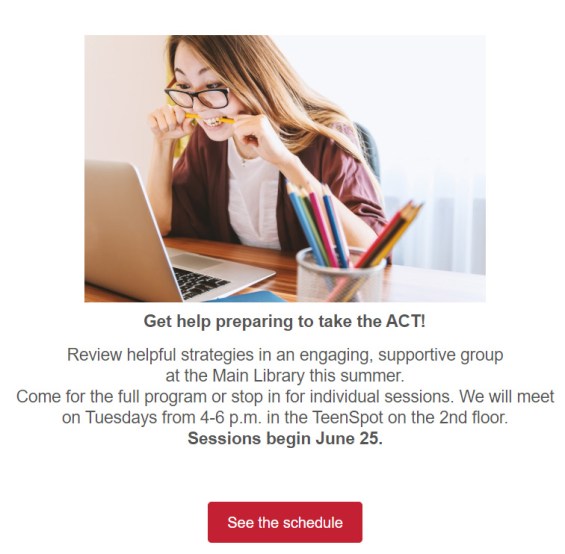
Solution: Use positive, active language in your CTA. “Register” “Read This Book”, “Learn More”, “Join Us”, “Donate”, and “Get Started” are some of my favorites. I put my CTAs in a square red box that looks like a button to compel my recipients to click on them. I embed the CTA in my image as well and use the “alt text” to convey the CTA in case someone’s eye skims the email. I try to keep my CTAs to one per email.
One image, with the main text in bold at 18 point found. A few sentences and a clear call to action.
Problem: Ignoring mobile responsiveness. Mobile opens accounted for 46 percent of all email opens according to the latest research from Litmus. If your emails aren’t optimized for mobile, you are missing a huge potential audience, particularly women and young people.
Solution: Optimize your emails for mobile to make them responsive. Most email marketing programs offer mobile responsive templates. My library uses Savannah by OrangeBoy. We switched to all responsive templates in January of this year. I’ve seen a nine percent increase in click-through rates. I count that as a win!
Problem: No system for proofing your emails in different kinds of email boxes. Your email design might look great in your creation software. But if you send it without testing it, you may find that your email becomes a kind of monster creature! It may show up a a jumbled mess of images and text. This happens because every email inbox will convert your email differently.
Solution: Test your email to make sure your message displays correctly for your recipients. Find people that you trust you have different providers… someone with Gmail, someone on Outlook, someone on Yahoo, and so on. Send them the message and ask them to check for warped images, font problems, and extra spaces.
Subscribe to this blog and you’ll receive an email every time I post. To do that, click on “Follow” button in the bottom left-hand corner of the page. Connect with me on Twitter,Instagram, and LinkedIn.
I need your help! In a few weeks, I’m giving a short online seminar to library directors about marketing! I have 15 minutes to convince them to throw their full support behind library marketing. I really want this talk to impact the way library directors think about your work. So… please let me know what you want library directors to know about library marketing. Fill out the form before you even read this post. It’s anonymous! Thank you!
Librarians are busy folks. You’re on the front lines, trying to work with cardholders and community members. You’re looking up information. You’re connecting people with social service resources. You’re filling out paperwork, creating curriculum for story time, and putting up displays. And you’re doing about 100 other things that I don’t know about because I’m not a librarian.
I worry about how much libraries lean on librarians to do their own marketing. Senior staff might believe spending money to hire staff for marketing is not a good use of their limited funds. But it’s not good for the librarians and it’s not good for the library.
I also can’t change the world in one blog post. What I can do is help the librarians in my readership to strategize to make marketing part of their regular duties. Here are four things that you can do that are already part of your job. These are marketing tactics, though you may not have thought of them that way before!
Merchandising. Merchandising is a form of marketing that focuses on presenting the items in your branch in the way that will compel people to interact with them. Every display, every sign, every decision on the arrangement space in your branch is a chance to market your library.
I know that the decision many libraries made to switch from using the Dewey Decimal system to a more categorized approach for arranging items pains library purists. But it pays off. Library visitors are accustomed to browsing in stores by categories. By mimicking that display effect, libraries make it easier for people to find the items they want and need. We want to be as easy to use (or easier) than our for-profit competitors.
It’s a time-consuming process but I’ve put merchandising first on this list because it is the most important and impactful way that librarians can market their branch. If you haven’t thought about re-arranging the materials in your branch, now is a great time to start. And to get some help, I recommend the slides from a presentation from Allison Fiscus of the Toledo Lucas County Public Library. She recently did an online seminar. Her presentation includes data that shows how merchandising positively effects the customer experience. She included a lot of visuals to help you understand her concepts. You can find them here.
Exceptional customer service. A lot of big brands have focused on improving customer service as a marketing tactic. If you are working on the front-line of your library, you have a unique opportunity to interact with cardholders.
The marketing buzz phrase for doing this is “surprise and delight.” We want to surprise our cardholders with service that exceeds their expectations. When we do that, they feel delighted with us! (Isn’t that just a sunny thought?) Delighted cardholders are more likely to spread the word to their friends and family about our system and the services we provide. They may be compelled to talk about us positively on social media, give us great reviews on Google Business, and support our work through donations or volunteerism. These are all marketing wins!
Good customer service is a competitive edge for libraries. If we can create an environment of inclusive and open access where people truly feel supported and cared for, we’ll have the clear advantage over for-profit competitors. One-on-one help is time-consuming, but it will pay off. We’ll build a reputation as a warm and inviting space. When’s the last time you heard Amazon or Best Buy described in those terms?
Library staff must make the commitment to provide good customer service. It’s not a skill that comes naturally to everyone. To help you, I love this free guide from Hubspot. It’s got templates and a ton of great information that you can use to improve your own customer service skills.
I also recommend you read this interview with Dan Gingiss, an expert at customer service. He’s written a great book with tips about customer service in social media and his interview has lots of ideas for improving library customer service to make our industry more competitive.
Word of mouth promotion. I get a lot of requests from librarians in my system who want our marketing department to promote their event or service. Posters and emails and fliers work, but the most effective method of marketing, in my experience, is word of mouth. You need to be telling your cardholders about your branch, events, and services. Talk to them!
Librarians are in a better position to sell people on their services and events than a for-profit business. That’s because you are a trusted member of the community. Librarians are admired and your opinions are valued more than the average person. Use that advantage to help “sell” the things that your branch offers!
I know word of mouth promotion seems time-consuming. But consider this. Data tells us that you have to get your message in front of your cardholder an average of SEVEN TIMES before they’ll be compelled to act on it. But when you have a direct conversation with a cardholder about your library, you are making a compelling and personal case. 75 percent of people don’t believe the advertisements they read but 92 percent believe brand recommendations they receive from trusted sources. Librarians are trusted! So just talk to people.
Sharing on your personal social media. Yes, you should be sharing posts from your library’s social media channels on your own personal channel. There’s no right or wrong way to do it. Just pick the promotions you feel most personally passionate about. Hit the “share” button and add a line about why this particular event or service is meaningful to you.
Your recommendations are trusted because of your position. It’s not unethical to share your employer’s promotional social posts. I know you feel passionate about the work your library is doing. Don’t be shy. Share your enthusiasm!
Subscribe to this blog and you’ll receive an email every time I post. To do that, click on “Follow” button in the bottom left-hand corner of the page. Connect with me on Twitter,Instagram, and LinkedIn.
This may mean I’m weird but one of my favorite things to do is check for information about social media on the Social Media Today website. And I’m a little obsessed with their monthly statistics report, which they publish in easy-to-digest infographic form. I spend a few minutes each month looking that report over just to make sure my library is still justified in posting on social media. I can also get new ideas for library marketing engagement on social media based on trends. This is fun for me. So yeah, I’m weird.
Data is always helpful. But social media is moving target. And many library marketers are busy doing other tasks as part of their job descriptions. We want to use our time efficiently. And we want to be effective.
I’ve gathered the most pressing questions about social media from some of my readers. Let’s lay out some answers and resources to help make your job easier.
What social media platforms should we post on? The answer to this really comes down to your strategy. What is your library trying to accomplish? Who is your target audience?
I love that monthly report from Social Media Today because it tells me why people use each social media platform. You can use that report to decide where you should post based on your library’s strategy and goals.
You must also consider how much time your library is willing to invest on social media. My library posts on Twitter, Facebook, Instagram, LinkedIn, and Pinterest because each of those platforms aligns with some portion of our library’s overall strategy. But I am not going to lie to you: that’s a lot of work. I’m lucky to have several staffers who work together to post. And it’s still really hard for us to keep up.
Smaller libraries will want to concentrate on the platform or platforms that will give their library the most benefit. Quality is better than quantity. It’s okay to only post on one platform!
How often should I post on social media? Posting on social media is a scientific attempt. You should set a reliable cadence. You’ll want to be consistent with your posts. Track the results and adjust your posting schedule based on the results.
Based on our experience at my library, here’s what I recommend as a starting point:
Facebook: No more than once a day
LinkedIn: Once or twice a day
Instagram stories: At least once a day
Instagram feed: Two to three times a week
Twitter: Five to 12 Tweets a day, plus retweets and responses. On Twitter, you should repeat tweets at intervals. The feed is a moving target and unless someone is scrolling through at the exact moment your tweet goes out, they’ll miss it. Users rarely go to a page to see a library’s full schedule of Tweets! It’s also okay to post 24 hours a day. There are people who are awake at 2 a.m. scrolling through Twitter!
Pinterest: Several organic Pins each day (something created by you and leading to your library’s website) plus as many curated Pins as you need to stay aligned with your strategy. An easy way to get those organic Pins onto your boards is to Pin the best new books from your collection. If you have a blog, you can also post content from that.
Does our library need to buy a Facebook ad to get any organic reach and, if so, how much should we spend? The short answer to this is yes. You’ll need to spend money on Facebook ads or boost your Facebook posts to see any significant organic traffic for your other Facebook posts. That’s the sad fact of it. (can you tell my enthusiasm for Facebook is waning?)
That said, you don’t have to spend much money at all. Most libraries can spend about $2-3 a day to boost a post or promote an event and see results. Facebook gives you a lot of control and help in choosing a target audience. As always, you’ll have to look at your library’s overall strategy to determine which posts to spend money on.
How can I get more followers on my social media accounts? Please stop focusing on follower counts. I want libraries to focus instead on engagement. It’s kind of like speaking at a conference. You might be thrilled at the prospect of talking to a huge group of people. But if half of your audience is yawning or looking at their phones, what is the point? It’s much more meaningful to speak in front of a small room of people who are riveted by what you have to say.
That’s how I look at social media followers. I don’t care how many followers my library has on any social account. I want people who want to engage with our content. Focus on shares, likes, and comments for posts and not the number of followers.
Should we have a team of people posting to social media or should we take a centralized approach? I am an advocate of centralized social media posting. If you have one or two staffers who post to all your social media accounts, you can preserve the brand voice and protect the security of your accounts. However, one or two people cannot know everything that’s going on in your library system. So create a team of contributors, who send post suggestions, photos, and videos.
Subscribe to this blog and you’ll receive an email every time I post. To do that, click on “Follow” button in the bottom left-hand corner of the page. Connect with me on Twitter,Instagram, and LinkedIn. I talk about library marketing on all those platforms!





 Super Library Marketing: Practical Tips and Ideas for Library Promotion