Search

Super Library Marketing: Practical Tips and Ideas for Library Promotion

Paid Partnership for the Win! How a Library System Turned a Holiday Tradition Into an Opportunity To Reach New Library Marketing Goals

Photo courtesy Cincinnati and Hamilton County Public Library

Trenton Smileyโ€™s job in a library is what you might call a full-circle moment.

At the age of 21, Trenton went to the library with his future wife to research careers. While inside the library, he decided to study communications in college.

Years later, he is working in communications for a library, specifically as Director of Marketing and Communications for Capital Area District Libraries (CADL). Located in Lansing, Michigan area, the library encompasses a service area of approximately 230,000 residents.

Every year, CADL does something extraordinary to reach new audiences. Beginning in 2020, the library launched a Christmas Eve Radio Storytime in partnership with 99.1 WFMK, one of the top radio stations in the Lansing market, especially among female listeners. During the holiday season, the station switches to an all-Christmas Music format, which provides a nice fit for storytime.

โ€œWe decided to read Clement Mooreโ€™s 1837 poem โ€˜Twas the night before Christmas because it was part of the public domain,โ€ said Trenton. โ€œEach year, we select one of our youth librarians to read the poem over a wonderfully produced music bed (done by the radio station) that also included special sound effects.โ€

โ€œA holiday greeting from our executive director Scott Duimstra is always included along with a message from a special guest. Michigan Governor Gretchen Whitmer appeared in 2020 and 2022, while a cast member of Disneyโ€™s Broadway Show Frozen appeared in 2021 to promote the show, which was coming to our community a couple of weeks after the storytime aired.โ€

The radio storytime, which is about six minutes in length, aired twice on Christmas Eve. Listeners could also hear the storytime on sister station 1240 WJIM every hour until midnight. To become more inclusive, CADL launched a Spanish version of the storytime which airs on two NPR radio stations and a Spanish podcast owned by WKAR.

The cost is about $500 to air the storytime, but the station helps promote the special through free commercials and placement on the website and social media.

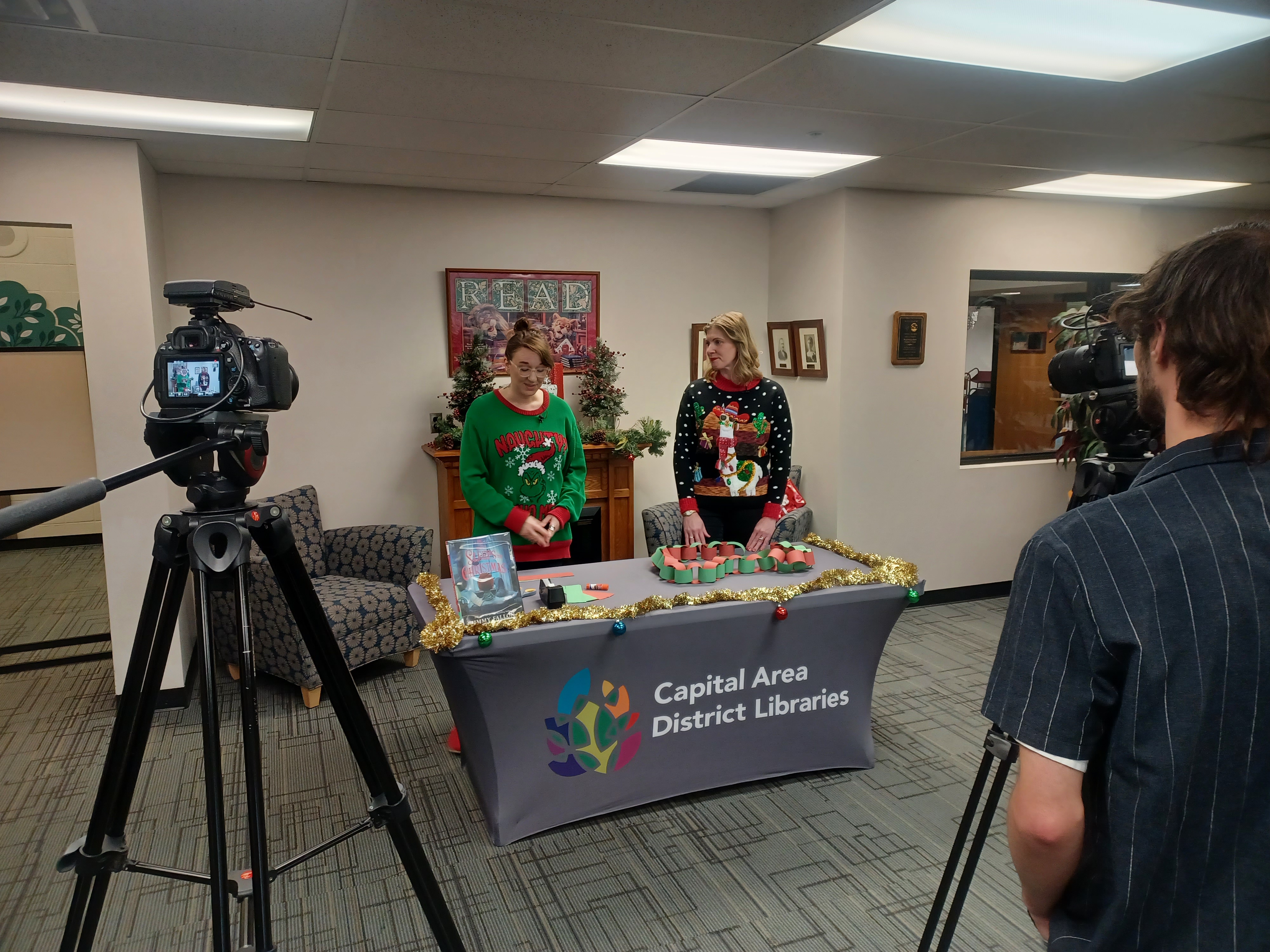
In addition to promotion on the radio, CADL began working with a local TV station WILX TV-10 to promote their reindeer visits and other holiday events.

โ€œIn addition to on-air ads, we also run homepage takeovers of WILX.com,โ€ said Trenton. โ€œA homepage takeover allows us to have 100 percent share of voice by using all available ad positions for a 24-hour period. We use this practice often to generate a great deal of web traffic over a short period of time.โ€

The library has taken that one step further by sponsoring the stationโ€™s broadcast of How the Grinch Stole Christmas and 5 More Sleeps Til Christmas. Itโ€™s a fantastic opportunity to reach people who never interact with the library.

โ€œThe idea to sponsor the holiday block of specials is really based on the homepage takeover concept,โ€ explained Trenton. โ€œWe would secure all the available local ad positions during the hour block of holiday specials, which translated to two minutes. We would use this ad time to air 2, one-minute segments featuring a duo of librarians demonstrating a craft that was related to one of the holiday specials.โ€

It only took one day for the library to receive clearance from station management. The station also offered to help produce the library segments and promotional ads, as well as help create awareness of this special program the week leading up to the air date. It took another hour to shoot the segments and promos for the event.

Trenton said his library had specific goals for this paid partnership: to find ways to share the library experience. Specifically, Trenton had three main goals.

  • Increase marketing reach and frequency. โ€œWe focus on a more outward approach to our marketing. The larger pool of people we can engage with the greater chance we have to convert them to users of the library. The same is true of how they are seeing and hearing our messages and content. โ€œ
  • Strengthen brand awareness. โ€œThese programs provide us with an opportunity to highlight our expertise, create awareness of CADL, and position the library differently in the minds of the viewers and listeners.โ€
  • Expand promotional inventory. โ€œCreation of programs like these provide CADL with content in which to promote other services and generate sponsorships.โ€

โ€œSince the specials aired during primetime on Friday evening, December 23, we were confident that there would be a large viewing audience and worthy of the $800 price tag,โ€ shared Trenton. โ€œThe total planning time on our part was about an hour.โ€

The television and radio events were marketed via email, social media, branch digital signage, press releases, a holiday guide, and promos on radio and television stations. โ€œAll the tactics helped spread the word about the specials,โ€ said Trenton. โ€œBut I favor the digital ones because they provide real-time reporting on engagement.โ€

And, the partnership was indeed a success. โ€œBased on the audience sizes of both our television and radio programs, we were able to accomplish our goal of increased marketing reach,โ€ shared Trenton.

โ€œThrough the partnerships with both the television station and three radio stations, we received free promotional ads which helped with our goals of increased frequency, strengthened brand awareness, and more content in which to use to cross-promote services and use for sponsorships. Discussions have also begun about expanding the number of radio stations airing our special storytime.โ€

Trenton says his library marketing inspiration comes from the for-profit world including Disney and retail outlets.

He has advice for library marketers looking to leverage events to promote their libraries.โ€œNegotiate from a position of strength,โ€ he said. โ€œLibraries have so much they can leverage including their expertise, content, goodwill, footprint (digital & physical), and customer base.โ€  


More advice

The One Question Your Library Staff Should Ask Every Single Guest To Unlock Promotional Success!

Building Advocates and Allies: How One Library Marketer Used Storytelling To Improve Promotions and Unify His Library

Subscribe to this blog and youโ€™ll receive an email every time I post. To do that, enter your email address and click on the โ€œFollowโ€ button in the lower left-hand corner of the page.

Thereโ€™s New Advice for Libraries About Posting to Social Media butโ€ฆ Should You Actually Take It?๐Ÿค”

Watch Now

The Library Marketing Show, Episode 176: A marketing agency has done the research and is unveiling the best days and times to post on social media. But is this the advice your library has been searching for? Or will you end up being less successful on social media if you take it?

We’ll unpack the results and how to interpret them in this episode.

Kudos in this episode go to the Milton Public Library.

Do you have a suggestion for a topic for a future episode? Want to nominate someone for kudos? Let me know in the comments.

And subscribe to this series to get a new weekly video tip for libraries.

Thanks for watching!


Subscribe to this blog and youโ€™ll receive an email whenever I post. To do that, enter your email address and click on the โ€œFollowโ€ button in the lower left-hand corner of the page.

8 Secrets to Writing Irresistible, Must-Open Library Email Subject Lines PLUS 6 Free Tools To Ensure Success!

Photo courtesy Cincinnati and Hamilton County Public Library

Your subject lines play a significant role in the success of your library email marketing campaigns. They’re the first thing your recipients notice about your emails.ย 

And a good subject line is crucial because you canโ€™t get email recipients to take an action, like registering for a program or downloading a book, unless they open your email.

The subject line is also the most difficult part of the email to create, at least for me! So today I’m going to share the tricks I use to write better subject lines. I’ve shared these tips with the libraries Iโ€™ve worked as well as my own staff at NoveList. We’re using these tips to increase open and click-through rates.

And I want to issue a challenge.

I want to see your best library marketing subject lines! When you write a great subject line, just forward the email to ahursh@ebsco.com.

At the end of every month, Iโ€™ll recognize the best subject lines from libraries in the Kudos section of The Library Marketing Show.

Here are 8 tips to help you create those irresistible library marketing email subject lines. Scroll down to the bottom of the post for 6 free online tools to help you make sure your subject line is the best it can be.

Tip #1: Write the subject line AFTER you create the email.

If you write the body of the email first, you’ll have the tone, the graphics, and the call to action decided by the time you get to the subject line. Those elements will help you write a subject line that works well for the email. By the time you get to it, the subject line might write itself!

Tip #2: Be personal.

Many libraries donโ€™t have the budget for the automated personalization of emails. But that doesnโ€™t mean you canโ€™t still add a personal touch to your subject line.

Email marketing expert Jay Schwedelson says open rates increase when you add a personal touch. According to Jay’s research, here are some specific examples of exactly how much open rates increase when you add this bit of personalization.

  • Geography: 26 percent. Example: Join other readers in Smithville and take the Winter Reading Challenge.
  • Life Event: 31 percent. Example: High school seniors get an extra boost of confidence with the libraryโ€™s online college prep course.
  • Hobby or interest: 22 percent. Example: Knittersโ€ฆ we want to help you create your next project!
  • Generation: 25 percent. Example: Gen Xersโ€”get a dose of movie nostalgia with Kanopy!

Personalization signals to your community that a real person was thinking of them when they sent this email.

Tip #3: Say something urgent. 

Urgency can create the “fear of missing out”(FOMO) effect in your emails.

For example, you can use urgent language to promote the Big Library Read promotions from Overdrive. This is a limited-time offer and using urgent language in the subject line is appropriate. Phrases like Hurry, Limited time offer, and Ending soon will increase participation.

You can also use urgent language to promote programs with a registration cap. Phrases, like Grab your seat now, will prompt people to open your library’s emails and increase registration and attendance.

Tip #4: Start with an “alert” phrase.

Using words like Alert, Sneak peek, First look, and Hey thereย to stop email recipients from scrolling past your message in their inbox. You might think they’re so overused by big brands that there is no way a library cardholder will engage with that language. You’d be wrong.

Cardholders are honestly accustomed to very serious library emails which avoid alert language. So, when you do use it, it grabs their attention.

Tip #5: Use sentence case.

Your library emails should be written to connect with people. For everyone but the President of the United States or the King of England, that means a more conversational tone.

Sentence case will make your library email seem like itโ€™s coming from a friend. For example: Do this one last thing for your library in 2022 or If you love free books, youโ€™ll want to open this email.

Tip #6: Use emojis.

Emojis work because the brain processes visual information 60,000 times faster than text. More than 90 percent of the information that we process is visual.

The emoji drawing stands out in a line of letters. And if your recipient is using a device that adds color to the emoji, that also makes your subject line pop.

For example, ๐ŸŽต Now THIS sounds like a fun Tuesday night! Or Best ๐Ÿ‘ book ๐Ÿ‘ ever! ๐Ÿ‘

Tip #7: Attempt alliteration.

Alliteration can break the monotony for someone scanning through their inbox. It’s catchy and memorable.

And you donโ€™t have to do it for every word in your subject line. Use it on two or three keywords and watch your open rate increase. For example, Fast fixes for the winter reading blahs or Grandparents get groovy at the libraryโ€™s new exercise class.

Tip #8: Use a subject line analyzer.

There are lots of free choices. Each has its own method for predicting the success of a subject line.

A good rule of thumb is to run your subject line through two or three analyzers. If you consistently get a good score, youโ€™ve got a good subject line!

Here are six free options.


More advice

The Emoji Experiment: The Pros and Cons of Adding Emojis to Your Library Marketing Email Subject Lines

5 Surprisingly Easy Ways to Write Email Subject Lines That People Actually WANT to Read

Subscribe to this blog and youโ€™ll receive an email every time I post. To do that, enter your email address and click on the โ€œFollowโ€ button in the lower left-hand corner of the page.

Is This the Beginning of the End for Social Media Marketing at Your Library? 4 Ways To Prepare Now!

Watch the video

The #LibraryMarketing Show, Episode 175: Is this the end of social media marketing for libraries?? I know that’s a scary thought. (But, is it really?) There are signs that social media, in general, is not holding the audience’s attention as it once did. And that’s bad news for your library marketing.

In this episode, I’ll share my predictions and the four things you can do right now to move away from dependence on social media to promote your library.

Kudos in this episode go to the Cobb County Public Library.

Do you have a suggestion for a topic for a future episode? Want to nominate someone for kudos? Let me know in the comments.

Thanks for watching!


Subscribe to this blog and youโ€™ll receive an email whenever I post. To do that, enter your email address and click on the โ€œFollowโ€ button in the lower left-hand corner of the page.

“Pure Chaos”: A Library Marketer Reveals How She Turned a Scavenger Hunt for Six Baby Dinosaurs Into a Promotional Win

Photo courtesy Cincinnati and Hamilton County Public Library

When Julia Pitts walks into a library or flips open a newly checked-out book, she remembers her grandmother, Velma.

A frugal woman who grew up in the Great Depression, Velma embedded Julia with her a few lifelong habits, including frequenting the library for its free entertainment.

โ€œWith eerie clarity, I can picture her tiny body reading a hardcover crime novel wrapped in the plastic library sheathing under the glow of her lima bean green table lamp,โ€ recalled Julia.

Julia Pitts and her grandmother Velma

Today, that lamp sits in Juliaโ€™s office at the W. Frank Steely Library on the campus of Northern Kentucky University, where she serves as Communications and Marketing Manager. Before taking the job at NKU, Julia was a freelance marketer. But after four years of feeling like she was always on the clock, she was ready for a change.

โ€œThe idea of working on a college campus where the target audience is primarily young adults actively working to create a better future for themselves excited me,โ€ remembered Julia. โ€œAfter all, what group of people could be more fun to market to than college students? Better yet, I could use my skills to share the work of a library, an institution designed to empower its patrons with free access to life-changing resources and services. It truly felt meant to be.โ€

The Steely Library Instagram account is a favorite of mine. Julia says the platform is where she focuses most of her content creation energy, and for good reason.

โ€œFrom a strategic standpoint, it is where the most significant chunk of our primary target audience (students) prefers to consume their content,โ€ she explained. โ€œAdditionally, Instagram is where the majority of NKU’s other social media accounts are the most active.โ€

โ€œSteely and a handful of other NKU accounts have created a bit of an unofficial influencer circle. We tag and share each other’s posts on stories, increasing the visibility across the campus of NKU’s services, resources, and events. After all, we aren’t competitors and are working towards the same goal; student success.โ€

โ€œOn a personal note, Instagram is my favorite platform. It is where I feel like I can best humanize the library through visual and written storytelling, speaking in a voice that resonates with students, capitalizing on visual elements, and creating fun mini-digital user experiences to engage with our audience. It’s where I can let Steely’s hair down and have a little fun.โ€

In the spring 2022 semester, Steely Library launched a weeklong scavenger hunt-inspired social media campaign. Staff hid six baby dinosaurs, each with their own adorable personality, throughout the library. The goal was to increase Instagram engagement and build awareness about their brand-new makerspace, Stego Studio, named after a 20-foot-long sculpture created by artist Pat Renick.

โ€œStego is the libraryโ€™s beloved unofficial mascot,โ€ explained Julia. โ€œThe six baby dinosaurs represented Stego’s children, curious wanderers, and patrons of the arts who had gotten lost in the library. If a student found and returned a baby stego, we rewarded them for their heroic efforts.โ€

Stego, the unofficial mascot of Steely Library

Each day, Steely Library shared a photographic clue along with a brief caption personifying the baby dinos on Instagram. Each baby stego included a small tag redirecting students to the makerspace with a message that read, “Woohoo! You found me! Take me to Stego Studio (Room SL 215) to claim your prize.” The prize for finding one of Stego’s long-lost children consisted of a Stego Studio sticker, an “I found baby stego” keychain, and a certificate to create a project of their choosing (free of charge) in the makerspace.

โ€œTo increase the awareness of our campaign and maximize the number of students that could participate, we created a second way to win a prize,โ€ revealed Julia โ€œIf students liked, saved, shared, and tagged friends in the campaign launch post, they were entered for a chance to win a study room for a day with a Jimmy John’s catered lunch for them and three friends.โ€

The idea for the campaign originated with the Board of Student Stakeholders (BOSS), the student library advisory board. Each year, the group receives funds to execute a library improvement project of their choosing.

BOSS’s idea to launch a social media campaign was the perfect opportunity to begin building awareness of the space and demystifying its technology to the student users. โ€œWith the makerspace’s off-the-beaten-path location in the library, we knew the campaign needed to contain an element that physically brought students into the space,โ€ explained Julia.

โ€œOnce we launched, it did not take long to realize that we were on to something. The first baby stego was found in seven minutes, the second in 30 seconds, and the third in 20 (seconds). Before we launched, I was just hoping that the baby dinos would be found by the end of the day. I was not expecting (or ready for) the high level of interest we received.โ€

After the third baby stego was found so quickly, Julia knew it was time to go back to the drawing board and shake things up. What started as a simple scavenger hunt promptly pivoted into a trail of clues and challenges rivaling the Amazing Race.

Students formed teams, scouting potential hiding locations, camping out in study rooms to be close to the action, and tracking Juliaโ€™s movements once it was revealed that she was the baby stego hider.โ€ One student even planted fake clues to lead other hopeful seekers astray,โ€ remembered Julia. โ€œIt was pure chaos, and I loved every minute of it.โ€

โ€œBy the end, it was clear that we had created something that struck a chord with our students and accomplished our goals. Over the week, we saw a 4,381% increase in post interaction and 71 new followers on Instagram. But, more importantly, we introduced Stego Studio and its technology to a highly captive audience.โ€

When sheโ€™s looking for inspiration, Julia turns to other libraries, both academic and public. One of her favorites is the University of Kentuckyโ€™s social media accounts. โ€œTheir posts are fun, lighthearted, and have a unique tone of voice,โ€ she explained. โ€œI think far too often, libraries fall into the trap of only sharing text-heavy promotional graphics for events and programs. As a result, their feed can come off as impersonal and spammy. UK relies more on intriguing photography to lure its viewers in, and I knew I wanted to do the same.โ€

And despite the successes she has created at Steely Library, Julia knows 2023 will be a banner year. “The most significant project of my life is projected to launch on January 21โ€ฆthe birth of my first child (eeek!). So, for the first few months of the year, I will be preoccupied with learning and panicking over how to keep a tiny human alive and well. Upon my return, I’d love to start building a team of student content creators or a library marketing fellowship opportunity.โ€


More advice

Was It a Fluke? What a Viral Instagram Video Can Teach You About Library Social Media Promotions

An Academic Library Increased Their Instagram Reach by 1149% in a Year! Learn Their Secrets for Success

Subscribe to this blog and youโ€™ll receive an email every time I post. To do that, enter your email address and click on the โ€œFollowโ€ button in the lower left-hand corner of the page.

The Library Marketing Lesson You Can Learn From the Greatest Out-of-Office Message Ever!

Watch this video

The Library Marketing Show, Episode 174: I received the best out-of-office message EVER from a librarian! And part of the reason it was the best was that it contained a marketing message.

Find out how you can promote your library even when you’re not at the library.

Kudos in this episode go to the Long Branch Free Public Library.

Do you have a suggestion for a topic for a future episode? Want to nominate someone for kudos? Let me know in the comments.

Thanks for watching!


Subscribe to this blog and youโ€™ll receive an email whenever I post. To do that, enter your email address and click on the โ€œFollowโ€ button in the lower left-hand corner of the page.
How to Analyze Your Library Marketing: A Primer AND a Deep-Dive into Data to Ensure Promotional Success This Year

Photo courtesy Cincinnati and Hamilton County Public Library

In my sophomore year of high school, I nearly failed my math class.

Geometry at Old Fort High School was taught by Mrs. Hoover, a quiet, unassuming woman with a bouffant hairdo reminiscent of the 1970s. She spent most of the class standing at the chalkboard, diagramming equations to calculate distance and space.

I believe she was doing the best she could do with me. But the numbers and formulas just didnโ€™t sink in. I could not understand them.

I knew Iโ€™d be in trouble with my parents if I brought home an F on my midterm report card. So, I decided to take drastic measures.

I was working as a student assistant in the office. When the day of midterm reports came in, I set mine aside. It was easy enough to change my Geometry grade from an F to a B by connecting lines in the letters. I thought I was a genius.

Of course, I was caught. I should have known that my mother, who also taught in the school, would talk to Mrs. Hoover in the teacherโ€™s lounge. I was assigned after-school tutoring several days a week until I eventually brought my grade up to a C.

Itโ€™s clear that Iโ€™m not good at math. But math is an essential part of my library job. Thankfully, I donโ€™t have to calculate space and distance, at least not in the ways that Geometry requires.

Library promotion does require data analysis. For too long, this was a step that many libraries skipped.

But in the last year, the scales have tipped as more libraries see the benefit of analyzing their promotions. In the most recent Super Library Marketing survey, 55 percent of respondents said they are measuring their promotions to gauge effectiveness. HOORAY!

It would be SO EASY to just chuck the analysis. You are so dang busy. But you must do it because it’s necessary and because the results always reveal something important.  

Without data analysis, you are blind to the trends that emerge in your communityโ€™s behavior. Your work is more efficient when you know how your cardholders react to messages and how those reactions change over time. So, to begin the new year, I want you to focus on analytics.

It doesnโ€™t need to take you a bunch of time. You donโ€™t have to be a math whiz. Focus on two core principles:

  • Identify what is working so you can replicate it.
  • Identify what isnโ€™t working so you can STOP doing that.

Three tips to make data analysis easier for libraries

Tip #1: Record your results soon after you send your promotions.

Make it a habit to document your data as soon as the campaign ends. If you love spreadsheets, this is your chance to put them to use. Here are my recommendations for how soon to record the numbers for the most used promotional tactics.

  • Emails: three days after the send
  • Social media: two days after posting
  • Videos: 30 days after publishing
  • Blog posts and website promotions: one week after posting
  • Print flyers and bookmarks promoting events: As soon as the event happens, record attendance and how attendees found out about the event.

Tip #2: Clear your schedule and set manageable time expectations for yourself.

Schedule your promotional measurement time into your calendar like you would a regular meeting. That ensures that time won’t get taken away from you and that you won’t be tempted to give it up for other tasks.

As you begin making a habit of data analysis, youโ€™ll get a good sense of exactly how much time you need to set aside. Then, shut the door of your office (if you have one)  and hunker down. It takes discipline but it’s worth it.

Tip #3: Share your results.

Transparency in marketing is a good thing. It helps your co-workers have a clearer understanding of what you are doing when you promote the library.

In my day job at NoveList, we share our metrics each month. And inevitably, someone asks a question about the results that is relevant and insightful.

Library marketers are often so close and precious about their work, that they canโ€™t see the forest for the trees. Your colleagues may look at the results and find some new insight that you missed.  

Common digital metrics and why they are important

Social media reach and impressions

These two measurements should be analyzed together. They help you see how big your audience is. They also give you a good picture of the overall engagement of your social media content. But, because they are so closely related, they can be confusing to explain.

Reach is the number of unique users who saw your content on their screens. In basic terms, reach indicates the size of your audience on any social media platform.

Impressions refer to the number of times your content appears on any screen, even if one user saw the content many times. Itโ€™s a way to measure whether you are meeting the algorithmโ€™s expectations.

If your posts are resonating with audiences and following the best practices of the platform, your Impression number should be higher than your Reach. If your Reach and Impressions are nearly the same, you know youโ€™ll need to adjust something to make your posts more algorithm friendly.

Social media likes and reactions 

Likes and reactions are a way for social media users to express their support for a piece of content. These measurements are proof that your audience connects with your content. Also, every algorithm uses likes and reactions are used as a ranking signal. More reactions lead to a wider audience.

Reactions can also help you refine your posts to increase engagement. For example, if you have an unusually low number of interactions on a post with a very high reach, you might want to consider changing up the text or graphic to make it more appealing to your audience and the algorithm. 

Link clicks 

Most of your library marketing is meant to drive action by your community members. Link clicks tell you whether people were inspired by your marketing to take an action.

If your promotions get only a few link clicks, you may need to adjust the text or accompanying media to be more enticing to your audience. You might also think about whether the promotion is being sent to the right audience on the right platform. 

Video Views and Watch Time

Like social media impressions and reach, views and watch time should be analyzed together. Views can tell whether your video title, thumbnail, and video description are interesting to users. Watch time shows you how engaging the video is.

In my opinion, watch time is more valuable than total views. Youโ€™ll be working toward an average watch time of 70-80 percent.   

Email open and click-through rates

An email open rate is the percentage of people who receive your email and open it. It can indicate the success of your subject line.

An email click-thru rate is the percentage of people who click on something inside your email. This is the true indication of success for your email. Once they opened the message, were they persuaded to click on your website or catalog by something you said? Compelling text, graphics, photos, and calls to action will all increase your click-thru rate.

Website visitors and bounce rate

As you analyze the success of your library website, record the raw number of visitors to your website. Youโ€™ll also want to keep track of the number of new visitors versus the number of returning visitors. And finally, track the length of time visitors spend on your website.

Note: If your main library marketing focus is on the collection, and your main focus is to drive people to your libraryโ€™s catalog, your time spent on the website may be minimal. In this case, focus on tracking circulation stats for the titles or collection items in your promotions. 

Blog views and visitors

Blog views are the total number of people who click on a post. This is a good way to measure the success of your post title and your promotion of the posts.

Blog visitors indicate the total number of people who visited any post on your blog.

In general, you want the number of your views to be twice the number of people who visit your blog. That would tell you that your visitors are clicking on more than one post as they visit your blog because your blog is filled with content that your visitors find interesting!

Can you measure non-digital promotions?

Non-digital library marketing, including print promotions and word-of-mouth marketing, is an effective way to promote your library when used in the right context. Itโ€™s true these tactics canโ€™t provide you with the kind of clear, concise data that digital promotions can. But there are ways to measure them.

  • QR codes
  • Google Analytics: view traffic to specific landing pages on your website. You can see how well those print pieces work by filtering for time and date.
  • Circulation and visitor stats

Whenever possible, use your print marketing messages to drive your community to a digital platform, like your website, where you can collect more detailed data.

A potential downside to library marketing data

There is a balance to strike between data and creativity. Sometimes, the most successful library promotions happen when you take creative risks.

Donโ€™t be afraid to experiment. And donโ€™t let data paralyze you or prevent you from trusting your gut instinct.


More advice

What the Heck Is the Difference Between Library Statistics and Marketing Metrics? Hereโ€™s the Full Explanation and Why They Are BOTH Important!

Looking for Guaranteed Email Marketing Success at Your Library? Here Are Four Essential Metrics To Track.

Subscribe to this blog and youโ€™ll receive an email every time I post. To do that, enter your email address and click on the โ€œFollowโ€ button in the lower left-hand corner of the page.
Stop Guessing When To Send Library Marketing Emails! Get a Free Calendar and Hit “Send.”๐Ÿ˜Š

Watch the video

The Library Marketingโ€‹โ€‹โ€‹โ€‹โ€‹โ€‹โ€‹โ€‹ Show, Episode 173: What if I told you, there is a calendar that can help you program all of your library emails for 2023? I’ll share this secret resource and more library email tips.

Kudos in this episode go to the Milwaukee Public Library.

Do you have a suggestion for a topic for a future episode? Want to nominate someone for kudos? Let me know in the comments.

And subscribe to this series to get a new weekly video tip for libraries. Thanks for watching!


Subscribe to this blog and youโ€™ll receive an email whenever I post. To do that, enter your email address and click on the โ€œFollowโ€ button in the lower left-hand corner of the page.

How Does Your Library Marketing Compare to Other Libraries? New Survey Results Released!

Select to watch this video

The Library Marketingโ€‹โ€‹โ€‹โ€‹โ€‹โ€‹โ€‹โ€‹ Show, Episode 172: In this episode, I’m going to share the results of the 7th Annual Super Library Marketing survey and talk about the value of surveying your community.

How does your library compare to others around the world in terms of library promotion? Watch the video to find out!

Kudos in this episode go to the Irondequoit Library.

Do you have a suggestion for a topic for a future episode? Want to nominate someone for kudos? Let me know in the comments.

And subscribe to this series to get a new weekly video tip for libraries. Thanks for watching!


Subscribe to this blog and youโ€™ll receive an email whenever I post. To do that, enter your email address and click on the โ€œFollowโ€ button in the lower left-hand corner of the page.

A WordPress.com Website.

Up ↑