Search

Super Library Marketing: Practical Tips and Ideas for Library Promotion

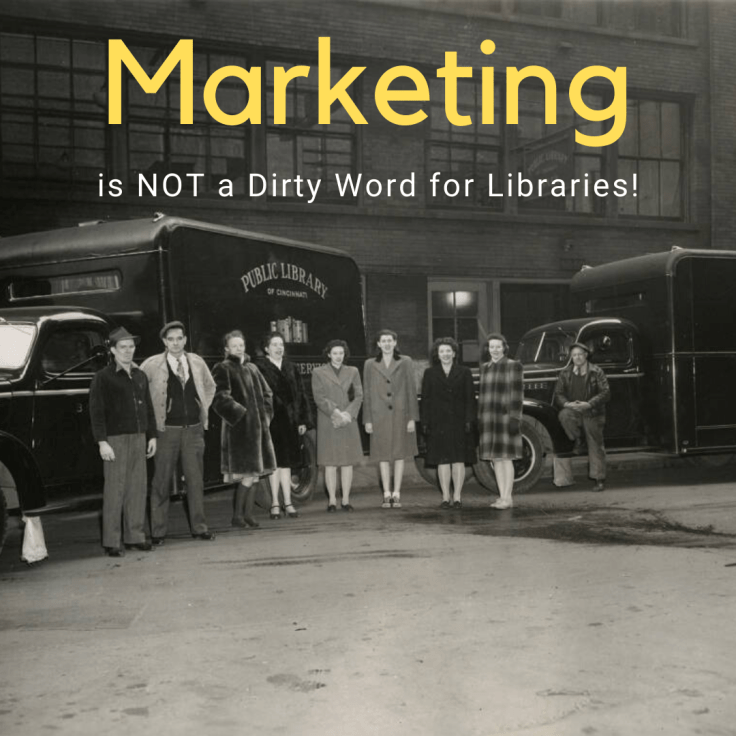
Marketing is Not a Dirty Word! Why Libraries Need to Promote Themselves Now, More Than Ever

Photo courtesy Public Library of Cincinnati and Hamilton County

Back in February, I had the great pleasure of attending and speaking at the Edge 2020 conference in Edinburgh, Scotland. While there, I heard from librarians across the United Kingdom as they shared stories about the fantastic work happening in their libraries. You can now see video of all the sessions on their web page.

Scott Simpson, Head of Library & Information Services, and Paul Martin, Systems Development & Support Officer, East Renfrewshire, discussed their library’s program, “Do Your Bucket List at Your Library.” Attendees can visit places they’ve always wanted to see, pretty much anywhere in the world, using a VR headset and guidance from a library staffer. Simpson and Martin told us that many older people use VR to revisit places they haven’t seen in years or to show their families where they grew up.

I think this is brilliant. And marketable. And I said so on Twitter.

That’s when this back and forth happened.
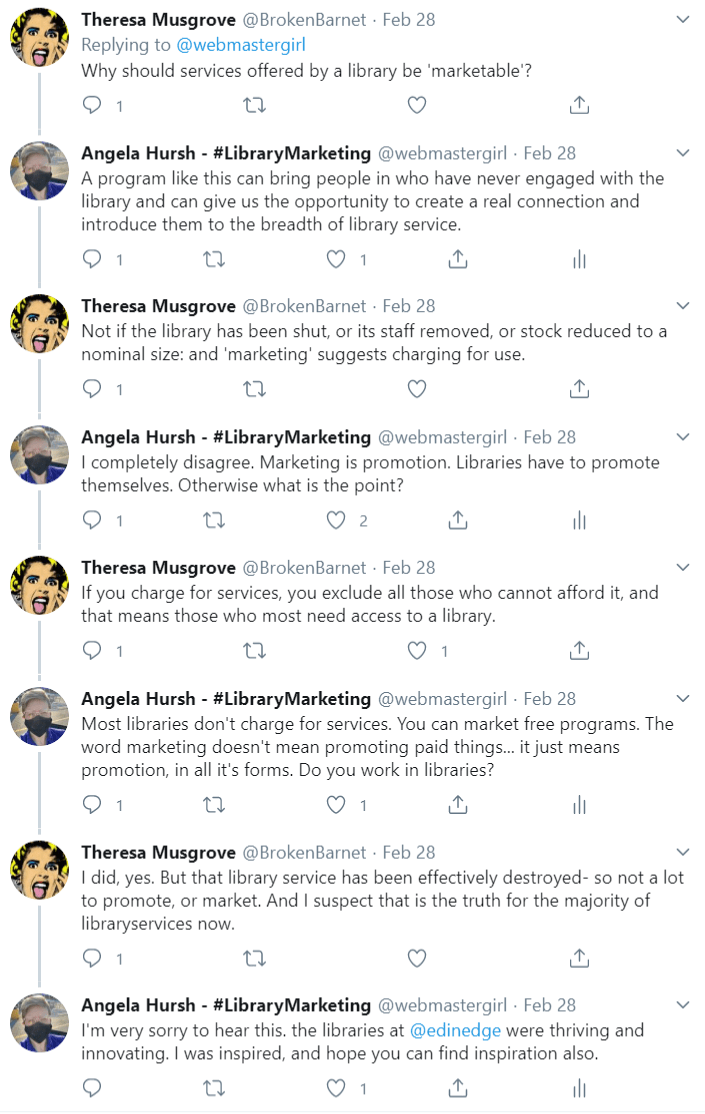
The discussion has been on my mind ever since. I thought about it last week, when I recorded an episode of The Library Marketing Show about the need for libraries to keep communicating their value. I want to expand on that point.

The debate surrounding the word “marketing” in libraries is not new. When I worked for a large metropolitan public library system, my department was often met with skepticism or wary looks from librarians.

Most staffers wanted me to promote their programs and events. But many told me they felt weird or icky about promoting the non-program library work, like the collection or summer reading or homework help or online resources.

Library staff was more than happy to talk one-on-one about how great their library was. But there was something off-putting about loudly proclaiming the value of the library in mass library promotions.

Frankly, we must get over it. We must stop being humble. We must talk more about the work we do in our libraries, as loudly as we can, to as many people as will listen. Our very existence depends on it.

I don’t mean to be overly dramatic. But I am deeply worried about the future of libraries.

Marketing is not a dirty word. The importance of library marketing is the reason I started this blog five years ago. It is my mission to help library staff communicate their value to the public.

I love the library industry. I truly believe that libraries are the key to building a fair, educated, and empathetic society.

We’re not very good at marketing libraries, to be honest. In 2018, OCLC released this report on the marketing approach of public libraries in the United States. According to the data, 96 percent of US libraries said they use social media. I bet that number is much higher now. 70 percent send emails (also probably higher now, due the pandemic).

Here is the bad news. At the time of this report, only 40 percent of public libraries had a communications strategy. Only 17 percent said their strategy was current.

Why?  75 percent of libraries say they don’t have the necessary staff resources to do marketing. They don’t even have a marketing professional on their staff. That’s a big red flag, my friends.

I’ve been frustrated by the lack of focus on library marketing for years. But now, amid a pandemic, when library buildings are closed and when libraries face imminent budget cuts, it’s become a serious problem.

Many library staffers make an assumption that the community knows what they do in the library. But I am certain your community does not know the full extent of your impact.

They don’t know how you help craft the resume of the single parent looking to get a better job so he or she can provide a better future for their family. They don’t see how you help a terrified cancer patient research the latest treatment option. They don’t have any idea that you provide after-school homework help or teach young children to love reading. They don’t have a clue that your building is the only safe space a teenager has to hang out. They don’t know that the library is sometimes the only place where a child in their community gets a meal. Heck, half the time, they don’t realize you have eBooks.

It’s important to talk about all your work–loudly, openly, and all the time. It’s more than pride. It’s survival.

If you educate your community about the work of your library, it’s going to be painful for leaders to make budget and staff cuts. Your community will come to defense if they understand the loss that those cuts will mean for their community.

This is a change in mindset for libraries. This is not something that you’ll talk about once at a staff meeting and forget it. This is something we need to do every day, without fail.

Now is the time to make marketing one of the main focal points of your library’s outreach. It’s our duty to advocate for our own professional services and expertise.

Your patrons don’t want you to remain neutral. They want you to take a stand.

If your library isn’t centered on marketing, you might well face more problems than just getting people to your programs.

The very survival of your library depends on marketing.

Subscribe to this blog and you’ll receive an email every time I post. To do that, click on the “Follow” button in the bottom left-hand corner of the page. Connect with me on YouTube, Twitter, Instagram, and LinkedIn.  
 

Don’t Stop Communicating! Tips for Handling Library Promotion Overload During a Crisis

Watch Now

The #LibraryMarketing Show, Episode 44

When you’re trying to figure out how to get all the work you have to get done during this pandemic and you’re feeling overloaded, the one thing you SHOULD NOT sacrifice is communication with your community. In this episode, Angela shares tips to make room in your day for promotion and for celebrating what you can get done instead of being hard on yourself for what gets left on your “to-do” list.

Also Kudos to The Richland Library in South Carolina. Their marketing team recently won the 2020 American Advertising District three (North Carolina, South Carolina & Virginia) Award WIN for their Access Magazine

What did you think of this episode? Are you struggling with marketing and promotion right now? Do you have tips for handling this crisis that you can share with other libraries? Do you have a nominee for the Kudos segment? Drop a comment below! And subscribe to this series on YouTube to get a new video tip for libraries each week!  

Want more Library Marketing Show? Watch previous episodes!

This blog consists of my own personal opinions and may not represent those of my employer. Subscribe to this blog and you’ll receive an email every time I post. To do that, click on “Follow” button in the bottom left-hand corner of the page. Connect with me on Twitter, Instagram, and LinkedIn.   

Virtual Library Programmers–Heads Up! Here’s a Super Easy, Step-by-Step Plan to Establish a Style Guide for Your Library Videos

Photo Courtesy Public Library of Cincinnati and Hamilton County

There’s a trend in library marketing now. It’s born out of necessity and determination.

More libraries are producing videos. They’re using the format to deliver programs to their community. They’re using video to explain the value of their library, as they brace for the economic impact of the pandemic.

I’ve long been a fan of video library marketing. And, even before COVID-19, there was mounting evidence that video is an effective and engaging way to communicate.

Video is easy to produce, really. Anyone with a smartphone and some editing software can make cool videos that look professional. My 19-year-old taught herself to edit this week in about two days’ time. I imagine many of you are doing the same thing.

But there’s one step in the process you may have missed. And for this, I must thank Mary from Evergreen Park Library. She asked me to talk about creating a video style guide. 

Why you need a video style guide

Any content coming out of your library will need to look like it’s coming from your library!

It’s the same philosophy you may have for any print material you create. You likely have rules and specifications about the look of the text, the placement of the logo, the use of colors, and more. Even if your guidelines are just a few sentences, someone along the line has likely laid out the rules.

Your videos need a similar set of guidelines. We want people to be able to recognize your work on all platforms.

And once you create a video style guide, it’s important to make sure everyone who creates content adheres to it. It’s incredibly important that we reinforce your library’s brand to your community. We want them to immediately know the video was produced by your library. Later, when we need support for funding, they’ll remember your work and the value you provide.

Creating your video style guide

In your style guide, answer these questions.  

  1. Logo: How often will your logo be used in the video? Where does it need to appear on the screen? How big should it be? What color should it be? If you have several versions of your logo, which one will be used in videos?
  2. Fonts: What font should be used for onscreen text? What color does it need to be? How large should it be? When should it appear?
  3. Graphics: If your video creators are adding additional graphics, what colors are allowed? What style of graphic should they use? What program should they use to create them? 
  4. Video: How should shots be framed? What resolution do you want recorded? What aspect ratio will be allowed? Do shots need to be focused? Does video need to be stable or will you allow shaky shots?    
  5. Audio: How loud should audio be in your videos? Should on camera talent use a microphone, headsets, or camera audio? If they edit music into the final product, how loud should the music be versus spoken words?  
  6. Talent: Which library staff members are permitted to record, edit, and upload videos? Should on-camera library staff wear something specific, like your library’s uniform shirt or a library branded t-shirt?
  7. Process: Is there a senior staff member who must give final approval for your video? How will the video be transferred between staff members at various stages of editing, approval, and posting?  
  8. Patron privacy: How do you go about getting permission from everyone who appears on camera, even in the background? This is especially important when library buildings reopen, and we start capturing video of patrons. It’s likely part of your library’s overall privacy policy. So, check to see what kind of permission you need to get from participants and set guidelines to make sure your video creators know that’s part of their responsibility.
  9. Liability and copyright issues: What music can your video creators legally use? What still photos can they legally use?  What extra footage can they legally use? Be explicit about fair use standards. 

Examples of video style guides

Pepperdine University

Oxford Brooks University

Washington University School of Medicine

You might also want to read these

Butts in Seats: Which Video Metrics Count as Attendance in the New World of Virtual Library Programming?

Videos Can Reach Library Users at Home Now and in the Future. Here’s Your Starter Kit.

Subscribe to this blog and you’ll receive an email every time I post. To do that, click on the “Follow” button in the bottom left-hand corner of the page. Connect with me on YouTube, Twitter, Instagram, and LinkedIn.  

Three SUPER Easy Ways to Get More Results from Your Library Email Marketing!

WATCH NOW

The #LibraryMarketing Show, Episode 43 In this episode, Angela shares three very simple ways you can add punch to your email subject line and header text. Doing one of these three things every time you send an email will increase the chances your recipients will open and engage with your emails. Here is the article with all the fantastic magnet or trigger or power words Angela mentions in the video, broken up into charts that will help you create an emotional reaction in your readers. Also Kudos to all the libraries creating backgrounds for Zoom and Teams meetings using photos of their libraries. Library Journal has a great list of them. Here’s another great list from the Library Land project. If you have a topic for the show, kudos to share, or want to talk to me about library marketing, contact me using this short form.

← Back

Thank you for your response. ✨

Want more Library Marketing Show? Watch previous episodes! Check the Upcoming Events page to see where I’ll be soon. Let’s connect! This blog consists of my own personal opinions and may not represent those of my employer. Subscribe to this blog and you’ll receive an email every time I post. To do that, click on “Follow” button in the bottom left-hand corner of the page. Connect with me on Twitter, Instagram, and LinkedIn.     

Butts in Seats: Which Video Metrics Count as Attendance in the New World of Virtual Library Programming?

Photo Courtesy the Public Library of Cincinnati and Hamilton County

This week’s post is inspired by a question on the Libraries and Social Media Facebook page. A library staff member asked this: “We’re being asked to track the virtual ‘butts in seats’ numbers for each of our programs and also how many views each get in the first hour. I can’t for the life of me find that in insights.”

Analytics on views for videos, both live and pre-recorded, are measured differently by each platform. So, tracking actual attendance can be confusing and time intensive. But it is valuable data.

I have done some research this week to find updated information about how to track video views on the platforms where most libraries are posting video and doing live stream programming: Facebook, Twitter, and YouTube.

Special note: Libraries are also using Instagram for live streaming and video views. However, analytics for videos on Instagram are nearly impossible to track. My advice is limited by that fact.

What counts as attendance?

Before you begin analyzing video views on any platform, you’ll want to establish what will count as attendance to a virtual programming. It may be easiest to align your library’s definition of what counts as video attendance with the way each platform measures a video view.

Most platforms based their metrics on someone viewing a very short portion of your video, not the whole thing. That sounds like good news. But, like an email open rate or a social media follower count, the simple video view is vanity metrics. We want our videos to impact our community. We need to push our definition of video program attendance into deeper territory.

You’ll also want to consider whether your library will use a different metric to measure the number of people who attend a live stream virtual program versus a pre-recorded video. My recommendation is to track both numbers separately. This will give you a sense of whether your followers prefer live streaming over pre-recorded video.

When you live stream, you can see right away how many people are “attending” your event. When you finish your live stream on Facebook and Instagram, you’ll have the option of saving your video to your device. Always do that.

Then, you’ll be asked if you want to upload your live stream recording to the platform for on-demand views. You should do that too!

As soon as you end your live stream, Facebook and Instagram both tell you right away the number of people who viewed your live stream. Then you’ll need to decide how often you check the on-demand views of your live stream. You’ll also need to decide how long will you track the on-demand views on each live stream recording.

Make these decisions now so you can consistently report the attendance and compare metrics on videos to see which ones perform best. If you have one type of video program that does well, you should offer more of that!

Once you decide what will count as attendance by one person on each platform, you’re ready to start recording your views. If you are using a social media scheduling platform, this will be easy. Most scheduling platforms have a video performance section that will help you analyze your views. If you can’t find it, go to the “Help” section of your platform. You should also check your scheduling platforms help section to get more information about how they gather those metrics.

If you don’t have a social media scheduling platform, you’ll check the video views on each platform. Here’s how to do that.

Facebook: Go to your library’s page. At the top, under the general Facebook search bar, you’ll see “Insights.” Click on that. Then scroll down the menu on the left side of the page until you see “Videos.” Click on that.

Instagram: You can see how many people viewed your live stream after it’s finished. If you post your live stream to your stories, you can see how many people viewed it. Be sure to check it before the end of your 24 hour period, because it will disappear! If you upload a video to IGTV, you can see how many people viewed the video, but there are no further analytics. You cannot track video views for videos posted to your normal Instagram feed.

Twitter: Go to Google and type “Twitter Analytics.” If you are logged into your library’s Twitter account, the URL will automatically populate with your library’s analytics. At the top of the page, to the right of the Twitter logo, you’ll see the word “More” and a drop-down menu. Click on the arrow to find “Videos.”

YouTube: Go to your channel. Click on YouTube Studio, then Video Analytics.

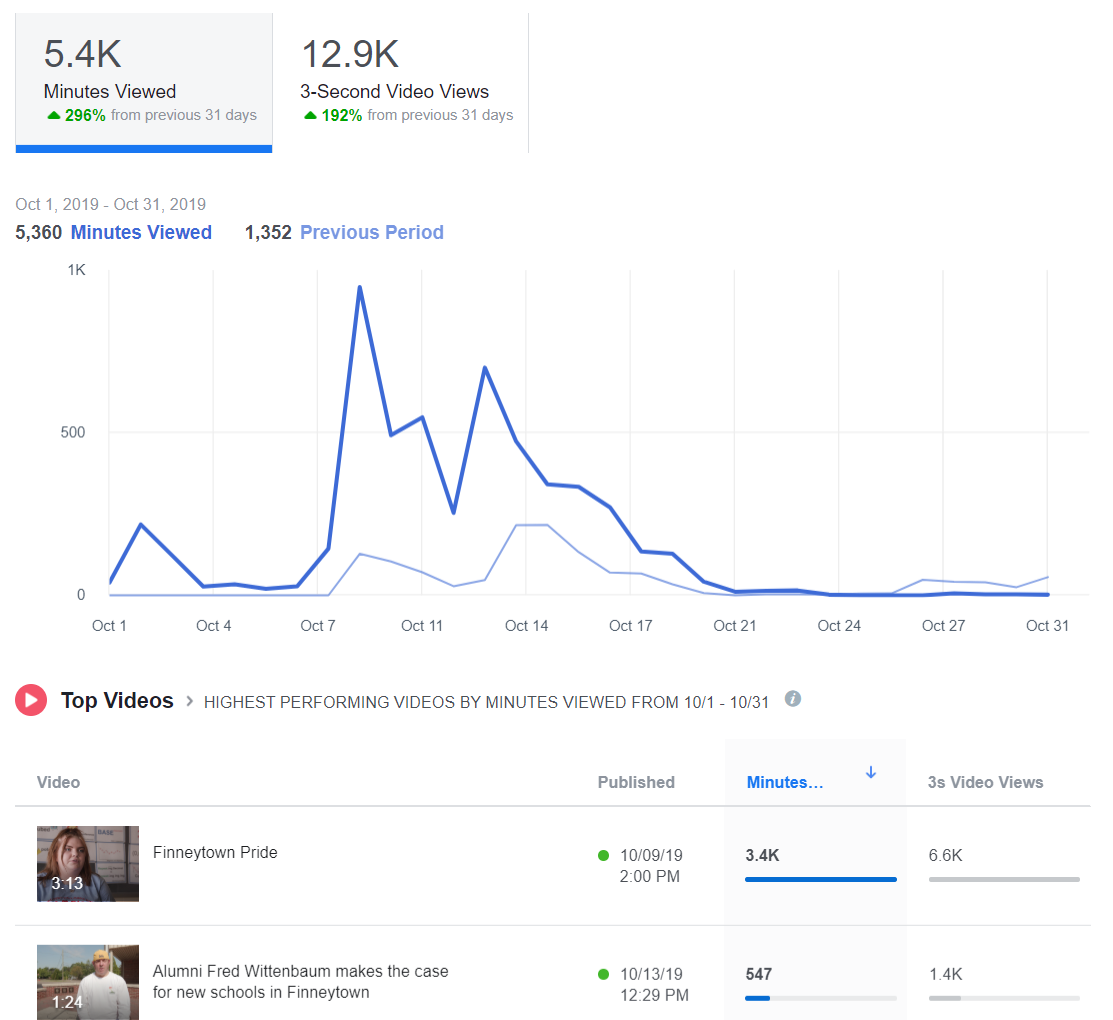
Side note: You can see my latest book review did not do very well on YouTube. I am comforted by the fact that it was gangbusters on Facebook. And that’s a lesson too. Different videos will work better on different platforms. You’ll learn how to pair a video to a platform by tracking video analytics.

The top three video metrics to track

#1-Video Views

Facebook and Instagram: a view is counted anytime someone watches your video for at least three seconds.

Twitter: a view counts if someone watches at least two seconds. Additionally, at least 50 percent of the tweeted video must be visible on screen to be registered as viewed. This rule is to account for the auto-play function.

YouTube: a view is counted anytime someone watches your video for at least 30 seconds.

#2-Watch Time

Facebook reports this metric in insights and calls it “minutes viewed.”

Instagram, as far as I can tell at this writing, does not report watch time. (BOO!)

Twitter reports minutes watched under the “video details” of every video you publish on the site. In addition, they have a cool graph that tells you how long the average viewer watches your video. This is reported in quarter percentages. You’ll also get the completion rate, or the percentage of viewers who watched your video from start to finish.

YouTube will tell you the average total watch time for every video you create.

Let’s say you post a 10-minute video on YouTube. You might have 500 views, which means 500 people watched at least the first 30 seconds. Then you’ll have an average watch time of say, 5:33, which means most people watched at least five minutes and 33 seconds of your video.

YouTube prioritizes videos with high watch times in its viewing suggestion algorithm.

I can tell you from my own experience posting The Library Marketing Show to YouTube each week that it’s rare for someone to watch an entire video from start to finish. I challenge myself every week to improve my watch time.

#3-Engagement

As always, you want to record likes, comments, and shares of your videos, as you would with other social media posts. These metrics can tell you how many people were compelled to act based on your video. You can help boost these numbers by actively asking your viewers to like, comment, and share.

Shares are the most important engagement metric, because that means someone liked your online program so much, they wanted their friends and family to enjoy it too.

You might also want to read these⬇️

Videos Can Reach Library Users at Home Now and in the Future. Here’s Your Starter Kit.

The New Guide to Library Marketing Social Media for 2020! Part Four: Maximizing YouTube for Video Plus What About Tumblr, Snapchat, and TikTok?

Subscribe to this blog and you’ll receive an email every time I post. To do that, click on the “Follow” button in the bottom left-hand corner of the page. Connect with me on YouTube, Twitter, Instagram, and LinkedIn.  

I Broke This Library Social Media Rule… and You Should Too!

WATCH NOW

The #LibraryMarketing Show, Episode 42

In this episode, Angela talks about discovering that she was breaking a Twitter Policy Rule repeatedly, for years and years. Hear about why she panicked… and how she figured out it’s actually a good rule to break!

Also Kudos to The State Archives and Records Authority of New South Wales (NSW State Archives and Records) in Australia for their incredible interactive online jigsaw puzzle!  

If you have a topic for the show, kudos to share, or want to talk to me about library marketing, contact me using this short form.

← Back

Thank you for your response. ✨

Want more Library Marketing Show? Watch previous episodes!

Check the Upcoming Events page to see where I’ll be soon. Let’s connect!

This blog consists of my own personal opinions and may not represent those of my employer. Subscribe to this blog and you’ll receive an email every time I post. To do that, click on “Follow” button in the bottom left-hand corner of the page. Connect with me on Twitter, Instagram, and LinkedIn.   

Now is the Absolute BEST Time to Prove Digital Promotions are Essential for Library Marketing. Here’s How to Gather Evidence.

PHoto courtesy of Public Library of Cincinnati and Hamilton County

I had a wonderful conversation with a librarian from Canada this week. She heads technical services at her library. We were brainstorming about ways to market her library services, programs, and collection during the COVID-19 shutdown. And we both realized something. The pandemic is awful and scary. But it also affords one big opportunity for librarians and library marketers.

Now is the time to prove the value of digital promotions 

The Marketing Rule of 7 states that a prospect needs to “hear” the advertiser’s message at least seven times before they’ll take action to buy that product or service. This marketing maxim developed by the movie industry in the 1930s. Studio bosses discovered that a certain amount of advertising and promotion was required to compel someone to see one of their movies. 

What does the Marketing Rule of 7 have to do with your library? Digital promotion helps you fulfill the rule of seven. It’s the most efficient way to get your message in front of eyes in a variety of places.

In fact, if you’ve been thinking of slowing down the communication you do right now, don’t. Ramp it up! Your community needs to hear from you.

You should be sending more email to your cardholders. You should be posting to social media more frequently. You should be putting more notices about digital resources on the homepage of your website. 

In this moment, we can accurately measure the results of digital marketing because of the lack of competition from more traditional means of library marketing, like book displays, flyers, and posters. No one is seeing those at this moment, because no one is coming into your physical library building. Digital results are easy to record.

And, if we take this unique moment to gather data to prove that our work yields results, we can provide solid evidence of our worth in the community. We may prevent layoffs and budget cuts. When this is all over, we can say the library was there–and people turned to it for help. 

Statistics to gather now to prove your worth later

Measure virtual program viewing. Many libraries are putting together great virtual programming, particularly story times. If you do live streaming or on-demand videos, be sure to gather metrics on views.

Some platforms will tell you how a person got to your video and some will tell you how long they watch. Most will give you demographics on your viewers, like their age, identified gender, and location. All will give you stats on reach, engagement, and follower growth.

All those data points are valuable. Start a spreadsheet now and track the results day by day. You’ll be able to prove that people watched, how they found out about the video, which videos they liked most, and how long your library held their interest.

Send more emails, and track results religiously. Your library can use email to promote everything from services to events to the collection. Tell your cardholders about the new eBooks and eAudiobooks in your collection. Use your email to drive usage of those hidden treasures in your library, like online homework help, streaming music, and resume or job-hunting databases. Then…  

Tracks holds, checkouts, and usage for digital collection items. Be sure to write down how many holds and checkouts there are before you market, and one week after. It’s easy to prove the value of digital collection marketing when no one can walk into a library to check out a book. Every checkout is likely coming from your efforts!

Ramp up your social media posting schedule on two platforms. Social media is the second method most effective method for digital promotions. And it’s the best way for you to reach non-library cardholders right now.

Current research shows that people are Tweeting a lot more right now. With the amount of content on that platform, I would not recommend posting more frequently on Twitter. There’s too much competition and your posts are likely to get lost in the shuffle.

However, those same stats also show growth in use of LinkedIn and Pinterest during the pandemic. If your library is not posting on those platforms, now is a fantastic time to experiment and reach a new audience.

On LinkedIn, you can share collection items, services, and events that focus on job-hunting, career advancement, personal wellness, diversity, literacy, and entrepreneurship.

On Pinterest, post new eBooks and eAudiobooks added to your collection. If you have DIY, STEM-activities, or story time videos, you can also post those to Pinterest. People are using the platform for inspiration and to find activities to fill their time. Now is a great time to give them some content so they can discover your amazing library.

One more thing to do

Advocate to change your marketing emails from opt-in to opt-out. That means every cardholder who gives your library their email address, in the past or in the future, is on your marketing list. If they want to opt-out, they can (but they won’t!).

I know many libraries will find this to be a radical shift. Libraries worry about angering their cardholders by sending them emails. They don’t want to be one of the “bad brands” that sends spam. Many libraries have actual board policies making opt-in mandatory for emails.

Now is the time to advocate for change. Here’s why.

A library is NOT a business. The normal consumer sentiment about spam email does not apply to you. Your cardholders want your emails.

People love the library. They love what you offer them. They want to know what’s going on at the library. 

You are not going to spam people or make them mad by sending them emails. Unwavering cardholder loyalty is the one big advantage libraries have over their competitors in the profit world. And we should use it!

In addition, people are accustomed to opt-out emails. They know that if they give you their email, you’re going to message them. 

My argument for opt-out emails comes from lots of experience. When I worked for a public library, we sent marketing emails nearly every day of the week. My library’s unsubscribe rate was ZERO percent. I usually saw about 10-15 unsubscribes for every 10-thousand emails I send. Across the non-profit world, the average unsubscribe rate is about .19 percent, according to Smart Insights.

I worked the library outreach table at a book festival every year while I worked at the public library. Without prompting, customers asked about the library’s marketing emails. One lady said she heard her friends talking about them and wondered why she wasn’t receiving them! Several others mentioned they learned about new books and services from our emails. I had people GIVING ME their email addresses to check their status.

Do you think customers of other companies ask about their emails or talk about them with fondness to other customers?  I never have, and I sign up for A LOT of marketing emails from other companies.

Start sending your emails to every customer. They want to hear from you! And you can track usage and circulation increases from those emails to help prove your library’s worth.

You might also want to read these⬇️

What Metrics Demonstrate Your Library’s Social Media Marketing is Working?

How to Reverse Engineer Your Library Marketing Social Media Audiences!

The One Social Media Shortcut That Can Tank Engagement and Cost Your Library in a Pandemic–or Anytime!

Subscribe to this blog and you’ll receive an email every time I post. To do that, click on the “Follow” button in the bottom left-hand corner of the page. Connect with me on YouTube, Twitter, Instagram, and LinkedIn.  

Three Tips to Navigate the Tricky Job of Fundraising for #LibraryGivingDay During a Pandemic

Watch Now

In this episode, Angela talks about how to navigate the tricky job of fundraising for your library during the pandemic… or anytime.  Library Giving Day is April 23. I’ll share three ideas for raising much needed library funds during a crisis.

Also Kudos to the Tredyffrin Township Public Libraries for their fantastic YouTube channel. Watch their clever database promotional parody video here: https://youtu.be/cS0J99KWaGA And be sure to subscribe to their channel.

More Help During Covid-19

What Will Happen to Library Summer Reading Programs This Year?

Library Marketing During a Pandemic: Tips for Working from Home or the Office and Dealing with the Stress of a Crisis

Self-Care for Library Social Media Staff in the Midst of a Crisis like #COVID-19

How #COVID-19 is Impacting Social Media Marketing and What That Means for Libraries

Why Libraries Must Promote Reading for Pleasure During the COVID-19 Crisis

If you have a topic for the show, kudos to share, or want to talk to me about library marketing, contact me using this short form.

← Back

Thank you for your response. ✨

Want more Library Marketing Show? Watch previous episodes!

Check the Upcoming Events page to see where I’ll be soon. Let’s connect!

This blog consists of my own personal opinions and may not represent those of my employer. Subscribe to this blog and you’ll receive an email every time I post. To do that, click on “Follow” button in the bottom left-hand corner of the page. Connect with me on Twitter, Instagram, and LinkedIn.    


The One Social Media Shortcut That Can Tank Engagement and Cost Your Library in a Pandemic–or Anytime!

I know work is hard right now. But there is one time-saving social media marketing technique that libraries should avoid at all costs.

Libraries should avoid cross-posting on social media. Cross-posting is when you post the same text and graphics in a message across multiple social media networks.

I get why many libraries cross-post. Cross-posting is easy. It saves time and energy. And library staff have a lot of work to do. Even when there is no pandemic to deal with, librarians are often asked to take care of marketing along with their regular duties. But the detrimental effects of cross-posting outweigh any time you might save doing it.

Why cross-posting is a bad idea

Cross-posting is a bad idea because social media platforms are different. They have different standards for post length, image size, hashtags, links, and captions.

For example, LinkedIn is more copy-heavy and formal. Instagram is more visual and informal. Twitter is more suited to short quotes, threads, and GIFs. Pinterest is graphic-heavy. One post with the same text and photo can’t be all those things.

An image you post on one platform may not be sized for another platform. It may end up stretched, pixelated, or squished. This will hurt your ranking and engagement.

Speaking of engagement, the metrics are different for each platform. On Facebook, you’re aiming for likes, comments, and shares. On Twitter, you want retweets and replies. On Pinterest, you want comments and re-pins. One post can’t generate all those things.

Your followers are also different depending on the platform. Twitter users are overwhelming between the ages of 18 and 44. LinkedIn users are more likely to have a college degree than users of other platforms. 70 percent of Pinterest users are women. Every platform has a unique demographic with different needs.

When you cross-post, you risk looking inauthentic and spammy. Your posts will feel like they’re auto generated and robotic. It may look like you don’t care about what you post on your account or worse, that you don’t know you to use social media.

Your audience will respond negatively by not responding at all. That hurts your standing in the algorithm. It can have a negative effect on your reach.

What to do instead

Cross-promotion is better! Take your message and adjust it slightly to suit each social media platform. It’s much easier than it sounds.

First, you need a base message. What is the basic info you wish to convey? What is the action you want your followers to take? Answer these two questions in a two or three sentence nugget. This is your base message.

Then take that base message and adjust it for each of the social media platforms you wish to use. A tweak of a word or phrase here and there, an adjustment of an image, and a unique call to action are all you need to be authentic.

Westerville Public Library in Westerville, Ohio did a great job of tweaking this promotion for Twitter…

…and Facebook.

Here’s another good example of cross-promotion from Barlett Public Library District in Illinois. This is their Twitter post…

..and the same message tweaked for Facebook.

Decide how much time your library is willing to invest on social media. Smaller libraries will want to concentrate on the platform or platforms that will give their library the most benefit. If you are pressed for time, pick the platforms that perform best for you or the platforms where the audience you wish to target is using. If that means you only post on one social media network, it’s okay. Quality is better than quantity.

Use a scheduling tool. There are plenty of free scheduling tools that will help you to share your social media messages without cross-posting. I have used the free version of TweetDeck for my personal social media for years. You can schedule lots of posts in advance and the metrics are great. I recommend it for libraries without the budget for scheduling software.

At my former library job, we had a paid account with Sprout Social. It was easy to use and had more cross promotion capabilities than TweetDeck. I recommend it if you have money for a paid scheduling platform.

More library social media advice

How #COVID-19 is Impacting Social Media Marketing and What That Means for Libraries

Self-Care for Library Social Media Staff in the Midst of a Crisis like #COVID-19

What Metrics Demonstrate Your Library’s Social Media Marketing is Working?

How to Reverse Engineer Your Library Marketing Social Media Audiences!

Subscribe to this blog and you’ll receive an email every time I post. To do that, click on the “Follow” button in the bottom left-hand corner of the page. Connect with me on YouTube, Twitter, Instagram, and LinkedIn.  

A WordPress.com Website.

Up ↑