Search

Super Library Marketing: Practical Tips and Ideas for Library Promotion

Tag

library marketing

Show, Don’t Tell: Why Infographics are an Essential Component in Your Library Marketing

Infographics are visual marketing pieces that help explain facts and figures or lay out a complex set of information in a way that is easy to understand. They’re an incredibly effective marketing tactic.

Until recently, I thought infographics were a relatively new marketing tactic. I remember deciding in 2013 to create an infographic, the first for my library, to promote a readalikes list. I thought I was so innovative!

Turns out, infographics have been around for hundreds of years. Fun fact: The first known instance of infographics as we know them today dates to the late 1700s with a chart of wheat process and labor wages.

Frankly, I love infographics. They appeal to my visual and creative nature. They work well on social media. But they take a lot of time and planning. So, for libraries with a limited marketing staff, it can seem daunting to create one. But it’s worth it.

Why use infographics in library marketing?

Infographics grab attention. Our brains are hard wired for visuals. The human eye can process 36,000 visual messages per hour. That’s 60,000 times faster than the brain can process text. 60,000 times. Whoa.

A good infographic will trigger a reaction in the human brain, sometimes even before the person consciously realizes and processes that reaction.

Think about what happens to you when you see a photograph of a beloved family member or friend. The photo instantly makes you cry, laugh, or long for that person to return to your life. An infographic can trigger the same kind of emotional response. And emotional responses are the best kind of marketing, because they are memorable.

Infographics can explain complex ideas and convey a lot of information in a simple way that is accessible to many audiences. Libraries deal with a lot of data. Our products and services are sometimes difficult to break down into steps. A good infographic will take facts and figures, difficult instructions, or confusing concepts and present them in a way that everyone can understand.

Infographics will position your library as an expert in a way that words can’t. A good visual will demonstrate your library’s subject-matter expertise. It can boost your credibility. It shows that you care about effective communication with your community. And that builds trust with your visitors, community members, and stakeholders in a way that feels more genuine that fancy words.

Three ways to use infographics in your library marketing

Promote your collection. Use infographics to promote a themed collection series, such as new dystopian fiction, the best book club reads, or mystery authors.

You can recruit your collection development department to come up with a list or, if your library is a NoveList client, you can use the NoveList database to find books within a theme. Use the infographic to drive traffic to those titles in your catalog. This works really well on social media.

Explain difficult information. Create an infographic to help you explain something to your cardholders, like how to download an eBook, how to pay a fine, how your library uses taxpayer funding, or why summer reading is vital to childhood literacy.

Infographic template from LibraryAware

Show that your library is fun! Have your content team come up with a great idea for a fun promotion, like 20 signs that you might be a bookworm or how to make a bookmark out of an old book.

How to design a library marketing infographic

Create an outline. An outline can help you to lay out the pieces of the infographic and cut your ideas down to the essential elements.

Decide which points are essential for getting your message across. Is there a story to be told in the data or concept you are trying to convey? Is there a beginning, a middle, and an end to that story?

Once your outline is set, your other design elements will become clear to you. What is your theme? Will you use charts or graphics, lists or numbered elements, photos, shapes, or icons? Write those decisions down next to each section in the outline to help you organize your thoughts.

Plan your layout. You’ll want to make sure all the elements of your infographic are balanced. But that doesn’t mean everything has to be symmetrical!

For instance, if your infographic is explaining something that has a lot of considerations at the beginning of the process and works toward one end result, you could consider a funnel-design: making the number of visuals heavy at the top and lighter as the eye moves down.

If you are explaining something on a timeline, you can arrange your elements evenly from top to bottom but not directly across from one another.

It’s good to sketch your layout out before you go into a design program. This saves time in the actual process of creation and gives you space to make changes at a stage where it’s easy to fix.

You will also want to plan out any places in your infographic where you might need a visual break, like a solid block of color or a line or shape. Finally, be sure to leave white space. You want your infographic to look uncluttered.

Decide your color scheme. A good rule of thumb is to design your infographic with two or three main colors. Then choose a few minor color accents.

The subject of your infographic will have a bearing on your color decision. Some colors work better for explaining data, and some work better for explaining processes.
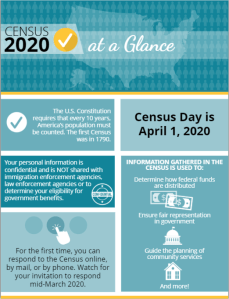
Infographic template in LibraryAware

Take your branding into consideration when you decide on your color scheme, to avoid clashing with your logo.

Pick your fonts. You’ll want to make sure your type is accessible to all audiences. Avoid script-type fonts. Keep in mind that an infographic is visual, and the amount of text will be minimal, so the font you choose must compliment the design elements of the infographics.

Limit your use of fonts to just two or three types. It’s good design to pick a font for the header, one for the main body text, and a third for the complimentary or subtext.

Write a headline that hooks your target audience. As you would with emails or blog articles, the headline or title of your infographic will need to convey the general theme of your visual and catch the attention of your potential audience. Be descriptive and catchy. The title should be shorter than a headline you may use for other content—only a few words long.

Subscribe to this blog and you’ll receive an email every time I post. To do that, click on the “Follow” button in the bottom left-hand corner of the page. Connect with me on YouTube, Twitter, Instagram, and LinkedIn.  

MY BIG ANNOUNCEMENT!

The Library Marketing Show: Episode 30

WATCH NOW

I have a huge announcement for readers of SuperLibraryMarketing.com and viewers of The Library Marketing Show! In this episode, I share why I’m making a big change in my career and what it means for the future of Super Library Marketing and the Library Marketing Show.

Also Kudos to the Oklahoma City Metro Library System! Their customers checked out more than 2 million eBooks in 2019, which is a huge number! It shows that collection marketing is important and effective. It also makes it clear that public libraries need to keep fighting for fair pricing models from publishers and digital vendors.

Want more Library Marketing Show or want to suggest a topic for a future episode? Watch previous episodes!

Check the Upcoming Events page to see where I’ll be soon. Let’s connect!

Subscribe to this blog and you’ll receive an email every time I post. To do that, click on “Follow” button in the bottom left-hand corner of the page. Connect with me on Twitter, Instagram, and LinkedIn.  

Libraries are Winning the Relevancy War! Why Now is the Perfect Time to Banish Your Fear and Promote Your Books

I have a confession to make.

For more than a year now, I’ve been amid an internal struggle that caused me some anguish. It started when I realized that I was hearing the same phrase from many administrators and staff in public libraries, both here in the U.S. and abroad.

Here’s what I kept hearing, over and over: In order to stay relevant, libraries must change completely.

The fear that the public perceives libraries as old-fashioned and unnecessary is not new. But it seemed to reach a kind of fever pitch last year. Everyone was writing about it. Everyone was talking about. There were whole conference sessions and webinars dedicated to library relevancy.

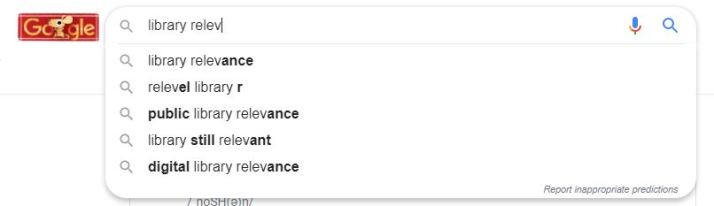
I thought maybe I was imagining it at first. So, I did what any normal person does when they’re looking for validation. I did a Google search.

I clicked on the first result, “library relevance.” There are 314 million results.

I understand why libraries are worried about relevancy. It’s the media narrative. (For a great perspective on that, read this fabulous opinion piece from Public Libraries Online). It’s also the argument made by those who want to cut funding and services for libraries.

But here’s the thing. The public at large doesn’t think libraries are irrelevant. In fact, they think quite the opposite.

I’m sure you saw the new Gallup poll released this past Friday (Jan. 24, 2020) that shows “Visiting the library remains the most common cultural activity Americans engage in, by far. The average 10.5 trips to the library U.S. adults report taking in 2019 exceeds their participation in eight other common leisure activities.”  

Public libraries have bought into the notion that we have a brand perception problem. But we don’t. We’re doing a great job. And people see it.

What we have is a fear problem. Public libraries are afraid to market the fact that they have books.

Why? Because they’re terrified that talking about our collection will reinforce a notion that libraries are a dusty, old, unsophisticated repository of classics. They may even believe that marketing the collection will distract people from the other great services that the library offers.

I vehemently disagree.

Libraries should market their collection. In fact, they should do a lot of collection marketing. Instead of limiting the conversation to non-collection services, libraries should expand the conversation to show the connection between the books, literacy, and all the other amazing work they do.

Your collection makes it possible for you to offer social services. Your collection makes it possible for you to create programming around workforce development. Your collection makes it possible for your library to offer support to educational institutions in your community. Your collection makes it possible for your library to be a thriving, open, welcoming, and inclusive public space.  

Literacy is tied, undeniably and inextricably, with all the things libraries do outside the realm of books.

Data tells us that most people who sign up for a library card do so to get free and open access to the collection. The collection is the gateway to get community members in the door of your library, where they’ll experience the other services you provide.

If you were to look at the Google Analytics data for your website, or the usage data provided by your library’s app developer, I’ll bet my bottom dollar that the number one activity for online use of your library is collection-based. That’s why your library spends most of its non-facility related, non-staff related budget on collections.

Studies of library usage by the Pew Research Institute shows that 66 percent of library cardholders use their card to check out items including books, magazines, CDs, and more. Only 17 percent of library cardholders say they use their card to attend programs, classes, or lectures.

People are still reading books. People believe libraries have transformed themselves into tech hubs. People see that libraries offer digital services. People hear about the social service help offered by libraries. Libraries are winning the relevancy war (good job, you!). The community knows and understands that we are more than a place for books. It’s why your library gets regular requests from organizations looking for a partner in important outreach work and advocacy.

The message is out there that libraries are more than books. But make no mistake, most of the folks who walk through your doors or interact with your library online, are there for the collection.

Before I was a library marketer, I worked as a television news producer. That means I put together each night’s newscast, decided which stories were told, in what order, and how they were told.

Every year, our news director would bring in a consulting firm to help us improve our shows and increase our viewership. I was proud of my work as a journalist. But when I was presented with the feedback from focus groups, it was clear that most viewers were watching my show for the weather. I spent a lot of time writing insightful, informed, well-sourced investigative pieces. But my viewers only wanted to know was whether it would rain the next day.

In television news, weather is king. In libraries, the collection is king. That’s why your library spends the majority of it’s non-staff and non-facility money on the collection.

Now, please understand me. I’m not saying you stop promoting your non-collection related activities. Far from it. Library programs and outreach nourish the soul of our community and offer cultural and educational opportunities for those who might not otherwise have access to them. And they must be given attention through marketing.

But don’t stop talking about your collection. Don’t hide your collection below the fold on your website. Mention your collection when you talk with the media. Write about your collection on your blog. Send emails to your cardholders with reading suggestions.

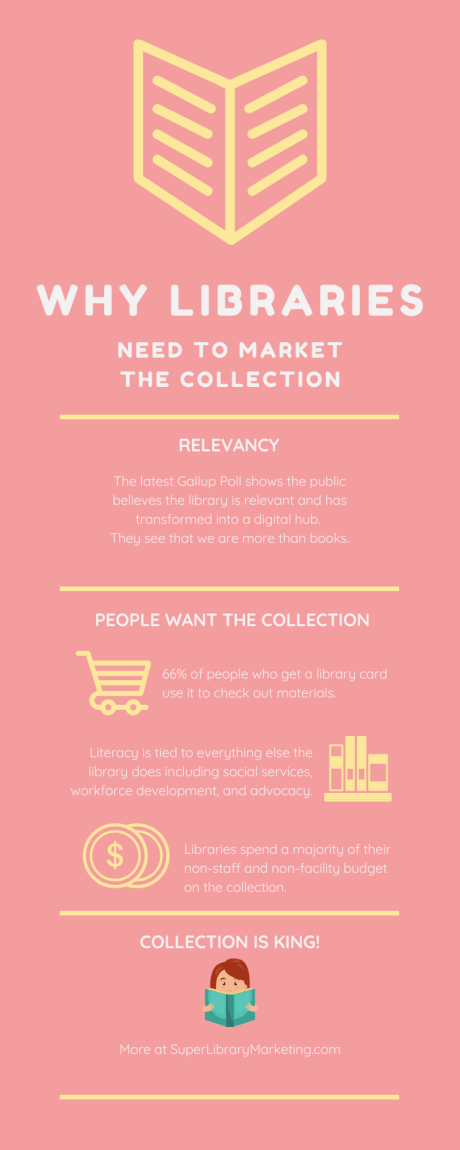
If we want to compete with Amazon, Audible, Netflix, Hulu, and other paid content providers, we must promote our main asset. If you want to attract new cardholders and keep the ones we have happy and using their library, market the collection. If you want to have a part in making the world more informed, more educated, and more empathetic, market the collection. Share this infographic to help spread the word!

Check the Upcoming Events page for a list of webinars and conferences where I’ll be next. Let’s connect! Plus, subscribe to this blog and you’ll receive an email every time I post. To do that, click on the “Follow” button in the bottom left-hand corner of the page. Connect with me on YouTube, Twitter, Instagram, and LinkedIn. 

How to Reverse Engineer Your Library Marketing Social Media Audiences!

The Library Marketing Show: Episode 29

WATCH NOW

A Library Marketing show viewer recently asked me: Do you target specific audiences with different social media venues?

I do, but I reverse engineer it! I’ll explain in this video.

Also, kudos go out to Cesar from the Austin Public Library in Austin, Texas. He wrote an article in the Texas Library Journal on the topic of social media ambassadors, how they work and why your library needs them. We hear a lot about using influencers on social media but the traditional influencer model doesn’t really work for libraries. And this is a version that will work. These are volunteers who willingly help promote your library on their personal social media channels. We know social proof is really important in social media promotion-that idea that other people are really into this one particular thing, your library because it gives people FOMO and a sense that they might be missing out if they don’t get in on some library action! Cesar lays out how his library recruits and uses ambassadors and how they’ve helped the Austin Public Library.   

Want more Library Marketing Show? Watch previous episodes!

Check the Upcoming Events page to see where I’ll be soon. Let’s connect!

Subscribe to this blog and you’ll receive an email every time I post. To do that, click on “Follow” button in the bottom left-hand corner of the page. Connect with me on Twitter, Instagram, and LinkedIn.  

The Emoji Experiment: The Pros and Cons of Adding Emojis to Your Library Marketing Email Subject Lines

I notice it, groggy from sleep. I check my email, as one does, first thing in the morning before getting out of bed. 😉

The sight of it causes my heart to skip a beat. “It’s going to be a glorious day,” I think to myself as I jump out of bed. 🤩

What is the magical thing that makes getting up in the morning easier? 🌟

An emoji. To be specific, a set of headphones, situated in the subject line of an email. An email that comes from my library.⬇️⬇️

The headphones signal to my brain, before I can read the words that come after them, that my audiobook from Overdrive is ready for download.

After dozens of such emails, my body has an almost Pavlovian response to the tiny drawing of headphones.

I get giddy. I get excited. I am filled with anticipation to download and start the audiobook.

According to Salesforce, only two percent of emails sent by businesses to consumers in 2019 had an emoji in the subject line. That’s not a lot, really. And that means there is room for libraries to experiment.

I don’t think there is any doubt that emojis are here to stay. As of October 2019, there were 3,178 widely-recognized emojis, according to Emojipedia. And the major cell phone and digital marketing companies keep adding emojis to their libraries.

I want my cardholders to have the same reaction I have to the headphone emoji when I send them library marketing emails. The idea that an email from my library could energize someone or fill them with anticipation or cause them to do a mini-celebratory dance is one I can’t ignore.

Why might emojis work?

Emojis work because the brain processes visual information 60,000 times faster than text. More than 90 percent of the information that we process is visual.

The emoji drawing stands out in a line of letters. And if your recipient is using a device that adds color to the emoji, that also makes your subject line pop.

Your subject lines can also be shorter when you use an emoji because an emoji can do the work of some of the wording. And the shorter the subject line, the more effective the email. In 2018, 61 percent of emails were opened on mobile. Subject lines exceeding certain character counts can get cut off by mobile devices. And that impacts your open and conversion rates.

The experiment

I kept reading articles on the increased use of emojis in emails for brand marketing. There isn’t much data to suggest whether they are effective in converting customers to take any action on the email. And I thought, as I am apt to do, that someone should experiment with emojis in the library marketing space. Would my cardholders find them amusing? Would emojis help increase the effectiveness of my emails? Or would people think we had lost our mind and gone too far?

There was only one way to find out.

Over the course of six months, I sent 17 test emails to my cardholders with an emoji in the subject line. I used them in instances where I thought they added value to the subject line or helped me to make the subject line shorter. I also made sure I sent emojis to cardholders who tend to use digital services.

The results

After the six-month trial period, I crunched the numbers. And I discovered…

60 percent of the emails with an emoji in the subject line were effective. Ten of the 17 emails caused an increase in circulation, program attendance, or database usage for the item we promoted via email. That’s close to the average effective rate of my regular emails which do not include an emoji.

Emojis DID increase my open rate. The 17 messages I sent had an average open rate of 40 percent. Most of my regular emails have an open rate between 20 and 35 percent. So that was an improvement.

Emojis DID increase my click-through rate. The average click-through rate for the messages with emojis was eight percent. That is also slightly higher than normal. Most of my emails have a click-through rate of five percent.

Here are the subject lines from the four emails in the emoji test that had the highest open and click-through rates.

Ebook Publisher Policies
🚨New publisher policies will limit your access to eBooks.

This email had an 81 percent open rate and a 22 percent click-through rate.

Penguin Programs
🐧Make a date to visit the Library to see real live penguins this month!

This email had a 37 percent open rate and a 23 percent click-through rate.

Beach Reads 2019 Booklist
🏖️ Dreaming of sand, sun, surf, and great books? Here’s our 2019 vacation reading list!

This email had a 39 percent open rate and a 19 percent click-through rate.

Green Township Library Anniversary
🎈You’re invited to the Green Township 30th Anniversary celebration!

This email had a 54 percent open rate and a five percent click-through rate.

Now, there is something to consider and that is that the emoji may have had absolutely no effect on the overall effectiveness of these emails! Because my email marketing provider does not give me the ability to do true A/B testing, it may be that these emails had higher open, click-through, and conversion rates because of the wording of the subject line or the content of the email itself. The fact that there was an emoji in the subject line might be pure coincidence.🤷

Are there downsides to emojis?

There are some negative things to consider when you’re using emojis for email subject lines in library marketing.

Your emoji may not display correctly for your cardholder, depending on what kind of email platform they use.

Emojis can give the impression that your emails are not authentic. In some instances, users see an emoji and wonder if your library wrote it… or a robot.

Emojis can be overused. Finding the perfect emoji is fun. It makes you feel cool. But if you start putting an emoji in every subject line of every marketing email you send, you will likely find that they’ll soon have no impact or, worse, a negative impact.

That said, I think it’s worth it to experiment with emojis in your library’s email marketing. Your audience may love or hate them. There’s only one way to find out.

Remember to use them in the right context. Use emojis sparingly and make sure they add something to the message of your subject. And get your emojis from reliable sources like Emojipedia, GetEmoji, or your email platform.

Check the Upcoming Events page for a list of webinars and conferences where I’ll be next. Let’s connect! Plus, subscribe to this blog and you’ll receive an email every time I post. To do that, click on the “Follow” button in the bottom left-hand corner of the page. Connect with me on YouTube, Twitter, Instagram, and LinkedIn. 
The Best Posts and Videos to Get Started in #LibraryMarketing! The Library Marketing Show: Episode 28

WATCH NOW

The #LibraryMarketing Show, Episode 28: Brenna Jaco at the Lubbock Public Library in Lubbock, Texas submitted this question: “I just discovered your blog and I wish I had the time to go back and read all your posts from the beginning. In your opinion, what are the most important/useful/favorite blog posts and YouTube videos you’ve done over the years?”

Thanks for the question, Brenna! I give the top three blog posts and videos, ranked by views. That means other library marketing pros found them helpful. I hope you will too!

The Top video was Fighting Back Against the Endless Poster-Flyer-Bookmark Cycle! #LibraryMarketing Show: Episode 8.

A close second was Best Free Ways To Reach Non-Cardholders! #LibraryMarketing Show: Episode 13.

And finally, people love Advice for Digital Signage in Libraries! The #LibraryMarketing Show: Episode 21.

Now for the top three blog posts. The top post is The Best Library Customer Service Advice from an Expert! I interviewed Dan Gingiss, author of Winning at Social Customer Care: How Top Brands Create Engaging Experiences on Social Media.

People also love my early list of the best conference for library marketers. There’s no link because it’s outdated now, but a new list for 2020 is coming out on February 3rd!!

Finally, one of the most popular posts is about how my library increased participation in our summer reading program by 97% one year!

And KUDOS go out to the East Baton Rouge Parish Library System because they have a Library Road show! It’s a whole 30-minute show on YouTube.  It’s well-produced and informative. Great job!

Want more Library Marketing Show? Watch previous episodes!

Check the Upcoming Events page to see where I’ll be soon. Let’s connect!

Subscribe to this blog and you’ll receive an email every time I post. To do that, click on “Follow” button in the bottom left-hand corner of the page. Connect with me on Twitter, Instagram, and LinkedIn.  

The Seven-Step Process to Empower Your Branch Staff and Turn Them into Incredible Library Marketing Ambassadors

I realized something significant in the past few months. It has changed the way I think about library marketing.

I have built a pretty great team and I’ve been vigilant about using data to help me market my library with tactics like email, social, and video.

But there was one marketing tactic that I haven’t used. I haven’t thought about using it. And I need to correct this oversight to take my library marketing to a whole new level.

I need to empower my library’s front-line staff to be library marketing ambassadors.

In the Library Marketing Show, Episode 26, we discussed handing over some of the library marketing work to branch staff. There is work that can only be done by trained marketing and communications professionals. But there are things branch staff can do to offer personalized promotions of events, services, and collection items. They can also offer personalized customer service. And that’s the most important marketing tactic of all.

Back in 2017,  commerce platform Cloud IQ team research found that 69 percent of people want personalized customer service.

In 2018, Accenture Research found that 91 percent of consumers are more likely to shop brands that provide a personalized experience.

Providing personalized customer experience is important for library marketing success. This is difficult for libraries, given our strong commitment to the privacy of our cardholders and their data. But there is a way to do personalized customer service without data. And it could differentiate libraries from our competition.

Library staff must be empowered to think of themselves as marketing ambassadors for the library. If we give our branch staff the tools, training, and confidence, they can create a great customer experience for our visitors. And that can be a competitive advantage for libraries.

We don’t have the money for artificial intelligence or fancy automated marketing tools. But we do have people. Great people. People who are passionately committed to their communities and their customers.

This is really a change in mindset for libraries. This is not something that you’ll talk about once at a staff meeting and forget it. This is something we need to do every day, without fail.

Here is the seven-step process to get front line staff to think of their work as part of marketing.

Change your own thought process around marketing. Just as the front-line staff doesn’t often think that their interactions with customers have anything to do with marketing, the marketing staff often doesn’t consider putting front-line staff to use. Make it a habit to think about how to incorporate front-line staff in your marketing. Handing them some posters doesn’t count. You will want to plot out the specific ways staff can help you with each campaign. Then give them the tools to help them succeed.

Communicate with branch staff regularly about your marketing. If you have a library staff blog or another communication channel, use it to share what you’re doing in your marketing department. And share often.

Each time you start a new marketing campaign or initiative, share your plans with staff. Tell them exactly what the goals are, what tactics you’re using to achieve them, and how you’ll measure success. Always remind the staff about your library’s strategic goals. State how your marketing efforts are making those goals become a reality.

Set aside time in your regular schedule to have conversations with the librarians. This shouldn’t be a scripted interaction. Ask the staff about their work. Find out what they get asked by customers. You will learn something new and get plenty of ideas for what library offerings need more marketing support. Speaking of ideas…

Ask the branch staff for ideas.  An informal suggestion process will help staff feel like they’re part of the marketing department’s success or failure. It makes them more likely to help market the initiative. And you’re likely to find something amazing in their suggestions.

Never reject an idea outright, even if it seems crazy. You risk hampering the creativity of your library staff if they are worried that their suggestions will be silly or stupid. Tell the staff that all ideas are welcome and that library marketing staff will consider each idea carefully. Incorporate the ones that best suit the campaign, the library’s strategic goals, the budget, and the library’s resources.

Try to work at least one staff idea for your marketing into each campaign. If staff make suggestions but see that their ideas are never taken seriously, they’ll stop giving you feedback

Encourage your staff to think of themselves as ambassadors for the library system. They represent everything your library stands for. Your library staff knows their community. They know the needs of their customer base. And they can offer the best, personalized customer service to the people coming into their location.

Let the staff know that you appreciate their unique perspective on your customer base. Reinforce the idea that every part of their job, from shelving holds, to signing people up for cards, to running programs, is a form of marketing. Every interaction they have with a cardholder is a chance for promotion.

Encourage staff to interact with your library on social media if they feel comfortable doing so. Talk to senior leaders and see if it’s possible to grant library staff 15 minutes a week, on work time, to share library social media posts on their personal profiles.

Give staff specific ideas for how they can help spread the library’s message on social by sharing library posts, sharing their own stories or inspiring thoughts about the library, and tagging the library’s social media accounts, commenting or liking posts, inviting friends and family to follow the library on social media, and listing your library as their employer on their personal profiles.

If staff is regularly engaging and sharing content from your library’s social media profiles, you’ll see engagement increase. Algorithms reward libraries with engaged staff!

Lead by example and encourage other senior leaders in your organization to do the same. When staff sees senior leaders and marketing staff talking about the library and sharing their enthusiasm for their work on social, they’ll likely follow suit.

Check the Upcoming Events page for a list of webinars and conferences where I’ll be next. Let’s connect! Plus, subscribe to this blog and you’ll receive an email every time I post. To do that, click on the “Follow” button in the bottom left-hand corner of the page. Connect with me on YouTube, Twitter, Instagram, and LinkedIn.   


The Top Eight Free Websites to Spy on Competitors and Get Ahead in the Library Marketing Game!

Eight Free Websites to Use to Spy on Your Library Marketing Competition

Library marketers are asked to make a lot of miracles happen. We are asked to grow circulation, drive attendance at programs, and increase the visibility of our libraries.

To reach your goals for 2020, your library marketing needs to stay ahead of your competitors. Who are you competing with? You’re fighting with independent bookstores, Amazon, Audible.com, video streaming services like Netflix, museums or other local attractions, genealogy websites like Ancestry.com, language apps like Duolingo, retail stores, and co-working spaces for your cardholders’ time and attention.

But don’t be discouraged! You can spy on your competitors and identify their areas of weakness. Then, you can use those weaknesses as an opportunity to promote your library. And you don’t have to pay to find out how to target your competitors.

I found eight websites that will help you gather intelligence on your competition’s website and social media presence. Most of these sites require you to sign up with an email and password for free access but their information is extensive. They also have paid plans (most are very affordable) that give you access to more data. I use all of them.

Here are my top picks to help you spy on your competitors in 2020!

SEMrush: This is my favorite tool. I check it frequently. Their analytics are incredibly robust. You can compare your own website and your competitors’ website in several areas, including keywords, traffic, where your page ranks on Google, what websites are sending traffic to your library’s website, and so much more. The colorful charts will tell you how well your website is positioned on the internet in comparison with your competitors. And it will even show you the cost, in dollars, that your library is losing in traffic to other websites. That’s a great statistic to have if you’re trying to advocate for additional resources for your library’s online presence.

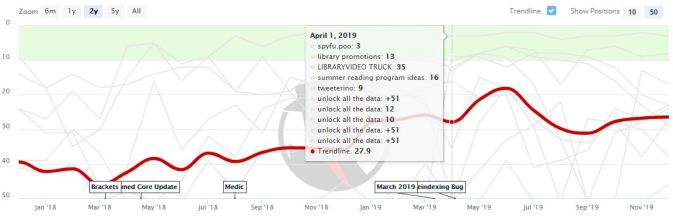
SpyFu:  Use this tool to check how high your competitors rank in SEO keyword search. Get insight on keywords that lead people to your competitors’ site, including any paid keywords they may be using. You can plot the reach of any website on a timeline, giving you an idea of when the site is seeing a spike in traffic. The graphic below shows you what that looks like for this website!

My favorite feature on SpyFu is the keyword analysis. I found out that people searching for “free downloads,” “free download music,” and “free faxing” are most likely to end up at my library’s website. Now I know that I need to make sure the word “free” appears frequently on every page of my library’s website to drive more traffic!

Social Searcher: This real-time social media search engine allows you to quickly pull all recent mentions of a competitor from the major social media platforms and the internet together into one dashboard. You can search for keywords and hashtags to see recently published posts. You can also set up email alerts to keep track of what people are saying about your library, a competitor, or a service, like Audible or DuoLingo.

SimilarWeb: This tool reminds me of Google Analytics, but with prettier graphics. You can see all kinds of useful information about your competitors including where their customers live, how much of their website traffic comes from social media, what keywords people are using to find their website and more. You can also see the top five “interests” of visitors to your competitors’ websites. And of course, you can compare that with your library’s website.

Moz: The site is focused on links and can tell you how other websites are linking to your competitors’ website, and how your competitor is using anchor text to drive traffic. You can also download their reports for free as a CSV file. You can also find out your website’s Spam Score!

Alexa:  This site will show you how your bounce rate and traffic sources compare with your competitors, as well as how much of your audience overlaps with that of your competition. Best of all, Alexa will identify keywords to drive more traffic to your website, based on what people in your area are searching for on Google and Amazon (Alexa is owned by Amazon).

TalkWalker: An alternative to Google Alerts, it lets you search blogs, websites, and news for posts about your competitors. You can have the alerts delivered to your inbox once a day or once a week.

MarketGrader: This free tool from Hubspot grades your website or your competitors on factors like how fast the pages load, keyword ranking, and security.

I did an analysis of this website and found that 30 percent of my traffic comes from mobile devices. That’s incredibly important information because that means that I must make sure everything I do on this website is responsive. This tool also gave me tips on how to increase my SEO ranking and security. All of those tips would be invaluable for my library’s website as well.

Check the Upcoming Events page for a list of webinars and conferences where I’ll be next. Let’s connect! Plus, subscribe to this blog and you’ll receive an email every time I post. To do that, click on the “Follow” button in the bottom left-hand corner of the page. Connect with me on YouTube, Twitter, Instagram, and LinkedIn.   

How Much Library Marketing Should You Hand Over to Your Branches? The Library Marketing Show: Episode 26

Watch Now

Erin at Casey Cardinia Libraries in Casey, Victoria, Australia, asks: “Could you talk about how marketing can support the branch and then what the branch can do locally on their own. It’s a constant thing coming up in our service and I’m thinking a one-pager with some face to face training will help. Marketing teams (if the service is lucky to have one!!) are generally small and we need everyone to take ownership!”

Plus you’re gonna want to watch through the Kudos sections!

Have an idea for the next Library Marketing Live Show? Submit it now.

Want more Library Marketing Show? Watch previous episodes!

Check the Upcoming Events page to see where I’ll be soon. Let’s connect!

Subscribe to this blog and you’ll receive an email every time I post. To do that, click on “Follow” button in the bottom left-hand corner of the page. Connect with me on Twitter, Instagram, and LinkedIn.  
A WordPress.com Website.

Up ↑