In this episode, I answer a viewer question from Natasha Buran of Thousand Oaks Library. She asked, “I was curious if you’ve seen other libraries use ‘Revue’ – Twitter’s newsletter tool for writers and publishers. I thought it would be interesting to add monthly programs or resources and pin it to our profile. I haven’t seen libraries use this feature before and thought I’d ask.”
I gave my answer in the video. This is just my opinion of course!
Kudos in this episode go to the Topeka-Shawnee County Public Library. They recently opened a resource center for community members without a computer or internet access.
Do you have a suggestion for a topic for a future episode? Want to nominate someone for kudos? Let me know by clicking on the feedback button. And subscribe to this series to get a new video tip for libraries each week.
Use the feedback button to share your most pressing email marketing question. I’ll answer these in a future blog post!
I love opening the “reports” tab on an email platform. There is a second or two of anticipation as the page loads that brings me a thrill.
What will the numbers say? Will they be better or worse than last month? Will they reveal a new trend that I can use to better serve my target audience?
I realize I sound a little nuts. But honestly, I love metrics.
They are clear and concise. They show you what’s working and what’s not working. They give you permission to stop doing promotions that don’t help your library at all. If you try something new, they’ll tell you whether your idea worked or not.
Tracked over time, email metrics will help you to take the 30,000-foot view of your library marketing. You can see if your emails are doing what they are supposed to do… moving your library toward its overall strategic goals.
There is a lot we could measure in terms of email marketing. It would be easy to get lost in the quagmire of numbers and analysis.
So, I want you to focus on four data points that really matter to library email marketing. Use these metrics to determine whether your messages are connecting with your audience and promoting your library’s overall strategic goals. And don’t miss the bonus tip at the end of this list!
“Email is the only place where people, not algorithms, are in control.”
Ann Handley, writer, digital marketing pioneer, and Wall Street Journal best-selling author
1. Increase of raw circulation numbers.
Record the number of checkouts and holds before you send the message and then again after the message is sent. You can generally wait about three days to check those numbers. Cardholders who want to act on an email will do so within a three-day period of receiving it.
What this metric will tell you: Raw circulation numbers will likely be of interest to anyone in collection development at your library. They are also the basis for the next two metrics, which will help you compare the effectiveness of your emails.
2. Percentage increase in circulation.
Once you start collecting data on raw holds and checkout increases, you will want to calculate the percentage increase in circulation.
Let’s say on Monday, you send an email promoting one specific eBook. Before you send the email, you note that there are currently three holds or checkouts of this eBook. When you check on Tuesday, there are four new holds or checkouts placed on the eBook. In total, there are now seven holds or checkouts on this item.
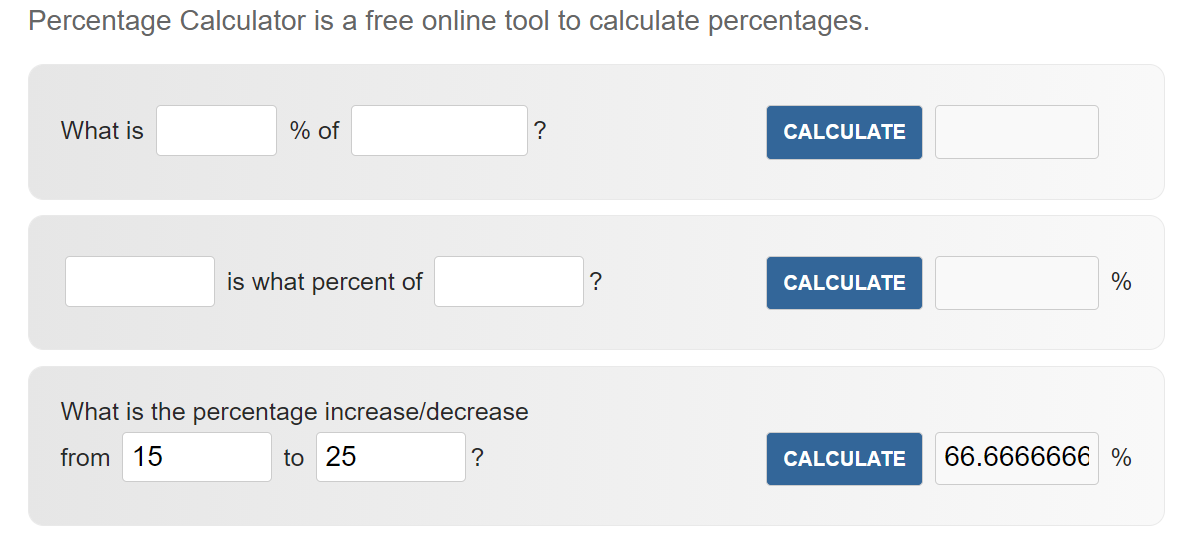
Use percentagecalculator.net to calculate the percentage increase in circulation. For this example, we use the third calculation tool on the page:
That’s a 133 percent increase in circulation.
Now, the next week, you decide to send another email promoting a different eBook. But this time, the eBook you choose to promote has 15 holds or copies before the email is sent. When you check 24 hours after sending the email, there are 10 new holds or checkouts. In total, there are now 25 holds or checkouts on the eBook.
The raw numbers for the second email are bigger (an increase of 4 holds/checkouts vs. an increase of 10 holds/checkouts). But the percentage increase for the second email is actually smaller, at 66%! That means email #1 was more effective.
What this metric will tell you: Percentage increase in circulation lets you compare your promotions more accurately. If you are short on time, this kind of comparison will help you determine which promotions will give you the most success with your limited resources.
3. Conversion rate.
This is the percentage of people who took an action after receiving your email.
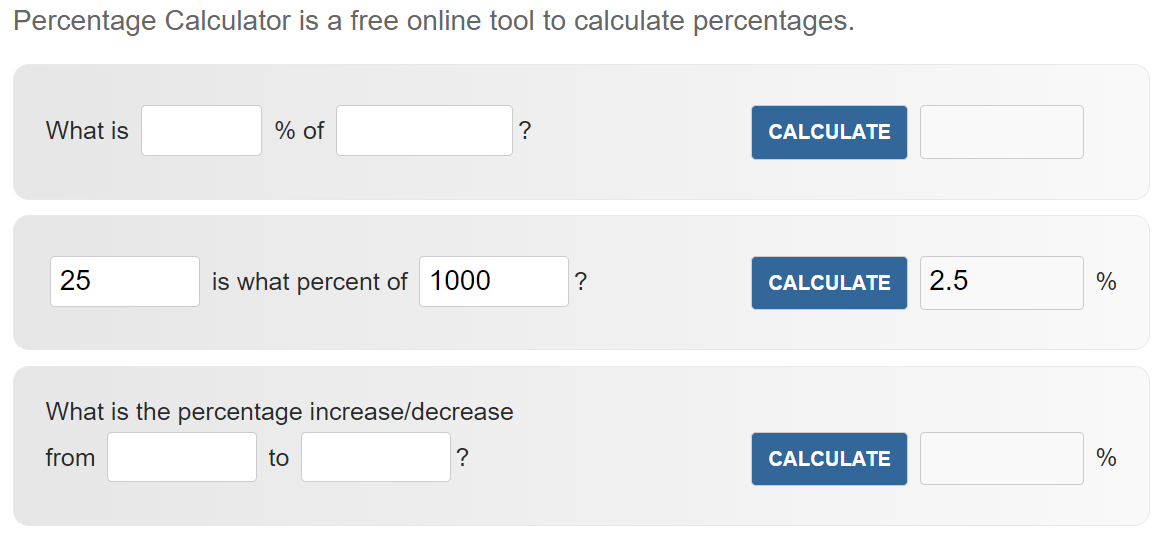
Let’s pretend that you’ve sent an email to 1000 people. The email promotes a streaming video on your library website that hasn’t had any views in the past couple of weeks.
When you check the streaming statistics for that video, you see that 25 people watched the video in the days immediately after you sent the email.
Using the second tool on our percentage calculator website, you can calculate the percentage of people who “converted” or took an action after your email.
What this metric will tell you: If you start tracking conversion rates on your emails, over time you’ll have a clear picture of the types of emails your audience responds to. You’ll be able to establish a good base percentage for your audience. This number will be different for every library.
If you are short on time, this metric will help you determine which promotions will give you the most success with your limited resources. When you find a certain type of email promotion works based on conversion rate, you should do it more often.
4. Amount of traffic driven to your website.
Track how much traffic is funneled to your public website by your emails. You can use Google Analytics to analyze how efforts on those platform translates into action by your cardholders. If you’ve never worked with Google Analytics, here is an easy guide to get you started.
What this metric will tell you: This is an important metric to share with administration, because it clearly demonstrates the value of the time and energy you have invested in email marketing.
Special bonus tip!
If you promote the same collection item or booklist on social media, email, and your website, put some space between those three promotions. A week is a good amount of time. That allows you to really pinpoint whether your increase in circulation is coming from email, your placement of the item on your website, or social media.
In fact, that’s a fun experiment to run. Can you drive higher circulation numbers by promoting your collection on your website, email, or social media?
You can even get more granular: which social media platform is best for collection promotion? Which page on your website is best for placing collection promotions? Which email list responds best? See, this is fun!
Subscribe to this blog and you’ll receive an email every time I post. To do that, click on the “Follow” button in the bottom left-hand corner of the page.
This is the 100th episode of the Library Marketing Show. It’s a celebration of YOU… the person who does marketing and promotions at your library.
I think you are amazing and awesome, and I’m sharing the five reasons why library marketing is the best job at the library.
And Kudos in this episode go to… you! Thank you for your comments, feedback, ideas, and support. The library marketing community is gracious and warm and wonderful, and I’m proud to be a part of it.
Do you have a suggestion for a topic for a future episode? Want to nominate someone for kudos? Let me know in the comments. And subscribe to this series to get a new video tip for libraries each week.
Thanks for watching!
Subscribe to this blog and you’ll receive an email every time I post. To do that, click on the “Follow” button in the bottom left-hand corner of the page.
In this episode, I’ll explain what an email drip campaign is, why you might want to use a drip campaign for library promotions, and then HOW to actually put the campaign together!
Kudos goes to Barbara Swinn of York Libraries for her British Empire Medal!
Do you have a suggestion for a topic for a future episode? Want to nominate someone for kudos? Let me know in the comments. And subscribe to this series to get a new video tip for libraries each week.
Thanks for watching!
Subscribe to this blog and you’ll receive an email every time I post. To do that, click on the “Follow” button in the bottom left-hand corner of the page. Connect with me on YouTube, Twitter, Instagram, Goodreads, andLinkedIn.
I mean, you might as well ask me to explain the meaning of life. (I’m kidding. Please don’t ask me that question.)
There are two ways to define engagement in your library promotional efforts.
Transactional Engagement
One way to talk about engagement in library marketing is solely centered on numbers.
How many likes, shares, comments, and direct messages do your social media posts get? What is the open and click through rate of your emails? How many people signed up to attend your program based on the flyer you slipped into their checkout? How many people used a database after you mentioned it at your last program?
These hard numbers are measurable and easy to explain. They demonstrate that your community sees your marketing. They take an action.
Transactional engagement is data that proves people are interacting with your library marketing.
Relationship Engagement
But engagement cannot, and should not, be solely defined by the hard numbers. It must also be the ongoing relationship building that your library does with patrons.
People may be opening your emails and clicking on your social media posts. They’re checking out books and using your services.
But more importantly, how do they feel about your library long term?
Engagement must involve building a deeper relationship with your patrons over time. When that happens, the relationship will manifest itself in ways that go beyond hard numbers.
This is the real value of your library. Your cardholders will not only use the library more, but they’ll also donate more, volunteer more, speak out to support you more often, and influence others to use the library.
If this relationship building has not been in your list of priorities, you’re not alone. A study by Chief Marketing Officer found that most marketers fail to nurture long-term relationships. Instead, they focus more on the transactional nature of engagement.
That’s because transactional engagement is easy to measure. You can take those metrics to your supervisor and to the board. You can prove what you’re doing is effective. And you can feel good about your work.
It’s far more difficult to explain to your library administrators and stakeholders that you are building a lifelong emotional connection and loyalty with your community. It is hard to convince them that this is important. It’s also difficult to measure this work.
And building relationships doesn’t happen overnight. Libraries may feel they don’t have the luxury of devoting time to this work.
But we must. And we must do that right now.
Why this is the moment to focus on relationship building
Libraries are at a crossroads. I cannot stress this strongly enough: as we emerge into the post-pandemic world, we should not go back to doing things the way we were doing them before the crisis.
Libraries were already facing budget cuts, apathy, and accusations of irrelevancy. And that was before the pandemic forced us into lockdown and severed tenuous ties with our community by physically separating us from our customers.
The pandemic forced us to take our service models in a whole new direction. We proved that we can pivot.
We should use this opportunity to move our marketing in a new direction too. We cannot let the fear of doing something different keep us from making the bold changes needed to move into a real position of success.
Libraries should use this time to turn their sights on building loyalty. We’re going to need it to survive in the post-pandemic world.
Relationship engagement is the key. When we focus on building loyalty, we’ll learn more about our communities. We can put those discoveries to use to create services that actually solve problems. We can provide the services our community needs, not the services we *think* they need.
Yes, I know this sounds a little aspirational and far-fetched
Now, when I gave this answers to the folks who asked me do define engagement, I could see the look of skepticism on the faces of some of my peers. And I understand why.
We are just coming out a major life changing event. Most libraries think they must be solely focused on trying to get their circulation and usage numbers back up to pre-pandemic levels.
But I think this is a chance to do something bigger. This moment is an opportunity that comes once in a lifetime.
Library staffers often seek to find the deeper meaning of the work they are doing. They want to know that their jobs are having an impact on the community. If we focus on building sustainable relationships of loyalty and trust with our community, staff will feel like they are contributing to the library’s overall goals in a meaningful way.
How does relationship building work in a real library?
Let’s say your library does personalized reading suggestions. Staff members may view their work as transactional. A reader asks for a suggestion and answers a few questions. The library staffer sends them a list of suggested books based on their reading preferences. Interaction complete.
To turn this from solely a transactional interaction to a relationship building interaction, the library staff member could write a personal email or note to the reader, to explain why they chose these particular books. A few weeks later, the staff member could reach out to the reader to ask for their thoughts about the selections. Did they like them? Which books did they check out? Did they learn anything new about what they like to read?
This interaction takes longer but it’s more meaningful. It shows that the library cares about the person and strives to provide the best customer service possible. And that’s how you build loyalty in your community.
Here are more ideas that will help you take transactional library interactions and turn them into relationship building engagement.
By the way, this weekend, I heard someone say they believe the meaning of life is for us to help each other get to wherever we are going next.
That view has a connection to the work you do at your library, don’t you agree?
Subscribe to this blog and you’ll receive an email every time I post. To do that, click on the “Follow” button in the bottom left-hand corner of the page. Connect with me on YouTube, Twitter, Instagram, Goodreads, andLinkedIn.
In this episode, I respond to the common misconception that a library can send too many emails and annoy their cardholders. Libraries are the exception to the email marketing rule and I’ll explain why that is.
Kudos in this episode go to the Dallas Public Library, who did a branch grand opening in the middle of the pandemic!
Do you have a suggestion for a topic for a future episode? Want to nominate someone for kudos? Let me know in the comments. And subscribe to this series to get a new video tip for libraries each week. Thanks for watching!
I recently learned that there are some library marketers who face push back when they try to make sure their marketing materials are accessible.
Accessibility is a library mission. One in five people around the globe live with a disability. Libraries will never be truly inclusive until they design services, programs, and marketing with this group in mind. And so, in this episode, I’ll share some strategies to help you make sure this goal becomes a reality at your library.
Kudos in this episode go to the Hutchinson Public Library for their advocacy idea that they deploy during Library Lovers Week.
Do you have a suggestion for a topic for a future episode? Want to nominate someone for kudos? Let me know in the comments. And subscribe to this series to get a new video tip for libraries each week. Thanks for watching!
In this episode, I’ll share the MOST IMPORTANT thing you need to do in library marketing and why you must make time for this step!
Kudos in this episode go to the Madison Library District for their commitment to marketing on Pinterest.
Do you have a suggestion for a topic for a future episode? Want to nominate someone for kudos? Let me know in the comments. And subscribe to this series to get a new video tip for libraries each week.
I started this blog six years ago. Can you believe it?
When I published my first post, I really had one goal: To help other library workers. I believed that sharing tips, strategies, ideas, and best practices for library marketing would strengthen the whole library industry and help secure the future of libraries.
I still believe that.
And we’ve come a long way in library marketing. Many libraries are promoting their collection and services in ways they would have never imagined six years ago. They’re focused on strategy and innovation. They’re not afraid to try new things. They’re experimenting. They’re putting cardholders first.
Library marketing no longer stinks! Now it’s time to advance library marketing to the next level. Here are the four things libraries should do now to move successfully into the future.
Put your collection front and center on your website.
When I visit a library website, the first thing I notice is how prominently they promote their books, movies, and streaming content. When I must search for these things, it causes me real grief. It’s like going to the grocery store and finding the milk and eggs hidden in a back room accessible only to the most intrepid shoppers.
Most of the folks who interact with your library online are there for the collection. If you don’t believe me, check your website statistics. Look at Google Analytics. I’ll bet you the most visited pages of your website are the homepage, your catalog, and any page that showcases your collection items.
Don’t hide your collection on your website.
If you have a personalized reading recommendation service, put it right in the middle of your homepage. If you have reading recommendation newsletters, put your opt-in link right in the middle of your homepage. Post about your collection on social media at least 50 percent of the time.
Books are your brand. If your library wants to have a part in making the world more informed, more educated, and more empathetic, put your collection right where people can find it on your website.
Shift your energy from library programs to library services.
I have shared many conversations in the past few years with library workers who express frustration over program promotion.
This reached a fever pitch in 2020, as the pandemic forced programs to move online. Library workers couldn’t measure attendance as they once did. And attendance and registration numbers dropped off.
The frustration is palpable. We put all this work into quality programs, and no one shows up. Doesn’t that bother anyone else? Why are we doing this?
Libraries need to have a hard conversation with themselves. Programming gets too much emphasis in libraries.
We should spend our energy instead on developing and promoting our unique services, like homework help, adult education courses, genealogy research, and small business support.
No one else in our community does these things for free. They are so important to our communities. These are the hidden treasures of libraries. And they are underused because people don’t know they exist.
So, let’s spend this year shifting our focus to strategically and systematically promoting these services. Add mentions of these services in your email newsletters. Post about these services on social media at least 25 percent of the time.
And use those precious in-person interactions to market your services. If you see someone picking up curbside items on topics like career, education, or family history, let the patron know about the appropriate matching service.
Use data to make current library cardholders happy.
Many libraries spend an awful lot of time focused on trying to get new customers. But once a person signs up for a library card, we take it for granted that this cardholder will use their card again.
It takes a lot of time and energy to get a cardholder signed up in the first place. That time and energy is better spent working to make current library users realize everything their magical library card can offer them. Because what would you rather have… lots of library cardholders or lots of library users?
This year, I want libraries to spend less time chasing new cardholders and more time gathering data about our current cardholders. Then target current cardholders with marketing messages that keep them coming back to the library.
We can create surveys to gather demographic data and psychographic data. Then we can use that data to ask ourselves: what do our current cardholders want and need from us? Focus on those things this year for maximum effectiveness in your library marketing.
Make it easier for people to use your library.
Let’s be honest: people must clear a lot of hurdles to use the library.
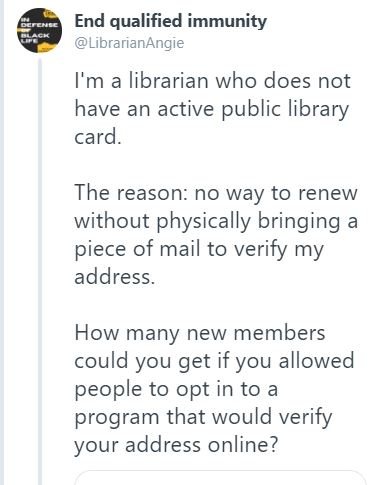
It’s hard to get a library card. Community members must provide proper identification. If they apply online, they must show up at a branch to claim their card, often within a specific amount of time. I was reminded of this just a few days ago, when I received this Tweet.
Library users also must have separate logins and passwords to use services like Hoopla, Overdrive, Kanopy, and Freegal.
And if cardholders don’t return items on time, they get fined. If a library user accumulates too many fines, they lose the ability to use their card.
All these things may seem like little inconveniences. But it is these little hurdles that stand in the way of advancing our libraries in the future.
I know some of these hurdles are not the fault of the library. We’re often at the mercy of our vendors. But our communities don’t know that and, frankly, I don’t think it matters. People expect easy access to library services. And they receive easy and convenient services from other companies.
Libraries need to make a concerted and deliberate effort to make it easier for people to use the library in 2021. We’ll have to do this to compete with convenient services that threaten to take away our market share.
First, let’s fix the things that are in our control. We can make it easy for anyone to get a library card online without ID. And we can eliminate fines and fees that serve as a barrier to many of our patrons.
Next, let’s band together to demand vendors create integration that allows library users to access their services from our website with one-step authentication: their library card number. Demanding this change as an industry will be one of the best ways to advocate on behalf of our cardholders this year.
Subscribe to this blog and you’ll receive an email every time I post. To do that, click on the “Follow” button in the bottom left-hand corner of the page. Connect with me on YouTube, Twitter, Instagram, and LinkedIn.





 Super Library Marketing: Practical Tips and Ideas for Library Promotion