Search

Super Library Marketing: Practical Tips and Ideas for Library Promotion

Tag

marketing libraries

I Broke This Library Social Media Rule… and You Should Too!

WATCH NOW

The #LibraryMarketing Show, Episode 42

In this episode, Angela talks about discovering that she was breaking a Twitter Policy Rule repeatedly, for years and years. Hear about why she panicked… and how she figured out it’s actually a good rule to break!

Also Kudos to The State Archives and Records Authority of New South Wales (NSW State Archives and Records) in Australia for their incredible interactive online jigsaw puzzle!  

If you have a topic for the show, kudos to share, or want to talk to me about library marketing, contact me using this short form.

← Back

Thank you for your response. ✨

Want more Library Marketing Show? Watch previous episodes!

Check the Upcoming Events page to see where I’ll be soon. Let’s connect!

This blog consists of my own personal opinions and may not represent those of my employer. Subscribe to this blog and you’ll receive an email every time I post. To do that, click on “Follow” button in the bottom left-hand corner of the page. Connect with me on Twitter, Instagram, and LinkedIn.   

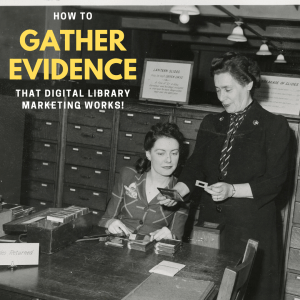
Now is the Absolute BEST Time to Prove Digital Promotions are Essential for Library Marketing. Here’s How to Gather Evidence.

PHoto courtesy of Public Library of Cincinnati and Hamilton County

I had a wonderful conversation with a librarian from Canada this week. She heads technical services at her library. We were brainstorming about ways to market her library services, programs, and collection during the COVID-19 shutdown. And we both realized something. The pandemic is awful and scary. But it also affords one big opportunity for librarians and library marketers.

Now is the time to prove the value of digital promotions 

The Marketing Rule of 7 states that a prospect needs to “hear” the advertiser’s message at least seven times before they’ll take action to buy that product or service. This marketing maxim developed by the movie industry in the 1930s. Studio bosses discovered that a certain amount of advertising and promotion was required to compel someone to see one of their movies. 

What does the Marketing Rule of 7 have to do with your library? Digital promotion helps you fulfill the rule of seven. It’s the most efficient way to get your message in front of eyes in a variety of places.

In fact, if you’ve been thinking of slowing down the communication you do right now, don’t. Ramp it up! Your community needs to hear from you.

You should be sending more email to your cardholders. You should be posting to social media more frequently. You should be putting more notices about digital resources on the homepage of your website. 

In this moment, we can accurately measure the results of digital marketing because of the lack of competition from more traditional means of library marketing, like book displays, flyers, and posters. No one is seeing those at this moment, because no one is coming into your physical library building. Digital results are easy to record.

And, if we take this unique moment to gather data to prove that our work yields results, we can provide solid evidence of our worth in the community. We may prevent layoffs and budget cuts. When this is all over, we can say the library was there–and people turned to it for help. 

Statistics to gather now to prove your worth later

Measure virtual program viewing. Many libraries are putting together great virtual programming, particularly story times. If you do live streaming or on-demand videos, be sure to gather metrics on views.

Some platforms will tell you how a person got to your video and some will tell you how long they watch. Most will give you demographics on your viewers, like their age, identified gender, and location. All will give you stats on reach, engagement, and follower growth.

All those data points are valuable. Start a spreadsheet now and track the results day by day. You’ll be able to prove that people watched, how they found out about the video, which videos they liked most, and how long your library held their interest.

Send more emails, and track results religiously. Your library can use email to promote everything from services to events to the collection. Tell your cardholders about the new eBooks and eAudiobooks in your collection. Use your email to drive usage of those hidden treasures in your library, like online homework help, streaming music, and resume or job-hunting databases. Then…  

Tracks holds, checkouts, and usage for digital collection items. Be sure to write down how many holds and checkouts there are before you market, and one week after. It’s easy to prove the value of digital collection marketing when no one can walk into a library to check out a book. Every checkout is likely coming from your efforts!

Ramp up your social media posting schedule on two platforms. Social media is the second method most effective method for digital promotions. And it’s the best way for you to reach non-library cardholders right now.

Current research shows that people are Tweeting a lot more right now. With the amount of content on that platform, I would not recommend posting more frequently on Twitter. There’s too much competition and your posts are likely to get lost in the shuffle.

However, those same stats also show growth in use of LinkedIn and Pinterest during the pandemic. If your library is not posting on those platforms, now is a fantastic time to experiment and reach a new audience.

On LinkedIn, you can share collection items, services, and events that focus on job-hunting, career advancement, personal wellness, diversity, literacy, and entrepreneurship.

On Pinterest, post new eBooks and eAudiobooks added to your collection. If you have DIY, STEM-activities, or story time videos, you can also post those to Pinterest. People are using the platform for inspiration and to find activities to fill their time. Now is a great time to give them some content so they can discover your amazing library.

One more thing to do

Advocate to change your marketing emails from opt-in to opt-out. That means every cardholder who gives your library their email address, in the past or in the future, is on your marketing list. If they want to opt-out, they can (but they won’t!).

I know many libraries will find this to be a radical shift. Libraries worry about angering their cardholders by sending them emails. They don’t want to be one of the “bad brands” that sends spam. Many libraries have actual board policies making opt-in mandatory for emails.

Now is the time to advocate for change. Here’s why.

A library is NOT a business. The normal consumer sentiment about spam email does not apply to you. Your cardholders want your emails.

People love the library. They love what you offer them. They want to know what’s going on at the library. 

You are not going to spam people or make them mad by sending them emails. Unwavering cardholder loyalty is the one big advantage libraries have over their competitors in the profit world. And we should use it!

In addition, people are accustomed to opt-out emails. They know that if they give you their email, you’re going to message them. 

My argument for opt-out emails comes from lots of experience. When I worked for a public library, we sent marketing emails nearly every day of the week. My library’s unsubscribe rate was ZERO percent. I usually saw about 10-15 unsubscribes for every 10-thousand emails I send. Across the non-profit world, the average unsubscribe rate is about .19 percent, according to Smart Insights.

I worked the library outreach table at a book festival every year while I worked at the public library. Without prompting, customers asked about the library’s marketing emails. One lady said she heard her friends talking about them and wondered why she wasn’t receiving them! Several others mentioned they learned about new books and services from our emails. I had people GIVING ME their email addresses to check their status.

Do you think customers of other companies ask about their emails or talk about them with fondness to other customers?  I never have, and I sign up for A LOT of marketing emails from other companies.

Start sending your emails to every customer. They want to hear from you! And you can track usage and circulation increases from those emails to help prove your library’s worth.

You might also want to read these⬇️

What Metrics Demonstrate Your Library’s Social Media Marketing is Working?

How to Reverse Engineer Your Library Marketing Social Media Audiences!

The One Social Media Shortcut That Can Tank Engagement and Cost Your Library in a Pandemic–or Anytime!

Subscribe to this blog and you’ll receive an email every time I post. To do that, click on the “Follow” button in the bottom left-hand corner of the page. Connect with me on YouTube, Twitter, Instagram, and LinkedIn.  
Three Tips to Navigate the Tricky Job of Fundraising for #LibraryGivingDay During a Pandemic

Watch Now

In this episode, Angela talks about how to navigate the tricky job of fundraising for your library during the pandemic… or anytime.  Library Giving Day is April 23. I’ll share three ideas for raising much needed library funds during a crisis.

Also Kudos to the Tredyffrin Township Public Libraries for their fantastic YouTube channel. Watch their clever database promotional parody video here: https://youtu.be/cS0J99KWaGA And be sure to subscribe to their channel.

More Help During Covid-19

What Will Happen to Library Summer Reading Programs This Year?

Library Marketing During a Pandemic: Tips for Working from Home or the Office and Dealing with the Stress of a Crisis

Self-Care for Library Social Media Staff in the Midst of a Crisis like #COVID-19

How #COVID-19 is Impacting Social Media Marketing and What That Means for Libraries

Why Libraries Must Promote Reading for Pleasure During the COVID-19 Crisis

If you have a topic for the show, kudos to share, or want to talk to me about library marketing, contact me using this short form.

← Back

Thank you for your response. ✨

Want more Library Marketing Show? Watch previous episodes!

Check the Upcoming Events page to see where I’ll be soon. Let’s connect!

This blog consists of my own personal opinions and may not represent those of my employer. Subscribe to this blog and you’ll receive an email every time I post. To do that, click on “Follow” button in the bottom left-hand corner of the page. Connect with me on Twitter, Instagram, and LinkedIn.    


The One Social Media Shortcut That Can Tank Engagement and Cost Your Library in a Pandemic–or Anytime!

I know work is hard right now. But there is one time-saving social media marketing technique that libraries should avoid at all costs.

Libraries should avoid cross-posting on social media. Cross-posting is when you post the same text and graphics in a message across multiple social media networks.

I get why many libraries cross-post. Cross-posting is easy. It saves time and energy. And library staff have a lot of work to do. Even when there is no pandemic to deal with, librarians are often asked to take care of marketing along with their regular duties. But the detrimental effects of cross-posting outweigh any time you might save doing it.

Why cross-posting is a bad idea

Cross-posting is a bad idea because social media platforms are different. They have different standards for post length, image size, hashtags, links, and captions.

For example, LinkedIn is more copy-heavy and formal. Instagram is more visual and informal. Twitter is more suited to short quotes, threads, and GIFs. Pinterest is graphic-heavy. One post with the same text and photo can’t be all those things.

An image you post on one platform may not be sized for another platform. It may end up stretched, pixelated, or squished. This will hurt your ranking and engagement.

Speaking of engagement, the metrics are different for each platform. On Facebook, you’re aiming for likes, comments, and shares. On Twitter, you want retweets and replies. On Pinterest, you want comments and re-pins. One post can’t generate all those things.

Your followers are also different depending on the platform. Twitter users are overwhelming between the ages of 18 and 44. LinkedIn users are more likely to have a college degree than users of other platforms. 70 percent of Pinterest users are women. Every platform has a unique demographic with different needs.

When you cross-post, you risk looking inauthentic and spammy. Your posts will feel like they’re auto generated and robotic. It may look like you don’t care about what you post on your account or worse, that you don’t know you to use social media.

Your audience will respond negatively by not responding at all. That hurts your standing in the algorithm. It can have a negative effect on your reach.

What to do instead

Cross-promotion is better! Take your message and adjust it slightly to suit each social media platform. It’s much easier than it sounds.

First, you need a base message. What is the basic info you wish to convey? What is the action you want your followers to take? Answer these two questions in a two or three sentence nugget. This is your base message.

Then take that base message and adjust it for each of the social media platforms you wish to use. A tweak of a word or phrase here and there, an adjustment of an image, and a unique call to action are all you need to be authentic.

Westerville Public Library in Westerville, Ohio did a great job of tweaking this promotion for Twitter…

…and Facebook.

Here’s another good example of cross-promotion from Barlett Public Library District in Illinois. This is their Twitter post…

..and the same message tweaked for Facebook.

Decide how much time your library is willing to invest on social media. Smaller libraries will want to concentrate on the platform or platforms that will give their library the most benefit. If you are pressed for time, pick the platforms that perform best for you or the platforms where the audience you wish to target is using. If that means you only post on one social media network, it’s okay. Quality is better than quantity.

Use a scheduling tool. There are plenty of free scheduling tools that will help you to share your social media messages without cross-posting. I have used the free version of TweetDeck for my personal social media for years. You can schedule lots of posts in advance and the metrics are great. I recommend it for libraries without the budget for scheduling software.

At my former library job, we had a paid account with Sprout Social. It was easy to use and had more cross promotion capabilities than TweetDeck. I recommend it if you have money for a paid scheduling platform.

More library social media advice

How #COVID-19 is Impacting Social Media Marketing and What That Means for Libraries

Self-Care for Library Social Media Staff in the Midst of a Crisis like #COVID-19

What Metrics Demonstrate Your Library’s Social Media Marketing is Working?

How to Reverse Engineer Your Library Marketing Social Media Audiences!

Subscribe to this blog and you’ll receive an email every time I post. To do that, click on the “Follow” button in the bottom left-hand corner of the page. Connect with me on YouTube, Twitter, Instagram, and LinkedIn.  

Why Libraries Must Promote Reading for Pleasure During the COVID-19 Crisis

Watch Now

In this episode, I’ll share why reading for escape is important! Libraries are so focused on learning and connecting people to resources to help them with the transition to remote learning that we might forget we don’t always have to be educational. Here’s a great article from Jordan Kisner in the New York Times about why people fall in love with reading. 

Here are some places to find booklists for “escape” reading that you can share with your patrons.

10 Books to Warm the Soul from Food52 

The Best Books to Read While Social Distancing from Fortune.com 

Books to Escape Reality from the Daily Beast

Books to Keep Kids Happy During Quarantine from The Conversation.Com.

Also Kudos to the Schlow Library in State College, Pennsylvania. They’ve come up with a way to extend a public meeting space to patrons even though their physical library is closed. They’re helping people reserve Zoom meeting rooms!

More Help

Library Marketing During a Pandemic: Tips for Working from Home or the Office and Dealing with the Stress of a Crisis

Self-Care for Library Social Media Staff in the Midst of a Crisis like #COVID-19

How #COVID-19 is Impacting Social Media Marketing and What That Means for Libraries

Recording of live session on promoting your online resources through social media. 

If you have a topic for the show, kudos to share, or want to talk to me about library marketing, contact me using this short form.

← Back

Thank you for your response. ✨

Want more Library Marketing Show? Watch previous episodes!

Check the Upcoming Events page to see where I’ll be soon. Let’s connect!

This blog consists of my own personal opinions and may not represent those of my employer. Subscribe to this blog and you’ll receive an email every time I post. To do that, click on “Follow” button in the bottom left-hand corner of the page. Connect with me on Twitter, Instagram, and LinkedIn.   

Self-Care for Library Social Media Staff in the Midst of a Crisis like #COVID-19

Watch Now

In this episode, Angela shares tips for self-care for anyone who is trying to manage a library social media account in the midst of a crisis, like a global pandemic.

More Help

Library Marketing During a Pandemic: Tips for Working from Home or the Office and Dealing with the Stress of a Crisis

How Libraries Are Responding to the Coronavirus Threat and How Your Library Can Prep for Any Crisis

Plus kudos go out this week to the Lake Macquarie Library system in Australia. They have a new app and it’s pretty darn amazing.

Subscribe to this series to get a new video tip for libraries each week!

If you have a topic for the show, kudos to share, or want to talk to me about library marketing, contact me using this short form.

← Back

Thank you for your response. ✨

Want more Library Marketing Show? Watch previous episodes!

Check the Upcoming Events page to see where I’ll be soon. Let’s connect!

This blog consists of my own personal opinions and may not represent those of my employer. Subscribe to this blog and you’ll receive an email every time I post. To do that, click on “Follow” button in the bottom left-hand corner of the page. Connect with me on Twitter, Instagram, and LinkedIn.   

How Libraries Are Responding to the Coronavirus Threat and How Your Library Can Prep for Any Crisis

Photo courtesy Public Library of Cincinnati and Hamilton County

This past week, many public libraries found themselves grappling with a real and unexpected threat. The 2019 Novel Coronavirus, also known as COVID-19, is causing many libraries to consider how they can best share information about the disease and protect their patrons.

Public library staff and patrons may be particularly vulnerable. The library is one of the last places in the world where people of all ages, economic backgrounds, and social standings are welcome to gather without judgment or prejudice. We hold public programs, share equipment, and conduct business face-to-face. We have lots of surfaces touched by thousands of hands. We help the elderly, those experiencing homelessness, and the young.

Libraries are also a vital source of truthful information about many subjects, including the spread of COVID-19. It’s no surprise that there are already lots of rumors and false safety tips circulating on the internet. Libraries must help make sure the public has accurate information about how to protect themselves.

I want to share some resources to help your library as you grapple with COVID-19. These are gathered from official sources and from librarians working in libraries across the U.S.

This is also a good time for library marketers to consider how they respond in a crisis and to update their crisis communication plans. Scroll down for more help with that.

Coronavirus Resources for Libraries

Official CDC site for Coronavirus. Bookmark this page so you can provide information to the public. Library social media managers should post facts about the illness taken from the CDC site. A once-a-day Coronavirus fact check post is a good way to counteract the effects of false internet rumors. It will establish your library as a trusted source for the truth about the illness.

CDC Communications Resources for Coronavirus. This section of the CDC site includes videos and print materials to share with your patrons. In addition, the section for public health communicators should be shared with your senior staff.

CDC provided Coronavirus graphic

EveryLibrary guide. EveryLibrary has created an extensive resource page for libraries. They’re also holding a free webinar on Thursday, March 26, on pandemic preparations for libraries. You don’t have to register but you do have to be a member of Library 2.0, which is free.

Comic for kids from NPR. Library social media managers are passing around this piece by NPR education reporter Cory Turner. He asked some experts what kids might want to know about the Coronavirus. You can print and fold the comic, which also comes in Chinese.

BrainPOP video for kids. You can share this video with teachers and caregivers or play it at story times or children’s events to help educate kids and alleviate their fears. The site also has lots of other resources for kids including related reading, games, and lesson plans.

Blog post from North Central Regional Library, Washington. This is a great example of how to communicate the facts about the illness to a broad audience. This library used state and federal authorities to answer key questions. They also addressed concerns about visiting their public library. If you have a blog, I recommend a similar post to help spread facts and assuage fears.

Blog post from Bucks County Free Library, Pennsylvania. Their post includes a special section of information for kids that would be particularly helpful for caregivers and teachers.

Oregon City, Oregon resource guide. This version includes documents that anyone can print or download and share.

Clemson Libraries Guide. The Clemson library included a Google news feed with stories from trusted stories, which is a great idea.

UC San Diego Guide. The University of California San Diego post includes a graphic from John Hopkins that updates the number of cases around the world, making it easy for people to get updated information about the spread of Coronavirus.

Libraries 2020 article. If your library doesn’t have resources for a blog or a page on your website, you can share this fantastic article from Libraries 2020 to help customers recognize rumors and false information about Coronavirus.

Kimberly Barker, Librarian for Digital Life at Claude Moore Health Sciences Library – University of Virginia, created this printable PDF for libraries to post. She gave me permission to share it with you.

Preparing for a Crisis

At some point your library will face a crisis. It might be a transmittable disease, like COVID-19. It might be a non-lethal but worrisome issue–black mold found in study rooms. It might be a power outage that lasts several days and closes several branches (that happened to my former library!) Perhaps it will be more severe–a fire that destroys a branch, a violent argument between customers, or an administrator caught doing something illegal.

As upsetting as it is to contemplate, it will happen–this I can promise you. Your response to the crisis in your role as the library spokesperson can make or break an organization. In my earlier life as a journalist, I watched it happen dozens of times. It’s heartbreaking to watch an organization fall apart during a crisis.

On the flip side, I’ve witnessed communicators who keep their organization afloat with amazing and inspiring work during scary and emotionally trying times.

The best thing you can do right now is to prepare. Here’s how.

Have a frank conversation with the administration about disaster preparedness. They might feel uncomfortable having this conversation but make it clear that it’s necessary so that you can perform your job in the best way possible. Make decisions about how you’ll handle a crisis while you are calm and rational because rationality and calm will fly out the window the minute a serious crisis threatens your library.

Create a system-wide disaster communications plan. If your library doesn’t have one in place yet, now is the time to decide how a crisis will be handled.  Your library should assign employees to serve on a crisis communications team. This team will be responsible for gathering and disseminating information to internal and external audiences, including staff and the media.

Decide who will be authorized to speak to the media on behalf of the library. Ideally, you’ll have one main spokesperson and a backup. Try to limit it to two people, or you’ll risk losing control of your message. The spokespeople need to be comfortable in front of a TV camera, credible, knowledgeable about the library, articulate, calm, and able to work with other agencies to coordinate responses.

When it happens, be sure to communicate with your staff first, then the media. But do so quickly. Don’t wait until you know all the facts about your situation. By then, rumors will spread through social media by your customers and your co-workers and you’ll lose control of your narrative. If you don’t talk first and fast, reporters will start looking for workers and customers to interview.

Don’t be afraid to say “we don’t know yet” and refer questions to the investigating authorities. This is particularly true in criminal investigations. Send reporters to the investigating agency for answers.

Prepare your staff for ambush interviews.  Warn your staff that they will likely be approached by a reporter wanting information. Train them to funnel all such requests through your designated spokesperson.

Always having someone watching social media.  Designate one person to watch for any mention of your organization on social media channels. Have clear guidelines in place for how this person can respond to those mentions and comments.

Subscribe to this blog and you’ll receive an email every time I post. To do that, click on the “Follow” button in the bottom left-hand corner of the page. Connect with me on YouTube, Twitter, Instagram, and LinkedIn.  

The Secret to Forge Library Loyalty: Stop Holding Programs and Start Creating Experiences

Photo courtesy Public Library of Cincinnati and Hamilton County

Anytime I hear anyone talk a new marketing trend, I must consciously remind myself not to roll my eyes. Marketing trends tend to be nonsense created by agencies hoping to generate buzz.

So, when I first learned about a trend called experiential marketing a few years ago at a conference, I listened politely, and filed it away in the back of my mind, along with my skepticism about whether this truly existed.

It’s clear to me now that experiential marketing isn’t just a buzzword. It’s a legit marketing option for libraries everywhere. And it could be the trend that permanently cements the bond between your library and the community it serves.

What is experiential marketing?

Experiential marketing is sometimes also called event marketing. It can be a pop-up library or program. It can take the form of a special day long library event, an immersion experience, a conference, a workshop—there are limitless possibilities.

But this isn’t just an ordinary event. An experiential marketing event is a program that includes a way to create an experience, to engage the attendee’s senses, and to create a personal and memorable interaction with your library.

It’s about sparking positive emotions in the people who attend. Those emotions become imprinted in the minds of the attendees. They associate that positive emotion with your library.

See why it sounded a little hokey to me the first time I heard it?

But here’s the thing. While most marketing interrupts and forces itself on the community, the experiential experience is voluntary. Your community or cardholders are choosing to interact with your library. Those experiences create beautiful memories. Those beautiful memories become a part of the overall library experience for your community. A loyalty is formed.

Libraries tend to think about their programs and events in simple terms. The program is a way to offer something to the community that is in line with the library’s overall strategic plan. It may also help to fill a community need like literacy or workforce development. These reasons are all valid and valuable.

But there is a clear marketing value in expanding our understanding of what a program or experience can be for our community–and what it can do for our libraries.

And we need to do so because our younger cardholders are at stake. Experiential marketing appeals to younger people. A study by Harris Group found that 72 percent of millennials would rather pay for an experience than for material objects.

This can be a differentiating factor for libraries. We should jump at the chance.

Why experiential marketing is so appealing

It all comes down to the fear of missing out, or FOMO. We see our friends and family posting on social media as they engage in exciting events. We feel anxious because we are missing out on these amazing experiences. And we feel compelled to resolve that anxiety by attending.

Think FOMO isn’t real? Check out the Twitter feed anytime the ALA or PLA conference is in full swing. The number of librarians who lament about missing the conference is pretty astounding.

What are the benefits of creating library experiences?

Experiential marketing forges a personal connection with your library. As younger generations increasingly value experience over tangible items, they’ll patronize and visit libraries that have taken the time to get to know them and offer them experiences that they can learn and grow from in a deep and meaningful way.

  • 85% of consumers say they were likely to purchase after participating in events or experiences.
  • 91% of consumers say they had more positive feelings about brands after attending events or experiences.

Examples of experiential library marketing programs

Challenge yourself to go beyond the normal crafting groups, story times, and passive programs. Instead, push your library to nurture the relationship between the library brand and your community.

You can create all kinds of innovative programs that foster a love and joy of reading. Try a TED talk style book talk. Invite readers to give a compelling talk under a time limit,  say 60 seconds, to convince people to read one of their favorite books. Or schedule book dates, where readers talk one-on-one with under a limited time deadline about their favorite books.

At the Edge 2020 conference in Edinburgh last week, the head of Library and Information Services at East Renfrewshire Libraries in Scotland talked about programs they hold called “Come Complete Your Bucket List at the Library.” Visitors use virtual reality sets to visit places and have experiences they’ve only dreamed about. That is an amazing example of experiential library marketing.

Other great experiences for library customers include:

  • Escape rooms
  • Interactive STEM programs for adults and kids
  • Interactive activities between patrons and in-residence programs featuring authors, entrepreneurs, makers, and artists
  • Interactive programs in your MakerSpace
  • A conference connecting readers and authors interacting in sessions, workshops, and one-on-one experiences
  • Interactive and immersive library exhibits
  • Interactive activities at outreach events
  • Library sleepovers

Experiential experiences are any kind of program that creates a lasting, emotional experience that will bond your community to your library. This is not a one-off kind of event. This is something memorable.

You’ll notice the word “interactive” is used frequently to describe these events. Experiential marketing events require that attendees to do more than sit, listen, and absorb. If they are playing a part in the activities, they’ll remember them.

Experiential marketing is not a quiet kind of marketing. It’s often noisy, literally and figuratively. It might be messy. It might take more planning. These events are not what people think of when they think about what libraries look like.

And that’s the whole point, isn’t it?

Subscribe to this blog and you’ll receive an email every time I post. To do that, click on the “Follow” button in the bottom left-hand corner of the page. Connect with me on YouTube, Twitter, Instagram, and LinkedIn.  

Seven Big Revelations I Had About Library Collection Marketing and How You Can Avoid Making the Same Mistakes

Photo Courtesy Public Library of Cincinnati and Hamilton County

Four weeks ago, I started my new job.

In my previous role at a major metropolitan system serving a population of nearly a million people, I thought I knew people who were wild about books. But these folks at my new company love books on a whole new level.

I have learned so much in my first month. And I’ve come to realize that, as much as I loved collection marketing, I was making mistakes. In fact, I did a lot of things wrong.🤷

Because promoting the collection should be the core of any library’s marketing efforts, I want to make sure I pass on what I’ve learned.

Seven Mistakes to Avoid When Promoting Books

What I did wrong: I recommended books.
What you should do instead: Suggest books.

It sounds like semantics, but there is a real difference between recommending and suggesting books to potential readers.

Readers advisory consultant Becky Spratford of RA for All points out that library anxiety is a real thing. People come into your building or log onto your website to find a book they love. But they have a certain amount of anxiety. They feel like they absolutely must read a book that is recommended to them by a library staff worker. If they don’t finish it, they worry that we will judge them.

So, let your library users know that your book recommendations are just suggestions. No one will judge them for not reading the titles you suggest. And let your customers know it’s okay to return books unread!

What I did wrong: I used plot to promote books.
What you should do instead: Use story elements to promote books.

Most readers advisory experts rely on something called the Vocabulary of Story Appeals to make books suggestions. This is a way of describing the book without talking about the plot.

When picking their next book, readers don’t look for a certain plot line. They are looking for factors that appeal to them, including pacing, characters, tone, style, and the story line. Story line, I have learned, is different from plot in that it focuses on the WAY the story is told, as opposed to what happens in the story. Mind blown.

Library marketers can learn about story elements by requesting a free copy of The Secret Language of Books. I got my copy at the 2019 Library Marketing and Communications Conference. It expanded my vocabulary and gave me new words to use when marketing my library’s collection.

It’s so much more interesting to describe a book in terms of story elements. It intrigues readers and may lead them to place holds on books they would otherwise ignore.

What I did wrong: Promoting only new books.
What you should do instead: Promote new books AND offer a readalike available right now on the shelf to help soften the hold wait.

At my library job, I stopped promoting older books because the data told me that new books were the ones that got the most circulation from my targeted email marketing.

My change in philosophy doesn’t mean that the data was wrong. But there was a piece I was missing.

Sometimes, the most popular books are also the ones with the longest hold list. Most library lovers are, in my experience, okay with waiting awhile for a book they really want to read.

In the meantime, library marketers can do a better job of suggesting a currently available readalikes to our readers. This helps to create satisfaction for our readers. It also can expand their worldview. It keeps them engaged with the library while they wait for the new title. And, it helps our circulation numbers!

What I did wrong: Thinking I really didn’t have the skills to suggest books.
What you should do instead: Everyone in your library can suggest books. And I mean everyone!

I had a real hang-up with suggesting books to others. I can’t tell you how many times I said the words, “I’m not a real librarian but…”

But what I’ve come to learn is that I am a book expert because I love reading! I don’t have a degree, but I do read… a lot.

I also read about books a lot. I listen to podcasts about books. I talk to other book lovers. I have resources at my disposal that I can use like NoveList and Goodreads.

You don’t have to have a degree to be passionate about books or connect with another reader.

What I did wrong: Limiting the book genres I suggest to what I have know or read.
What you should do instead: Use resources to make recommendations from genres you’re not familiar with.

Consciously push yourself to suggest books outside your own comfort zone. It’s better for you, for your friends, your fellow readers, and for the world in general, when we broaden our horizons to suggest books outside our comfort zone. We should strive for equity, diversity, and inclusion in all areas of our lives—and that includes our reading materials.

What I did wrong: Putting more weight on New York Times bestsllers list for book suggestions.
What you should do instead: Promote books on the USA Today best seller list and on Amazon.

By using more than just one list of bestsellers, I could have gotten a better idea about what was truly a best seller. Lists from USA Today and Amazon include books from every age, genre, and publishing house.

Don’t discount sales of a book. If a book is making money, it’s popular. And your community is full of people who can’t afford to buy those books. But that doesn’t mean that people don’t want to read those books. We need to let them know they have access.

What I did wrong: Not asking my readers often enough what kind of books they like.
What you should do instead: Ask your readers about the books they love!

Survey your patrons. And do it regularly, because their tastes change. Your population changes. You don’t even have to do this using a formal survey. Just ask on social media. People love to talk about what they’re reading or what they want to read!

Subscribe to this blog and you’ll receive an email every time I post. To do that, click on the “Follow” button in the bottom left-hand corner of the page. Connect with me on YouTube, Twitter, Instagram, and LinkedIn. For more help with your library marketing, email me at ahursh@ebsco.com.

A WordPress.com Website.

Up ↑