Search

Super Library Marketing: Practical Tips and Ideas for Library Promotion

Category

Writing

The Secret to Writing Engaging Copy for Any Library Promotion AND Getting Results Starts With a โ€œKISSโ€!

	
Delivery room (2nd floor of intermediate building) - in 1898-1899 Annual Report. Moved here from first floor in 1898-1899. Photo courtesy Public Library of Cincinnati and Hamilton County.

In 1960, Kelly Johnson was the lead engineer at a division of Lockheed that made spy plans.

One day, he handed a team of design engineers a handful of tools. Then he told the engineers that they must design a jet aircraft that would be repairable by the average mechanic in the field under combat conditions using only those tools.

At that moment, the popular design phrase “Keep it Simple, Stupid” or KISS was born. It describes the idea that most systems will work better if they are designed simply.

I first heard this phrase in journalism school. Reporters, marketers, ad agents, and public relations employees are all taught the power of simplified language in copy.

Simplified copy is easy to read and understand. It sounds authentic. Conversational copy subconsciously signals to your audience that you are a person, and people like communicating with other people.

Librarians are intelligent and sophisticated people. They have a deep understanding and appreciation of complex concepts. They’re driven by accuracy and information. It’s challenging to write clearly when you’re an expert in your field!

But our cardholders may have a difficult time understanding library brochures, posters, blogs, and websites with convoluted and confusing language. They may be tune out if the wording of your promotions isn’t conversational.

Your job as a library marketer is to translate complex thoughts and concepts into a concise and clear language your audience can understand and appreciate.ย You must present information in a way that the cardholder can understand.

It’s easier said than done, but here is some guidance you can put into practice any time you’re asked to write a piece of library marketing.

Identify your target audience and the action you want them to take.  

Before you even write the first draft of any promotion, pinpoint your audience as precisely as possible.

Are you writing for teens ages 13-15? Are you writing for women, ages 25-54, who love to read cozy mysteries? Are you aiming your message at parents of preschoolers who need help finding books to read to their children?

When you’ve settled on your target audience, write a sentence about them at the top of the page. Be as descriptive as possible.

Underneath that, write a sentence that describes the point of your marketing material. Are you trying to persuade someone to try a new service? Do you want to increase participation in a preschool storytime? Are you trying to get teens to enter an art contest?

Once you know precisely who your audience is and what you want them to do after they’re read your marketing material, you’ll have an easier job of writing clearly.

Define unfamiliar or difficult words, titles, or services. 

Go through the draft of your material and highlight words or terms that may confuse your audience. Then, find a better way to say or explain those words.

Never take it for granted that your reader has been a lifelong user or follower of the library. Words used by librarians to describe services, programs, catalogs, and databases, which may seem common and every day to you and your staff, may not be so to your reader.

Shorten your sentences and paragraphs. 

You may have noticed that, about 18 months ago, I started writing shorter sentences and paragraphs here on the blog. Views rose by 118 percent!

That’s because shorter sentences and paragraphs make it easier for your reader to understand and absorb what you are saying. Long paragraphs look thick and off-putting. Multiple studies show readers will skip lengthy paragraphs. And the Poynter Institute’s Eyetrack Study shows people are more likely to read an entire webpage when the paragraphs are short.

There are two rules you can remember to help you get into the habit of shortening sentences and paragraphs.

  • Ziomek’s 1-2-3-4-5 rule: Created by Jon Ziomek, a professor at the Medill School of Journalism. The rule says each paragraph must contain: 1 idea, expressed in 2 to 3 short sentences, taking 4 to 5 lines.
  • Nityesh Agarwal‘s 80-20 rule: You can convey 80 percent of the information in any piece of writing using 20 percent of the words.

Get into the habit of hitting your return key more often. You can also break your writing up using bullet points or lists.

Use online writing tools.

There are lots of free tools that can help you craft sentences that are clear and concise, even when the subject matter is not! They can help you figure out a headline that will draw readers in. They can help you discover just the right word to make your meaning clear.

Here’s a list of my favorite online writing tools. The Grammarly extension for Windows is also extremely helpful.

Ask a non-library employee to read your work.

I often ask my family members to read my writing. If they find anything to be confusing or convoluted, I know I need to change it.

Bonus Tip: Read or listen to the bookย Everybody Writesย by Ann Handley. It’s life-changing. Check your library collection first. If you have Overdrive, you’ll have the audiobook version. You MUST read this. It will make you a better writer.

Do you have tips for writing more clearly or examples where you have taken a complex library concept and simplified it for an audience? Share your experience or questions in the comments.  

Related Posts

Library Blogs are the Best! How to Use Your Website to Amplify Your Library Marketing Message on Your Own Terms

Breaking News: Make Sure Your Library Gets More Press Coverage with These Six Tips from a Former Journalist

Angela’s Latest Book Review

The Office of Historical Corrections by Danielle Evans


Subscribe to this blog and youโ€™ll receive an email every time I post. To do that, enter your email address and click on the โ€œFollowโ€ button in the lower left-hand corner of the page.
Breaking News: Make Sure Your Library Gets More Press Coverage with These Six Tips from a Former Journalist

Photo courtesy Public Library of Cincinnati and Hamilton County

Before I worked in library marketing, I spent nearly 20 years as a broadcast television journalist.

I was a newscast producer for a local TV station. I created a nightly newscast from scratch. I decided which stories would be told, who would tell them, how long they would be, and more.

Every day, I was part of the newsroom decision-making process. I know why certain stories get airtime and others don’t (ratings). I know why important facts end up “on the cutting room floor” (time constraints). I know why online media outlets and newspapers write sensational headlines (clicks).

For the last eight years, I’ve been on the other side of that world. I’ve been the one sending press releases and asking, sometimes begging, for coverage of my library or for the libraries I work with in my current job.

A library blog and a video marketing strategy are the best ways to control the narrative and tell your own library story on your terms.

But let’s be honest… media coverage can be great for your library.

So here are my top six tips to help get more positive press for your library.

Did your library get amazing press coverage? How did you do it? Share your story by clicking on the feedback button in the lower left-hand corner of your screen.

Send news releases early.

For events like author visits, grand openings, and other programs, send press releases four to six weeks before the event. Then, send a reminder to the media again about a week before the event.

If your library is unveiling a new service, send your press release one to two weeks before the new service launches.

For big announcements, like awards, send the press release one week before the official announcement and include a line that embargos the release. That means the news outlet can’t cover the story in print or on air until the day the embargo ends. Put the embargo right in the sub-headline of the press release, to be sure the journalists see it.

Write a news story instead of writing a press release.

If you send the newsroom a publishable piece of content with photos or video, you win on two levels.

First, you’ll increase the chances that your library will get coverage. Second, the narrative is exactly as you want it! You make the important points. You have control.

So, write a story which the media outlet can copy and paste into a script or column. Use Associated Press style and these four basic journalistic principles:

  • A catchy lead sentence;
  • The who-what-where-when-why sequence,ย interspersed withย a quote or two;
  • Clear writing without library jargon or technical terms. If you must use a technical term, explain it clearly. And,
  • A concise ending.

Make your quotes sound like they come from a real person.

Reporters and editors can spot a manufactured quote a mile away.

I know a manufactured quote is often a necessity in libraries. So, if you must make up a quote from your director, don’t write: “Our dynamic approach to customer service is central to our strategic initiatives. We are scheduled to implement more of these forward-thinking tactics.”

This is so much better: “We are adding an online, real-time reading recommendations service because we wanted to do a better job of answering our patrons’ questions and help them find the books they want. We’re hoping to really shake up the service experience. But mostly, we want to make it easy for people to get personal attention and a great book.”

Don’t send your press release in a mass email.  

A reporter is much less likely to follow up with you for a story if they are part of a large group of journalists who’ve all received the same story. Journalists want the “exclusive,” even on small things. So don’t let on that you are also sending your release to other outlets.

When you create your list of media contacts, include information about that outlet’s target audience, the kind of stories they usually cover, and the reporters with whom you have a personal connection.

Then, match your potential story with the right reporter rather than sending your release to every reporter you know. It’s a better use of your time and energy, and you’re more likely to get media coverage.

Find good interview subjects ahead of time.

Reporters are looking for compelling quotes that add depth to a story.

They’ll love a quote or a soundbite from a child who finally catches up in reading because of extra tutoring from a children’s librarian. They’ll jump at the chance for a quote or soundbite from an immigrant who got help at his library filling out a naturalization form.

Arrange diverse interviews, including people from all different backgrounds and walks of life. Most newspapers, TV, and radio stations will tell you their target audience is women, ages 25-54. Your interview subjects should be relatable to people in that demographic.

Pick interview subjects who are comfortable on camera and can “talk in soundbites”. That means they can make a point in three to four sentences.

Respect the reporters’ deadline.

When I was a journalist, it was frustrating to call an organization hoping for an interview or answers to questions only to be told that the person was out of the office or wouldn’t be able to call me back until late in the day.

If a reporter is calling you, chances are that they’re working on the story for today’s edition or newscast, which means they’d really like to have all the elements by early afternoon at the latest, to give themselves time to craft the story. Tomorrow is too late.

Move heaven and earth to accommodate the reporter as much as possible. When you do that, you’re more likely to get coverage every time you ask for it.

Newsrooms often have crews available at odd hours, like 10 a.m. or 8 p.m. Sometimes reporters will squeeze in a story during a very limited window in their day. They may call you and say they can come to the library in 10 minutes. Make sure you and your interview subjects can accommodate those last-minute requests.

I have a special request.

I’m putting together a conference presentation and I’m looking for some examples.

  • Libraries that have reopened and have had some success drawing people back into the physical branch.
  • Libraries who believe they’ve figured out the hybrid program model.
  • Libraries who are trying to turn their pandemic digital users on to other services now that the library has reopened.

I’ve created a form so you can brag about your library.

I know you are doing amazing work. I want to highlight you on a national stage! Thank you in advance.


Subscribe to this blog and youโ€™ll receive an email every time I post. To do that, click on the โ€œFollowโ€ button in the bottom left-hand corner of the page.

You May Also Want to Read These Posts

You Donโ€™t Need a Press Release to Get Good Media Coverage of Your Library! Hereโ€™s the Secret Trick From a Former Journalist.

Lessons From The Greatest Press Release Ever Written!

Angela’s Latest Book Review

The Indifferent Stars Above by Daniel James Brown

Two New Tools That Will Help You Write Better Library Promotional Copy!

Watch Now

The Library Marketingโ€‹โ€‹โ€‹โ€‹โ€‹โ€‹โ€‹ Show, Episode 93

In this episode, I’m sharing two tools that will help you when you’re writing any kind of library promotional copy for any type of marketing tactic.

Kudos go to the Elizabeth Public Library in New Jersey for their great work with their immigrant population and with job seekers.

Do you have a suggestion for a topic for a future episode? Want to nominate someone for kudos? Let me know in the comments. And subscribe to this series to get a new video tip for libraries each week.

Thanks for watching!

The Quest for Perfection May Spoil Your Library Promotions! How To Walk the Line During the Revision Process and Still Create Authentic Messages

I learned a skill as a journalist which has been invaluable to me as a marketer.

As a journalist, I was an expert at knowingย when to let go of a piece of contentย and send it out into space, even though it was imperfect.

It’s the nature of the news business. You have a deadline and when the deadline arrives, you go to air or to print with as much information as you have. You know that youย can revisit the story later to add new details. And that must be enough.

One of the hardest adjustments I had to make when I left the newsroom and went to the library was the constant reshaping of promotional messages and campaigns.

The good and bad of the revision process

When I worked in a library, each blog post, print piece, email, social media post, or video would go through rounds of review by several departments. The record was held by our content marketing magazine, which sometimes went through upwards of 15 edits per issue.

All the scrutiny had its advantages. More edits meant grammatical, punctuation, and spelling errors were found and fixed. The revision process also gave me the chance to see how each message was perceived by different people with different perspectives.

I purposefully chose reviewers who worked with different target cardholder audiences. They told me whether they thought their patron base would respond to the message. I trusted their opinions and took their advice when they told me a phrasing or image change would increase my message’s effectiveness.

But there were also pitfalls to revision process. The message was sometimes reshaped by people who pressured me to add words or phrases that weren’t customer friendly. They might also wish to dilute or change the message altogether, depending on their department’s own goals or agenda.ย 

The point at which your library’s revision process goes from helpful to over-examined is the space I want to focus on in this post.

It’s very easy to start over-thinking text, images, and graphics. The message you’ve carefully crafted may not connect with your audience because it disappears in the search for perfection. It can be crippling.

There is a very thin line between authenticity and perfection. It takes practice to walk that line. Here’s the advice I have for you.

Constant improvement is better than perfection

The best content isn’t perfect. That is what makes it good.

Imperfection shows your library’s human side. When you write from the heart, your message feels more authentic. 

Don’t sabotage your own marketing efforts by waiting for the moment when every single detail is right.ย Give yourself permission to release a piece of marketing content when the time is right, not when it’s perfect.

Creative, honest messaging will be the doorway for your library to connect with consumers in the moment when they are genuinely searching for answers from your library.

I’m a fan of author, speaker, and showrunner Jay Acunzo. I highly recommend his newsletter. His niche is creativity. He inspires others by talking about how creativity intersects with work in the real world.

In this blog post, Jay makes a great point that I think about all the time. He says, “How can we aspire to perfection (even if it’s never something we reach) while still moving forward without delay (even if we aren’t creating amazing work yet)? Well, I think the key is to place perfection where it belongs: away in the distance. Then, we can busy ourselves with marching towards it.”

In the library, that means we must do the work and ship it when it needs to be shipped. But we also must commit to revising it, molding it, and realizing that it is a work in progress.

In your library promotional work, your goal must not be perfection. It must be constant improvement.

But I have a deadline!

You work in a real library with real goals and strategies. And the quest for perfection will sometimes seem like a lofty goal that you don’t have the luxury of achieving.

So how do you know when a piece of content is ready for release, even if it’s not perfect? Ask yourself these three questions.

1. Is your promotion as compelling and authentic as it can be in this moment?

2. Is your promotional piece free of grammatical, punctuation, and spelling errors?

3. Is the information in your promotional piece correct?

If the answer is yet to these three questions, it’s time to let go.

Marketing is one giant experiment. Even when you release a promotion that isn’t perfect, you will still learn plenty from it. Measure and record the results of your promotion. Then use that data to adjust and reconfigure your attempts on the next go-around.

Don’t get bogged down in the quest for perfection. Be human. Be authentic. Be true to your library voice.

And get the message out there! Your imperfect message may lead to some perfect insight into your community.


Do you have an example of a time when an imperfect message brought you some perfect insight into your customers? Share your thoughts in the comments!

You may also like these posts

Hereโ€™s When Itโ€™s Okay for Your Library To Forget Perfection and Just Push Send!

You Donโ€™t Have To Be Cool To Promote Your Library to Teens! Here Are Seven Seriously Easy Ways To Connect With Gen Z

Latest Book Review

The Only Good Indians by Stephen Graham Jones

Subscribe to this blog and youโ€™ll receive an email every time I post. To do that, click on the โ€œFollowโ€ button in the bottom left-hand corner of the page. Connect with me on YouTube, Twitter, Instagram, Goodreads, and LinkedIn.

Worries in the Library World: Here are Answers to Your Four Biggest Library Marketing Concerns Right Now!

Photo Courtesy Public Library of Cincinnati and Hamilton County

A few weeks ago, a good number of you were kind enough to respond to this question, “What is your biggest library marketing concern right now?” As you can imagine, many of those worries are not all marketing related. In fact, as the responses came in, I realized they all fell into one of four categories: delivering a clear message about reopening and new safety precautions, keeping everyone safe, dealing with angry patrons, and communicating the library’s value.

I decided to research resources to help library staff tackle each of these concerns. I also mixed in a little of my own advice, gathered from my experience as a former public library staff member and my current work consulting with library staff.

I’d also love to hear your tips for dealing with these four concerns. If you have advice to add for your fellow library staffers, please share it in the post comments.

Clear messagingย 

Libraries are struggling to make sure everyone understands the new expectations for library service. Many libraries have fragmented social media accounts, with different branches or departments running their own Facebook pages and Instagram feeds. That makes the job twice as difficult.

Messaging is the most important job for libraries right now. Before anyone posts anything on social media, you must do one thing: Create a core set of talking points. Commit to repeating them on every promotional platform.ย 

Write posts word-for-word and send them to any staff handling social media accounts. Tell them to copy and paste the message into their pages to maintain consistent wording and calls to action.ย 

You’ll also want to use your core messages on signage, in emails, and in your videos. If you do live virtual events, ask staff to repeat the message before they go into their main program.

Itโ€™s going to seem redundant to staff. But a consistently repeated messaging campaign works. Remember, research tells us that people need to hear a message seven times in order to remember it and take action.ย 

And a consistent and clear message now will have long-range benefits for your library. It will reduce frustration and anger from patrons. And it will position your library as a strong yet calm institution with a plan to provide the best library service possible while keeping everyone safe. People will remember the way your library handled this crisis when it comes time to ask for funding later.

Keeping everyone safe

Health and library organizations have worked tirelessly to create guides for reopening. Some of my favorites are The Safe Work Playbook from the Toledo Lucas County Public Library, the Reopening and Working Safely Guide from the Idaho Commission for Libraries, and the Service Recovery Checklist from the Australian Library and Information Association. There is also guidance available in this article from Library Journal.ย 

If your managers haven’t communicated their plans for keeping you safe, now is the time to ask. If it’s your job to figure out the new protocols, first check your local health authorities for their mandates. Your library will need to follow those rules. Next, check with you state library association for guidelines. Many library consortiums are also putting together suggestions and holding virtual meetups to talk about the best practices for library reopening and safety.ย 

Dealing with angry patrons

This may be the most frequently expressed fear among library staff. A recent episode of the Library Marketing Show centered on this topic:ย Tips for Dealing With Angry Patrons When Your Library Reopens. I also recommend this webinar from RAILS (Reaching Across Illinois Library System) and this recent article from American Libraries magazine. Scroll down to the second half, which is all about libraries are dealing with staff anxiety.

Proving the library’s value

While you are knee-deep in reopening plans, there is another messaging mission your library must now champion with fervor. You must make sure the public and local lawmakers realize how valuable you are.

The pandemic has taken a toll on the economy. We may not be able to grasp the full extent of it now, but it will surely affect libraries, to the detriment of our communities. Messaging that emphasizes the value of the library is vital to our survival as an industry.

You must make sure the public knows how hard your staff was working while the building was closed. Did you help people file for unemployment? Did you help parents with remote learning? Did you help small business secure PPP loans to pay their workers?ย  Did you provide comfort and distraction to communities on lockdown?

Tell people what you did. Emphasize the ways your library helped with the economic recovery and the mental well-being of your community. Talk about how quickly you pivoted to online services and how your audience responded.

We must start letting people know about all the fantastic things we do when we are physically reopened. We must work a value-oriented message into everything we put out into the world. We must repeat these messages, over and over again, to drive home the point.

Libraries are too humble about their work. It’s a virtue that may lead to our downfall.

For more inspiration, read this post:ย Marketing is Not a Dirty Word! Why Libraries Need to Promote Themselves Now, More Than Ever

Latest Book Reviews

The Ballad of Songbirds and Snakes by Suzanne Collins

Conjure Women by Afia Atakora

Find more 60-second Book Reviews here.

Subscribe to this blog and youโ€™ll receive an email every time I post. To do that, click on the โ€œFollowโ€ button in the bottom left-hand corner of the page. Connect with me on YouTube, Twitter,ย Instagram, and LinkedIn.ย ย 


Attention! Here’s How to Write Headlines That People Simply Can’t Ignore for Any Piece of Content

In my former life as a web journalist for a television news station, crafting the best headline for each story was the most challenging part of my day. It was also the most crucial task.

A compelling headline for any piece of content–email, social media posts, blog posts, newsletters, posters, and signage is essential. The right headline will make it impossible for people to ignore your content.

It may seem silly to spend a lot of time, energy, and brainpower on a couple of words. But it’s a critical component of all your marketing efforts. Libraries should spend time crafting the best headline on every piece of content they publish. This applies to their website, blog, social media posts, press releases, and emails, including personal emails and mass emails to customers.

A good headline should give your readers a hint at the copy that lies ahead without giving away the whole story. It should trigger an emotional response that includes an irresistible urge to read more.

Think of your headline as the gateway to all the content you have poured energy into creating. It may seem tall order for a short succession of words but it can be done.

So how do you write a good headline? Here are my tips.

If someone heldย a gun to your head and demanded you describe the copy in one sentence, what wouldย you say? This is my twisted yet effective technique for getting that first draft of a headline down on paper. It forces you to boil your workย down to its main point or big idea. Go for the emotional core of your copy.

Example: ย The title of this issue of our Library Links magazine. The lead story was about a veteran living with a disability. His neighborhood branch is a Carnegie library built in 1909. It’s never been renovated and it’s inaccessible to people living with mobility issues. We were about to ask voters to pass a levy to fund upgrades to this branch and more just like it.

I asked to interview him. He told me the story about how he can’t climb those stairs, and how fellow veteran friends who also live in his neighborhood have to drive their motorized wheelchairs to the next closest branch. The trip sometimes takes three hours. His story invoked a feeling of frustration and injustice. How the heck do you encapsulate that in a short sentence?

Keep the length manageable and the vocabulary conversational. Remember, you want to tease your readers into craving more information, not give away the whole story. You also don’t want to confuse them by using language they don’t understand.

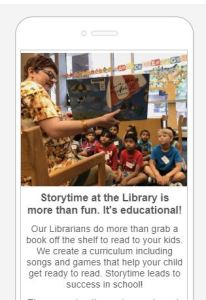
Example: Our library recently made a pivotal switch in the way we market our storytimes. We want to emphasize the educational aspects.

It would be easy to get lost in a lot of technical language and big words to describe our focus on literacy and learning. I decided the best approach would be to write text that sounded like what I would say in person if I were talking to a parent about storytime.

This sounds like an easy step, but I see a lot of libraries and brands that get caught up in the technical language of their products and services. It makes us feel important when we use big words. But headlines and copy need to be simple in order to connect with the audience.

Headlines for press releases deserve as much attention as headlines for emails and blogs. ย Library marketers must remember newsrooms are a target audience and journalists crave a good story just as much as the average Joe. You really have to dig deep to grab their attention and evoke your emotional response. You want them to go into their morning meeting and fight for the permission to cover your library’s story. So, give them enough ammunition.

Example: ย This release triggered coverage by all the major media outlets in town. Its headline is very simple and straightforward but it got the job done.

Be versatile–it’s okay to change the headline based on the distribution platform. If you have a great blog post you want to share on Twitter, but the headline, when coupled with the URL and a photo, exceed the 280-character limit, re-craft the headline just for Twitter. You might also want to re-craft headlines for different social media audiences. Your Twitter fans may have a different perspective on your article than your LinkedIn fans. You can rewrite it for an email distribution too.

Example: This blog! I often change the headline for the different social media platforms. Sometimes I’ll repost a blog in a month or two with a different headline as well, just to freshen it up and catch viewers who might not have been interested by my first headline. Experimenting is good!

Use the tools. There are lots of fantastic tools to help you fine tune your headline. My absolute favorite is Sharethough’s Headline Analyzer. It’s easy to understand. Since I’ve been using it to craft headlines for this blog, my views have gone up about 10 percent!

For this particular post, Sharethrough gave me a 75 rating, which is above average. It says this headline works because it’s long, it has a human connection, and limited use of positive sentiment. It also gives suggestions on how to improve the headline to get a higher score.

Go with your gut. ย Sometimes, all the tools and analysis can cloud your head. If you’ve composed a headline that you feel will do the best job at capturing your audience’s attention, use it. You know your audience best.

Subscribe to this blog and youโ€™ll receive an email every time I post. To do that, click on โ€œFollowโ€ button in the bottom left-hand corner of the page. Connect with me on YouTube, Twitter,ย Instagram, and LinkedIn. ย And check my list of upcoming events so we can connect.

Library Marketing Show Episode 16: How to Gently But Firmly Get Any Department to Let You Handle Marketing Messages!

Watch Now

In this episode, we talk about an anonymous question from a reader who has a little problem: The departments in their library get upset when they re-write their text suggestions for marketing messages. I’ll talk about how I handle this situation at my library. We’re all in this boat, right??

As promised, some articles to help convince your skeptical programming co-workers about the importance of writing library marketing text.

Why Marketers Must Learn to Write

KISS Bad Writing Goodbye: How to Save Your Marketing

Why Writing Skills Are Necessary in Marketing

Also kudos to the West Gippsland Libraries in Australia for their hilarious new brand awareness video.

Stay in Touch

Check the Upcoming Events page to see where I’ll be soon. Let’s connect! More events are coming soon.

Have an idea for the next Library Marketing Live Show?ย Submit it now.

Subscribe to this blog and youโ€™llย receiveย an emailย every time I post. To do that, click on โ€œFollowโ€ button in the bottom left-hand corner of the page. Connect with me onย Twitter,ย Instagram, andย LinkedIn.ย ย 

How to Launch a Library Blog: A Guide to Pitching Your Idea and Getting It Off the Ground

How to Launch a Library Blog

We did a big, big thing at my library this year.

We launched a blog.

It’s been a long time coming. I first pitched the idea of a blog to senior leadership in 2015. I created a document that explained the reasons why our library needed a blog. It also laid out my bare bones ideas for how the content creation process would work.

Marketing Advantages to Having a Library Blog

  • Easy, cheap, effective way to promote smaller, niche programs.
  • We no longer have to rely on traditional media to get the word out about programs and services. We have our own publishing platform for reaching our audience. Traditional media outlets will follow the blog. The posts will be more engaging than a press release and will pitch themselves as bigger story ideas.
  • The blog will give us something to link to for promotional posts on social media.
  • ย A blog would be a place to show our thought leadership. We are the information experts! We can demonstrate why people should care about what we say in a long-form, insightful, and meaningful way.
  • ย Easy way to keep our brand top of mind all the time.
  • ย Easy way to show the Libraryโ€™s human side and let our customers get to know one another.
  • Partnership opportunity: We can invite partners to write posts for the library, creating great, shareable content for our users and in turn getting our posts shared by our partners.

So How Would This Work?

  • Marketing would be the centralized location for publication-we would manage the editorial calendar, recruit writers, copy edit, publish, and promote posts.
  • We would set a cadence for postsโ€”one post per week to startโ€”and re-evaluate at a later date.
  • We would recruit post writers from all branches and departments at the Library. We would also recruit Library customers, evangelists, and fellow bloggers and influencers to write guest posts. We would provide them with a simple template for writing their posts, which we would copy-edit and publish. We would ask all guest writers to share the content, once published, on their platforms, giving us instant exposure to their audience.
  • Editorial standards will be high: content must be written in a conversational tone, AP style usage of punctuation and grammar must be adhered to, and posts must be engaging, shareable, and interesting to our core audience.
  • We would also re-purpose content to use as posts, providing new/updated/additional information not seen in print from sources such as Library newsletters, and email.
  • We would evaluate top performing posts once per month and adjust our editorial calendar as necessarily based on data.

I also created a mock editorial calendar listing various post ideas and who might be tapped to write them. After presenting these to my boss, I waited.

And waited.

And waited.

For four long years.

Finally, in the summer of 2018, there was major leadership change at our library. Our previous director resigned and a new person took the director’s role. And a few months after that, marketing got the green light for a blog.

To say that there was much rejoicing and celebrating among my staff would be an understatement. After the confetti was cleaned up and the champagne was gone (I’m kidding–there was no confetti or champagne and I regret this immensely), we realized we had to launch this thing as we had promised. And so, we did! Here’s our beautiful finished product.

Our first blog was published on March 4, 2019. So far, we’ve published 65 posts on the blog.

It has already fulfilled all of the advantages I listed in the proposal document. Traffic to our website is up. Media are now going to our blog for story ideas about the library. Our search ranking increased. We have lots of partner organizations asking for permission to write posts for us. Our staff members are writing posts and using the blog as a way to let the public know about the important work they’re doing in their branches and departments. We haven’t spent any money creating beyond staff time. And it helps us to stay top-of-mind with our cardholders and the community at large.

We did learn some big lessons during the process and I want to share them with you now.

Lessons Learned While Launching a Library Blog

Lesson #1: The hardest part is getting started. It took forever to get buy-in on the idea.ย  Keep advocating. Don’t give up.

Lesson #2: Building something from scratch is exciting and frustrating. It was liberating to have the freedom to do whatever we wanted. It was also terrifying. Lean into it! Be open and honest about your fears and expectations. Keep your supervisors in the loop about your observations as you work through the process.

Lesson #3: Communication with staff is vital. Get a vision and guidelines set down on paper and approved as soon as possible, then tell staff so they can begin to build excitement among cardholders. Their enthusiasm is your best marketing tool.

Lesson #4: The first year will be about experimentation. Set a posting schedule that you can keep to without having a stroke. Write all kinds of posts to see what interests your audience. Experiment with posting on different days of the week to see which is best for capturing your audience’s attention.

Lesson #5: Promotion of your blog is just as important as your blog itself. Make sure you work out a plan for how you’ll promote the blog once it’s up and running.

My big piece of advice is to actually refrain from promoting the fact that you have a blog until you have a cache of articles. Promote individual posts but wait a couple of weeks to start talking about the blog as a whole service. Once you have a variety of posts up on the blog, then you can do your big promotional push and reveal. You’ll have to do this full push campaign at least once a year to remind the public that the blog exists, and to let new cardholders and community members know that it’s there.

Lesson #6: Your blog doesn’t have to be perfect on launch day. Pick a launch day and stick to it. It can be a work in progress. You can fix things as you go along. But if you wait for it to be exactly perfect,ย  it’ll never get off the ground.

Lesson #7: Measure and report. Data is your friend. Evaluate what works and what doesn’t. look at the data but also gather feedback from staff and customers about what they want to see.

Don’t forget to join us for the LIVE LIBRARY MARKETING TALK ON INSTAGRAM every Tuesday at noon ET. We’ll talk about library marketing topics for about 15 minutes each week. My handle is Webmastergirl. You can email questions and topic suggestions ahead of time. Just fill out this form.

And check out these upcoming events and webinars where we can connect and discuss library marketing. Registration links included!

Subscribe to this blog and youโ€™llย receiveย an emailย every time I post. To do that, click on โ€œFollowโ€ button in the bottom left-hand corner of the page. Connect with me on Twitter,ย Instagram, and LinkedIn. ย 

Inspiring Advice From An Expert Blogger

A few months ago, I asked readers whether their library had a blog. 61 percent of respondents said no. I have to include myself in that statistic. And the more I think about it, the more that bothers me.

Blog-less libraries are missing a HUGE opportunity. A blog has a number of promotional advantages that simply cannot be replicated with any other type of tactic. And to make my case, I am going to share insights with you from a session at Content Marketing World–one that I haven’t been able to stop thinking about in the months since the conference.

Amanda Todorovich is the Director of Content Marketing at the Cleveland Clinic. She’s the 2016 winner of the Content Marketer of the Year from the Content Marketing Institute and she runs the most visited hospital blog in the United States, Health Essentials. Her session was all about the Cleveland Clinic blog and its success. And her story made me want a blog for my library.

Amanda says a blog is the best promotional tool because it creates brand awareness and relationships with current and potential customers. The goal of the Cleveland Clinic blog is to create a space in which the hospital is top of mind all the time with people looking for health information. Think about this: the hospital cannot create demand for their services. So they aim to provide credible health information at all times so that, in the unfortunate moment when someone is sick or injured, the first place they think of is the Cleveland Clinic.

That principle applies to libraries as well. There are times when a library cardholder may not need their library, but we want to stay top of mind with them so that they’ll turn to us when they do need books, or help with a struggling reader in their home, a passport, a voter registration form, help to create a resume, or whatever problem they might have. Libraries are not just about programs and books and there is a lot of value to offer your cardholders beyond those two basic services.

But Amanda also says in order for your blog to work, you have to stand strong. Your blog cannot be all things to all people. You’ll have to decide on your mission, write it down, and stick to it. This doesn’t mean that you are ignoring certain cardholders. It means that your blog has one focus, one mission and that everything you write–no matter the audience–drives at completing that mission. For example, Health Essentials mission isย to engage users in daily conversation using health, wellness and clinical content that is unique to Cleveland Clinic. They’re not ignoring anyone. Rather, they are focusing all their energy on delivering on that mission to all of their potential patients and patient families. See the difference?

Blogs have a value beyond pure promotion. Using the right keywords and paying attention to metadata, tags, and links will help boost your position in search traffic. That means people will be able to find you first during a search. Some big brands pay big money for great search results placement. Can you imagine what would happen if; every time someone searches Google for a book, a DVD, or information that they land on your library’s blog? The impact would be mind-blowing.

Some library marketers are already taking this advice to heart, including Brook Savoie, who works for Lafourche Public Library in Thibodaux, Louisiana. She told me, “Our librarians take turns writing a post weekly. The purpose is to just bring more awareness to things that we do! It works well for me for social media, because I can share these blog posts weekly with our audiences without having to create any content myself.”

So, step one is convincing you, your staff, and your administration, to launch a blog. It’s worth it. You can do it. Here are Amanda’s other tips for blog success.

Focus on creating better posts, not more posts.ย You don’t have to post every day. Just pick a CONSISTENT schedule. Create a list of topics and then write. That’s what I do with this blog. I spend roughly three hours a week on this blog and that’s really only because I am my own editor. If I could just write and revise a draft and then hand it off to another person to edit, it wouldn’t take much time at all. I spend about ten minutes crafting and testing headlines. I spend about ten minutes making the graphic. I spend about ten minutes scheduling all the distribution. I write on the weekend and it feels like it doesn’t take much time at all.

Be willing to say no. Amanda says she doesnโ€™t have a lot of friends outside her team because she says no to a lot of requests by other departments for blog posts. The hospital blog is focused on the needs of their readers, not on the needs of the organization and that’s why it works. When your customers are the center of your universe, you are providing them with value and they’ll keep coming back to you. You are beholden to your cardholders, and they should be your only concern.

Measure and test and test again. Never be content with the results, even when they seem good. Ask โ€œwhat ifโ€ all the time–it could lead you to an extraordinary idea that takes your blog to the next level. Testing actually keeps blog writing interesting and keeps life exciting (I AGREE).

Subscribe to this blog and youโ€™llย receiveย an emailย every time I post. To do that, click on โ€œFollowโ€ button on the bottom left-hand corner of the page. Connect with me on Twitter and Snapchatโ€“itโ€™s where I talk about library marketing! Iโ€™mย @Webmastergirl.ย Iโ€™m also onย LinkedIn,ย Instagramย andย Pinterest.ย Views in this post are my own and do not represent those of my employer.


A WordPress.com Website.

Up ↑