Search

Super Library Marketing: Practical Tips and Ideas for Library Promotion

Tag

library email marketing

Timing Is Everything: How To Determine the Perfect Day and Time To Send Library Emails

Photo of a woman on a computer courtesy Public Library of Cincinnati and Hamilton County

The plain fact is: Next to the face-to-face interaction between librarians and community, an email list is your most effective library marketing tactic.

How do your cardholders learn about new services? How do they find their next great read? How do they figure out how to use parts of the collection they didn’t even know existed, like video streaming or eAudiobooks? You can tell them all about your library’s awesome resources by talking with them in their inbox.

If your library isn’t already collecting cardholder email addresses, please start now.

You’ll create emails with an enticing subject line. Your emails will contain great content that your recipients will want to read. And you’ll be tracking metrics so you can build on your successes.

As your finger hovers over the send button, you may find yourself facing another important decision.

When should I send the email?

Does the timing really matter?

The simple answer is yes.

A great headline and great content are only half the battle for your cardholders’ attention. You’re also competing with their personal schedule, other messages sitting in their inbox, and social media.

Your message is more likely to catch their attention if it lands in their inbox at the right time of day.

Your library is fighting with others for urgency. You want your recipient to say to him or herself, “I need to read this and act on it, right now!”

Getting that message in front of your audience at the right moment increases the open, click-through, and conversion rate becauseย it takes advantage of that sense of urgency.

What the data tells us about the best time to send emails

I’ve done a lot of experimenting with time of day emailing over the course of my library marketing career.

There are three times of day to send messages for the most effective results.

  • Really early in the morning (by 5 a.m.)
  • Lunchtime (11 a.m. to 1 p.m.)
  • Before bed (between 8 and 10 p.m.)

The website Optinmonster calls these “key transition times.” And their research confirms what I learned.

A message sent in the early morning will be sitting in your cardholders mailbox when they first wake up. It’ll be among the first things they check. An email sent at lunch means it’ll be sitting there when they check their messages over their tunaย sandwich. An email before bedtime means it’ll be there when they scroll through their emails while they watch a show or before they get ready for bed.

Optinmonster also recommends sending emails at 4 p.m., when people need a little distraction as they get through the last hours of their workday.

As for day of the week, most libraries should avoid sending emails on Mondays and weekends. The agency Wordstream says their data agrees with that assessment.

Your recipients inbox may be flooded with emails on Mondays. And on weekends, many people are running errands and doing other things with their friends and family. They’re less likely to check their inbox on a Saturday or Sunday. Case in point: I’m writing this on a Saturday. It’s 9 a.m. and I just realized I haven’t checked my email yet today!

But what works for me and what works for Optinmonster and Wordstream might not work for you.

It’s crucial that you do your own experimentation.

Try this Four Email Experiment to narrow down the best day and time for your audience.

For this experiment, use the same email for your test. Perhaps you have a weekly newsletter you send to parents, or a bi-weekly email that you send to people who regularly visit a certain library branch. Those emails will work perfectly for this experiment.

Try to keep the subject line for each of the four emails in your experiment similar. You’re testing for the best day and time, so you want to rule out other factors that may make an email more or less likely to be engaging.

Start by sending your email on Tuesday at 4 a.m. The next time you send it, schedule the email for Tuesday at noon. The following send, try Tuesday at 4 p.m. and finally, Tuesday at 8 p.m.

Track your open, click-through, and conversion rates on all these messages to see which is most effective. Work through each day of the week to see which days get you the most traction.

When you find a day and time that works best for your audience, stick to it for about six months. Continue to track your metrics over that six-month period to ensure you’re not seeing a slip in the numbers.

If, after six months, that day and time continues to be effective for you, you don’t need to run the experiment again.

But the habits of your audience may change during that time. Outside forces (like the pandemic) may affect the daily rituals of your recipients. You may need to run the experiment again if you see numbers slipping.


I have a special request.

I’m putting together a conference presentation and I’m looking for some examples.

  • Libraries that have reopened and have had some success drawing people back into the physical branch.
  • Libraries who believe they’ve figured out the hybrid program model.
  • Libraries who are trying to turn their pandemic digital users on to other services now that the library has reopened.

I’ve created a form so you can brag about your library.

I know you are doing amazing work. I want to highlight you on a national stage! Thank you in advance.


Subscribe to this blog and youโ€™ll receive an email every time I post. To do that, click on the โ€œFollowโ€ button in the bottom left-hand corner of the page.

You May Also Want to Read These Posts

Looking for Guaranteed Email Marketing Success at Your Library? Here Are Four Essential Metrics To Track.

Try These Two Fun Tests To Improve the Effectiveness of Your Library Promotional Emails!

Angela’s Latest Book Review

The Southern Book Club’s Guide to Slaying Vampires by Grady Hendrix

Try These Two Fun Tests To Improve the Effectiveness of Your Library Promotional Emails!

Watch Now

The Library Marketingโ€‹โ€‹โ€‹โ€‹โ€‹โ€‹โ€‹โ€‹ Show, Episode 94

In this episode, I’m sharing two fun tests you can do that may lead to more effective email marketing messages for your libraries.

Kudos go to the Chicago Public Library for their initiative to include affordable housing units in the renovations of their library buildings. Check out the video for links to read more about this work.

Do you have a suggestion for a topic for a future episode? Want to nominate someone for kudos? Let me know in the comments. And subscribe to this series to get a new video tip for libraries each week.

Thanks for watching!

Latest Book Reviews from Angela

The Removed by Brandon Hobson

The Vanishing Half by Brit Bennet

Take Your Library Email Newsletter to the Next Level with These Eight New Topic Ideas!

Photo courtesy Public Library of Cincinnati and Hamilton County

This week, I heard a truism about email marketing.

Marketing expert Ann Handley said, โ€œEmail is the only place where people, not algorithms, are in control.โ€

When the pandemic struck, email became the only reliable way libraries had to communicate with their patrons. More libraries are sending email newsletters. And theyโ€™ve gotten good at the basics.

So, itโ€™s time to take the power of email newsletters to the next level.

Focus less on the news, more on the letter

Handley has one of the best newsletters Iโ€™ve ever seen. It stands out because she focuses less on the news partโ€ฆ and more on the letter. Sign up, and you’ll see what I mean.

What I’ve learned from Handley is that your newsletter is your opportunity to directly connect with cardholders in their inbox. What does your community need? What can you provide for them? And most importantly, how can your library demonstrate the way it is different than any other organization?

Ann recommends you lose the marketing voice for your newsletter. Instead, write as you would if you were trying to convince a friend or family member to use the library. Be personable and relatable. Your authentic voice will connect to your readers.

New topic ideas for your library email newsletter

Your library newsletter can and should contain more than book recommendations and announcements about programs and services. Here is a list of ideas that go beyond the typical library information.

Send simple how-to instructions for using your library.

There are all kinds of opportunities to share instructions. Write simple steps for using one of your services. Or share instructions on how to complete a task outside of your library, like fill out an absentee ballot form or make a COVID-19 vaccination appointment.

Step-by-by-step instructions shared in your newsletter will help you build a relationship and form trust with your community. It demonstrates your libraryโ€™s ability to find solutions to your communityโ€™s most pressing problems.

Answer frequently asked questions.

Ask your front line staff, your chat service operator, or the person who handles your library’s main email inbox to share the questions they get most frequently from the public. Then, answer them in your newsletter!

Your email audience will learn new things about your library. Youโ€™ll make your library more accessible. And you’ll build trust with your community by proving your library is a place where answers are found.

Promote blog posts.

Use your newsletter to promote your blog and get more views.

Take the first few lines of your post and use them to tease your newsletter audience. Include a photo or graphic from the post to tie your newsletter into your blog. If you send one newsletter a month but post several blogs, tease each post and include a link. 

Your newsletter audience will be introduced to a new way to interact with and get news from your library. It will also give you valuable information about which blog posts your newsletter audience is interested in.

For instance, if you see that your newsletter audience always click on links for blog posts about genealogy and history, then youโ€™ll know to write more posts on that topic and include them your next newsletter.

Promote your videos.

If your library is creating and posting videos on YouTube, Facebook, Vimeo, or another platform, your newsletter is the perfect place to give those videos an extra boost. As with the blog posts, share a sentence or two to entice your audience to click on a link to the video.

One note: Include a link to the video on the original platform to which you published. Donโ€™t embed the video in your newsletter. Many email services view embedded video code as suspicious, and will mark your email as spam.

Create lists.

Thereโ€™s a reason Buzzfeed articles are so popularโ€ฆ they contain listicles, which are articles that feature a numbered list (Hey, this post is a listicle of sorts!) A list is easy for your audience to digest and remember.

Create a top ten list of anything: your staffโ€™s book picks, the ten things a patron can create in your Makerspace, the best albums to download from the libraryโ€ฆ the possibilities are endless. Your email readers will love it. You can even ask your readers to suggest a topic for a list in your next email newsletter!

Share social media content in your newsletter.

If you library had a popular social media post, you can replicate it by adding it to your newsletter.

For instance, if your library posted a book review that got a lot of comments, likes, and shares, put that post into your newsletter, along with a link so your patrons can visit the social media platform, see the original post, and interact with it.

Likewise, when your library gets a great piece of user-generated content, share it in your newsletter as well as on your social media audience. 

Share testimonials and reviews.

We know that trust is built between your community and your library through social proof: namely, other community members talking about how theyโ€™ve used and loved your library. So, when you get those reviews and testimonials, insert them into your newsletter.

You should also ask your email readers to share reviews and testimonials of your library. Include an easy way for them to send you feedback on what they love about your library. Then share those in your next newsletter and on social media.

Advocate your library.

As a library staffer, you likely know about all the good work your library is doing. But your community has a very limited understanding of the value of your work.

Your newsletter is a great way to begin to share examples and stories of how your library works to make your community a better place. Share short tidbits or an infographic to explain your library’s value.

You Might Also Like These Posts

There is NO SUCH THING as Too Many Library Marketing Emails! Why Libraries are the Exception to the Rule.

Are My Library Email Metrics Goodโ€ฆ. or Bad?! Here Are the Latest Stats to Help You Figure It Out.

Latest Book Reviews

The Kitchen Front by Jennifer Ryan

The Wife Upstairs by Rachel Hawkins

Subscribe to this blog and youโ€™ll receive an email every time I post. To do that, click on the โ€œFollowโ€ button in the bottom left-hand corner of the page. Connect with me on YouTubeTwitter, InstagramGoodreadsand LinkedIn.

Psychographics Are the Key to Powerful Email Marketing: How to Unlock the Motivations and Aspirations of Your Cardholders

Photo courtesy Public Library of Cincinnati and Hamilton County

This is the second in a two-part series on email marketing for libraries. Read part one here.

At the Library Advocacy and Funding Conference in September, a new buzzword seemed to be on the lips of many of the presenters. They were all talking about psychographic segmentation of library audiences for email marketing.

I thought I knew most of the marketing buzzwords, but I confess this was the first time I’d ever heard the term. So, it was time to do some research.

What is psychographics?

Psychographics is the study and classification of people according to their attitudes, aspirations, and other psychological criteria, especially in market research (Oxford Dictionary).

Psychographics go beyond basic demographics: location, age, gender identity, and library card usage. To segment by psychographics is to divide your library audience into groups according to their beliefs, values, and reasons for being. It delves deeper into your cardholder’s values, dreams, desires, and outlook on life.

Psychographics identify motivation. Why does your library community take certain actions? Why do they feel the way they do about the library? How do they see the role of the library in their life? And what activities do they participate in, both inside and outside of the library?

Psychographics lead to compelling email marketing messages because they focus on your community’s unarticulated needs and motivations.

Understanding psychographics

The term is new to me but it’s not new to marketing. In 1964, Harvard graduate and social scientist Daniel Yankelovich wrote that traditional demographic traitsโ€”sex, age, and education levelโ€”lacked the insights marketers needed to target their audiences.

Around the same time, market researcher Emanuel Demby began using the term โ€˜psychographicsโ€™ to reference variations in attitudes, values, and behaviors within a specific demographic segment.

In the 1980s, the Stanford Research Institute developed the Values Attitudes and Lifestyles (VALS) psychographic methodology. It was hailed as a breakthrough in marketing.

One way to understand this concept is to find your own VALS type by taking this survey. My results show that I like to have historical context, that I buy proven products, and that I’m not influenced by what’s “hot.” I also like to experiment. Share your results in the comments.

The travel industry uses psychographics. Email marketing by hotels, cruise lines, and cities, states, and countries often focuses on why a person wants to travel: adventure, romance, curiosity, and relaxation.

Libraries can do the same thing.

Imagine if we started focusing our library email marketing messages not on what are cardholders want to do… but WHY they want to do it.

Uncover the psychographics of your library audience

How do you figure out what makes your library audience do the things they do? You must ask them! A survey is the best way to drill down on the psychographics of your library audience.

Most library surveys focus solely on demographics like age, location, and income. They generally ask people how they use the library now. They may ask people to predict how they’ll use the library in the future.

By adding psychographic questions, you’ll get a look at your audience’s true motivations. That may include questions like, “The last time you checked out a book, what was the reason?” “How do you feel about the library’s work with people experiencing homelessness?”

You can also use matrix-rated questions to gauge psychographics. For instance, you could include a statement like “The library helps people find a new job” and ask respondents to select an answer from a range of “not important” to “extremely important.”

How to Create an Effective Library Survey to Pinpoint the Needs of Yourย Community

You can also use outside data sources to get at the psychographics of your library audience. Take a closer look at the comments on your social media posts. Can you uncover any reasons why your followers are interacting with your library on social media? Do they share or comment on a particular type of post?

Check Google analytics on your library’s website. Are visitors taking the same steps to move from one landing page to another on your site? Do they spend a longer amount of time on one type of page?

Your circulation stats are a source of psychographics. Are you seeing a surge in the checkouts or interest of one genre of book, or one format? What language do your cardholders use when they ask for recommendations using your form-based readers’ advisory service?

If your library answers reference questions, what type of problems and language are your cardholders using when they ask for help?

Try to look at any interaction your library has with your cardholders, in any arena, as an opportunity to unlock their motivations and psychology. Then use those new insights to craft compelling email marketing messages.

Using psychographics in library email segmentation

Libraries can segment their email audience without violating CAN-SPAM laws. If your cardholders gave you permission to send them email, you can segment them into psychographic segments. As long as your email includes opt-out language (i.e. “If you no longer wish to receive emails about job services at the library, click here”), you are complying with the law.

Combine your demographic knowledge of your cardholders with the research you’ve done on the psychographics of your cardholders. Then divide your email recipients into new segments and try sending them psychographic messages.

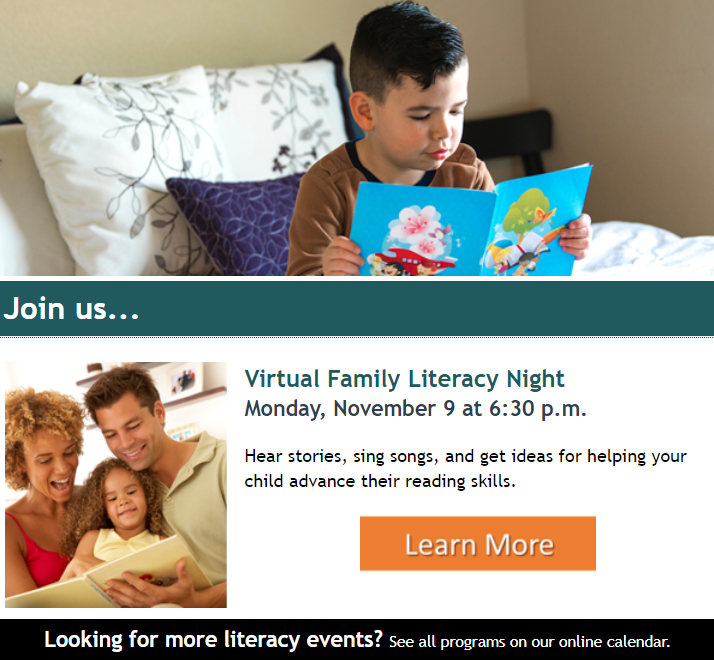
For example, let’s say you are already sending a monthly email to parents about storytime at the library. Now let’s say your library decides to offer a new program, like a virtual family literacy night, to help families whose children are not attending in-person classes during the pandemic.

Without psychographics, your email message may have looked like this:

But, thanks to your survey results, you know that many parents are worried about the effect that virtual learning is having on their child’s education. They believe their child will need extra tutoring and classroom attention to succeed in life because of the impact of virtual learning.

Now you can combine your audience’s motivations for attending with your message about the new program.

This marketing message pivoted from a simple invitation to a message that strikes at the heart of the caregiver’s concern for their child.

Psychographics activate the motivations and aspirations of your cardholders. When you get to know your community better, you’ll do a better job of getting your community to know your library!

You may also find these posts helpful

Are My Library Email Metrics Goodโ€ฆ. or Bad?! Here Are the Latest Stats to Help You Figure It Out.

The Emoji Experiment: The Pros and Cons of Adding Emojis to Your Library Marketing Email Subject Lines

Latest Book Reviews

Nothing to See Here by Kevin Wilson

Find more 60-second Book Reviews here.

Subscribe to this blog and youโ€™ll receive an email every time I post. To do that, click on the โ€œFollowโ€ button in the bottom left-hand corner of the page. Connect with me on YouTube, Twitter, Instagram, and LinkedIn.

Targeted Email Marketing for a New Era: The Pros and Cons of How Most Libraries Segment Their Audiences

Photo courtesy Public Library of Cincinnati and Hamilton County. Bond Hill Branch.

This is the first in a two-part series on email marketing for libraries. Part two is here.

If there is one thing that I know about library promotion, it’s this:

If you want to be successful in library email marketing, you must target your messages.

This isn’t just my personal belief. It is a method which worked, with impressive results, during my years at a public library. And I see it working now for hundreds of libraries around the country and around the world in my day job at NoveList.

Why are libraries hesitant to do targeted email marketing?

There are two big reasons that libraries fear the idea of segmenting their email audiences.

First, libraries are worried about email marketing in general. They feel it’s too promotional and that email messages from the library will be received as spam. They may even believe that people don’t want to receive email marketing from anyone, even a library.

This is not the case. The average consumer is accustomed to giving out their email address in exchange for marketing messages targeted specifically to them. Opt-in Monster research shows 99 percent of people with an email address check their inbox at least once a day.

Why? Because they are looking for messages from friends, family, and places they love. They love the library. Your cardholders and community members feel excitement when they receive an email from you.

Libraries worry that, by sending targeted messages to segmented audiences, they will miss out on the chance to get a message to all their cardholders. 

Many libraries are sending the same message to every cardholder, sometimes hundreds of thousands of people in one burst. It feels like the natural thing to do. “Everyone needs to know about this!”

The problem with that approach is that your cardholders are individuals. One message never fits them all.

This is particularly true if your service area covers a range of incomes and demographics. The needs and interests of your cardholders vary greatly.

By targeting your message, you are more likely to say something that matters significantly to your cardholders, which makes them more likely to take an action, which makes it more likely that your email will be successful.

Targeted email marketing for libraries is effective because it serves the right message to the right group of people. And it works for all kind of messages.

Do not let your fears about email set you up for failure. Your cardholders want to hear from you. There are not very many industries which can say that. Let’s take advantage of it and give the people what they want!

Libraries who do segment their audiences tend to use three main methods. There are benefits and drawbacks for each.

Segmenting by library card use

Some libraries group their cardholders by the type of material they most frequently check out: kids’ books, print books, e-books, etc. Then, they send targeted email messages about those formats or collection types to those specific users.

This was the method we used when I worked a public library. For example, we would send an email promoting three new e-books every month to people who appear to favor e-books.

Benefits: This method is great for collection marketing. Most libraries will notice holds and checkouts increase, sometimes exponentially, when they send messages about items to people who have shown a previous interest in those items.

Drawbacks: The way a person uses their library card may not correspond to their true library interests.

For instance, an adult who frequently checks out children’s books for their kids may also love to read e-books. By focusing solely on the fact that they more frequently check out children’s books, a library may miss a key opportunity to market e-books to that cardholder.

A second drawback is that your library will want to promote things besides your collection, like programs, big events, and advocacy messages. Segmenting audiences solely by their favorite collection format gives you no clue as to your cardholders other potential interests.

Finally, this kind of segmentation often requires sophisticated email marketing programs that are expensive and time-consuming to manage. Smaller libraries without a dedicated marketing department and libraries with limited budgets may find these programs cost prohibitive.

Letting people self-select

Many libraries have an opt-in page on their website listing email interest groups. Visitors can self-select which emails they prefer to receive.

Benefits: When a person chooses to receive an email from you about a certain subject, they are also likely to open and engage with that email. They have already indicated their interest by selecting it.

Most library email opt-in pages do not require a person to be a cardholder to sign up. So, a second benefit of this method is that you can send marketing messages to people who aren’t in your cardholder base but can be enticed to use your library. That’s a fantastic way to expand your cardholder base!

Drawbacks: A library using this method must commit to intentionally market the marketing lists. They must make sure the community knows the opt-in page exists and convince people to sign up.

Segmenting by cardholder location

Some libraries have sent messages to people who have indicated a certain branch is their home branch or to people who live in a certain portion of the community.

Benefits: This is a great method for in-person program promotion. People are more likely to attend events that are near their home. Segmenting your audience by their location is an efficient use of your time for program promotion.

Drawbacks: There is a certain set of library cardholders who are willing to travel to attend programs and events at branches far from their home. They may be interested in hearing from your library about certain types of events, no matter where they are held.

In addition, the branch a person most frequently uses may not actually be near their home! Many people frequent the library branch near their workplace or some other important and frequently visited location.

You may also find these posts helpful

Three SUPER Easy Ways to Get More Results from Your Library Email Marketing!

Are My Library Email Metrics Goodโ€ฆ. or Bad?! Here Are the Latest Stats to Help You Figure It Out.

Latest Book Reviews

The Little Book of Lykke: The Danish Search for the World’s Happiest People by Meik Wiking

The Bear by Andrew Krivak

Find more 60-second Book Reviews here.

Subscribe to this blog and youโ€™ll receive an email every time I post. To do that, click on the โ€œFollowโ€ button in the bottom left-hand corner of the page. Connect with me on YouTube, Twitter, Instagram, and LinkedIn.

Are My Library Email Metrics Good…. or Bad?! Here Are the Latest Stats to Help You Figure It Out.

Watch Now

The Library Marketing Show, Episode 62

In this episode, Angela shares the latest metrics on open and click-thru rates for library email marketing and helps you figure out what metrics are good!

She also shares Kudos with the Madison Public Library for their back-to-school teacher button project.

Check out the virtual conferences I’ll be attending. Let’s connect!

What did you think of this episode? Are you struggling with marketing and promotion right now? Do you have a suggestion for a topic for a future episode? Want to nominate someone for kudos? Let me know in the comments. And subscribe to this series to get a new video tip for libraries each week!

Thanks for watching.

Three SUPER Easy Ways to Get More Results from Your Library Email Marketing!

WATCH NOW

The #LibraryMarketing Show, Episode 43 In this episode, Angela shares three very simple ways you can add punch to your email subject line and header text. Doing one of these three things every time you send an email will increase the chances your recipients will open and engage with your emails. Here is the article with all the fantastic magnet or trigger or power words Angela mentions in the video, broken up into charts that will help you create an emotional reaction in your readers. Also Kudos to all the libraries creating backgrounds for Zoom and Teams meetings using photos of their libraries. Library Journal has a great list of them. Here’s another great list from the Library Land project. If you have a topic for the show, kudos to share, or want to talk to me about library marketing, contact me using this short form.

Go back

Your message has been sent

Warning
Warning
Warning

Warning.

Want more Library Marketing Show? Watch previous episodes! Check the Upcoming Events page to see where I’ll be soon. Let’s connect! This blog consistsย of my own personal opinions and may not represent those of my employer. Subscribe to this blog and youโ€™ll receive an email every time I post. To do that, click on โ€œFollowโ€ button in the bottom left-hand corner of the page. Connect with me on Twitter,ย Instagram, andย LinkedIn.ย  ย   
Email is Not Dead! Here are Eight New Ways to Help You Get the Best Results With Your Library Email Marketing

I have a thing for email marketing.

I think it’s fun. I like trying to figure out all the pieces. Which subject line is best? To emoji or not to emoji? How much text? What should it say?ย  What kind of photo or graphic should I use? What’s the best call to action? Who should I send it to? On what day and at what time?

I love experiments. I love sending the message and then watching the results. How many people opened it? More importantly, how many people clicked on my call to action? MOST IMPORTANTLY, how many people did the thing I wanted them to do?

Maybe I just like convincing people to do stuff.

Email is not dead, at least not for libraries. People want to hear from us. They love free stuff and that’s basically all we have to offer! I send tens of thousands of emails a week to my cardholders (I live in a large county service area with nearly a million residents). My unsubscribe rate is zero percent. No kidding.

Email marketing truly is the most effective method of digital promotion for libraries. I use it whenever I can at my library because it gives the best return on my investment of time and money.

And because it’s the most effective digital tactic at my disposal, I spend an awful lot of time researching email marketing. I read a ton of blogs. I listen to a lot of podcasts. I comb surveys for insights that will make my emails better.

I’ve started a document where I keep a bunch of statistics and insights gleaned. I realized that I needed to share these insights with you. Email marketing could be your most valuable asset too. So here are the eight newest things I’ve learned about email marketing that will improve the work you’re doing at your library.

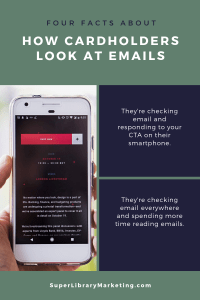
How cardholders look at your emails

You’ve heard it before but I’ll say it again. You must make sure your emails are mobile-friendly and responsive. About 3 in 5 consumers check their email on the go. 75 percent of Americans say they use their smartphones most often to check email. (Blue Corona)

And you must assume your cardholders will use their phones to respond to your email call-to-action. 62 percent of email opens occur on mobile. Only 10 percent occur on desktop. That’s huge! (Adestra)

Your cardholders are checking their email literally everywhere. People admit to checking email while watching TV, in bed, on vacation, in the bathroom, while walking, during meals, during commuting, while talking, while working out, while driving, and while at a formal ceremony! (Adobe)

Your cardholders are spending more time reading emails. In the last decade, the amount of time people spent reading an email actually increased by 7 percent, to 11.1 seconds. (Litmus)

How to design the best library email

Your subject line is the most important part of your email. It gets your cardholders in the door, so to speak. Focus on sentiment by using emotional words. Use different words for different audiences. The subject line for a message you send to teens will be completely different from the message you send to parents. Make it simple and easy. However, length doesn’t matter anymore, so you can make your subject longer if you need too!

Write like a human and make sure everyone can read your text. For the text, speak conversationally. No industry-speak (words like periodicals are out!).You don’t have to convey all the information about your product or service or collection item in the body of the email. Get to the point and drive users to your website or another platform for more information. Avoid multi-colored fonts. Use fonts that are accessible, like Arial, Helvetica, Lucida Sans, Tahoma, and Verdana. (Bureau of Internet Accessibility).

Make your email design hard to ignore. Use a one-column layout so people can scroll easily. Make the text large! Headlines should be no smaller than 25 pixels, body text should be no smaller than 18 pixels.ย  Call to action buttons can be pretty huge– anywhere from 44 x 44 pixels to 72 x 72 pixels.

Images matter. Photos of real people, especially faces with emotional expressions, are best. But don’t be afraid to use gifs too!

Learn more about email marketing for libraries

The Step-by-Step Method for Figuring Out the Best Time to Send Library Marketing Emails and Why You Should Never Stop Experimenting!

The Tiny Little Mistakes That Ruin Your Library Marketing Emails AND How to Fix Them!

This Advice Will Boost Your Library Marketing Email Click-Thru Rates

Don’t forget to join us for the LIVE LIBRARY MARKETING TALK ON INSTAGRAM every Tuesday at noon ET. We’ll talk about library marketing topics for about 15 minutes each week. My handle is Webmastergirl. You can email questions and topic suggestions ahead of time. Just fill out this form.

And check out these upcoming events and webinars where we can connect and discuss library marketing. Registration links included.

Subscribe to this blog and youโ€™llย receiveย an emailย every time I post. To do that, click on โ€œFollowโ€ button in the bottom left-hand corner of the page. Connect with me on Twitter,ย Instagram, and LinkedIn. ย 

The Tiny Little Mistakes That Ruin Your Library Marketing Emails AND How to Fix Them!

NEW LIVE LIBRARY MARKETING SHOW ON INSTAGRAM! I’ve decided to try a new thing! I’ll be doing a live Instagram Q&A and discussion about Library Marketing. The sessions will be every Tuesday at noon ET (10 a.m. Central and 9 a.m. Pacific) beginning Tuesday, June 25. Join me to talk about library marketing topics for about 20 minutes each week. My handle is Webmastergirl. You can email questions and topic suggestions ahead of time. Just fill out this form below. See you there!

Go back

Your message has been sent

Warning
Warning
Warning
Warning
Warning

Warning.

I get a lot of library marketing emails. I love to see what other systems are doing. So, I go to their websites and I see if I can get on their mailing lists! It’s fun and it helps me to find new things to promote and new ways to communicate with my audience.

I also get a first-hand look at some of the small boo-boos that other library marketers make in their emails. Email is hard. I’ve been doing email marketing for so long (feels like forever!) that I have made all of these mistakes myself! And I love email marketing, so I’m weirdly obsessed with learning about it. Some of the positive text and design choices that work for library marketing in other promotional pieces, like posters, flyers, websites, and blogs, do not work in email marketing.

The good news is that these little problems are easily fixed! Tiny adjustments in the text and design of your email can improve your click-through rates and effectiveness. Check this list against what you’re doing now and start reaping the benefits of improved email design!

Problem: too many images: A clean design is crucial to engagement. Too many images or too much text is off-putting to your email recipient.

The most common email programs like Yahoo and Outlook will NOT automatically download images. In fact, only Gmail downloads images automatically. With all other providers, the email recipient receiver must consciously click a prompt in order to download an image. That means if your image is conveying most of the key message in your email, your receiver likely won’t see it.ย  They will miss the information and the call to action, and your email is useless.

Solution: Create an email that is mainly text-based. I have found an 80-20 mix works best: 80 percent of my email is text, 20 percent is image-based. The image I use compliments the text. Its purpose is to create emotion or set the mood of the email. It’s there to inspire. It doesn’t convey key messages and it doesn’t contain the call to action.

Problem: too much text. An email that contains several long paragraphs of information is off-putting to recipients. It gives the impression that your email will take a long time to read.

The email scheduling platform Boomerang studied results of about 20 million emails sent using their software. They found that the optimal length of a marketing email is between 50 and 125 words. A study by Constant Contact of more than 2.1 million customers found emails with approximately 20 lines of text or 200 or so words had the highest click-through rates.

Excessive text can also send negative signals to spam filters. Too much text added to excessive punctuation or large images could keep your emails from ever arriving in an inbox.

Solution: Limit your email text to 200 words or less. The recipient should be able to read all the information in your email in about 15 seconds. If you have more information to share, use your call to action to indicate that there’s more to know about your subject. Then send your recipient to a landing page where they can get all the information they need.

Problem: Text that is too small. Keep in mind the growing number of people who will read your email on a mobile device. You want to make sure they can actually see your words. An 11 or 12 point font size is too small to be seen clearly on a screen.

Solution: Increase your text size.ย ย Email font should never be below 18 point in size.ย  You should also use the bold option to make the most important information stand out.

Problem: Wishy-washy calls to action.ย  A compelling call to action is one of the best ways to increase the click-through rates of your library marketing. Some library marketing emails also contain too many CTAs.

Solution: Use positive, active language in your CTA. “Register” “Read This Book”, “Learn More”, “Join Us”, “Donate”, and “Get Started” are some of my favorites. I put my CTAs in a square red box that looks like a button to compel my recipients to click on them. I embed the CTA in my image as well and use the “alt text” to convey the CTA in case someone’s eye skims the email. I try to keep my CTAs to one per email.

One image, with the main text in bold at 18 point found. A few sentences and a clear call to action.

Problem: Ignoring mobile responsiveness.ย  Mobile opens accounted for 46 percent of all email opens according to the latest research from Litmus. If your emails arenโ€™t optimized for mobile, you are missing a huge potential audience, particularly women and young people.

Solution: Optimize your emails for mobile to make them responsive. Most email marketing programs offer mobile responsive templates. My library uses Savannah by OrangeBoy. We switched to all responsive templates in January of this year. I’ve seen a nine percent increase in click-through rates. I count that as a win!

Problem: No system for proofing your emails in different kinds of email boxes. Your email design might look great in your creation software. But if you send it without testing it, you may find that your email becomes a kind of monster creature! It may show up a a jumbled mess of images and text. This happens because every email inbox will convert your email differently.

Solution: Test your email to make sure your message displays correctly for your recipients. Find people that you trust you have different providers… someone with Gmail, someone on Outlook, someone on Yahoo, and so on. Send them the message and ask them to check for warped images, font problems, and extra spaces.

Subscribe to this blog and youโ€™llย receiveย an emailย every time I post. To do that, click on โ€œFollowโ€ button in the bottom left-hand corner of the page. Connect with me on Twitter,ย Instagram, and LinkedIn. ย 

A WordPress.com Website.

Up ↑