Search

Super Library Marketing: Practical Tips and Ideas for Library Promotion

Tag

library marketing advice

The Four Library Marketing Myths That Need to Die RIGHT NOW!

One of my staffers wrote a post for our Library’s blog recently about common library myths. You can read it here. That post got me to thinking about library marketing myths, and how library marketing professionals can “bust” them. Here are my top four choices.

My library marketing video/blog post/article needs to be short because people will only consume “snackable content.” This one is really prevalent for all kind of companies and institutions, and it’s so, so wrong!

At the beginning of 2019, I started to write longer blog posts. Did you notice?? I went from 500-700 words to between 1000 and 1500 words.

And what happened? My site stats jumped. Already in October of 2019, I’ve exceeded the number of views and visitors for the site in 2018. I’ve had twice the number of people reading each post as I did in 2018.

When you write long form, more people will read your posts. People stay on the site longer. They read multiple posts. This is also true for longer blogs written for our library’s website.

I made the switch to longer posts because I’d read a lot of research about long form content and its benefits. It’s not easy. I spend more time on each post. I have to do more research. I have to be careful not to add words or sentences just to fill this imaginary word count goal in my head. It’s sometimes difficult. But it’s worth it.

The smart people at a company call serpIQ did a study of the average length of the content in the top ten results of search queries. The company found that the top-rated posts usually were more than 2,000 words long.

If your post is written well, helpful, educational, interesting, and builds interest or suspense, people will stay on your site longer. This will boost your library’s web page rankings in Google and drive more traffic to your site. Long form content also builds trust in the authority of your library. There’s no downside to longer pieces.

The only exception to this myth is email. The text inside mail marketing messages should be short, because evidence shows people will not read emails that are longer than 200 words (sorry, fans of the newsletter). Your short email can and should link to a longer piece but the actual text body itself should be 50-200 words max.

A high open rate is the best way to tell that my library email marketing is successful. So many libraries focus on high open rates for their emails. It’s sometimes hard to contradict that measure. But I’m going to do it because I want your work to matter. And if your open rates are high, you may still be failing at email marketing. Hear me out.

Open rates do mean something. They are a sign of customer loyalty. A high open rate means that your cardholders are eager to see what you’ve sent them. And that’s good. You are writing compelling email subject lines (Good job, you!). You have a loyal and eager audience.

But it’s what happens AFTER your cardholders open your email that counts. If your click-thru rate is low, you’ll know the content you are sending to your cardholders isn’t what they want.

The higher the click-thru rate is, the more excited I get. It means that my cardholders opened an email, saw something they liked, and acted!

Most of the time, my library emails direct cardholders to do one of two things: click a link for a specific item in our collection or go to the event calendar where they can register or put an upcoming event on their calendar.

If a cardholder takes one of those actions is a huge victory. It gives me data about what that particular cardholder is interested in. And I can use that information to craft future emails that are also compelling for that cardholder.

As happy as I get over a high email click-thru rate, a high conversion rate is the most accurate way to measure email effectiveness. It is the percentage of people who take an action after clicking through.

For example, let’s say 100 people click-through to look at a book I promote by email. If 50 of those 100 people put the book on hold, my conversion rate is 50 percent.

Conversion rate is the gold standard for the success of any email campaign. Your goal should always be to get people to act!

I need to grow my Twitter/Facebook/Pinterest followers. I’m not saying that a huge social media following wouldn’t be nice. But in the age of algorithms, it’s not as important as it once was.

What you really want is a large audience of ENGAGED followers. You don’t just want people to see your posts. You want them to compel people to take an actual: like, share, subscribe, comment, post emojis, and generally jump up and down virtually.

It’s kind of like speaking at a conference. You might be thrilled at the prospect of talking to a huge group of people. But it’s disheartening if half of your audience is yawning or looking at their phones. It’s much more meaningful to speak in front of a small room of people who are riveted by what you have to say.

I don’t care how many followers my library has on any social account. I want to see people engage with our content. Focus on actions and not the number of followers.

If you need to tell your cardholder something, just make a sign. No one reads signs. Seriously, we just don’t. I lead the team that makes signs at my library FOR A LIVING and I don’t read them.

Too many signs in a branch, particularly in a small location, can create clutter and confusion. And too much signage can annoy your cardholders, particularly if most of your signs are bombarding them with marketing messages.

Just as white space works to create breadth and depth for a website or a graphic, well-spaced signage in a branch creates flow. About 75 percent of the signs in your library locations should be wayfaring only, directing cardholders to important service points in the building. The other 25 percent can be selective marketing–promoting services and items that are of interest to your cardholders.

Don’t rely on signs to convey everything you want to tell the customer. Hire staff who are willing to speak with customers and show customers where items are located.

Do you have a myth you encounter in your work? Let me know about it, and how you’re busting it in the comments.

Subscribe to this blog and you’ll receive an email every time I post. To do that, click on “Follow” button in the bottom left-hand corner of the page. Connect with me on YouTube, Twitter, Instagram, and LinkedIn.

The Library Marketing Show Episode 10: Why Email Marketing is the BEST THING EVER for Libraries

Library Marketing Show Episode 10

Watch Now

Library News: IFLA’s new Idea Store! I’m obsessed. It’s a great place to exchange ideas. Check it out here.

Reader question: Leigh of Pikes Peak Library District asked: I’d like to talk about how to convince the powers-that-be that email marketing is the best thing ever. That email is not dead and ROI is high. That automatic opt-in upon card signup is a great option, and that people expect to be catered to. How to segment and the welcome campaigns…all that good stuff!

I talked about the value of email marketing and made a personal plea to senior leaders to let library marketing professionals do email marketing! Here are some more posts about library email marketing that you’ll want to read.

Be Quietly Relentless! A Guide for How to Win Senior Leadership Support for Your Library Marketing Ideas

Email is Not Dead! Here are Eight New Ways to Help You Get the Best Results

Kudos: To the Tulsa Public Library for their My Neighborhood Library video, which showed the value of libraries AND made me want to move to Tulsa! It had energy, it evoked emotion, it did exactly what it was supposed to do… it made me feel connected to Tulsa and I’ve never been there! Watch it here.

Stay in Touch

Have an idea for the next Library Marketing Live Show? Submit it now.

Subscribe to this blog and you’ll receive an email every time I post. To do that, click on “Follow” button in the bottom left-hand corner of the page. Connect with me on Twitter, Instagram, and LinkedIn.  
 

The Library Marketing Show Episode 8: Fighting Back Against the Endless Poster-Flyer-Bookmark Cycle!

Alright my friends, you asked for it and I’ve delivered. The Library Marketing Show is now pre-recorded and posted on YouTube! This week’s episode comes to you from the vintage newspaper stacks of my library.

Watch Now

Please subscribe, comment, and share the video. I’d love to be able to grow my channel from nothing to something. This is a great exercise for me. I’m going to learn a ton about YouTube! And there are lots of features I can add if I get a certain amount of views and watch time, as you likely know. Thank you in advance!

What We Talked About

Library news: I discussed the recent decision by four publishing companies to change the lending models for eBook and eAudiobook leases to public libraries. It’s going to affect the way libraries market their collection and cause customer service complaints at libraries to rise. And that makes me angry.

Reader question: Babette from the Licking County Library wrote in to ask me to discuss this: “How to help your ‘traditional’ staff understand and EMBRACE new ways to market. They are so disappointed that we are not doing tons of paper flyers, promoting every program on FB, press releases not being in the newspaper, etc. Staff struggling with the change. Sigh….”

Great question, and thanks Babette! I tried to share how I’ve handled this ongoing issue by explaining (over and over again) to staff that embracing new marketing tactics, particularly digital tactics, is not doing “less” marketing but actually doing more. It’s more efficient, it reaches customers where they are, and it allows us to get our message in front of new customers. I also love to share the marketing statistic that says we have to “touch” our customers 4-7 times with a marketing message before they will “convert” or take an action on any marketing message. If a person doesn’t come into your physical branch, they’ll never see your print marketing materials! I also tried to explain why I’m not ever super worried about press coverage of my library, particularly by newspapers. There are better ways to communicate your message, like a customer-facing blog. And when you’re doing the messaging, you get to control the narrative. For more on that subject, read How to Get Media Coverage Without a Press Release.

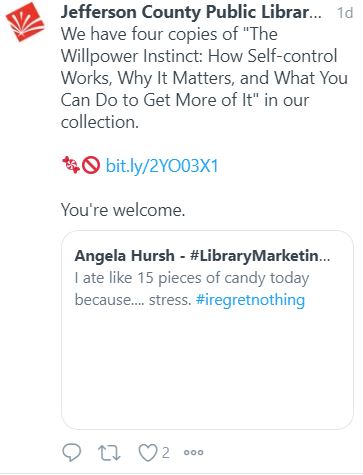
Kudos: Finally, I gave a shout-out to my friends at the Jefferson County Public Library for this hilarious and clever response to my stress-related tweet on Tuesday! I laughed all night!

Stay in Touch

I’m speaking at two conferences this fall and you can register for both on the Upcoming Events page. If you come to OLC, you’ll be able to tour the Downtown Main Library where I work! I’m getting ready to add new events soon so check back.

Have an idea for the next Library Marketing Live Show? Submit it now.

Subscribe to this blog and you’ll receive an email every time I post. To do that, click on “Follow” button in the bottom left-hand corner of the page. Connect with me on Twitter, Instagram, and LinkedIn.  

The Library Marketing Live Show Episode 3: When People Criticize Your Library Plus Should You Focus on Increasing Your Library’s Social Media Following?

The good news: I finally got the screen recorder to work and I was able to upload the whole show to this post (including a funny bit at the beginning where I do my set up. I don’t have the ability to edit video yet!!)

Watch it now

Things we talked about

How to handle criticism of your library. I shared an experience I had with a marketing expert that I look(ed) up to. I am thinking about the way he responded to me in terms of library marketing.

We all face criticism and we have to handle it in a professional and constructive manner. I’m thinking of taking this interaction and turning it into a learning experience by writing a blog post about how to handle criticism of your library.

If you have any thoughts on that subject or can share examples of how you or someone at your library deftly handled criticism from a customer, resident, taxpayer, stakeholder, or community leader, please let me know in the contact form at the bottom of this post.

We also talked about social media followers: do you need a bunch and how do you get more? The short answer is no and no. Watch the episode for a fuller explanation.

Social media is the topic of my talk at the Library Marketing and Communications  Conference in November! Register to attend that event plus register for a free webinar on digital promotions later this month. You’ll find links on the events page.

Have an idea for the next Library Marketing Live Show? Submit it now.

We’ll chat on Instagram on Tuesday at noon EST for about 20 minutes. My handle is @Webmastergirl so follow me to see the show live!

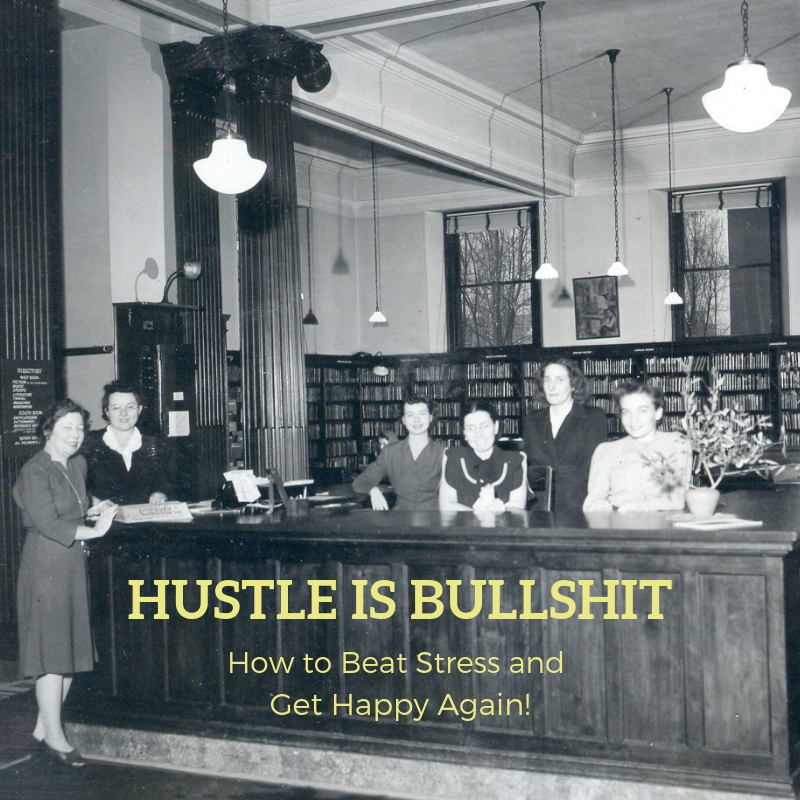
Hustle is Bullshit: How to Beat Stress and Get Happy Again!

I don’t know about you, but I am feeling a bit stressed out.

There are many reasons for that. It’s been an incredibly busy year for my library. We’ve gone through a ton of changes. We endured a public outcry over a potential building sale. We hired a new director–our first new director in 20 years. We passed a levy. And we started a facilities master plan to renovate or rebuild ALL our 41 locations.

I’m tired. I need a break. So why do I feel an incredible sense of guilt walking away from it all, even for just a few days?

It may be because marketing industry thought-leaders are constantly preaching the notion that extreme hustle is the only way to get results. You must post consistently, no matter what. Your audience expects a steady stream of content, no matter what. You have to keep talking or they’ll forget about you.

To some extent, that is true. Audiences do expect consistent content. But they’re also forgiving. And if you are turning out amazing work, a little break in the action can be beneficial to you and to your audience.

A break gives you space to recharge your brain and reinvigorate your creative juices. That’s really important for those of us who do this library marketing job without the help of support staff. For your audience, a small break can build anticipation for your work. It can make your audience realize how special your content is, and how much they rely on it.

I listen to the “Lovett or Leave It” podcast. Jon Lovett, the host, recently took a two-week break over the Thanksgiving holiday. His first show back was the funniest it had been in a while. And he talked about how many messages he received from listeners, especially toward the end of his break, about how they were really missing the show. Those message re-invigorated him and made him excited to get back to the microphone. He did some of his best work.

Hustle is bullshit. We’re not robots. We all need self-care. I recently asked some of my readers to share their favorite ways to keep their sanity. Here are some suggestions!

Cara Luddy from the Onondaga County Public Library says, “When you’re frustrated, you are not going to do your best at work. Get up and take a walk around the library, eat something, or make some coffee/tea. If you don’t want to take a break, switch to working on a project that you’re excited about for a little bit. Use the momentum of working on something you really enjoy to build your confidence and help yourself tackle the less desirable parts of your job.

Teresa Tidwell of the Carusthersville Public Library says, “Delegate! Delegate! Delegate!

Erika Hill works at the Provo City Library, shared a really helpful story and example. “I think sometimes as marketers, we try to turn anecdotes into generalizations. DON’T DO IT! For example, we just sent out a satisfaction survey to our patrons. About 2,000 people responded. Of those 2,000 people, 20 people had some negative comments about our website (which are totally valid! Our mobile website is terrible!). I showed those comments to some colleagues, and they started talking about how much “everyone” hated our website. Nope, not “everyone.” 20 people. We have a tendency to do this kind of thing a lot; we take a few negative patron experiences and allow them to be a referendum on our jobs, and it takes a toll! Certainly, we need to listen to feedback. Certainly we need to try to help every patron have a good experience. But just because one person didn’t hear about an event doesn’t mean that I did my job badly.

Amy Tollison works at the Weldon Public Library. She makes a great point, saying, “As I’m sure is true for many of us, marketing is not my only job at the library. If I get tired of working on this, or feel like I’m losing my creativity, I just switch hats and work on one of my other jobs such as programming or materials selection. Sometimes getting out of my chair and doing something physical like shelf reading is helpful. At home, I try to get enough sleep and to spend at least a little time each day doing my favorite thing–reading!

And Elle Mott, who works with me at the Public Library of Cincinnati and Hamilton County, has a great suggestion. “Attend an ongoing library event–just for the fun of it–your engagement will likely elicit genuine passion which will show when later promoting the library plus it will have gotten you out of the business zone for a few minutes.

The best thing sometimes for your mental health and the health of your organization is to take a short break. Reset your mind. Find your creative space. Reset your goals. Get inspired. Then, start again.

Subscribe to this blog and you’ll receive an email every time I post. To do that, click on “Follow” button in the bottom left-hand corner of the page. Connect with me on Twitter, Snapchat, and LinkedIn. I talk about library marketing on all those platforms!

Get More Library Marketing Reach on Social Media

Every library marketer I know is fighting a battle for the attention of cardholders on social media. Platforms don’t make it easy for us, do they? The kind of organic reach we enjoyed even five years ago is a nearly unattainable now. Plus, we’re all stretched for time. Social media can feel like an endless treadmill or a giant monster that needs constant feeding.

But there one thing you can do to stretch your library marketing efforts further each day on social. It’s called re-purposing. Basically, you take original content created by you or content created by your fans. You reshape it, then share it on different platforms. It’s easy and it’s fun. It saves time. And it helps you get the most effective library marketing messages in front of more eyes.

Now, I want to say that I don’t recommend full cross posting… in other words, copy and pasting a post on one social media platform automatically onto another one. Always think about whether your audience really wants to see the same content on each platform. The answer is usually no. Different platforms have different audiences with different needs.

But you can take a post on one platform and re-craft it to work on a second or third social media platform. For instance, an Instagram story shot at a super-fun teen program probably won’t work on your library’s LinkedIn page but it could be re-purposed on Snapchat. You can also make minor changes to single posts to make them work on different platforms. Change the text or the captions of the posts, add or remove hashtags, and or use a different photo.

Here are some tips for spotting social media posts that can be re-purposed. First, make a daily habit of social listening. Essentially, that means you monitor mentions of your library on all social media platforms every day. It’s easiest to do when you use social media scheduling software. At our library, we use Sprout Social. We can see mentions of our library on Instagram, Facebook, and Twitter, which are the big three platforms where we spend most of our social media energy. For my personal blog promotion, I have a free version of Tweetdeck. I can add columns and get notices when readers mention me by name or through the hashtag #librarymarketing on Twitter, where I do my main promotion.

When you monitor and share mentions of your library, you are nurturing the relationship with people who are already fans of the library. By giving them some exposure on your social media channels, you’ll be generating exposure for them and creating more loyalty. However you decide to do social listening, set aside time every day to go through the platforms and look for mentions of your library. The complimentary ones can be turned into posts on other platforms. They can be shared directly with your followers in retweets.

Ask for testimonials from your cardholders through social media. Then share those posts in your print publications, on your website, in videos, and across other social media channels. My social media specialist likes to take mentions and turn them into testimonial graphics in Canva. Then she shares those posts on select platforms. Bonus tip: I also asked for testimonials using our email marketing list recently. I sent an email to the most active adult cardholders at all our branches and asked them to tell us why they loved their library. The email linked to a specific email address. I even populated the subject line. All the cardholder had to do was type a few sentences about why they love the library. I got back more than 400 responses… a gold mine of future content for all our platforms!

You can also turn all questions sent to you on social into re-purposed content. Cardholders will often choose social media to communicate with libraries. There’s a great book with lots of tips of social customer care. I interviewed the author earlier this year and you can read that post. You’ll learn lots of ways to make social media customer care work for your library. The trick again is to set aside time every work day to go through each platform. And to keep track of the platforms where your library is mentioned.

And now, I’m going to share a social media fail I suffered recently. I forget that Google Business existed! My boss checked our account and found dozens of questions posted on Google Business sites for our 41 library locations. Now, I go through the messages my library gets each day. With 41 locations, we get about five messages a day on that platform. Some are questions about things like branch hours or services. I try to answer all questions within 24 hours if possible. Many posts are people leaving specific reviews of branches. Those people are thanked by me with a personal message. The whole process takes maybe 10 minutes a day. But the quick interaction will leave cardholders who take the time to write to you feeling like they were really heard, and that’s extremely important. And now, I can take the best of those Google reviews and re-share them on other platforms. They work great because they often mention specific branches and staff members. They feel more personal to the people who live in those neighborhoods because they know that branch and staff.

Re-purposing content is a great way to stretch your library marketing reach. It’s relatively easy and it’s fun and it’s free. And here’s the big thing: many for-profit brands are not doing a good job of re-purposing content. That’s our advantage. Our cardholders love us, and they love to hear other fans rave about our work. So set aside a tiny block of time in every day to search for content that can be re-purposed.

And now, I have a favor to ask. If you didn’t see last week’s post, can you take three minutes to fill out my tiny little survey? It’ll help make this blog better in 2019. Thank you!

Subscribe to this blog and you’ll receive an email every time I post. To do that, click on “Follow” button in the bottom left-hand corner of the page. Connect with me on Twitter, Snapchat, and LinkedIn. I talk about library marketing on all those platforms!

Introducing the Nine Blogs That Will Make You a Better Library Marketer

(Read time: 2 minutes, 28 seconds)

I am a fan of blogs. God bless the internet, it’s the best way to keep up to date on everything–food, fashion, the news, and the changes in library marketing. And, as much as I am also a fan of books of all kinds, I am not a fan of marketing books! The landscape of this profession changes fast. Unless it’s a philosophical take on marketing, most marketing books feel out of date within a year or two of publication.

Instead, I get my advice from blogs. So I’ve listed the nine blogs I recommend you read to stay on abreast of all the news in marketing. For the best use of your time, sign up for the email newsletters offered by these sites. Most will let you choose which topics you like to hear about and will send you content at the frequency that’s best for you. Set aside time on your calendar every day to read the content shared by these blogs. It’ll be time well spent. I’ve listed them in alphabetical order.

The Content Strategist

This blog features interesting articles broken into categories like storytelling, strategy, and ROI. They also post inspirational articles, which I love to save and read on days when I feel like my work is not having the impact it could or should.

Content Marketing Institute

At first glance, you might be intimidated. This blog is aimed at C-Suite or executive level marketers. But it’s good to read this advice even when you’re a little guy! There are always pieces of their strategy and bits of advice you can pick up and mold to work for your library. And the writers of this blog always seem to see the trends in consumer and business marketing before any other experts. Also, when you sign up for this newsletter you’ll get notifications about CMI’s free webinars. They have the most helpful webinars of any company in the marketing space.

Coschedule

I found this blog after using their online tool for writing better headlines. It’s among my favorites. Coschedule creates a lot of useful templates and writes easy-to-read, concise instructions on how to use them and how to improve your marketing.

The Daily Carnage

I read this one for laughs, good advice, and a lesson on how to write with humor and still be taken seriously.

Hubspot

Hubspot also gives away a lot of free templates and online courses that have tremendous value. Their blog posts cover a range of topics and are fun and insightful.

Mashable Marketing

One of my favorites by far. Their content is easy to read and interesting. They cover topics from social media to graphic elements to equipment to how pop culture affects marketing. It’s also written very, very well. This website is daily appointment reading for me!

PR Daily

If you sign up or bookmark just one blog from this post, this should be it. It’s essential for library marketing. This blog contains everything you need to know about public relations and the media. You have my permission to stop reading and subscribe to this one now. Then come back. Please.

Social Media Examiner

When I interview candidates for a social media position, I asked them where they get their news about social media. If they name this blog, they get a big A+ from me. Read it AND listen to Michael Stelzner’s podcast to get the best advice on social media from the industry’s best minds.

Spin Sucks

This blog offers a lot of helpful PR advice with a mix of fun posts designed to stretch your creative brain and general marketing advice. I really look forward to their daily email newsletter. I always learn something!

What is your favorite marketing blog? Please share the name in the comments so I can read it too!

Subscribe to this blog and you’ll receive an email every time I post. To do that, click on “Follow” button on the bottom left-hand corner of the page. Connect with me on Twitter and Snapchat–it’s where I talk about library marketing! I’m @Webmastergirl. I’m also on LinkedInInstagram and Pinterest. Views in this post are my own and do not represent those of my employer.


The Most Exciting Library Marketing Lessons from Content Marketing World

The future of content marketing at your library is stories, videos, and making personal connections between your cardholders and your libraries. That’s the big takeaway for me from the year’s Content Marketing World, a giant marketing conference in Cleveland. I’ve just returned with a head full of ideas and heart full of energy. Rubbing elbows with 4,000 marketers bursting with love for the profession will do that to you.

At #CMWorld, I attended 15 sessions and learned a ton of new information which I will flesh out here over the course of the next several months. Some tips can be put into action immediately and some will need time for processing in my brain, as I work to figure out how to make them doable for libraries of all sizes, shapes, and missions.

Here are the main takeaways I received from 15 sessions with links so you can check out more of the speaker’s work and get started on transforming your own library marketing.

Linda Boff, Chief Marketing Officer at General Electric:  Stories are everywhere, right under your nose. Find and embrace them.

Jay Acunzo, host of the podcast Unthinkable:  Content marketing is about inspiring your true believers, not coercing the skeptics. (This was an ah-ha moment for me!)

Drew Davis, a former marketer, best-selling author, and speaker:  Audience retention is the true definition of video engagement. Stop trying to just get views and get audiences to watch your whole video!

Doug Kessler, creative director and co-founder of Velocity Partners: It’s our job as marketers to expose the hidden marketing conventions and turn them on their heads. In other words, conventional thinking will get you nowhere. Now is the time to be creative.

Ian Cleary, founder of Razorsocial: Be smart when you publish your content because if no one sees it, what’s the point? Use smart keywords, collaborate with influencers, and promote yourself. During this session, I realized I know nothing about web optimization!

Amanda Todorovich, Content Marketing Director at the Cleveland Clinic: Never be content. Measure and test and test again. Ask “what if” all the time.

Casey Neistat, YouTube star: Do what you can’t. Make it count. Follow your gut. Cut through the bullshit. Yes, I put that all in bold because IT’S IMPORTANT.

Colson Whitehead, author of The Underground Railroad and a bunch of other books, Pulitzer Price Winner, National Book Award Winner, etc., etc., etc. You know him, you work at a library: If you have ideas and you’re not sure you can pull them off, it’s ok to wait until you are actually ready. I’ll be honest, I don’t know if I agree with this but I’m going to think about it for a while.

Amy Schmittauer Landino, vlogger, author, and speaker: The secret to great video is asking yourself…would you share it?? Really?? Not just because you think everything you do is fantastic, but because what you do is actually fantastic.

Arnie Kuen, CEO of Vertical Measures: There is only a two percent chance your followers will see your organic post. (YIKES!)

Scott Stratten, author, speaker, blogger, podcaster, promoter of unconventional marketing. This was a session on public speaking: Tell a personal story but only if it makes a point. Respect the audience’s time.

Tamsen Webster, speaker, and producer of TEDx Cambridge, during the same session on public speaking: Go ask for the stage you deserve. The way to speak more is… to speak more.

Joseph Gordon-Levitt, actor and creator of hitRECord, an online collaboration and creation website for video, graphics, music, and more: Community, fair compensation, and collaboration are the future of content creation.

Joseph Gordon-Levitt

Jonathan Stanley, Executive Producer for Lowe’s: Test all the time on YouTube. Fail fast and learn fast. Don’t spend years scripting.

Michelle Park Lazette, Content Marketer for the Federal Reserve Bank of Cleveland: Deliver different! Try your best to produce the “okra breakfasts” of content. Okra breakfasts are content that is unexpected but delicious and filling!

Subscribe to this blog and you’ll receive an email every time I post. To do that, click on “Follow” button on the bottom left-hand corner of the page. Connect with me on Twitter and Snapchat–it’s where I talk about library marketing! I’m @Webmastergirl. I’m also on LinkedIn, Instagram and Pinterest. Views in this post are my own and do not represent those of my employer.


What Does Your Library Stand For? Advice From Ann Handley

I worked in a local television newsroom for 20 years. Broadcast TV schools tend to churn out formulaic writers; who, what, where, when, why, don’t bury your lead, put the important stuff in the first few sentences, pepper your story with natural sound breaks, no sounds bites over 20 seconds, done! Next!

When I jumped to Marketing, I spent the first year trying to get my sea legs. It took a long time to learn the process, the lingo, the organizational structure, and the institutional history of the library. It was dizzyingly busy and exciting. But about three-quarters of the way through that first year, I realized I had a weird ache that I couldn’t soothe. What the heck was bothering me, I wondered?

I’d stopped writing. I missed it. I longed for it.

Lucky for me, I came into marketing during a time when good writing is viewed as a necessary, relevant, and effective way to add value to consumer’s lives. Marketers are moving past the catch-phrase, one-line, ad-jingle variety. Today’s audiences demand witty, sharp, insightful work that inspires and motivates. Challenge accepted.

About six months ago, I heard a podcast interview with Ann Handley (I can’t remember exactly which podcast but I think it was Social Media Examiner.) Ann is a veteran of creating and managing digital content to build relationships for organizations and individuals. She is the Chief Content Officer of MarketingProfs; a columnist for Entrepreneur magazine; a LinkedIn Influencer; a keynote speaker, mom, and writer.

130503AH_9843

Here’s why everybody loves Ann-she doesn’t sugar-coat the writing process. She admits it’s hard work. She has faced those angst-filled moments when a blank page is staring you in the face and you’ve literally got your head on the table, moaning “Dear God, why am I even here!” She shares easy-to-understand tactics for dealing with that anxiety. She believes everyone can write. She speaks to her readers on their level. You can read the first chapter of her book and start implementing her advice right away. No fluff. No bull. No pretension.

B-FWqj9CMAACS9b

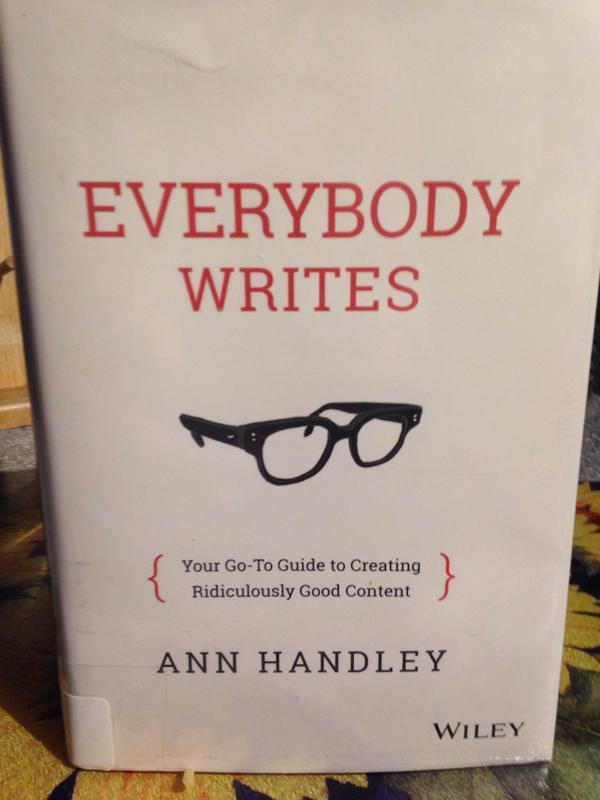
I devoured Content Rules in about three days. Everybody Writes literally arrived on the holds shelf yesterday. Just this evening, I’ve read the foreword, the acknowledgments (yep, I’m one of those people) and the first two chapters. I actually hadn’t figured out what I wanted to write for the introduction to this interview, but I ran for my laptop after finishing those first two chapters. Ann inspires me. How is that possible with someone I’ve never even met? That’s the power of the written word done right.

I’m grateful to Ann for taking the time out of her busy schedule to answer my questions about library content marketing. Ann is fan and supporter of libraries and even served on a library Board of Trustees. I encourage you to read her books. There’s no way you’ll ever be more of a super-fan than me though, so don’t even try.

recite-1gcgoor

One of the big points you make in Content Rules” is that you have to find your brand’s voice. I think many libraries have a hard time doing this–they feel like they need be all things to all people. Are there some questions libraries can ask themselves in order to find their voice?

Ann Handley: The question libraries need to ask is the same question we all need to ask ourselves, on behalf of our own organizations: What do we stand for? For example, the New York Public Library says it is “on a mission to inspire lifelong learning, advance knowledge, and strengthen communities.” Then, use that to craft your content strategy and voice, and identify key themes that you can “own,” for lack of a better word. You can see how the NYPL does that on its wildly popular Instagram feed.

Our industry is all about the promotion of stories and yet somehow we struggle to find compelling stories that spur our audience to action. I think in some ways libraries take their evangelists for granted. How do you go about taking library cardholders on a journey through storytelling that leads them beyond that generic “I love the library” feeling?

Ann Handley: This relates to the finding what you stand for in the previous question, because it’s all about inspiring people to connect with a mission. The #Shelfies movement is a great example of that, when the NYPL asked book lovers to submit photos of their personal bookshelves or favorite library shelves to profess their love of books, and the role they play in our lives. The response was impressive: More than 1,200 Instagram posts and 1,700 tweets from 11 countries in 6 languages.

Your best content is not about what you do or what you sell – but what you do for others. Good content doesn’t happen in a vacuum. It has everything to do with the experience you are creating for those you serve. Does that sound high-minded? It’s really not – it’s about getting comfortable embracing what makes your organization unique.

Libraries often struggle to fill the content demands with a small staff and an even smaller budget. Can you talk a little about how we might use repurposing to help ease those demands?

Ann Handley: Repurposing or reimagining existing content in new forms is a potentially rich source of content, especially at libraries with long histories. What’s in your archives that you could reimagine as blog fodder? What’s in your history that’s relevant to patrons today? What’s commonplace to you that might be interesting to others? “What already exists is an inspiration,” as the designer Michael Wolff says.

Also, creating a culture of content can help, because it empowers people to create content on behalf of your organization. Those who maintain the NYPL’s Instagram feed aren’t in “marketing.” But they are great at visual storytelling.

Curating the content others produce is a fantastic way to augment your content efforts. Said another way: Crowdsource, don’t create.

A year or so ago, my MarketingProfs team bonded after hours at Bowl and Barrel, a Dallas-based bar and bowling spot. I shared a photo from there because it’s what I do when I’m in a ridiculously photogenic place: the interior brickwork just begged to be Instagrammed. So I did, and I geo-tagged the location. A day or so later, Bowl & Barrel featured my photo (with full credit) on its burgeoning Instagram feed.

Library employees are surrounded by books, they host author visits, but they may not feel comfortable writing. How do you get over that fear and get something on the page?

Ann Handley: Librarians who don’t love words…? Is that really a thing?!

Fear of the blank page is a real thing, which is why I wrote a whole book about it! (Everybodywrites.com) How much space do we have…?

One key thing is to take pressure off yourself to write any certain way – there is no one way to write, just as there is no one way to raise a child or roast a turkey. (But there are terrible ways to do all three!)

Do you have any examples of libraries that are doing great content marketing which the rest of us could learn from?

Ann Handley: I mentioned the NYPL already. I also like what the Cincinnati Library is doing on Pinterest, as an extension of its in-house “Maker” programming.  (Thanks Ann!) The NYPL does some cool stuff on Pinterest, too, especially its Little Lions board.

You’ve served on a library board of trustees. Tell us a little about how you got that gig and what you learned about libraries from that service.

Ann Handley: A friend of mine was on the board, and he recommended me. That’s not a very interesting story, is it? I said yes because I always loved libraries. I grew up visiting our town’s tiny library weekly, and carrying a stack of books to and fro became a ritual that, as I think back on it now, almost defined my childhood. The excitement of discovering new titles on the shelf. Getting my first library card. Meeting new friends in the pages. Reading about places far away from my insulated suburban world. My goal to read every book in the Children’s Section before moving across the aisle to Adult’s (I didn’t quite accomplish that)… well, all of it thrilled me.

I’m guessing you and your readers know exactly what I’m talking about? Later, I replicated that ritual with my own kids.

Libraries have changed a lot since I was a child visiting with my mother. Children’s sections with giant stuffed animals that kids flop on? Movie nights? Wii parties in the teen room? Coffee hangouts? Libraries are more cultural and community centers than they are just about books.

What book are you reading right now?

Ann Handley: Beside my bed is #Girlboss by Sophia Amoruso. I gave it to my teenage daughter for Christmas, and so I picked it up when she was done. It’s ok. I’d give it 3 out of 5 stars and one of those stars I’m giving just because I admire anyone who has the tenacity to write a book. Writing a book is truly like birthing a Honda Civic: It’s hard work, and you sweat a lot, and most of the work is done while crying.

If you could send a message to yourself ten years ago (in 2005), what would you say?

Ann Handley: Poke your nose out. No one is going to invite you.

Subscribe to this blog for updates every time I post. Click on the little “Follow” at the top left of this page.

Connect with me on Twitter. I’m @Webmastergirl and LinkedIn. I’m also on Instagram and Pinterest.

Views in this post are my own and do not represent those of my employer.

A WordPress.com Website.

Up ↑