The Library Marketingโโโโโโโโ Show, Episode 137: In this episode, I’ll share highlights of my favorite session at the #PLA2022 Conference in Portland, Oregon.
One library saw a 79 percent increase in circulation during the pandemic. How did they do it? Details in the video!
Do you have a suggestion for a topic for a future episode? Want to nominate someone for kudos? Let me know in the comments. And subscribe to this series to get a new video tip for libraries each week.
Thanks for watching!
Subscribe to this blog and youโll receive an email every time I post. To do that, enter your email address and click on the โFollowโ button in the lower left-hand corner of the page.
I check my holds list on my library’s website pretty much every single day.
This is no lie.
At my library, each cardholder has a dashboard. You can see all the items you’ve put on hold and how many cardholders are in line in front of you.
You can also put books, DVDs, and CDs on a “for later” shelf. If you’re like me, you’ll check that shelf religiously.
After checking my print item holds, I open the Libby app and check the status of all the audiobooks I’ve put on hold. I try to guess which audiobook has the best potential to be made available at the exact moment I finish my current audiobook.
That’s totally normal, right?
I promise you that there are thousands, nay, tens of thousands of readers who partake in this same obsessive routine. Libraries who capitalize on that obsession get higher circulation numbers. And the more people engage with your collection, the more they are likely to engage with other parts of your library.
That’s why I am an advocate for robust and strategic collection promotion. But most library marketing teams spend their energy and resources promoting programs.
75 percent said promoting programs and events. A mere FOUR PERCENT said promoting their collection.
(Excuse me now while I have a short cry).
These libraries are missing a crucial fact about their cardholders.
People want the collection items. That’s why people get a card. And that’s the main way people use their card once they’ve got it.
The Public Library Survey Report‘s latest data, released in August, showed that there were 2.2 billion items circulated in 2019, about seven items per person in the United States.
By comparison, there are almost 125 million program attendees at public libraries. If each of those attendees only attended one program, that would account for only 38 percent of the total population in the U.S.
And most libraries spend significantly more on their collection than they do on anything else. Library Journalโs 2021 Budgets and Funding Survey shows that libraries spent 11.2 percent of their total budget on materials in 2020.
I am certain the data for other countries is similar.
If your library is putting resources into your collection, you must promote it. That’s the truth no matter what size library you work in.
But my gosh does it seem intimidating. Where do you start? And how do you get the most bang for your buck, in terms of circulation success?
Here are four easy things you should do right now to promote your collection. Because it’s what your community wants and needs from you.
Create FOMO with email.
Last month, I spoke to a self-described “library fan” who confessed to me that she often buys books because she didn’t know her library had new titles for checkout.
Most people don’t even think about turning to the library when their favorite author releases a new book. A concentrated collection marketing effort will change that.
Holds are a promotional opportunity. And the Fear of Missing Out (FOMO) is a real and tangible driver of promotional success.
So, promote your titles, especially new titles, using email. Include a line telling your cardholders that they are getting a jump on the holds list. Your most avid cardholders will pounce at the chance.
You can start small. Send an email once a month promoting three titles. Include a link to your catalog that will allow people to check that title out in whatever format they prefer.
All you need to do is include the book jackets, a short annotation, and a link. There are email programs designed specifically for libraries that make this process super easy.
You can also create a list of titles that aren’t new, but that are related by story element to the new titles which are the primary focus of your email. Give cardholders the option to check out these older titles while they wait for the newer titles.
Make sure you track holds and checkouts of the titles you promote in your email. That will give you some data to help you make decisions about what to promote next month. It will also be proof of the effectiveness of your work.
In my experience, one email a month can drive a circulation increase on average anywhere from 125 percent to 375 percent!
Strategically “upsell” your collection
Upselling is a sales term in which customers are encouraged to buy a more expensive version of a product than they originally intended.
Libraries can upsell too. We want our cardholders to end up checking out more items than they originally intended!
To do that, we must always be thinking of ways to offer other collection items to patrons as they checkout.
For instance, if you are running your library’s drive-thru window and a patron comes to pick up their hold on a memoir by a rock star, you can encourage them to log onto your library’s website to listen to that musician’s streaming music.
Or maybe you notice a patron bringing a stack of Regency-era books to your checkout desk. Suggest that the patron also check out DVDs of movies like “Pride and Prejudice”.
If your library is doing a screening of a kids’ movie, be sure to have an abundant number of books for kids in the same genre so that your patrons can leave the movie with a stack of books to read at home.
Look for every opportunity to encourage your patrons to check out more materials.
Harness the power of an eye-catching book cover.
Publishers understand the psychological impact of a good book cover. They spend a ton of money and research to pick the most engaging cover. We can use that to our advantage when we promote collection items.
On digital platforms, you’re trying to get people to stop scrolling as they move their feed. And a beautiful book cover works great for this purpose.
You can also put this concept to work for in-person book displays. Put your books face out. You want people to be drawn in by the beauty of the book cover.
Let someone else pick the items.
Delegate the selection of items to promote to the people who know what they’re doing–your collection or materials selection department.
Or ask the general staff of your library for recommendations. Librarians love it when you ask them what they’re reading. Your biggest problem will be whittling down the answers!
You can also crowdsource collection promotions from your followers. Ask people to share their book recommendations with you on social media or by emailing you.
You can even ask them to record a short video of themselves making their recommendations. Then you can share that content! You can even make a poster or sign featuring a photo of your patron and their book recommendations.
Subscribe to this blog and youโll receive an email every time I post. To do that, enter your email address and click on the โFollowโ button in the lower left-hand corner of the page.
The Library Marketingโโโโโโโโ Show, Episode 110
This video is for anyone who works in a library with a long holds list and frustrated readers. I’ll share some ideas for keeping people engaged with your collection even as they wait for that one book they are dying to read.
Kudos in this episode go to Indian Trails Public Library for this cute Library Card Signup month video, created by staff member Stephanie Diebel.
Do you have a suggestion for a topic for a future episode? Want to nominate someone for kudos? Let me know in the comments. And subscribe to this series to get a new video tip for libraries each week.
Thanks for watching!
Subscribe to this blog and youโll receive an email every time I post. To do that, click on the โFollowโ button in the bottom left-hand corner of the page.
The Library Marketingโโโโโโโโ Show, Episode 109
In this video, I’ll share four ways you can make sure the public knows about the many wonderful children’s books you have in your library’s collection.
Kudos in this episode go to the Bridges Library System, which has a wonderful and funny newsletter signup and confirmation process.
Do you have a suggestion for a topic for a future episode? Want to nominate someone for kudos? Let me know in the comments.
And subscribe to this series to get a new video tip for libraries each week.
Thanks for watching!
Subscribe to this blog and youโll receive an email every time I post. To do that, click on the โFollowโ button in the bottom left-hand corner of the page.
In just a few weeks, the annual summer reading program will kick off at libraries in the U.S., Canada, and the U.K. And for the second year in a row, libraries are struggling to create a program that engages the community without risking their safety.
Last year’s pandemic Summer Reading program was a challenge (boy, that’s the understatement of the decade). Many libraries were physically closed. We were still learning about how the virus spread and trying to figure out how to mitigate the risk with physical materials. Staff members were doing virtual programming for the first time. We counted any participation as a success.
I think 2021 is going to be the first rebuilding year for summer reading. Attendance and participation numbers are not going to return to pre-pandemic levels this year. Many libraries are still dealing with limited service. Zoom fatigue is real. Vaccines are not widely available. It’s going to take us a couple years to get back to “normal.”
It’s okay. Do the best you can. Celebrate any growth you see this year. And use these ten tips to make your summer reading program as successful as possible.
Drop the library card requirement.
Let anyone in your community participate in summer reading, not just library cardholders.
Dropping the requirement to get a library card sounds counterintuitive. But it opens your program up to a whole population of people who don’t regularly use the library, particularly those in under-served communities. It makes your program more inclusive. It’s a goodwill gesture.
Of course, at registration and check-in, your front-line library staff should still suggest participants get a card. Doing so will grow your cardholder numbers. But don’t make it a requirement to register or get prizes.
Make participation super easy.
Don’t ask your participants to jump through complicated steps to earn a prize. Summer reading should be three-step maximum– read, log your reading, claim a prize.
If you want to push participation in programs, I suggest making that a bonus: let people earn extra prizes or points toward prizes by attending virtual programs or in-person events, if that can be done safely in your area. You can also reward people for watching a streaming video or listening to free streaming music.
Let adults participate.
It still surprises me when I see a library that limits their summer reading program to only teens and kids. Children who see the adults in their lives reading are more likely to read themselves. So why not entice parents to participate?
This year is an opportunity to get more adults engaged with your library. Plus, the adults in your community deserve to have some fun! If you can provide that for them, they will be grateful and supportive of your library.
Add experiences to your participation elements.
Create themes for each week of your summer program, like DIY, arts, nature, and sports. Make suggestions for activities people can complete to earn participation credit, like cooking a recipe from a cookbook they got at the library, going on a nature walk, visiting the zoo or a park, painting a picture or making sidewalk art, building something with LEGOs, writing a storyโฆ the possibilities are endless.
If a participant doesnโt read 20 minutes a day but still completes an experience activity, they should get credit. This is another way to make your program more inclusive and enticing to people.
Offer both print and digital tracking options.
Many libraries have an app or an online software platform that participants use to track their reading. But your under-served community members donโt have access to a computer or Wi-Fi at home. They canโt log in to track their reading and they canโt download or use an app.
In addition, many of your connected participants may find the process of downloading the app, putting in their information, and then using it to log their reading to be cumbersome. Add a paper tracking option to ensure everyone can participate.
Print copies of your tracking log and add them to your curbside pickup bags or slip them into holds. Let participants bring it back to your drive-thru or curbside window for credit.
Ask partner organizations to help you promote summer reading.
Now is the time to “call in favors” with your partner organizations. Ask them to show support and help rebuild your summer reading program.
If you don’t have partners, you can use summer reading to build partnerships! Ask local realtors and rental agencies if they can hand out a summer reading promotional piece to prospective homeowners or new renters. Give information and promotional pieces to day care providers, teachers, summer camps, recreational centers, your local zoo, your local park board, and other civic organizations. You can even ask restaurants to include a summer reading promotional piece in their takeout bags!
Use your email list to its full potential.
If your summer goal is to increase the number of readers and the amount of materials they read, then keep suggesting things for them to read! This is a great time to promote parts of your collection that don’t get a lot of use, like online graphic novels, as well as your backlist titles.
Build a template with whatever email service you use and fill in the blanks. Send two to three suggestions to your cardholders every two weeks during your summer program. It’s a great way to re-engage cardholders. You can also use email to remind your cardholders to participate in summer reading and boost your circulation numbers for the year.
Spend money on targeted social media ads.
This is the most efficient and cost-effective way to reach people and summer is the perfect time to buy social media ads. You barely need a budget to get started. $25 is all you need to get started.
Summer reading is also a great opportunity to buy ads on several platforms and compare results. The platforms will guide you through the process of picking your target audience. If you see success on one platform, you can use that data to create other small budget campaigns for your library during the year.
Incentivize user-generated content.
Hold contests to encourage people to post photos and videos of themselves using your library and participating in summer reading. Offer a chance to win a prize drawing for submitting reviews and testimonials about your library. You can use that content to further promote summer reading.
You may discover someone who is a super-fan of your library. That person could be an “influencer” for a future library promotional campaign!
Put good customer service on display.
Even with the pandemic, you’ll likely see a boost in visits to your library for curbside or holds pickup during the summer. You’ll definitely get more visitors to your website. Make sure everything is in tip-top shape, attractive, and easy-to-use.
Stress the importance of good customer service to staff, including those who work on responding to comments and questions via email, chat, and social media. Give them talking points to help them promote a few year-round services and challenge them to pick one to mention during every customer interaction.
Put your expertise on display front and center on the website. Is your staff great at readers’ advisory? Do you have an amazing e-newsletter? Are your virtual programs fun and innovative? Use summer reading to promote the best of your year-round services and collection items.
Is your library doing anything innovative this year for summer reading? What concerns do you have about the program this year? Share your thoughts in the comments!
Subscribe to this blog and youโll receive an email every time I post. To do that, click on the โFollowโ button in the bottom left-hand corner of the page. Connect with me on YouTube, Twitter, Instagram, Goodreads, and LinkedIn.
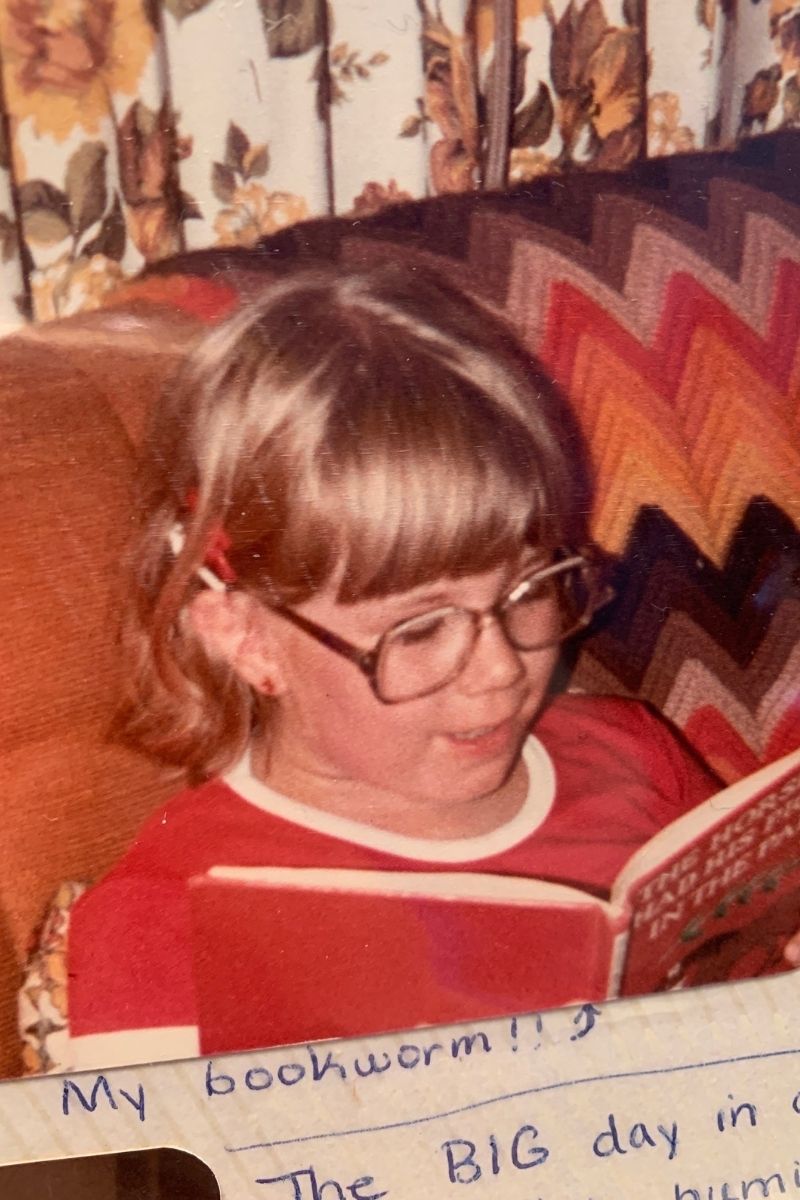
I was recently looking through some old photo albums when I came across this gem.
You can see my mother wrote the words “My bookworm” under this photo of me, age 7, reading “The Horse That Had His Picture in the Paper” by Helen Stone. I have always loved fiction.
Of all the people in the world, I am certain I really don’t have to explain to my readers why fiction is amazing. You work in a building stuffed with fiction!
But, if I were to ask you what you’ve read lately that will help improve your work skills, my guess is that you would not name a work of fiction.
Of course, your work will be improved by reading a great business or career-oriented book. I can think of a few inspiring examples, like Ann Handley’s Content Rules, which literally changed my life, or Unmarketing by Scott Stratten. You can get a chance to read books like these and talk about them with other library staffers if you join the Library Marketing Book Club on Facebook. There is a lot of value in reading advice on marketing.
But reading fiction will also make you a better marketer. Here are the six reasons why reading fiction will improve your ability to promote your library.
Fiction is good for your brain. A study by researchers at Emory University, published in the journal BrainConnect, found that reading a novel can increase connectivity in the brain and improve brain function. Lead researcher Gregory Berns concluded, “At a minimum, we can say that reading storiesโespecially those with strong narrative arcsโreconfigures brain networks for at least a few days. It shows how stories can stay with us.”
Storytelling requires the work of different areas of your brain in order to help you understand the dialogue, plot, and characters. A work of fiction will train your brain will do a better job of processing complex problems in your library work.
Fiction teaches you to empathize with your community. That same study from Emory University found that reading fiction improved the readers’ ability to view the world from another person’s perspective.
Researchers theorize the act of reading forces the brain to process the emotions and physical actions of the protagonist. That processing leads to a greater compassion.
Activating compassion will cause you to create better service for your community. When you can put yourself in the shoes of your patrons, you are more likely to see their needs and find ways that your library can meet those needs.
Fiction activates your imagination. Reading fiction improved the imagination of the Emory University study subjects. It teaches you to think outside the normal boundaries of your life. It shows you the possibilities that exist when you don’t constrain yourself. It’s also a great way to forget your troubles for a few hours, and we could all use a little of that!
Fiction expands your vocabulary. A novel will expose your brain to a larger variety of words than you might run across in normal conversation or emails. The more your brain is exposed to this increased mass of vocabulary, the more you absorb it and incorporate it into your own work.
That doesn’t mean you have to write in a verbose manner in order to prove how your vocabulary has expanded. Rather, it means you’ll have a greater bank of words in your native vocabulary to choose from when you are trying to convey the perfect sentiment in your marketing pieces.
Fiction teaches you the difference between a great story and a terrible story. When’s the last time you started reading a novel and couldn’t stop? (For me, it was last month.) Now, when’s the last time you started reading a book and had to quit three chapters in because you couldn’t stand it anymore? (Again, this happened to me last month!)
The more fiction you read, the more you understand what a great story looks like. You’ll start to recognize good stories you can use as marketing for your library.
Reading fiction from your own library gives you a sense of your patrons’ experience. In the business world, companies and entrepreneurs are encouraged to go through the buying process for their own products to get a sense of what their customers experience. Library staff should do the same.
Look at the whole experience through the eyes of your community. Is your catalog easy to find on your website? Are there plenty of reading suggestions on your website, in your emails, and social media platforms? Can you find the books you love in the genre you prefer? How long do you have to wait to get your holds? Does your catalog suggest read-a-likes to keep your readers engaged while you wait for your holds? Is the process of checking out a book easy and painless?
Using your own collection can give you valuable insight. Your patrons’ delight and frustrations become your own delight and frustrations. The delights can become promotional tools for you to use in your marketing pieces. And the frustrations will prompt your library to make improvements that will increase circulation.
What are you reading right now? Do you prefer fiction or nonfiction books? Why or why not? Share your thoughts about reading and books in the comments section.
Subscribe to this blog and youโll receive an email every time I post. To do that, click on the โFollowโ button in the bottom left-hand corner of the page. Connect with me on YouTube, Twitter, Instagram, Goodreads, and LinkedIn.
In this episode, Angela explains why she believes that marketing your library’s collection will keep your library afloat during these trying times. She’ll lay out three reasons why at least 50 percent of your marketing should be promoting your collection.
Kudos in this episode go to Stacey Desroisers and Melissa Mannon who launched “The Curious Reader” podcast, a collaboration between the Goffstown Public Library and the local high school.
Do you have a suggestion for a topic for a future episode? Want to nominate someone for kudos? Let me know in the comments. And subscribe to this series to get a new video tip for libraries each week!
In this episode, I’ll share why reading for escape is important! Libraries are so focused on learning and connecting people to resources to help them with the transition to remote learning that we might forget we don’t always have to be educational. Here’s a great article from Jordan Kisner in the New York Times about why people fall in love with reading.ย
Here are some places to find booklists for “escape” reading that you can share with your patrons.
Also Kudos to the Schlow Library in State College, Pennsylvania. They’ve come up with a way to extend a public meeting space to patrons even though their physical library is closed. They’re helping people reserve Zoom meeting rooms!
Check the Upcoming Events page to see where I’ll be soon. Let’s connect!
This blog consistsย of my own personal opinions and may not represent those of my employer. Subscribe to this blog and youโll receive an email every time I post. To do that, click on โFollowโ button in the bottom left-hand corner of the page. Connect with me on Twitter,ย Instagram, andย LinkedIn.ย ย
This week, we talk about the work of Becky Spratford from RaForAll.Blogspot.com. She is a reader’s advisory expert. Her seminar made me think about how to improve library book promotion. You’ll learn four things that can help you with your library collection promotion.
Also, KUDOS in this episode go out to Greenfield Public Library in Greenfield, Massachusetts which recently received great press for their pop-up library initiative. Get out of your building and reach out to the community. Thatโs good marketing!
If you have a topic for the show, kudos to share, or want to talk to me about library marketing, email me at ahursh@ebsco.com.
Check the Upcoming Events page to see where I’ll be soon. Let’s connect!
This blog consistsย of my own personal opinions and may not represent those of my employer. Subscribe to this blog and youโll receive an email every time I post. To do that, click on โFollowโ button in the bottom left-hand corner of the page. Connect with me on Twitter,ย Instagram, andย LinkedIn.ย Need help with your library marketing? Email me at ahursh@ebsco.com.