The Library Marketing Show, Episode 139: In this episode, I’ll answer a question I hear frequently at conferences and events. There are thousands of small and rural libraries across the world that depend on a very small staff to deliver services and create promotions. How do you effectively market your library when you’re working alone? I’ll share my top four tips.
Kudos in this episode go to the Niles-Maine District Library. Be sure to watch the video to see why they’re being recognized.
Do you have a suggestion for a topic for a future episode? Want to nominate someone for kudos? Let me know in the comments. And subscribe to this series to get a new video tip for libraries each week.
Thanks for watching!
Subscribe to this blog and you’ll receive an email every time I post. To do that, enter your email address and click on the “Follow” button in the lower left-hand corner of the page.
Image courtesy Cincinnati and Hamilton County Public Library
Here is a question that has been the source of many an existential crisis for library staff. What is the value of your work?
That proposition is at the heart of a major project every library undertakes once a year–the creation of the annual report. In its most basic form, the annual report summarizes the work conducted by a library during the preceding year.
But what if the annual report was more than a formal document? What if it truly told the story of the impact a library had on its community, beyond numbers and statistics?
Explore York provides library service for a city founded in 71 AD by the Romans. The flagship library sits within Roman-era medieval walls and has the remains of St Leonards, the largest hospital in medieval Europe, within its grounds.
The library serves more than 211,000 residents. It is an affluent city but there is also need in the community. 13 percent of children in York live in low-income families.
Putting together an annual report that connects with a varied audience and also demonstrates the vast but important work of Explore York is daunting. Barbara has a small team at her disposal: herself, a co-worker, and an outsourced graphic designer. But these three visionaries wanted to do more than report facts and figures. So, they took a storytelling approach to their annual report.
“Not everyone who reads our Annual Review will necessarily be a library user. This is our chance to intrigue, delight, and create that ‘wow, I didn’t know my library did that’ moment.”
Barbara Swinn
Barbara begins work on her next annual report as soon as she’s released the latest version. “We already produce quarterly reports for our Board of Directors, and for the City Council,” explains Barbara. “However, these reports are focused on fairly ‘dry’ information – statistics, evidence that we have met contract requirements, etc. We recognized that our Annual Review needed to be more than a reiteration of the year’s quarterly reviews. We knew, at the end of an extraordinary year, that our pandemic story made a powerful case for the enduring value of public libraries not only in our city but everywhere.”
So Barbara and her team decided to take a different approach. “To start off our planning we read Angela’s article on “The Dreaded Annual Library report” (!) and used it as a basis for our approach,” Barbara recalled. “We read the example Reviews cited in the article, we chose our favorites, and decided which bits we were going to steal from them! We also looked at the Reviews some of our local cultural organizations had produced. We shared our thoughts with our graphic designer early on too, so she could start to think about how some of our preferred visual elements could be incorporated using our branding and style.”
Next, Barbara and her team set goals for their annual review. They had to connect with a variety of audiences, from politicians to donors to volunteers to library users. “We kept in our mind what we wanted our audiences to think, feel, and do as they read our Review,” remembers Barbara. “We wanted them to understand the breadth and depth of what we had provided, feel reassured and proud of their libraries, and to support us in future years whether financially or through advocacy or practical support such as volunteering.”
“We wanted it to be a powerful advocacy tool and something that would tell our story through its imagery and design as well as through words and numbers.”
With all that in mind, Barbara and her team began to plan and gather content for each section. But she recalls that, with so much worthy and valuable work happening at her library, the focus was tricky. “Our aim was to hold up some diamonds from our daily work and from our special projects, so they could shed light over all the work we do day by day, in every library and Reading Café across the City of York,” explained Barbara.
The team did a lot of groundwork gathering feedback and testimonials from the community. “Some of the feedback we had gathered specifically with documenting our pandemic story, some arrived through the ordinary feedback channels and through conversations with our library staff,” said Barbara. “We gave equal weight to facts and figures, quotations from people, and imagery. We edited and edited to keep the words brief and to the point.”
“Telling the story was key for us,” continued Barbara. “We wanted to create a connection with the reader and us, to demonstrate our values that would hopefully resonate with the reader and encourage them to find out more, to become more involved perhaps as a volunteer or potential funder. Angela described this as a call to action for readers, that by the end of the review they would know what help we need for the following year.”
Barbara has some advice for libraries in putting together their annual report or review. “Remember we are all about stories, we hear them every day and we see the impact we have on the lives of people in our communities every day,” she explains. “Use that rich resource to shine a light on the value of our community activities, programs, and events to stir emotion and build a connection to our organization. Inspire future donors and volunteers to be involved, to want to be part of our story.”
Barbara Swinn joined Explore in 2015 as manager of the city centre flagship library York Explore and has worked in the libraries sector for 40 years. She’s been awarded the British Empire Medal in The Queen’s Birthday Honours for her work with the library. She is a passionate advocate for public libraries and a gifted leader. Committed to improving the customer experience, Barbara is skilled at creating spaces and environments where people can learn and grow, connect with others, and contribute to their community. In particular, her work with the award-winning Explore Labs project shows Barbara’s exceptional talent for development and innovation. Her work and encouragement have helped Explore grow and develop as a cultural business, and she is always looking at new ways for people to engage with the riches of York’s libraries and archives.
Subscribe to this blog and you’ll receive an email every time I post. To do that, enter your email address and click on the “Follow” button in the lower left-hand corner of the page.
The Library Marketing Show, Episode 137: In this episode, I’ll share highlights of my favorite session at the #PLA2022 Conference in Portland, Oregon.
One library saw a 79 percent increase in circulation during the pandemic. How did they do it? Details in the video!
Do you have a suggestion for a topic for a future episode? Want to nominate someone for kudos? Let me know in the comments. And subscribe to this series to get a new video tip for libraries each week.
Thanks for watching!
Subscribe to this blog and you’ll receive an email every time I post. To do that, enter your email address and click on the “Follow” button in the lower left-hand corner of the page.
My mother believes the old-fashioned way is the best way to do most things.
She prefers mixing cookie dough with a spoon rather than using her KitchenAid mixer. She likes wrapping gifts with paper rather than using gift bags. She hangs her towels on the clothesline in the summer, rather than using the dryer.
I’m the complete opposite. If there is an easier way to do my household and cooking chores, I’m in. Give me all the gadgets. Hand me the tools. Machines are my friends.
For the past few months, I’ve been collecting a list of tools for those of us working in library promotion. They will help your library with video production, social media, writing, and content creation. Best of all, they are all free.
I’m listing the first 13 tools in alphabetical order. And I’ve included one bonus tool at the end of the list. It’s not related to marketing. However, it is the coolest thing since sliced bread.
Have a tool that you use to make your work easier? Let me know in the comments.
Animoto is an online video maker that makes it easy to create videos for your website or social media. The free account lets you edit on a desktop or a mobile device at 720p quality with 50 music tracks, three fonts, 30 color swatches, unlimited sharing on social platforms. There is a watermark on the videos.
For libraries that can afford it, the basic package, at $96 a year, removes the watermark, gives you unlimited downloads, and increased your video quality to 1080p.
This is my go-to URL shortener. I’ve had a free account for years. It helps me to track all the clicks on different platforms, including email and social media. That’s an important step to make sure you track the effectiveness of your marketing.
You can make 100 links a month with the free account, and you can customize the back half of your URL. For libraries that can afford it, the basic package is $348 a year and includes branded links and QR codes.
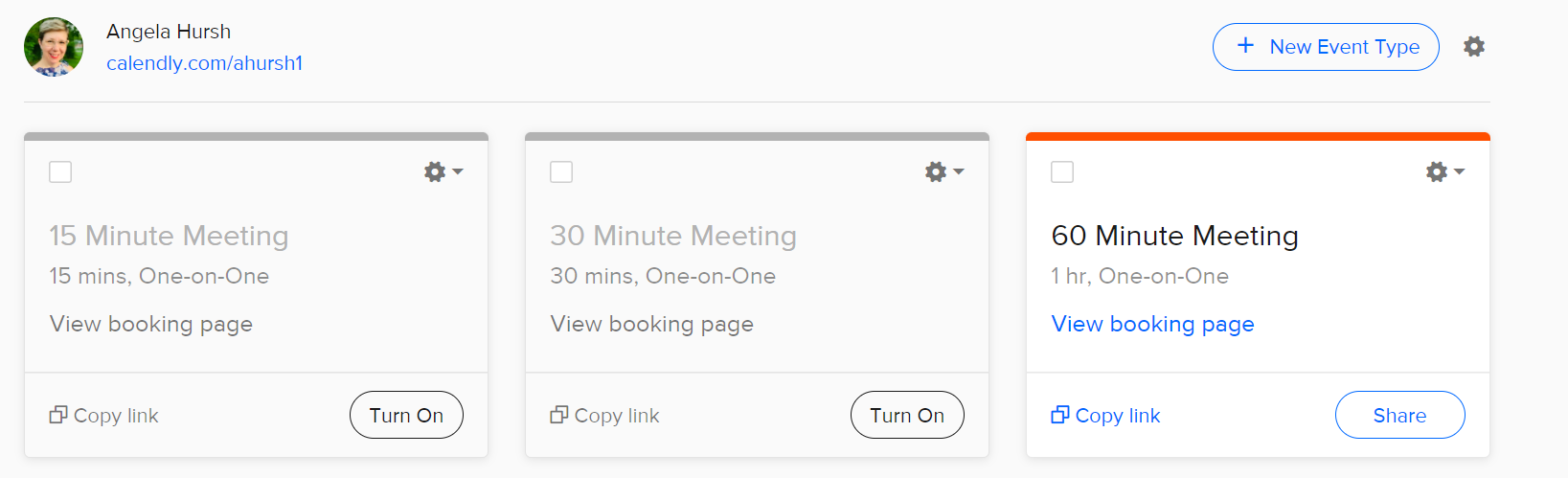
Whenever I need to schedule a meeting with someone who doesn’t work for my company, I use Calendly. It’s easy to integrate it with your calendar and a host of other apps, including Zoom. I cannot tell you the number of back and forth emails this tool has saved me!
Calendly also allows you to create rules for when someone can claim a block of your time. For instance, if you know you’ll be working the checkout desk every day from 12-1 p.m., you can block that off. You can also embed the link in your emails.
The free account only lets you share one length of meeting at a time (15, 30, or 60 minutes) but switching back and forth between the types is easy. You just flip a switch, share the link with the person you need to meet with, and you’re done!
I can switch between these three meeting lengths easily, depending on the circumstance.
Coolers is a color scheme generator that lets you explore and test thousands of color palettes for your print and digital graphic design projects. It’s saved me a ton of time. And it helps me, the girl with no artistic abilities, to make sure everything I create looks beautiful.
You can save palettes, create a collage, or find colors from photos. It also has settings for color blindness and a built-in contrast checker for accessibility.
This is my favorite place to find free emojis for any social media post and email. It’s easy to search. Once you find what you want, just copy, and paste and you’re done.
Emojis are a great way to catch the attention of your social media followers. They also work great in emails. 😉
If your library’s calendar is unreliable or if Facebook events aren’t generating registrations for you, Eventbrite is a great option.
You can use it for free when your event is free (as most library events are). Plus, there’s a mobile app to help you manage registrations. And you get listed on Eventbrite and its partner sites, which can increase the reach of your programs.
I cannot, for the life of me, match fonts when making graphics. This site is a lifesaver.
Once you find a base font that you love, use this site to identify matching fonts for sub-headers and smaller text. I used this site when I revamped Super Library Marketing to be more accessible.
Giphy lets you create animated video GIFs and GIF slideshows with captions. You can get your GIFs in a variety of formats or as stickers.
A new feature lets you create custom backgrounds for online video conferencing. How cool would it be to have a moving library background for your next program?
My life has been changed since I started using this tool. The free version is perfectly wonderful for checking your written work for common and complex grammatical mistakes, spanning everything from subject-verb agreement to article use to modifier placement.
If you use Chrome, download the extension. With that, Grammarly can check everything you type in real-time, from emails to blog posts to social media posts.
I don’t know why but finding an easy and free way to screen record is hard. I finally found this site when a vendor I work with used it to send me a screen recording explaining how to fix a technical issue.
You can record your whole screen or crop to just one area. You can even annotate with text, arrows, and shapes. There are mouse effects! And you can trim your recording.
SnapWidget allows you to display your Facebook, Twitter, YouTube, and Instagram photos in collage format on your website or blog. The free plan gives you unlimited widgets that refresh every 15 minutes.
Project management is a pain. When I worked at the Public Library of Cincinnati and Hamilton County, this was the tool we used to coordinate projects across teams.
It’s easy and intuitive to use. There are boards, lists, and cards that enable your organization to prioritize your most important projects. Everything is drag and drop and shareable.
The free account gives you 10 boards, unlimited storage, custom backgrounds and stickers, an activity log, and the ability to assign team members and set due dates. It was plenty for my team and we never had to upgrade to a paid plan.
This free resource lets you capture, organize, and share multi-media resources with anyone. Save lists, do research, bookmark websites, and curate content for your newsletters, social media posts, and more.
This tool will not make your life in marketing better (unless you are looking for a better job!) But it was made by a librarian at the Allen County Public Library, and it is remarkably helpful for your patrons.
Simply fill in all the appropriate information that you would put into a resume, press a button, and viola. It’s not fancy but it certainly makes a professional and polished resume. Seriously, how cool is this?
Subscribe to this blog and you’ll receive an email every time I post. To do that, enter your email address and click on the “Follow” button in the lower left-hand corner of the page.
In this episode, I’ll share three tips to help you update your library marketing plans for 2022. This exercise will help you to promote your library in a way that is strategic and focused but also flexible.
Kudos in this episode go to the Saline County Library. Watch the video to find out why they’re being recognized.
Do you have a suggestion for a topic for a future episode? Want to nominate someone for kudos? Let me know in the comments. And subscribe to this series to get a new video tip for libraries each week.
Thanks for watching!
Subscribe to this blog and you’ll receive an email every time I post. To do that, enter your email address and click on the “Follow” button in the lower left-hand corner of the page.
I check my holds list on my library’s website pretty much every single day.
This is no lie.
At my library, each cardholder has a dashboard. You can see all the items you’ve put on hold and how many cardholders are in line in front of you.
You can also put books, DVDs, and CDs on a “for later” shelf. If you’re like me, you’ll check that shelf religiously.
After checking my print item holds, I open the Libby app and check the status of all the audiobooks I’ve put on hold. I try to guess which audiobook has the best potential to be made available at the exact moment I finish my current audiobook.
That’s totally normal, right?
I promise you that there are thousands, nay, tens of thousands of readers who partake in this same obsessive routine. Libraries who capitalize on that obsession get higher circulation numbers. And the more people engage with your collection, the more they are likely to engage with other parts of your library.
That’s why I am an advocate for robust and strategic collection promotion. But most library marketing teams spend their energy and resources promoting programs.
75 percent said promoting programs and events. A mere FOUR PERCENT said promoting their collection.
(Excuse me now while I have a short cry).
These libraries are missing a crucial fact about their cardholders.
People want the collection items. That’s why people get a card. And that’s the main way people use their card once they’ve got it.
The Public Library Survey Report‘s latest data, released in August, showed that there were 2.2 billion items circulated in 2019, about seven items per person in the United States.
By comparison, there are almost 125 million program attendees at public libraries. If each of those attendees only attended one program, that would account for only 38 percent of the total population in the U.S.
And most libraries spend significantly more on their collection than they do on anything else. Library Journal’s 2021 Budgets and Funding Survey shows that libraries spent 11.2 percent of their total budget on materials in 2020.
I am certain the data for other countries is similar.
If your library is putting resources into your collection, you must promote it. That’s the truth no matter what size library you work in.
But my gosh does it seem intimidating. Where do you start? And how do you get the most bang for your buck, in terms of circulation success?
Here are four easy things you should do right now to promote your collection. Because it’s what your community wants and needs from you.
Create FOMO with email.
Last month, I spoke to a self-described “library fan” who confessed to me that she often buys books because she didn’t know her library had new titles for checkout.
Most people don’t even think about turning to the library when their favorite author releases a new book. A concentrated collection marketing effort will change that.
Holds are a promotional opportunity. And the Fear of Missing Out (FOMO) is a real and tangible driver of promotional success.
So, promote your titles, especially new titles, using email. Include a line telling your cardholders that they are getting a jump on the holds list. Your most avid cardholders will pounce at the chance.
You can start small. Send an email once a month promoting three titles. Include a link to your catalog that will allow people to check that title out in whatever format they prefer.
All you need to do is include the book jackets, a short annotation, and a link. There are email programs designed specifically for libraries that make this process super easy.
You can also create a list of titles that aren’t new, but that are related by story element to the new titles which are the primary focus of your email. Give cardholders the option to check out these older titles while they wait for the newer titles.
Make sure you track holds and checkouts of the titles you promote in your email. That will give you some data to help you make decisions about what to promote next month. It will also be proof of the effectiveness of your work.
In my experience, one email a month can drive a circulation increase on average anywhere from 125 percent to 375 percent!
Strategically “upsell” your collection
Upselling is a sales term in which customers are encouraged to buy a more expensive version of a product than they originally intended.
Libraries can upsell too. We want our cardholders to end up checking out more items than they originally intended!
To do that, we must always be thinking of ways to offer other collection items to patrons as they checkout.
For instance, if you are running your library’s drive-thru window and a patron comes to pick up their hold on a memoir by a rock star, you can encourage them to log onto your library’s website to listen to that musician’s streaming music.
Or maybe you notice a patron bringing a stack of Regency-era books to your checkout desk. Suggest that the patron also check out DVDs of movies like “Pride and Prejudice”.
If your library is doing a screening of a kids’ movie, be sure to have an abundant number of books for kids in the same genre so that your patrons can leave the movie with a stack of books to read at home.
Look for every opportunity to encourage your patrons to check out more materials.
Harness the power of an eye-catching book cover.
Publishers understand the psychological impact of a good book cover. They spend a ton of money and research to pick the most engaging cover. We can use that to our advantage when we promote collection items.
On digital platforms, you’re trying to get people to stop scrolling as they move their feed. And a beautiful book cover works great for this purpose.
You can also put this concept to work for in-person book displays. Put your books face out. You want people to be drawn in by the beauty of the book cover.
Let someone else pick the items.
Delegate the selection of items to promote to the people who know what they’re doing–your collection or materials selection department.
Or ask the general staff of your library for recommendations. Librarians love it when you ask them what they’re reading. Your biggest problem will be whittling down the answers!
You can also crowdsource collection promotions from your followers. Ask people to share their book recommendations with you on social media or by emailing you.
You can even ask them to record a short video of themselves making their recommendations. Then you can share that content! You can even make a poster or sign featuring a photo of your patron and their book recommendations.
Subscribe to this blog and you’ll receive an email every time I post. To do that, enter your email address and click on the “Follow” button in the lower left-hand corner of the page.
As you well know, libraries have changed, evolved, and adapted in some remarkable ways, particularly in the past 19 months.
But past perception continues to be a real hurdle for libraries. Plenty of people who would call themselves a fan of the library don’t know all the things the modern library does.
We must make sure our community understands who we are right now. And there is a movement to do that through storytelling.
One of those storytellers is Evelyn Shapiro, Promotions Manager at Champaign Public Library in Illinois. As I was preparing to speak at Content Marketing World, I reached out to Evelyn to ask for details about her content marketing campaign, A Library for Life.
Evelyn graciously shared the story of how she compiled this amazing YouTube playlist of patrons who shared the relevance and importance of the Champaign Library’s work. And she’s permitted me to share what she wrote with you.
I hope you will find inspiration in her words. But also, I hope you will see how practical and, frankly, easy it is to gather and tell stories about the ways your library is changing lives.
“Libraries are one of the best ideas humans have ever had.”
Danielle Borasky, Vice-President, NoveList
“Friends and colleagues have told me that connecting with amazing people is one of my superpowers. It’s funny because I can’t help thinking—doesn’t everyone feel like they know truly remarkable people?”
“So, part of the genesis of the project came through the #LibraryLove shared by Karin Markovitch, the parent I interviewed. She had been sharing the most fantastic comments and stories with us in social media posts, tagging the library, also in person with the desk staff. She is just a natural library ambassador, brimming with appreciation.”
“I kept thinking about how I wanted to share her enthusiasm and appreciation of what we offer with the world, but especially with local community members who might not know about or use the library, and with staff because we never tire of hearing that our efforts and expertise result in a positive experience and impact for customers.”
“Our Teen Librarian Kathie Kading was keen on introducing me to Mallory Morris, the educator I interviewed. Mallory’s energy is pure magic, and she can speak with authority about the impact the library has on teachers’ and students’ lives. Interviewing her would mean other people would get to hear her stories, in her words. She was able to put together our group of teen interviewees, drawing from students at her school (across the street from the library) which turned out to be powerful testimony as well.”
“Also, a colleague in the children’s department introduced me to an area artist, Stacey Robinson, who was using the study room next to the children’s desk as his studio, coming in regularly and drawing illustrations for a graphic novel he was creating. She had gotten to know him over time and wanted to be sure I knew his story. (He ended up surprising her by thanking her by name in the acknowledgments of his book!)”
“I connected with him, and it turns out we know people in common in town in the art/design/theatre/dance/music worlds. Again, he was passionate about the library and spoke so well about what a treasure this place is. I wanted to be able to share his story. He also teaches on the University of Illinois campus in the Art + Design department and is a lot of fun to follow on social media.”
“So, momentum had started building and because it was our tenth anniversary in this building, I realized I could propose the project as interviews with ten community members. It was our first video project and not part of my original budget that year, but it was the right timing to ask.”
“Once approved, I needed to build my list of who I would bring on camera. I knew about some of the range I wanted and topics I wanted to highlight including a parent and teen, a Board member, and someone who could speak about the Branch. Our director was able to recommend three of those featured—Candace, Thom, and Rajiv.”
“While working on developing our strategic plan, we invited a group of community members (around 50) to a retreat here to talk about the library and community needs. In one session I attended, Charlisa spoke up about the Douglass Branch, what libraries meant to her as a child, and how children access literacy in our community. I was so compelled by what she had to say. Charlisa has become a very active participant on our social streams as well.”
“Around this time, I’d met a new-to-the-community social media manager named Huan who worked remotely with an international org in communications and marketing. It turned out she spent a lot of time in our new walk-in co-working space for area entrepreneurs. She used it as her office and was getting involved with supporting the library in a few different ways—through a United Way young professionals project and through serving on the Library Friends Board. We met by chance in the FriendShop Bookstore. At the time, she was volunteering in the shop, and we had a chance to chat. She had an international perspective, having lived, and worked in co-working spaces in London. She could compare what we offered here with co-working amenities in a Big City.”
“I already knew Amanda personally and at this time she was heading up the local Project READ initiative and both our locations were public sites where their group offered tutoring. I love talking with her about making good things happen in our community. She had held the role of liaison for families as part of a school program our daughter participated in. I had seen how fluidly she moved in different worlds and languages and what an effective advocate she is. She turned out to be an ideal example of how the library partners with community groups and how our services help immigrants.”
“I learned to bring a stash of tissues with me each time because someone always started crying. The stories were so heartful. I’ve also thought about additional ways we could share these stories, including in print somehow. I haven’t even transcribed them yet or pulled quotes from them. There may be obvious ways to expand and reuse their stories. The key seems to be selecting people who could talk glowingly about the library, without a lot of prompting from me.”
“As communicators, we focus a lot on our messages, as we need to. However, I see our role as much as a listener—how else can we share great comments and stories?”
Evelyn Shapiro is Promotions Manager at Champaign Public Library in Illinois. Before that, she worked in graphic design and has more than 75 published books and CDs to her credit, along with numerous awards from Parents’ Choice, University College and Designers Association, and the Chicago Book Clinic.
Is your library telling stories about your work and your patrons? I’d love to see and share those stories! Send me an email with more information.
Subscribe to this blog and you’ll receive an email every time I post. To do that, enter your email address and click on the “Follow” button in the lower left-hand corner of the page.
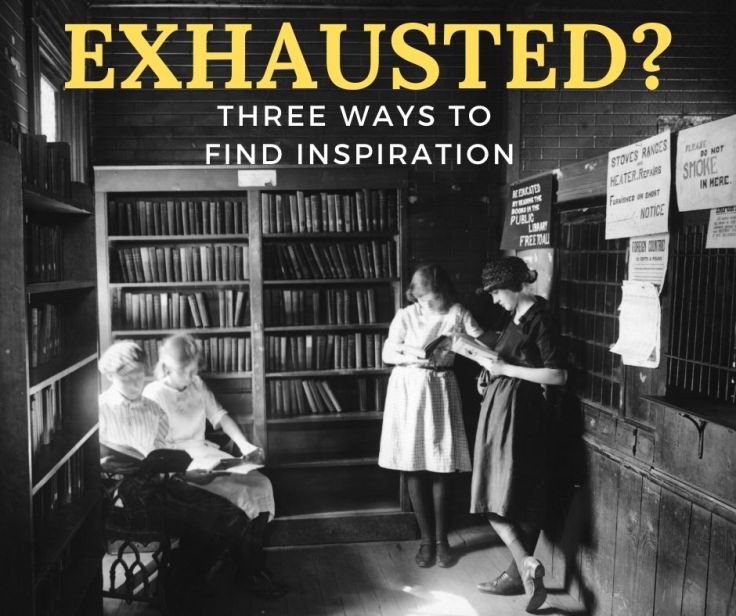
More than once, I’ve sat down at my computer to turn out a clever, groundbreaking, truly engaging library promotion… and ended up staring at a blank wall.
There are days, or weeks, or months (or let’s be honest, years… like 2020) when work in a library will run you ragged. As much as you’d like to create the most inspiring and noteworthy marketing piece for your library, you are just Too. Dang. Tired.
When I worked in a library, the exhaustion usually hit me after summer reading ended. With fall and winter looming, I felt my inspiration seeping away as quickly as the leaves fell from the trees.
If this happens to you, there are some things you can do to get your creativity back. If you need a little inspiration, look no further than your community.
The easiest and most effective library promotions are the ones that solve your cardholders’ big problems. If you have no idea what your community wants and needs from your library, here are three easy ways to figure that out and find the inspiration for your next effective promotion!
“Stalk” your library users.
There are three places you can go to learn more about your community.
Inside the building
If your library is currently open, take a walk around the library or visit the branches. This is your spy moment! Take off your badge and pretend to browse. Or sit at a table in a corner with your laptop.
Observe the way the cardholders browse the shelves, interact with staff, work the self-checkout machines, and use the public computers. Answer these questions.
Do they look for a map?
Are they drawn to a particular book display?
Do they linger over the new books, or do they dash in for their holds and dash out?
Do you notice all customers follow a particular path through your branch or are drawn to a particular place within the branch?
If your library has a drive-thru, is it busy? What kinds of customers use the drive-thru?
Watch how your community behaves inside the building to get an idea of what customers love and what problems they encounter during their interactions with your library. Both of those discoveries can be the basis for your next library promotion.
On your website
Take a close look at your library website’s analytics to find out who is visiting and what they’re doing.
Google Analytics is the best place to get a sense of how your community is interacting with your library’s website. If you don’t have access to your library’s Google Analytics, make an appointment to meet with whoever does have access. Talk with that person about their work. Then, share your goals for the library promotions you create. It’s your chance to form a collaboration that can lead to a more effective library website.
When you get a chance to see the data, ask these five questions:
Which landing pages are the most popular?
Which pages get zero traffic?
Has website traffic to certain pages changed over time or remained relatively the same?
How long did people stay on our website?
How does the bounce rate compare on your landing pages?
If you notice that people are interested in a certain section of your website, you may want to create promotions that support that. Likewise, if you realize that cardholders are missing some key places on your website, you may want to create promotions to entice people to visit those pages!
And if you notice that people are visiting a certain webpage but bouncing right off, you may want to think about improving the customer experience on that page.
On social media
Social listening is an insightful way to get promotional inspiration. It’s kind of like eavesdropping. It’s the purposeful search for conversations about your library on social media platforms.
Social listening will give you a clearer picture of how people feel about your library. You may be able to spot problems before they happen. And you will certainly spot promotional opportunities which you can amplify to connect to more users.
For full details about how to actively use social listening for promotional inspiration, read this post.
Check your statistics.
Your library likely makes circulation and programming stats available on your internal website. These pieces of data can inspire you to find ways to help make their interaction with the library more worthwhile.
If you make it a regular part of your job to check your library statistics, you will find promotional inspiration. You’ll notice when there is a dip in the use of a service. When it happens, you’ll want to consider shifting some of your promotional focus to re-educate your community about that service.
If you work for a system with more than one location, you may notice trends in visits and circulation between the locations. Library staff at branches with lower visits and circulation can reach out to those with higher visits and circulation to see if you can steal some of their successful promotional ideas!
Talk to your coworkers.
You might find inspiration simply by “interviewing” your fellow staffers. Some key questions you can ask include:
You might also learn that there is a customer problem that you can help to solve with your promotions. Answering a commonly asked cardholder question is an easy and effective way to promote your library.
Subscribe to this blog and you’ll receive an email every time I post. To do that, enter your email address and click on the “Follow” button in the lower left-hand corner of the page.
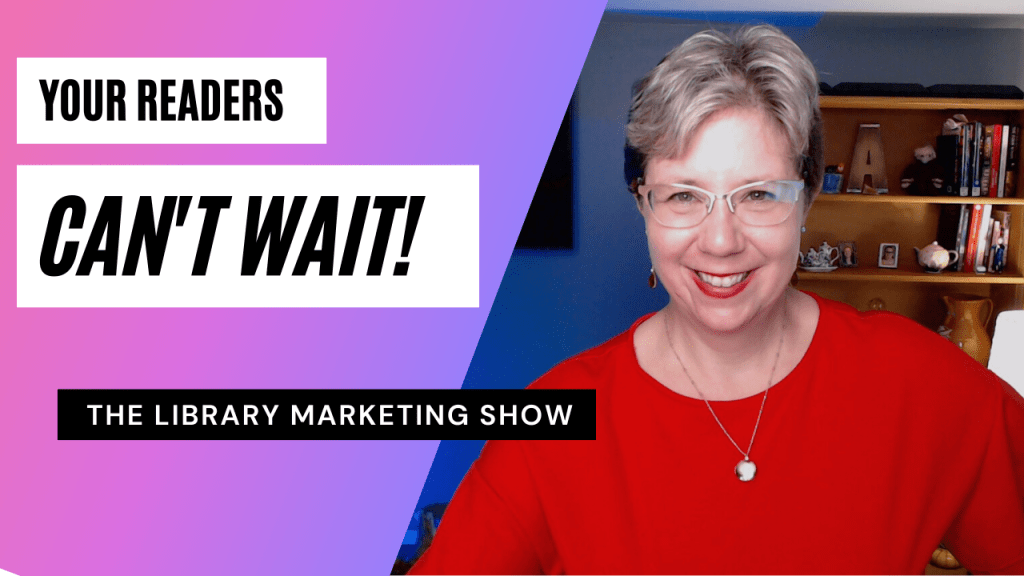
This video is for anyone who works in a library with a long holds list and frustrated readers. I’ll share some ideas for keeping people engaged with your collection even as they wait for that one book they are dying to read.
Kudos in this episode go to Indian Trails Public Library for this cute Library Card Signup month video, created by staff member Stephanie Diebel.
Do you have a suggestion for a topic for a future episode? Want to nominate someone for kudos? Let me know in the comments. And subscribe to this series to get a new video tip for libraries each week.
Thanks for watching!
Subscribe to this blog and you’ll receive an email every time I post. To do that, click on the “Follow” button in the bottom left-hand corner of the page.






 Super Library Marketing: Practical Tips and Ideas for Library Promotion