Search

Super Library Marketing: Practical Tips and Ideas for Library Promotion

Tag

marketing library

How to Reboot AND Optimize Your Library’s YouTube Channel for Marketing Success!

Watch Now

The Library Marketing Show, Episode 84

In this episode, I’ll answer a question from Jennifer of the Park Ridge Public Library. She asked, “What advice would you give to a library needing to reboot the way they use YouTube? We have a YouTube account but only used it sporadically in the past. How can we effectively use it to promote programs, host book talks, share big library news?”

Kudos in this episode go to the Sierra Madre Public Library for their amazing work on TikTok!

Do you have a suggestion for a topic for a future episode? Want to nominate someone for kudos? Let me know in the comments. And subscribe to this series to get a new video tip for libraries each week. Thanks for watching!

The Virtual Library Conference is Over and Now the Work Begins! Here’s What to do Once You’ve Closed Your Laptop

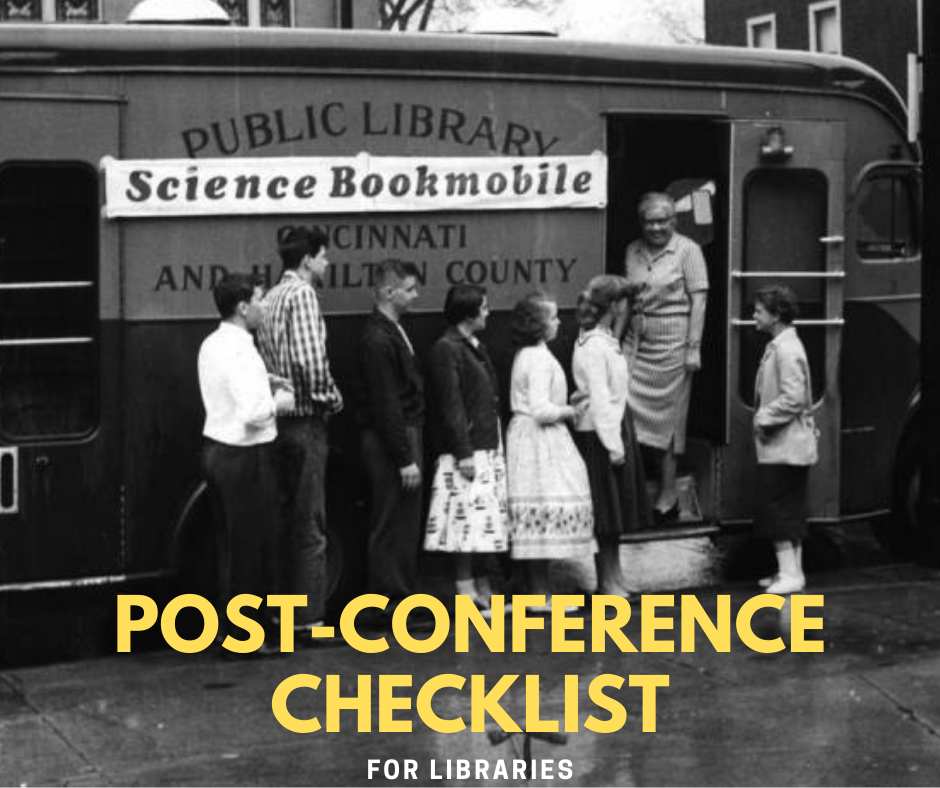
Photo courtesy Public Library of Cincinnati and Hamilton County

This post is part two in my series on making the most of your virtual conference experience in 2020. If you haven’t already, I’d love for you to read part one here.

Once you close your laptop, the second part of your conference experience begins. It’s time to reflect on what you’ve learned, share with your co-workers and, most importantly, figure out how to put these new ideas into practice at your library.

Here’s a framework you can follow to maximize the value of your virtual conference experience with three important post-conference steps.

Reflect on what you’ve learned

After a virtual conference, you might be tempted to switch your brain off the minute you close your computer. But try to resist the urge to unplug right away. Instead, commit to capturing the insights you’ve learned while they are fresh in your mind.

I usually spend a half hour to an hour at the end of a conference day organizing my thoughts. At an in-person conference, I would return to my hotel, grab an adult beverage from the bar, and head to my room to organize my notes. At home, I schedule “buffer time” into my work calendar to complete this step. Reviewing your notes in detail while they are still fresh in your mind will help you retain the information.

First, copy important names, insights, and ideas into a collaboration tool like Evernote, Trello, a Google doc, or your library’s shared documents drive. Fill in details you may have scribbled down in haste. If you took screenshots, organize them so you can easily identify the presenter and session later.

If the virtual conference organizers are making videos available after the conference ends, go back to the sessions you watched to copy and paste the URLs into your notes. That way, if you want to re-watch them again, you’ll save yourself the time hunting for the right video!

Next, formalize any connections you made with other attendees. Look them up on Twitter and LinkedIn and follow them or send them a connection invite. Include a personalized message so they understand why you are reaching out.

If there were speakers or sessions that really inspired you, send a thank you email to the presenter. As a speaker, I can tell you I really appreciate hearing from attendees, especially when a session inspires them.

Finally, be sure to fill out any post-conference survey. Conference organizers and speakers truly appreciate the feedback.

Share what you’ve learned

At the very least, you’ll want to share what you’ve learned with your boss and your team. But more than likely, your conference learnings contain lessons that everyone at your library could benefit from. So, turn your notes into a short presentation and invite co-workers to watch. My husband does this as a “lunch and learn” for his co-workers.

If you aren’t comfortable doing a “live” presentation, you can record yourself on Zoom, Teams, or WebEx, and share the video (like you do with virtual story times!). Loom is also a great option for recording yourself.

During your presentation, share the top-line things you learned at each session you attended. Tie your findings to your library’s overall strategy. This will help prove the value of your conference attendance to your supervisors. It will also lay the groundwork for when you put your new ideas into practice.

After your presentation, make sure your co-workers have access to the notes you took at the conference using the collaboration tool in step one. Include links to any slideshows, handouts, or screenshots you have.

Put big ideas to work

Here’s where you find the true nuggets that will help your library. I suggest you look through your notes again and organize a new list of action items in categories that correspond with your work.

Tools and technology: List any digital trends and industry advances that your library should act on.

For instance, at the Library Advocacy and Funding Conference, I learned about new software platforms which allow libraries to gather and use data related to their community. I also learned new information about how to increase organic reach on Facebook and Instagram.

If you learn about a new social media platform or about a product that helps you to do a better job at promoting your library, list those in this section. Include the reasons why an upgrade or a change in tools and technology will help your library. Research cost and timetables for implementation.

Content inspiration: List any new creative concepts or topics you think your cardholders would respond to. If you attended a session from someone who shared practical ideas for what to put in your library’s newsletters or how to design print pieces, list those ideas. Then, pull out your editorial calendar and start scheduling!

Productivity and project management: List anything you learned that will help you and your library co-workers to do your job more efficiently.

Maybe you had a Twitter exchange with a fellow attendee whose library has an approval process you wish to imitate. Or maybe you attended a demonstration of a platform like Trello or Asana.

If you learn about new ways to address existing challenges, optimize workflow, or streamline your promotional methods, put those on your list. Your co-workers and supervisors will appreciate any new insight on how to improve efficiency at your library.

Have you changed the way you work at your library because of something you learned at a conference? I’d love to hear about it. Let me know in the comments.

You might also find these posts helpful

Six Tips to Make the Most of Your Online Experience During Virtual Conference Season

Three Transformative Tips to Improve Focus and Re-Energize You When Working in the Library Doesn’t Feel Fun Anymore

Latest Book Reviews

The Escape Artist by Helen Fremont

Devolution by Max Brooks

Find more 60-second Book Reviews here.

Subscribe to this blog and you’ll receive an email every time I post. To do that, click on the “Follow” button in the bottom left-hand corner of the page. Connect with me on YouTube, Twitter, Instagram, and LinkedIn. 

Four Eye-Opening Library Marketing Lessons I Finally Learned When I Left My Library Job and Became a Regular Patron

Photo Courtesy Public Library of Cincinnati and Hamilton County

It’s been six months since I walked out of the Public Library of Cincinnati and Hamilton County for the last time as an employee. 

You’d think that moving from library staffer to library patron wouldn’t be that big of a revelation. After all, while I worked at the library, I was also a patron.

But there is a mindset shift that happens when you stop working on a library’s communication strategy and start seeing those communications exclusively from the customer side.

Now, when I receive an email from my library, or see a library social media post, or watch a library video, or see a sign at the library branch drive-through window, I don’t know what goal my library is trying to achieve.

I have no idea how long the marketing team worked on those promotional pieces.

I don’t have any insight into the discussion over wording, image selection, and calls to action.

I have no idea how many revisions they went through before they received final approval.

Once I took off my marketing hat and put on my customer hat, I started to see things very differently. I learned some eye-opening lessons.  

Patrons cannot fathom the breadth and depth of your services.

Libraries really do offer an extraordinary number of services. It is impossible for a regular person to understand or remember all of them.

I thought I had a pretty good handle on every service provided by my library. But I would be hard-pressed to list them all if I were forced to, even just six months out from my employment.

With that in mind, library marketing needs to get laser focused. Pick your promotions based on your library goals for the year.

With the pandemic, your goals likely shifted in the past few months. So, focus your promotions on achieving those goals.

Release your promotions consistently over a set period of time and on as many channels as makes sense for your audience. 

Most importantly, resist the urge to promote everything your library offers. It’s overwhelming to your community. Your message will get lost. 

Organic social media is not your friend.

I am a former library employee. I visit the library website at least once a day. I talk about the library on social media.

And yet, I rarely (if ever) get served my library’s Facebook, Twitter, and Instagram posts organically. Most of the time, I must go looking for them.

If I’m not seeing my library’s social media posts, can you imagine how many other people are not seeing them?

In my new job, I talk with a lot of libraries who rely heavily on social media. I’m not saying that you should not post to social. I just want to remind you that social media is also fickle and imperfect.

Be sure to distribute your marketing messages across multiple channels, including email, so you’re sure your whole community will see your message.

In a crisis, more communication is better.

The pandemic and the resulting shutdown came about six weeks after I left the library. And watching it unfold as a customer was interesting.

My honest assessment is that my library did a great job of communicating when it went into shutdown and when it reopened.

However, in the weeks in between those two major events, there was very little communication to patrons.

And I was craving news, even if it was “Our physical buildings are still closed, and we don’t know when we’ll reopen.” In fairness, this is a criticism I had for a lot of organizations, including my church and my kid’s school.

In a crisis, there is no such things as over-communication. Regular updates to your patrons and community are always better than radio silence.

The more you talk to your customer base, the more likely they are to remember you and support you when the crisis is over.

People just want to be informed. Silence feels like abandonment to your patrons. Communicate more often when your library is in crisis.

A well-designed website is a gift to your patrons and essential to your library’s success. 

The main digital entry point for your library is your most important asset.

In my new job, I do a lot of research on libraries of all shapes and sizes. I spend a lot of time looking at library websites.

Some are easy to use and some are not.

It’s no surprise that the libraries with beautiful, easy-to-navigate websites report more engagement from their patron base in the form of circulation, attendance at events (even virtual events), and donations.

If you have any say over your library’s website, it behooves you to spend time making it an amazing portal to your library. 

As a patron, I am grateful when I can find exactly what I need when I visit a library website. Need a place to start? Here are some tips.

You Might Find These Articles Helpful

This Free Tool Will COMPLETELY Change Your Library’s Social Media Posts!

Why the Circle of Promotion is Your Best Bet for Library Marketing

Latest Book Reviews

The Voyage of the Morning Light by Marina Endicott

Find more 60-second Book Reviews here.

Subscribe to this blog and you’ll receive an email every time I post. To do that, click on the “Follow” button in the bottom left-hand corner of the page. Connect with me on YouTube, Twitter, Instagram, and LinkedIn. 


You Don’t Need a Press Release to Get Good Media Coverage of Your Library! Here’s the Secret Trick From a Former Journalist.

Watch Now

The Library Marketing Show, Episode 55

Angela used to work in a TV newsroom and at a library and she shares a secret for getting good press coverage for your library. It doesn’t involve writing a press release!

Also, a reader wants to know if YOU know of any cartoon artists doing library-specific drawings or memes to share on social media. If you do, let her know in the comments!

Also Kudos to the winners of the 2020 PR Xchange Award Winners!

What did you think of this episode? Are you struggling with marketing and promotion right now? Do you have an episode suggestion? Would you like to nominate someone for kudos? Let me know in the comments.

And subscribe to this series to get a new video tip for libraries each week! Thanks for watching.

Subscribe to this blog and you’ll receive an email every time I post. To do that, click on the “Follow” button in the bottom left-hand corner of the page. Connect with me on YouTube, Twitter, Instagram, and LinkedIn. 

Worries in the Library World: Here are Answers to Your Four Biggest Library Marketing Concerns Right Now!

Photo Courtesy Public Library of Cincinnati and Hamilton County

A few weeks ago, a good number of you were kind enough to respond to this question, “What is your biggest library marketing concern right now?” As you can imagine, many of those worries are not all marketing related. In fact, as the responses came in, I realized they all fell into one of four categories: delivering a clear message about reopening and new safety precautions, keeping everyone safe, dealing with angry patrons, and communicating the library’s value.

I decided to research resources to help library staff tackle each of these concerns. I also mixed in a little of my own advice, gathered from my experience as a former public library staff member and my current work consulting with library staff.

I’d also love to hear your tips for dealing with these four concerns. If you have advice to add for your fellow library staffers, please share it in the post comments.

Clear messaging 

Libraries are struggling to make sure everyone understands the new expectations for library service. Many libraries have fragmented social media accounts, with different branches or departments running their own Facebook pages and Instagram feeds. That makes the job twice as difficult.

Messaging is the most important job for libraries right now. Before anyone posts anything on social media, you must do one thing: Create a core set of talking points. Commit to repeating them on every promotional platform. 

Write posts word-for-word and send them to any staff handling social media accounts. Tell them to copy and paste the message into their pages to maintain consistent wording and calls to action. 

You’ll also want to use your core messages on signage, in emails, and in your videos. If you do live virtual events, ask staff to repeat the message before they go into their main program.

It’s going to seem redundant to staff. But a consistently repeated messaging campaign works. Remember, research tells us that people need to hear a message seven times in order to remember it and take action. 

And a consistent and clear message now will have long-range benefits for your library. It will reduce frustration and anger from patrons. And it will position your library as a strong yet calm institution with a plan to provide the best library service possible while keeping everyone safe. People will remember the way your library handled this crisis when it comes time to ask for funding later.

Keeping everyone safe

Health and library organizations have worked tirelessly to create guides for reopening. Some of my favorites are The Safe Work Playbook from the Toledo Lucas County Public Library, the Reopening and Working Safely Guide from the Idaho Commission for Libraries, and the Service Recovery Checklist from the Australian Library and Information Association. There is also guidance available in this article from Library Journal. 

If your managers haven’t communicated their plans for keeping you safe, now is the time to ask. If it’s your job to figure out the new protocols, first check your local health authorities for their mandates. Your library will need to follow those rules. Next, check with you state library association for guidelines. Many library consortiums are also putting together suggestions and holding virtual meetups to talk about the best practices for library reopening and safety. 

Dealing with angry patrons

This may be the most frequently expressed fear among library staff. A recent episode of the Library Marketing Show centered on this topic: Tips for Dealing With Angry Patrons When Your Library Reopens. I also recommend this webinar from RAILS (Reaching Across Illinois Library System) and this recent article from American Libraries magazine. Scroll down to the second half, which is all about libraries are dealing with staff anxiety.

Proving the library’s value

While you are knee-deep in reopening plans, there is another messaging mission your library must now champion with fervor. You must make sure the public and local lawmakers realize how valuable you are.

The pandemic has taken a toll on the economy. We may not be able to grasp the full extent of it now, but it will surely affect libraries, to the detriment of our communities. Messaging that emphasizes the value of the library is vital to our survival as an industry.

You must make sure the public knows how hard your staff was working while the building was closed. Did you help people file for unemployment? Did you help parents with remote learning? Did you help small business secure PPP loans to pay their workers?  Did you provide comfort and distraction to communities on lockdown?

Tell people what you did. Emphasize the ways your library helped with the economic recovery and the mental well-being of your community. Talk about how quickly you pivoted to online services and how your audience responded.

We must start letting people know about all the fantastic things we do when we are physically reopened. We must work a value-oriented message into everything we put out into the world. We must repeat these messages, over and over again, to drive home the point.

Libraries are too humble about their work. It’s a virtue that may lead to our downfall.

For more inspiration, read this post: Marketing is Not a Dirty Word! Why Libraries Need to Promote Themselves Now, More Than Ever

Latest Book Reviews

The Ballad of Songbirds and Snakes by Suzanne Collins

Conjure Women by Afia Atakora

Find more 60-second Book Reviews here.

Subscribe to this blog and you’ll receive an email every time I post. To do that, click on the “Follow” button in the bottom left-hand corner of the page. Connect with me on YouTube, Twitter, Instagram, and LinkedIn.  


Your Library is Reopening: How to Communicate New Rules to Your Staff and the Public During a Pandemic

Photo courtesy Public Library of Cincinnati and Hamilton County

What is your #1 library marketing worry or concern right now?

Go back

Your message has been sent

Warning

Warning.

In many parts of the United States, library boards and senior staff have decided to reopen in the next few weeks. My social media feeds are filled with posts from library staff airing concerns over a return to “normal” library duties.

The plans vary. But it appears that most institutions are slowly phasing in services. Some libraries are doing curbside only. Some are opening drive-thrus. And some are fully allowing patrons back inside their physical buildings. 

When your library settles on what to do, it will be your job to let your staff and community know what’s happening. This week, I spent a lot of time compiling the best advice I could offer to help you communicate a library reopening during a pandemic.

As you know, communicating is SO important. Your staff, your regular customers, and your community need to know what you are doing and what changes you are making to keep them safe. They will need you to say it more than once. And they will need time to digest all this information.  

A guide to communicating your library’s new policies

It starts with the staff. So many libraries think about customer communications first and forget that staff need to know what is happening. If your library is contemplating reopening, be open and honest with your staff about all aspects of what that will entail. Ask for feedback and listen respectfully to staff concerns and ideas. Adjust your plan where you can.

And expect pushback. It’s uncomfortable. People are scared. And there are members of your staff who will be vocal about their disapproval. If you are a library leader, find ways to address the concerns of staff. The Library Management Group on Facebook is a helpful resource for advice from other managers.

When sharing news with your community, use all your tactics. Create a page on your website where you put all your re-opening information. Link to it from your homepage and, for the time being, in the bio of all your social media accounts.

Make a video, or several videos, to explain the changes. If your library has accounts on multiple social media platforms, use all of them to tell people about your plans. And make your re-opening plans the exclusive focus of a social media live event. You can really build excitement and interest by publicizing the livestream where you’ll unveil the plans and take direct questions from the audience in the comments or chat.

Send emails to your community and patrons. Ask community partners to help share information about your reopening. Finally, pitch your reopening as a story to your local media. 

Create one core message and repeat it. You are going to have to say the same things and repeat the same information before the changes sink in.

Remember the Marketing Rule of 7? People need to hear a message seven times before they are compelled to take an action. It applies in this instance. And, with the vast amount of information coming at them from various sources, your community may need MORE than seven messages to fully grasp your library’s new service requirements. 

For maximum effect, settle on a few sentences as your core message or talking points. Repeat those on all your channels.

For social media, post your message at varying times of the day to make sure that it’s seen by as many followers as possible. Add your message to all your email marketing campaigns. Ask staff to practice your message as talking points so they can deliver a consistent answer when they receive questions from people at the desk, at the door, or by phone. Add the message to your holds slips and receipts. Add your message to videos. If you do live virtual events, ask staff to repeat the message before they go into their main program. 

It’s going to seem redundant to you. But a consistently repeated messaging campaign works.

But don’t overwhelm people. I received a reopening email from a library this past week with no less than 18 calls to action! It was overwhelming. And I didn’t click on any of them.

Don’t make that mistake. The services you provide are going to be different for different people. If you can break your messages up by audience, do so. And instead of sending one message with EVERYTHING in it, send two or three messages containing your core talking points, plus two to three details that pertain to a targeted audience. Your readers will be better able to digest and retain the information.

Use your signage wisely. I know many libraries are putting a good deal of information on their signage to keep interactions with the public to a minimum. But remember that too much signage will look crowded, cluttered, and overwhelming to your patrons. Take some time to plan where you’re place signage, and what they will say, for maximum effect.

Don’t forget to keep stakeholders and legislators in the loop. It’s important to send regular updates about what your library has been doing during the shutdown and what it is doing now as it plans to resume physical service. Highlight the many ways your collection was used even when your building was closed.

Legislators love numbers… so check your library statistics for use of digital resources. Point out trends. Show how your library helped the community cope with the stresses of the shutdown. 

Why is this so important? Right now, we must send the message that the library is always valuable. A time is coming when the economic crisis caused by this pandemic will lead to budget cuts. We need to do everything we can on the front side of this crisis to save as much of our funding as possible. And that starts now, with communication. 

Resources to help you deal with reopening

Self-Care for Library Social Media Staff in the Midst of a Crisis like #COVID-19

Don’t Stop Communicating! Tips for Handling Library Promotion Overload During a Crisis

Libraries and Social Media Facebook Group

Libraries Step Up in a Time of Crisis Facebook Group

Subscribe to this blog and you’ll receive an email every time I post. To do that, click on the “Follow” button in the bottom left-hand corner of the page. Connect with me on YouTube, Twitter, Instagram, and LinkedIn.  

Podcast Like a Pro! Amazing Advice from a Library Podcast Expert

Photo courtesy Public Library of Cincinnati and Hamilton County

Readers, you are in for a treat.

I attended a session hosted by Jeff Laser at the Ohio Library Council Conference in Cincinnati. His tips on creating a great library podcast were clear, concise, and actionable.

I thought I knew everything there was to know about library podcasts, having helped launch and promote Inside the Writer’s Head, now in its fifth season. Turns out, I did not know everything. But Jeff does! And that’s why I asked him to share his knowledge with you. This post was written by him.

Jeff Laser is an Adult Services Librarian at Bexley Public Library in Columbus, Ohio. He has worked at BPL since 2012 and in that time has helped launch services such as Book-a-Librarian and is the host of the BPL Podcast. He has a BM in Music Composition from Capital University and an MLIS from Kent State University.

Podcast Like a Pro by Jeff Laser

So why start a podcast at your library? As we move further into the 21st century, libraries are increasingly looking for ways to serve the public beyond our physical walls. Podcasts allow just that.

In addition, they provide a platform to discuss important (and fun!) topics and promote library services. It’s also a great way to utilize staff talent, offering a unique, creative outlet that is both fun and stimulating.

That said, one of the main reasons Bexley Public Library (BPL) decided to give a library podcast an earnest shot was to leverage our high caliber adult programming. We host a range of speakers, professors, writers, and other experts to discuss a variety of subjects including social justice, literature, culture, and more. The podcast gives us a unique opportunity to have a concise conversation about these subjects in a format that is accessible beyond just the one-night speaking engagement. This gives patrons who are unable to attend the program itself an entertaining and convenient alternative.

Even if your library doesn’t have a similar focus on adult programming, don’t fret. There are several directions a podcast can go besides the traditional host-interviewing-guest structure. Narrative podcasts (e.g. Serial or Welcome to Night Vale) tell a story across multiple episodes. Review podcasts, such as Binge Mode, focus on a particular book, movie, or television show for in-depth discussion.

How Much Will It Cost?

Being a public library means having a limited budget. Employees need to justify expenses. Realizing this, Bexley Public Library purchased equipment that has multiple functions at the library.

For example, we use the same equipment for the library podcast that we use to record our oral history interviews, and to record full-length programs from time to time. We also make the equipment available for our patrons to use.

The initial expense for starting a podcast doesn’t need to be outrageous. Free software such as Audacity or GarageBand will work just fine. Quality microphones can be purchased for around $100 each. Add a few accessories like pop filters and boom, and you’re ready to record.

Making a Great Podcast

Interview preparation goes a long way to ensure an engaging conversation with your guest. Familiarize yourself with their material and come up with a few questions.

During the interview, allow yourself to go off-script and ask follow-up questions. If you know you and your guest share common interests, ask about them! Capturing that human connection is one of the most fruitful parts of podcasting and one of the primary reasons the format has grown exponentially.

Editing is arguably as important as preparation. If you come across long silences, excessive filler words, unwanted background noise, or even just generally uninteresting passages, remove them! Remember, however, the goal is to keep the human element intact. Don’t go as far as removing every single “um”, “uh”, or slight pause in the conversation. Keep it sounding natural.

From the technical side of things, less is usually more with podcast editing. I stick with equalization, compression, and reverb. A high-pass filter is useful for removing unwanted low sounds such as hums, fans, etc. Compression will help even out the peaks and valleys of your audio track for a smoother listening experience. Finally, a bit of reverb will add some depth to your recording (not too much though or it will sound like your interview was recorded in a gymnasium!)

Getting Your Podcast Out There

You have a few great interviews edited and ready to go, what now? First, you’ll want to find a hosting solution for your podcast. Popular options include Blubrry, Libsyn, and WordPress. BPL uses Podbean, which allows unlimited upload time for $108 per year. These services will guide you through setting up your Really Simple Syndication (RSS) feed, which will allow you to submit your podcast to various platforms. You’ll provide information about your podcast during this process, such as artwork, title, author, and description.

Once your RSS feed is ready, submit it to as many platforms as you can: Apple Podcasts, Google Podcasts, Stitcher, and Spotify. The process is easy and the more platforms you’re on, the easier it will be for listeners to find you.

Don’t overlook the importance of branding your podcast. Even if you aren’t a graphic designer, you can create simple but effective graphics by using tools such as Canva. (Note from Angela: If you are a LibraryAware user, you can also use a widget template to make your podcast graphic.)

Include brief theme music during your podcast to make it more memorable. If you don’t have the ability to create a jingle, try royalty-free music websites such as Bensound.

Marketing your podcast on a limited budget is challenging but not impossible. Try to utilize your guest’s social media following. Ask them to post (or re-post your content) about the podcast. A pull quote graphics (see below) is an easy way to draw people into any given episode and works well across social media platforms. Try placing an embeddable player in a prominent space on your library website to allow for spontaneous discovery and easy listening.

Go for It!

Now that you have an idea of the basics, give it a shot! If you’re looking for inspiration, check out the podcasts I linked above, or perhaps some library related podcasts such as The Librarian Is In, Lost in the Stacks, Book Squad Podcast, or (of course) The BPL Podcast. Hosting a podcast is truly one of the most unique and rewarding things I’ve done in my professional career, and it could be for you too!

For more help with your library marketing, email me at ahursh@ebsco.com. Subscribe to this blog and you’ll receive an email every time I post. To do that, click on the “Follow” button in the bottom left-hand corner of the page. Connect with me on YouTube, Twitter, Instagram, and LinkedIn.  


How to Reverse Engineer Your Library Marketing Social Media Audiences!

The Library Marketing Show: Episode 29

WATCH NOW

A Library Marketing show viewer recently asked me: Do you target specific audiences with different social media venues?

I do, but I reverse engineer it! I’ll explain in this video.

Also, kudos go out to Cesar from the Austin Public Library in Austin, Texas. He wrote an article in the Texas Library Journal on the topic of social media ambassadors, how they work and why your library needs them. We hear a lot about using influencers on social media but the traditional influencer model doesn’t really work for libraries. And this is a version that will work. These are volunteers who willingly help promote your library on their personal social media channels. We know social proof is really important in social media promotion-that idea that other people are really into this one particular thing, your library because it gives people FOMO and a sense that they might be missing out if they don’t get in on some library action! Cesar lays out how his library recruits and uses ambassadors and how they’ve helped the Austin Public Library.   

Want more Library Marketing Show? Watch previous episodes!

Check the Upcoming Events page to see where I’ll be soon. Let’s connect!

Subscribe to this blog and you’ll receive an email every time I post. To do that, click on “Follow” button in the bottom left-hand corner of the page. Connect with me on Twitter, Instagram, and LinkedIn.  
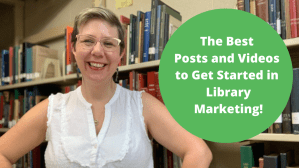
The Best Posts and Videos to Get Started in #LibraryMarketing! The Library Marketing Show: Episode 28

WATCH NOW

The #LibraryMarketing Show, Episode 28: Brenna Jaco at the Lubbock Public Library in Lubbock, Texas submitted this question: “I just discovered your blog and I wish I had the time to go back and read all your posts from the beginning. In your opinion, what are the most important/useful/favorite blog posts and YouTube videos you’ve done over the years?”

Thanks for the question, Brenna! I give the top three blog posts and videos, ranked by views. That means other library marketing pros found them helpful. I hope you will too!

The Top video was Fighting Back Against the Endless Poster-Flyer-Bookmark Cycle! #LibraryMarketing Show: Episode 8.

A close second was Best Free Ways To Reach Non-Cardholders! #LibraryMarketing Show: Episode 13.

And finally, people love Advice for Digital Signage in Libraries! The #LibraryMarketing Show: Episode 21.

Now for the top three blog posts. The top post is The Best Library Customer Service Advice from an Expert! I interviewed Dan Gingiss, author of Winning at Social Customer Care: How Top Brands Create Engaging Experiences on Social Media.

People also love my early list of the best conference for library marketers. There’s no link because it’s outdated now, but a new list for 2020 is coming out on February 3rd!!

Finally, one of the most popular posts is about how my library increased participation in our summer reading program by 97% one year!

And KUDOS go out to the East Baton Rouge Parish Library System because they have a Library Road show! It’s a whole 30-minute show on YouTube.  It’s well-produced and informative. Great job!

Want more Library Marketing Show? Watch previous episodes!

Check the Upcoming Events page to see where I’ll be soon. Let’s connect!

Subscribe to this blog and you’ll receive an email every time I post. To do that, click on “Follow” button in the bottom left-hand corner of the page. Connect with me on Twitter, Instagram, and LinkedIn.  

A WordPress.com Website.

Up ↑