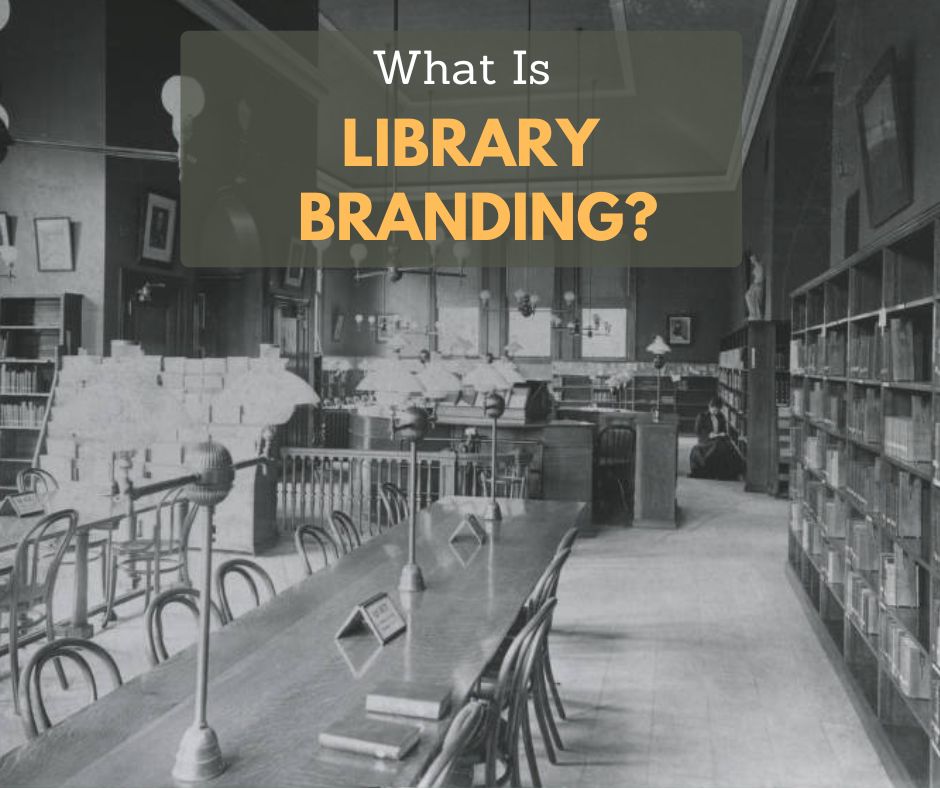
When most libraries talk about branding, they’re really talking about logos, colors, and templates.
But branding isn’t only what your materials look like.
It’s how your library feels to the people you serve.
And that experience doesn’t center only on the work that your communications staff does. It comes from every single staff member. This is especially true for small or rural libraries and for large metro libraries.
A solid library brand will define your library in a crowded world. It’s the thing that makes people say, “I love my library.”
But many libraries struggle with branding. When I asked, “What do you need help with?” in the State of Library Marketing survey, one of the most common answers was “branding.”
So, we’re going to tackle that! This is the first in a three-part series all about library branding.
Branding Is Not a Logo
We’ll begin with this concept, because it’s the root of the problem.
Branding is often confused with:
- Your logo
- Your color palette
- Your graphic templates
Those things matter. But they are expressions of your brand, not the brand itself.
In fact, research into library branding shows that a library’s brand encompasses multiple dimensions tied to user experience, perception, and emotional connection — not just visuals.
That means your library’s brand is shaped just as much by a storytime experience, a conversation at the circulation desk, the tone of a Facebook post, or signage in your building as it is by your logo.
Here’s the truth: Your library already has a brand! People in your community have an existing impression of your library. This is true even if you’ve never written a brand guide, your graphics are inconsistent, and your co-workers all seem to do their own thing when it comes to library promotion.
So, you’re not starting this journey from scratch.
Real Library Examples: When Branding Becomes Part of the Library Experience
One of the best examples of true library branding is the transformation of Rangeview Library District into Anythink Libraries.
Here’s what happened: The Rangeview Library District was considered by its community to be old-fashioned, small, and unappealing. In 2009, as part of its renewed branding efforts, the District changed the names of its libraries to Anythink libraries.
But the library did more than a name and logo change. They renamed every branch. The changed staff job titles to include “Concierge” and “Guide.” They reframed the entire library experience around creativity and curiosity.
It was a complete alignment of experience, language, and culture. And it worked.
The rebranding led to higher circulation and visitor numbers. The system was able to connect with users and pass a levy, which helped them build or renovate libraries. And they were awarded a national Medal for Museum and Library Service.
My own library, the Cincinnati & Hamilton County Public Library, also went through a rebrand in the last five years. While our name change is not as significant (previously, we were The Public Library of Cincinnati and Hamilton County), we are transforming our connection to the community.
Yes, we created a completely new visual palette. But the core of our new branding is focused on our beliefs, which every library staff member is committed to living out through their work. Our beliefs are:
- Empathy: We believe in everyone’s innate value and potential.
- Enjoyment: We believe there is no prescribed path to knowledge, so why not make the journey fun?
- Connection: We believe we got farther, together.
- Community: We believe libraries are incubators of community.
That defined focus on those four beliefs is strengthening the connection our library has to the community, elected officials, and donors. That’s the power of branding.
Many libraries have also leaned into branding through physical experience and design. In fact, studies show that libraries are increasingly positioned as community hubs and cultural spaces, with branding tied to how people use and feel in the space, not just what they see.
Branding encompasses everything. The building, the programming, the atmosphere — all of it contributes to the brand.
Where Most Libraries Go Wrong
Most libraries don’t have a branding problem. They have a disconnect problem.
It usually looks like this:
- Marketing creates one type of message
- Youth services create another
- Branches design their own flyers
- Social media has a completely different tone
This creates a fragmented experience. And from a patron’s perspective, it feels like interacting with multiple different organizations instead of one library system.
So What Is Library Branding?
Here’s the simplest, most useful definition I can give you:
Your library’s brand is the consistent experience people have every time they interact with you.
Branding is not owned by the marketing department. Branding is created by the entire staff.
That means every flyer, every conversation, every program description, every social media post is either strengthening your brand or weakening it.
Coming Next
In the next post on April 27, we’re going to tackle the biggest challenge libraries face when it comes to branding:
How do you actually get an entire library system to act like one brand?
Meanwhile, if your library has worked on branding, I’d love to hear what worked, what didn’t, and where your staff struggled. You can let me know by commenting below or by emailing me.
Want more help?
Boost Your Biggest Supporters: Branding and Marketing Advice for Your Friends of the Library Group
Subscribe to this blog, and you’ll receive an email whenever I post. To do that, enter your email address and click on the “Follow” button in the lower left-hand corner of the page. You can also follow me on the following social media platforms:
 Super Library Marketing: Practical Tips and Ideas for Library Promotion
Leave a comment